The Canadian real estate landscape is a tapestry of diverse market conditions, constantly evolving with regional economic shifts and national financial policies. As Spring 2024 unfolds, a comprehensive analysis of 27 major markets by Zoocasa, leveraging data from the Canadian Real Estate Association (CREA), provides crucial insights into where the power lies: with buyers, sellers, or in a state of equilibrium. Understanding these dynamics is paramount for anyone navigating the property market, whether you’re looking to buy your first home, sell an existing property, or invest in real estate.
Canada’s Real Estate Market: Unpacking Spring 2024 Dynamics
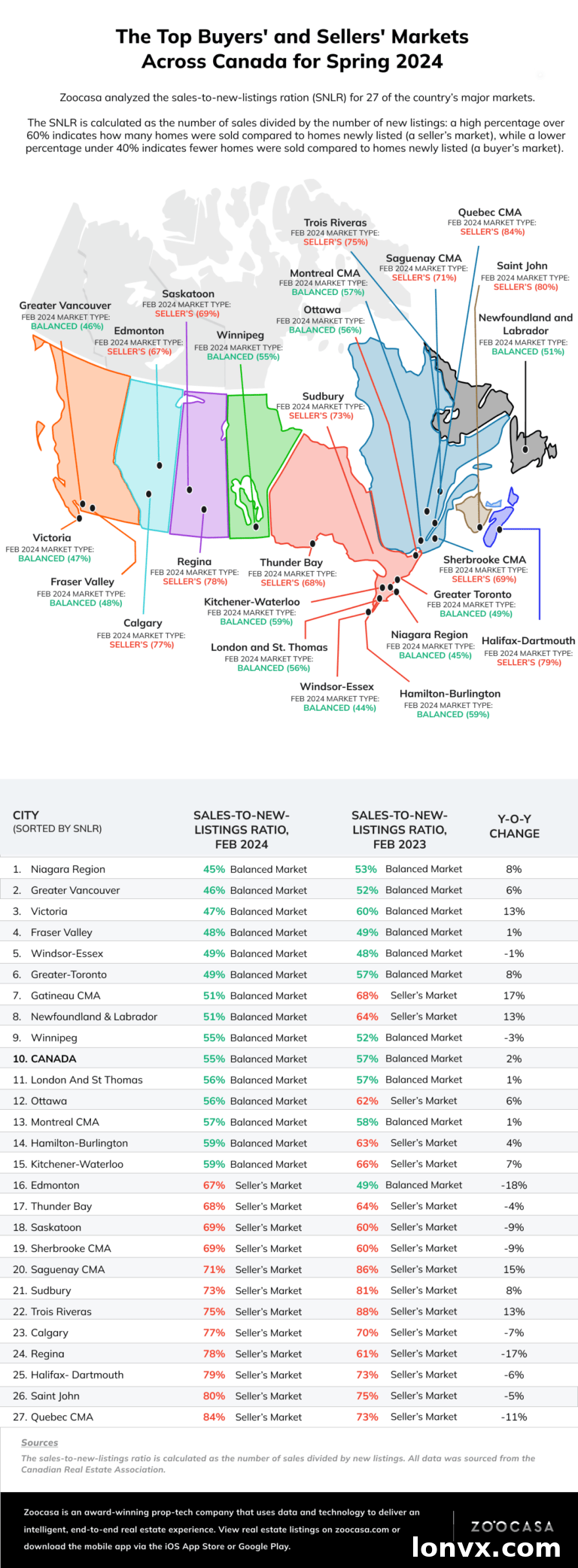
A striking revelation from the latest report is the complete absence of buyer-favoured markets among the 27 major regions analyzed. This trend, mirroring that of last spring, signals a persistent demand-side strength across the country, a notable shift from Winter 2023 when several regions, including Niagara, Greater Toronto, Hamilton-Burlington, and Victoria, experienced balanced conditions.
Defining Market Conditions: Buyer’s, Seller’s, and Balanced Markets
To fully appreciate the findings, it’s essential to understand what defines each market condition and how they impact participants:
- Buyer’s Market: Characterized by an abundance of homes for sale and fewer prospective buyers. This scenario gives buyers significant leverage, allowing them to negotiate prices, demand concessions, and take their time making decisions. Properties tend to stay on the market longer, and price reductions are more common.
- Seller’s Market: Marked by limited housing supply and robust buyer demand. Here, sellers hold the advantage, often receiving multiple offers, selling above their asking price, and experiencing quick transactions. Competition among buyers is fierce, often leading to waived conditions and higher bids.
- Balanced Market: Represents an equilibrium where the number of available homes roughly matches the number of interested buyers. Neither party has a significant advantage, leading to more stable prices, reasonable negotiation room, and a moderate pace of sales. This environment offers a fairer playing field for both buyers and sellers.
The current data indicates a decisive lean towards seller-friendly or balanced environments, reflecting underlying economic resilience, demographic trends, and the continued appeal of real estate as an investment across Canada.
A Significant Shift Towards Balance Across Canada
The Spring 2024 analysis reveals a noteworthy trend: the expansion of balanced markets. This year, five key regions have transitioned into a state of equilibrium, where housing supply and buyer demand are more closely aligned than before. These new additions include Gatineau, Quebec; Newfoundland & Labrador; Ottawa, Ontario; Hamilton-Burlington, Ontario; and Kitchener-Waterloo, Ontario. Their inclusion brings the total number of balanced markets across the 27 major regions to an impressive eleven.
This shift suggests a maturing market in these areas, moving away from the intense seller dominance seen in recent years. For buyers in these regions, it potentially means less frantic bidding wars and more opportunities to conduct due diligence, making property searches less stressful. Sellers, while still benefiting from steady demand, might need to adjust their expectations slightly, focusing on competitive pricing and excellent property presentation to attract offers. This transition to balance often signals healthier, more sustainable growth in the long term.
Notable Price Movements in Edmonton and Gatineau
Among the evolving markets, Edmonton and Gatineau stand out with particularly interesting dynamics that highlight regional specificities. Edmonton, for instance, transitioned significantly from a balanced market last year to a robust seller’s market this spring. This indicates a palpable surge in buyer interest and competitive activity within Alberta’s capital. The average home price in Edmonton surged by a notable 12 percent, reaching $398,960. This growth underscores Edmonton’s increasing attractiveness, possibly driven by its relative affordability compared to other major Canadian cities, a diversifying local economy, and a recovering energy sector that brings jobs and stability.
Conversely, Gatineau experienced a substantial shift into a balanced market category. Despite this move towards equilibrium, the city also saw a 5 percent increase in average home prices, with homes averaging $472,375. The report notes a “17 percent decrease in transitioning towards balance” for Gatineau. This phrasing indicates a significant change in its market indicator (like the sales-to-new-listings ratio) that brought it closer to balanced territory from a stronger seller’s position. The fact that prices continue to appreciate even in a balanced market suggests that underlying demand remains strong, particularly given Gatineau’s proximity to Ottawa, making it an appealing option for those seeking more affordable housing within commuting distance of a major urban center.
It is crucial to note that despite these impressive price increases, both Edmonton and Gatineau continue to offer more accessible housing options when compared to the national average home price, which currently stands at $685,809. This affordability factor is a key driver of demand in many regional markets across Canada, attracting both first-time homebuyers and those seeking more value for their investment in a landscape where major metropolitan centers are increasingly out of reach for many.
16 Major Markets Dominated by Sellers
The majority of Canada’s major real estate markets—a total of 16 out of the 27 analyzed—currently reside firmly in seller’s territory. These markets are characterized by either a scarcity of available housing inventory or exceptionally high buyer demand, often a combination of both. In such environments, sellers typically command stronger negotiating positions, leading to quicker sales, fewer conditions, and sustained upward pressure on prices. This situation creates a challenging landscape for buyers, who must often act quickly and decisively.
Leading Seller’s Markets and Their Performance
The report highlights several markets at the forefront of this seller-dominated landscape, showcasing robust demand and rising values:
- Quebec CMA: Leads the pack with an impressive Sales-to-New-Listings Ratio (SNLR) of 84 percent. An SNLR above 60 percent generally indicates a strong seller’s market, signifying that a high proportion of new listings are being sold shortly after being introduced to the market. This suggests robust demand relative to new supply. Quebec CMA saw an 11 percent jump in average home prices, reaching $384,430, making it an attractive investment region.
- Saint John, N.B.: Follows closely with an SNLR of 80 percent. The real estate market in Saint John experienced a significant 21 percent increase in average home prices, pushing values to $303,271. This remarkable growth is indicative of strong local economic factors, coupled with continued inter-provincial migration to the region, drawn by its relative affordability, emerging industries, and appealing quality of life.
- Halifax-Dartmouth: Recorded an SNLR of 79 percent. While experiencing a more moderate 4 percent increase in average home prices, reaching $561,454, the market remains highly competitive. Halifax-Dartmouth has been a hotbed for real estate activity over the past few years, benefiting from a thriving tech sector, expanding population, and its status as a vibrant provincial capital.
Despite the substantial price increases observed in some of these seller’s markets, it’s important to remember that many of them, particularly in Atlantic Canada and parts of Quebec, still offer homes well below the national average price. This comparative affordability continues to fuel demand, even as prices appreciate at a rapid pace, making these regions particularly appealing to those looking to escape the higher costs of living in larger metropolitan areas.
The Impact of Bank of Canada Rates on Seller’s Markets
While sellers in these high-demand markets may be buoyed by the potential for significant returns on their investments, the broader economic context, particularly the stance of the Bank of Canada, plays a crucial role. Stabilized interest rates, or even the anticipation of future rate cuts, could introduce a nuanced dynamic. On one hand, rate stability might encourage some buyers who have been on the sidelines due to rate uncertainty to re-enter the market, further intensifying demand. On the other hand, sustained high rates could prompt buyers, especially those reliant on financing, to adopt a more cautious approach, carefully evaluating their affordability limits and debt servicing capacity before making purchase commitments. This delicate balance means that even in strong seller’s markets, an overzealous pricing strategy or a lack of property appeal could lead to properties lingering longer than expected, signaling a potential tempering of the market.
Broader Implications and Future Outlook for Canadian Housing
The overall picture of Canada’s real estate market in Spring 2024 points to a resilient and competitive landscape. The complete absence of buyer’s markets signals robust underlying demand and, in many areas, an ongoing struggle with housing supply that continues to put upward pressure on prices. The transition of several markets to a balanced state is a positive development, indicating a potential stabilization and more sustainable growth trajectory for those specific regions. However, the prevalence of seller’s markets across the majority of major Canadian cities underscores the persistent challenges many Canadians face in accessing affordable housing and realizing their homeownership dreams.
Looking ahead, several interconnected factors will continue to shape these dynamics. Sustained population growth through immigration will undoubtedly maintain pressure on housing demand, particularly in densely populated urban centers. Government policies aimed at increasing housing supply, if effectively implemented and scaled, could gradually shift more markets towards a healthier balance. Furthermore, future decisions by the Bank of Canada regarding interest rates will be pivotal, directly influencing borrowing costs and, consequently, buyer activity, investor sentiment, and overall market momentum. Keeping an eye on these macroeconomic indicators will be crucial for forecasting the next wave of real estate trends.
Advice for Navigating the Current Market
- For Prospective Buyers: Even in seller’s or balanced markets, thorough research into specific neighbourhoods, securing pre-approval for financing to understand your budget, and working with an experienced real estate agent are absolutely crucial. Be prepared to act decisively and competitively in seller’s markets, but don’t rush into decisions without due diligence. In balanced markets, there may be more room for negotiation and a less pressured purchasing experience.
- For Sellers: While conditions are generally favourable, strategic pricing based on comparable sales, strong marketing, and excellent property presentation are key to maximizing returns and attracting serious buyers. Understanding local market nuances, including recent sales-to-new-listings ratios and average days on market, will help set realistic expectations and achieve optimal outcomes.
Conclusion
The Canadian real estate market remains a complex and dynamic entity, heavily influenced by regional economies, population shifts, and national monetary policies. Spring 2024 data from Zoocasa, based on comprehensive CREA insights, clearly illustrates a landscape dominated by seller and balanced markets, with no major regions currently favoring buyers. This highlights the ongoing strength of demand and the persistent need for increased housing supply across the country. As we move further into the year, monitoring regional shifts, key economic indicators, and interest rate policies will be essential for all participants in Canada’s vibrant and ever-evolving property sector, ensuring informed decisions in a competitive environment.
For a deeper dive into the specifics of these market trends, you can check out the full report here.