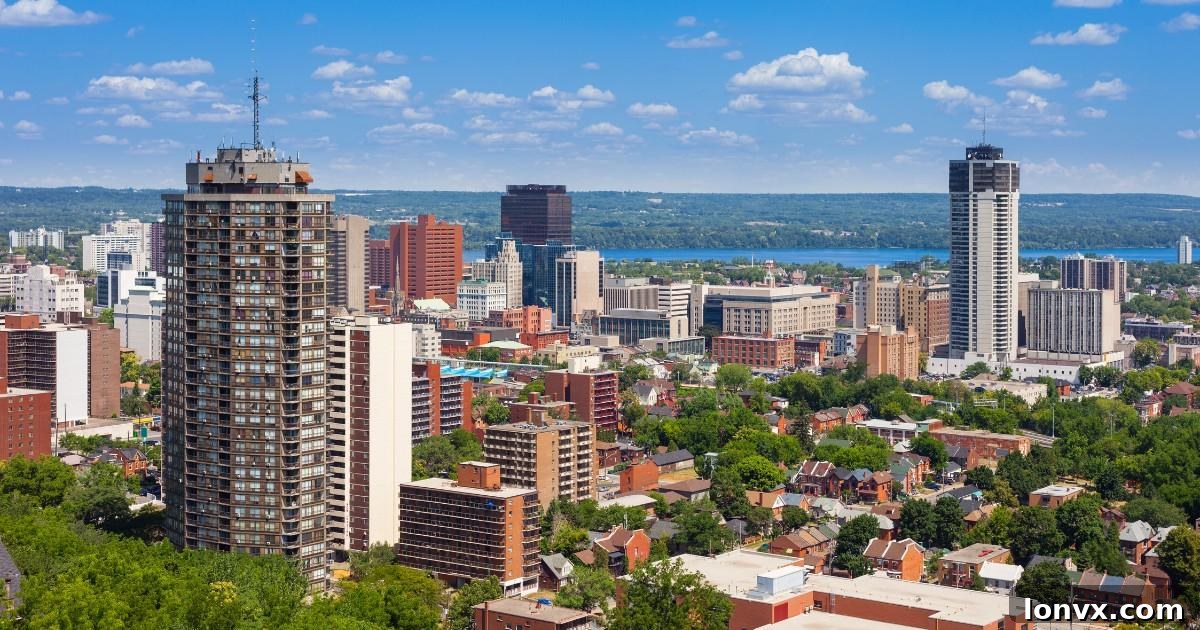
The housing markets across Southern Ontario are currently navigating a turbulent period, experiencing some of the most pronounced price declines in Canada. While the Greater Toronto Area (GTA) often captures headlines, the ripple effects of economic uncertainty and looming trade tensions are now profoundly impacting regions beyond its immediate borders. Areas such as Hamilton-Burlington, Niagara, Kitchener-Waterloo, and Windsor are feeling the brunt of a significant market downturn, driven by a complex interplay of factors, with fears over international tariffs emerging as a particularly potent force.
For years, the GTA was the focal point of Canada’s real estate narrative, characterized by soaring prices and intense bidding wars. However, recent trends indicate that the softest market conditions are now spreading outwards, affecting regions that are more inherently vulnerable to external economic shocks. These communities, often with deep industrial roots and strong ties to cross-border trade, find themselves particularly exposed to the unpredictable nature of global commerce and policy decisions.
The Spreading Chill: Southern Ontario’s Housing Market Downturn
The shadow of tariffs and broader trade uncertainty looms heavily over communities whose economies are intricately linked to manufacturing and international exchange. In Hamilton, a city historically known for its steel industry, the persistent threat of new steel tariffs has significantly eroded confidence across both the business sector and the housing market. This sentiment is not unique to Hamilton; similar pressures are being observed in Windsor, Niagara, and other key industrial areas throughout Ontario that rely substantially on manufacturing and cross-border trade with the United States.
Benjy Katchen, CEO of RPS Real Property Solutions and the real estate platform Wahi, aptly describes the situation: “Hamilton is the poster child for the impact of steel tariffs. We’re seeing the same sentiment-driven slowdown across much of Southern Ontario.” This highlights a crucial aspect of the current market climate: it’s not just about fundamental economic indicators, but also about the pervasive psychological impact of uncertainty on buyer and seller confidence.
With potential new tariff threats looming and deadlines approaching, the housing market remains mired in a state of limbo. This prolonged period of indecision and unpredictability is proving to be more detrimental than concrete bad news, as Katchen explains: “Often, uncertainty is worse than bad news. Businesses can’t plan, investors don’t know where to allocate capital, and companies aren’t sure where or how to sell their products. Once we get clarity—regardless of the direction—I believe we’ll see the market start to rebound.” This underscores the profound paralysis that economic uncertainty can inflict, preventing the natural flow of investment and consumer activity.
A Closer Look at Price Declines and Market Dynamics
The latest data paints a clear picture of the downward trajectory in prices across Southern Ontario. According to the Canadian Real Estate Association (CREA), June saw significant year-over-year price declines: a notable 7.5 per cent drop in Kitchener-Waterloo, a 5.8 per cent decrease in the Niagara Region, and an 8.7 per cent fall in Hamilton-Burlington. These figures illustrate the broad-based nature of the downturn affecting various regional markets.
Industry leaders attribute the continuing slide in home prices across Southern Ontario to a potent combination of local oversupply and global uncertainty. CREA data also indicates that the Greater Toronto Area experienced a 5.6 per cent year-over-year decline in June, while the Greater Vancouver Area saw prices fall by 4.8 per cent. While these major urban centers are also facing corrections, the underlying dynamics often differ.
Toronto’s Condo Conundrum vs. Regional Stresses
Benjy Katchen points out a critical distinction: “In Toronto, it’s a condo-specific issue. Tariffs are affecting national confidence a bit, but Toronto is mainly about condos.” This suggests that while global trade tensions may cast a wide net of general economic apprehension, the Toronto market’s challenges are more acutely concentrated within its high-density housing segment.
According to Katchen, both Toronto and Vancouver have indeed recorded the most pronounced price declines overall, but the nature of this downturn is distinctly concentrated in high-density housing. “Detached and semi-detached markets in the GTA and Greater Vancouver are holding up relatively well. But condos—there’s a real overhang right now.” This “overhang” is a significant factor, driven by a substantial influx of new inventory. A flood of condominium units has entered the market simultaneously with weakening demand, a phenomenon partly attributable to higher financing costs and a slight, albeit impactful, dip in immigration levels. Adding to this pressure is the reality that many of these condo units were initially purchased by investors, who are now grappling with the challenges of negative cash flow, potentially leading to more units coming onto the market.
The Shadow of Trade Fears and Interest Rate Hikes
While the GTA’s current challenges largely stem from an oversupply in the condo sector, the rest of Southern Ontario is contending with a different, yet equally stressful, kind of pressure—one deeply rooted in persistent uncertainty over trade policies and potential tariffs. This broader regional stress affects a wider range of housing types and economic segments.
Robert Hogue, Assistant Chief Economist with RBC, highlights that the combined effect of elevated interest rates and lingering trade-related uncertainty has severely eroded confidence, trapping the market in a prolonged slump. “Things are very soft,” Hogue confirms. “It’s a market that has corrected significantly since the Bank of Canada began raising interest rates back in June of 2022.” The initial aggressive rate hikes indeed triggered a swift decline in both prices and market activity. Briefly, the market appeared to stabilize when the Bank of Canada paused its tightening cycle approximately a year ago. However, any nascent momentum that began to build was quickly extinguished by renewed global economic uncertainty, particularly concerns surrounding escalating trade tensions.
As resale activity stalled across the region, inventory levels sharply increased, effectively pushing the market into clear buyer-friendly territory. “Prices are declining—not collapsing—but they are coming down,” Hogue carefully explained, emphasizing a correction rather than a crash. When asked whether Southern Ontario now represents the softest housing region in the country, Hogue responded with a cautious but telling, “Probably.” While British Columbia has also experienced its share of declines, the magnitude of the correction in Ontario, particularly in these industrial and suburban regions, has been more pronounced.
Still, Hogue noted an important context: this correction follows a period of massive, unprecedented price escalation during the pandemic. For many, this cooling-off period offers a glimmer of hope. “Not everyone is disappointed to see prices come down. A lot of potential homebuyers who had been shut out of the market are probably seeing these declines as a good development,” he stated. However, despite these recent corrections, affordability remains a highly strained issue. Prices are still historically elevated, especially within the GTA and its immediate surrounding cities. “This is part of the process of reversing the deterioration in affordability that occurred during the pandemic,” Hogue said, concluding that he anticipates this softness to persist for the foreseeable future as the market recalibrates.
Tariffs: A Direct Hit on Industrial Hubs
Another critical factor significantly weighing on Southern Ontario’s housing market is tariff-related uncertainty, which is particularly impactful in industrial hubs like Windsor, Hamilton, and Kitchener-Waterloo. These areas, with their strong economic ties to manufacturing and cross-border trade, are inherently more susceptible to trade-related shocks. “Those areas are much more vulnerable to trade-related shocks,” Hogue emphasized. “Confidence in those regions has been significantly affected,” leading to a palpable hesitancy in major financial decisions, including home purchases.
Chris Jokel, Senior Data Engineer at CREA, further elaborated on this multifaceted challenge, identifying a combination of tariff-related uncertainty, burgeoning inventory levels, and persistent, long-standing affordability challenges as the primary drivers of the current downturn. Jokel pointed out a consistent trend: “What we’re seeing right now is that the relatively most unaffordable or expensive areas of the country are experiencing the largest price declines.” This trend is particularly evident across Ontario’s Greater Toronto Area (GTA) and the broader Golden Horseshoe region, mirroring similar patterns of weakness observed in British Columbia’s Lower Mainland.
Both sales activity and pricing have taken a substantial hit in recent months, but CREA’s data specifically highlights especially sharp declines in parts of Southwestern Ontario. “Windsor is currently experiencing the lowest sales activity in about 12 years,” Jokel revealed, painting a stark picture of the market’s contraction. “At the same time, it’s facing extremely high new listings and overall inventory. The tariff impacts are clearly playing a role, especially with Windsor’s economy being so closely tied to the auto sector and cross-border trade.” Similarly, the RPS-Wahi House Price Index for June indicated that home sales in Hamilton had plummeted to a 15-year low for the month, reinforcing the severity of the regional downturn.
While CREA does not provide forecasts at a hyper-local level, Jokel explained that their provincial outlook for Ontario has recently undergone revisions to accurately reflect the escalating uncertainty. “Originally, for this year, we forecasted about a four per cent decline in sales. That’s since been revised downward to just under nine per cent,” he stated, indicating a deepening of market challenges. This volatility, in part, stems directly from the shifting and often unpredictable U.S. trade policy, which creates a challenging environment for both businesses and consumers. Earlier in the year, some markets had shown tentative “green shoots” of stabilization, suggesting a potential bottoming out. However, this fragile momentum is now at significant risk due to renewed trade anxieties.
The Looming Threat of Further Tariffs and Market Rebound Prospects
With another round of tariff threats potentially materializing ahead of a key August 1st deadline, Chris Jokel cautioned that any nascent market rebound could be severely derailed. “If those tariff increases move from 25 per cent to 35 per cent, that will likely dampen both economic and housing activity,” he warned. Such a hike could also inflict significant damage on consumer confidence, as people might begin to question the stability of the economic environment. “People might think, ‘If tariffs can jump from 25 per cent to 35 per cent arbitrarily, what’s stopping them from going even higher later?’” This psychological barrier, born from uncertainty, can suppress large-scale investments and purchasing decisions.
Navigating a “New Normal” in Canadian Real Estate
Phil Soper, CEO of Royal LePage, offered a broader perspective on affordability. He noted that while prices in some secondary Ontario markets might superficially appear more affordable compared to Toronto, they often remain quite high relative to national averages. “People don’t always realize it, but even though home prices seem cheaper in a place like Barrie compared to Toronto, they’re actually more expensive than in a city like Calgary,” he explained, emphasizing the nuanced nature of perceived value and actual cost.
The persistent uncertainty surrounding tariffs and American trade policy continues to exert pressure on the market, particularly in regions that are heavily reliant on manufacturing and cross-border economic ties. Soper suggested that Canadians are beginning to adapt to what he terms the “new normal” of ongoing trade tensions, drawing parallels to the pandemic period when individuals and businesses learned to adjust to persistent challenges. “People are beginning to tune out the daily barrage from the White House because it doesn’t seem to be affecting their day-to-day lives directly,” he said, implying a degree of psychological resilience developing within the population.
Ultimately, Soper believes that the most significant hurdle currently facing the housing market is more psychological than structural. “It’s about how people feel. They don’t feel confident making big investments. But that will pass,” he concluded. This perspective suggests that while external economic factors are influential, the market’s recovery may ultimately hinge on a return of consumer and investor confidence, which, while elusive in times of uncertainty, is often transient and capable of rebounding once clarity emerges or adaptation sets in.