
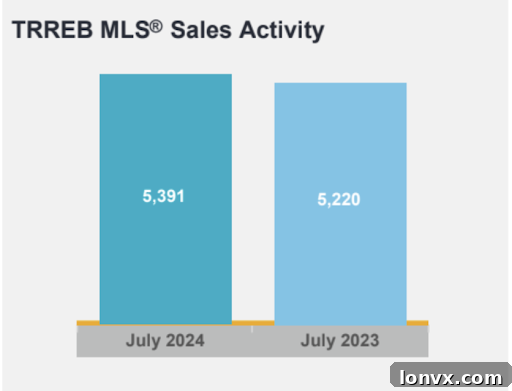
The Greater Toronto Area (GTA) housing market in July 2024 tells a compelling story of an evolving landscape, marked by a palpable resurgence in activity coupled with a necessary recalibration of prices. After a period of relative stagnation, the market is demonstrating clear signs of revival, with home sales experiencing a modest yet significant 3.3 percent increase year-over-year, culminating in 5,391 transactions compared to 5,220 in July of the previous year. This uptick in transactions signals renewed buyer confidence and a thawing of previous hesitancy that characterized earlier months.
Driving this renewed vitality is an impressive 18.5 percent surge in new listings compared to the prior year. This influx of properties provides prospective buyers with a significantly expanded array of choices, fundamentally shifting the dynamics from a seller-dominated market to one that offers more balance. However, this recovery is not without its nuances. As supply grows and options for buyers broaden, the average selling price across the GTA has witnessed a slight decline. This dual movement underscores the intricate interplay between supply, demand, and broader economic pressures that are reshaping the region’s real estate narrative.
Within this broader context, the condominium sector carves out its own distinct storyline. While rental demand continues its robust ascent, it is being outpaced by an even more substantial influx of new rental listings. This creates a unique scenario where tenants are benefiting from increased availability and, notably, slightly lower average rents – a welcome respite in one of Canada’s most competitive rental markets.
Increased Listings Drive Supply and Moderate GTA Housing Prices
July 2024’s housing market data for the GTA offers a clear indication that the market is steadily moving past its previous slowdown. The rebound in home sales is a crucial indicator of growing consumer confidence and a gradual return to more dynamic market conditions. This increase in sales activity was directly mirrored by a substantial rise in new listings, reaching an impressive 16,293 in July. This figure represents an 18.5 percent increase compared to July of last year, a significant jump that profoundly impacts the supply side of the equation. This robust boost in inventory is instrumental in meeting the sustained demand from buyers, who now find themselves with a much wider selection of properties to consider.
The improved market supply is a critical development for several reasons. Firstly, it alleviates some of the intense competition that has historically characterized the GTA housing market, potentially leading to fewer bidding wars and more measured decision-making for buyers. Secondly, a healthier inventory level is essential for market stability, preventing drastic price fluctuations and fostering a more predictable environment for both buyers and sellers. This abundance of choice is particularly beneficial for first-time homebuyers and those looking to upgrade, as it allows them more time to research, compare options, and make informed purchasing decisions without the immediate pressure of a rapidly depleting pool of homes.
Source: TRREB
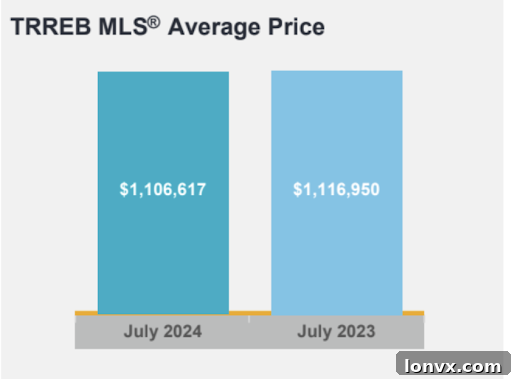
Despite the synchronized rise in both sales volumes and new listings last month, the average selling price across the GTA experienced a noticeable decline of 5.0 percent year-over-year. The average price was reported at $1,106,617, which also marks a slight 0.9 percent (over $10,000) decrease from the $1,116,950 recorded in July 2023. This reduction in average prices can be directly attributed to the significant increase in available inventory. As the supply of homes on the market expands, it naturally helps to ease the demand pressure, leading to a moderation in price growth or, as seen this month, a slight correction.
This pricing adjustment suggests a move towards a more balanced market, where sellers may need to adjust their expectations in response to increased competition and more discerning buyers. For many prospective homeowners, this trend represents a much-needed improvement in affordability, potentially opening doors that were previously closed due to soaring prices. It also reflects a broader market adjustment as economic factors, including interest rates and inflation, continue to influence purchasing power and buyer willingness to pay premium prices. The current environment indicates a cautious optimism, with buyers having more leverage and a greater ability to negotiate, which is a significant shift from the frenetic pace of previous years.
Source: TRREB
Detailed Analysis of GTA Condominium Sales and Rental Market Trends
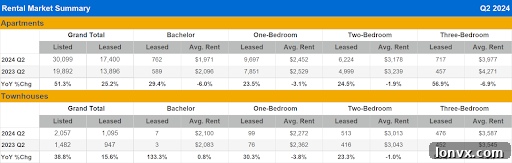
Against the backdrop of these broader housing market shifts, the Greater Toronto Area’s condominium market presented a compelling, albeit mixed, set of results for Q2 2024. The rental segment of the condominium market experienced robust activity, with a substantial 25.2 percent increase in rentals, totaling 17,400 transactions in Q2 2024 compared to 13,896 rentals in Q2 2023. This significant growth in rental transactions underscores the persistent demand for rental accommodation in the GTA, driven by factors such as immigration, a strong student population, and affordability challenges that make homeownership elusive for many.
However, what truly defined the condominium rental market in Q2 2024 was the even more dramatic surge in new rental listings, which soared by an astonishing 51.3 percent year-over-year. This remarkable influx of rental units has outpaced even the robust demand, leading to a landscape where tenants find themselves with considerably more options than before. This increase in inventory is likely due to several factors, including the completion of new condominium developments, some investors opting to rent out properties rather than sell in a softening sales market, or perhaps a shift from short-term rental platforms to long-term leasing.
Source: TRREB
The net effect of this supply-demand dynamic in the rental market has been a favorable shift for tenants. Despite the high overall demand for rental accommodations, the surge in listings has translated into increased choice and, importantly, slightly lower average rents. For instance, the average rent for a one-bedroom condominium apartment in Q2 2024 stood at $2,452, reflecting a 3.1 percent decline from the $2,529 average recorded in Q2 2023. Similarly, two-bedroom condominium apartments saw their average rent decrease by 1.9 percent, moving from $3,239 to $3,178 over the same period. These modest reductions, while not drastic, offer a tangible benefit to renters and represent a notable departure from the relentless rent increases seen in recent years.
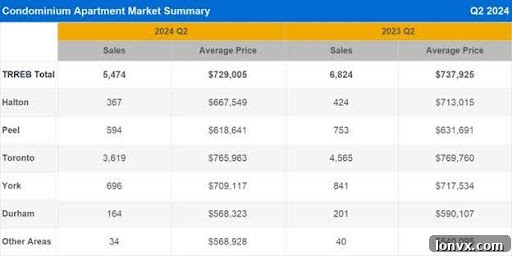
Conversely, the condominium sales market presented a different picture. While rentals thrived, condominium sales experienced a significant downturn, dropping by 19.8 percent to 5,474 units in Q2 2024, compared to 6,824 in Q2 2023. This decline in sales activity occurred even as the number of new condominium listings surged by 36.5 percent year-over-year, reaching 16,917. This indicates that while more units were available for purchase, buyers were either less willing or less able to commit. The average selling price of condominium apartments in Q2 2024 also saw a slight dip, settling at $729,005 from $737,925 in Q2 2023.
Source: TRREB
Geographically, Toronto’s condominium market reflected this cautious sentiment, with its average selling price decreasing by 0.5 percent to $765,963. Meanwhile, regions like Durham stood out for having one of the GTA’s lowest condominium sales volumes and lowest average prices in Q2 2024, highlighting the varying dynamics across different municipalities within the Greater Toronto Area. This disparity suggests that buyers might be seeking more affordable options outside the immediate core, or that different sub-markets are reacting uniquely to current economic conditions and interest rate environments.
The decline in condo sales, despite increased inventory and strong rental demand, can be attributed to several factors. Higher borrowing costs may be impacting the affordability of even entry-level condo units for many first-time buyers. Additionally, some potential investors might be hesitant due to the saturated rental market and moderate rent growth, making the investment less attractive compared to previous periods. This segment of the market appears to be undergoing a more pronounced adjustment, requiring both sellers and developers to adapt to changing buyer expectations and financial realities.
GTA Housing Market Outlook: Navigating a Complex and Dynamic Future
As we assess the Greater Toronto Area’s housing market in mid-2024, the prevailing trends paint a vivid picture of a market in significant transition. The simultaneous rise in transaction volumes and the moderation of average prices encapsulate a shift towards a more balanced and sustainable environment. The 3.3 percent increase in home sales, observed alongside a 5.0 percent decrease in average prices, is a testament to the delicate equilibrium emerging between growing supply and an increasingly discerning, yet active, demand pool. This balance offers a healthier foundation for the market, mitigating the risks of rapid appreciation while providing opportunities for more buyers to enter or move within the market.
In the crucial condominium sector, a similar narrative of adjustment unfolds, albeit with its own unique characteristics. A substantial increase in rental transactions and new rental listings signifies a vibrant, albeit highly competitive, rental market that is benefiting tenants with more choices and stable rents. Conversely, declining sales and a notable surge in new listings within the condo sales segment suggest that this particular housing type is experiencing a more pronounced period of recalibration. This complex interplay presents both significant opportunities for buyers and renters, while also posing challenges for sellers and developers who must adapt to evolving market conditions.
The evolving GTA housing market in 2024 is undoubtedly more than just a collection of statistical figures; it serves as a dynamic illustration of how various economic forces, prevailing buyer and seller sentiments, and strategic adjustments converge to shape the future of urban living. Factors such as fluctuating interest rates, ongoing immigration trends, and broader economic stability will continue to play pivotal roles in influencing market direction. For buyers, the increased inventory and moderated prices offer a window of opportunity to make well-considered purchases. For sellers, strategic pricing and presentation are paramount in a more competitive landscape. For investors, understanding the nuanced shifts between the rental and sales markets will be key to informed decisions.
While signs of recovery are clearly underway, the path ahead for the GTA housing market is likely to remain complex and multifaceted. Stakeholders across the board will need to remain agile and adaptable to navigate these evolving dynamics. The market’s resilience and capacity for adjustment suggest a promising trajectory, but one that requires careful monitoring and a nuanced understanding of its intricate mechanisms. This period of transition is crucial, shaping the affordability, accessibility, and overall health of one of North America’s most significant real estate markets for years to come.