
Canada’s Housing Market Cools: Sales Decline, Prices Moderate in November Amidst Economic Shifts
The Canadian housing market experienced a continued cooling trend in November, with new data from the Canadian Real Estate Association (CREA) indicating a significant slowdown in sales activity and a moderation in home prices across the nation. This latest report provides a crucial snapshot of a market grappling with shifting economic landscapes, higher interest rates, and evolving buyer and seller sentiments.
November’s statistics reveal a market that is steadily moving away from the frenzied activity seen in previous years, signaling a more balanced environment for many regions. As prospective homebuyers and sellers navigate these changing conditions, understanding the underlying dynamics becomes paramount to making informed decisions.
Key Highlights from CREA’s November Report
- National home sales in Canada saw a month-over-month decline of 3.3% in November, building on previous months’ moderation.
- New listings also decreased by 1.3% compared to October, indicating a tighter supply side despite lower demand.
- Compared to November 2021, monthly activity plummeted by nearly 40%, underscoring the dramatic shift in market conditions over the past year.
- The national average home price registered a 12% decrease year-over-year, settling at $632,802.
- Approximately 70% of local markets are now categorized as being in “balanced market territory,” a significant change from the seller-dominated conditions of recent times.
A Deeper Dive into November’s Sales and Listings Figures
According to CREA’s comprehensive national statistics, home sales in Canada experienced a 3.3% month-over-month decrease in November. This decline follows a brief uptick in October, which was the first monthly gain since February. However, the November data suggests that any momentum from October was short-lived, with the market rejoining the moderating trend that began earlier in the year. This consistent downward trajectory highlights the sustained impact of economic pressures on consumer purchasing power and market confidence.
The reduction in sales activity was accompanied by a marginal drop in the number of new listings, which edged down by 1.3% nationally. This pattern of declining listings was observed in over half of Canada’s local real estate markets, contributing to a tightening of available inventory. While a decrease in listings might typically suggest strong seller confidence, in the current climate, it often reflects a “wait and see” approach from potential sellers who may be hesitant to list their properties amidst falling prices and reduced buyer enthusiasm, or simply not needing to sell immediately.
The year-over-year comparison paints an even more striking picture of the market’s evolution. November’s number of transactions, when not seasonally adjusted, was down a substantial 38.9% compared to November 2021. This stark contrast emphasizes the dramatic shift from the peak of the pandemic-era housing boom, where record-low interest rates fueled unprecedented demand. Furthermore, current activity stands approximately 13% below the 10-year average for the month, illustrating the profound departure from historical norms and the re-establishment of a more traditional, albeit cautious, market cycle.
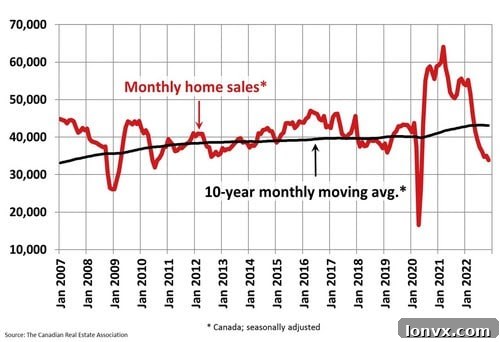
Monthly home sales (CNW Group/Canadian Real Estate Association)
Moderating Prices and the Shift Towards a Balanced Market Equilibrium
The national average home price in Canada, unadjusted for seasonality, was reported at $632,802 in November. This figure represents a notable 12% decrease when compared to November 2021, reflecting the direct impact of cooling demand and persistently rising interest rates on property valuations. While national prices have moderated significantly from their historical highs, the pace of adjustment continues to vary across different regions and property types, with some markets experiencing sharper corrections than others.
A key indicator of market health and balance is the sales-to-new listings ratio, which provides crucial insight into the relationship between supply and demand. In November, this ratio eased slightly to 49.9% from 50.9% in October. This metric has consistently hovered close to 50% since May, signaling a sustained shift towards a more balanced market environment. For context, the long-term average for this measure is 55.1%, suggesting that current conditions are slightly favoring buyers compared to the historical norm, granting them more negotiation power and choice.
Indeed, CREA’s analysis further solidifies this trend, confirming that approximately 70% of local markets across Canada are now operating within what is considered balanced market territory. This is a significant departure from the overheated seller’s market that characterized much of the past few years, where demand far outstripped supply, leading to rapid price appreciation and intense bidding wars. A balanced market implies a more even playing field for both buyers and sellers, where neither side holds a distinct advantage, and price negotiations become more common and essential.
The Impact of Interest Rates and Broader Economic Forecasts
The ongoing adjustments in the Canadian housing market are inextricably linked to the Bank of Canada’s aggressive interest rate hikes throughout 2022, aimed at taming persistent inflation. These successive rate increases have significantly impacted mortgage affordability, thereby dampening buyer demand, increasing borrowing costs, and contributing directly to the current moderation in sales and prices across the country.
Jill Oudil, Chair of CREA, offered her perspective on the consistent trends observed: “There were no big surprises in the November housing numbers, with the data showing the same trends of lower sales and moderating prices we’ve been seeing for a number of months now.” Oudil further elaborated on the prevailing sentiment regarding interest rates, stating that while they are not likely to improve significantly in the first half of 2023, many economists do not anticipate the Bank of Canada implementing further substantial hikes. This outlook suggests a potential stabilization of borrowing costs in the near term, which could offer some much-needed predictability for prospective buyers and contribute to a clearer market horizon.
However, the full impact of existing rate hikes continues to ripple through the market, profoundly influencing buyer confidence and financial capacity. Homeowners with variable-rate mortgages are already feeling the pinch of higher payments, leading to increased household budget strains. Simultaneously, prospective buyers face more stringent mortgage qualification criteria and significantly reduced purchasing power, compelling them to adjust their expectations or postpone their buying decisions.
Understanding Supply Dynamics: The Listings Enigma
Despite the overall cooling in buyer demand, one intriguing and crucial aspect of the November data is the persistent tightness in supply. CREA’s data highlights that November 2022 recorded the fewest new listings for that month in 17 years, with the sole exception of 2019. This scarcity of new properties coming onto the market is a critical factor influencing the sales-to-new listings ratio and, in many areas, preventing a more dramatic and steep decline in home prices.
Shaun Cathcart, Senior Economist for CREA, articulated the potential future implications of this unique supply dynamic. He stated, “It will be interesting to see what buyers do when listings start to come out in big numbers in the spring, and even more interesting to see what happens a little later when the Bank of Canada…starts to eventually cut rates.” Cathcart’s observation points to a potential turning point in the market, where a significant influx of listings could further shift the balance towards buyers, while future rate cuts could reinvigorate demand and potentially stabilize or even modestly increase prices.
The current low level of new listings can be attributed to several interwoven factors. Some potential sellers might be reluctant to list their properties for sale at lower prices than they might have achieved a year ago, leading to a holding pattern. Others might be waiting for interest rates to stabilize or for clear signs of market conditions to improve before making a move. This widespread reluctance to list contributes to the “listings enigma” – a scenario where a cooling market doesn’t necessarily translate into a flood of new homes for sale, thus preventing an even sharper correction in prices and maintaining a floor for valuations in many areas.
Expert Outlook and Future Prospects for the Canadian Housing Market
The perspectives offered by CREA’s leadership provide valuable insights into the potential trajectory of the Canadian housing market. While the immediate outlook suggests continued moderation and adaptation to new economic realities, there’s an underlying current of long-term optimism rooted in fundamental market strengths that continue to underpin the housing sector.
As Shaun Cathcart succinctly noted, “All the other fundamental factors needed for the market to take off again are still out there.” These fundamental factors often include robust population growth, primarily driven by substantial immigration targets, strong and resilient employment figures across various sectors, and a long-standing structural undersupply of housing in many major urban centers. These enduring elements suggest that once affordability challenges ease, and interest rate stability or even reductions are introduced, buyer demand could rebound significantly, setting the stage for renewed market activity.
The spring market, traditionally the busiest period for real estate activity in Canada, will be a critical test for these forecasts. An increase in listings, as anticipated by Cathcart, combined with a clearer picture of the Bank of Canada’s evolving monetary policy, will shape the immediate future. If listings flood the market while demand remains subdued due to persistently high interest rates, further price adjustments could occur. Conversely, if demand strengthens as rates stabilize or drop, the market could find a new equilibrium, potentially entering a more sustainable growth phase.
Moreover, it is crucial to remember that the Canadian housing market is not monolithic. While national averages provide a broad overview, local market conditions can vary considerably based on a multitude of factors. Elements such as regional economic performance, localized employment rates, specific provincial housing policies, and the dynamics of different housing types (e.g., detached homes versus condominiums) will continue to drive localized trends, even within the broader national narrative of moderation and recalibration.
Conclusion: A Market in Transition and Poised for a New Normal
November’s housing data from CREA unequivocally confirms that the Canadian real estate market is undergoing a significant and transformative transition. The era of rapid price appreciation, intense bidding wars, and seemingly endless demand has largely given way to a more measured and cautious environment. This new landscape is characterized by declining sales volumes, moderating home prices, and an increasing number of markets that are now firmly in balanced territory. This profound shift is a direct consequence of higher interest rates, which have fundamentally recalibrated affordability, tempered speculative activity, and compelled both buyers and sellers to reassess their strategies.
While the market has pulled back substantially from its recent peak, key figures within CREA suggest that underlying fundamental factors remain robust and supportive for a long-term recovery and sustained health of the housing sector. The coming months, particularly the crucial spring season, will be instrumental in determining the extent of further market adjustments and the pace at which buyer confidence and activity ultimately return. As the Bank of Canada’s monetary policy evolves in response to economic indicators and global trends, and as general economic conditions stabilize, the Canadian housing market is poised to navigate towards a new normal, offering both significant challenges and emerging opportunities for all participants.