
The Canadian real estate landscape is dynamic, and recent announcements in the federal government’s Budget 2024 have introduced significant changes for secondary property owners. One of the most impactful adjustments is the increase in the capital gains inclusion rate, moving from 50 per cent to 66.7 per cent. This policy shift is set to affect a wide array of Canadians, particularly those who own cottages, vacation homes, or other secondary properties across the country, especially those in popular destinations like Ontario’s picturesque cottage country.
Under the new rules, which come into effect on June 25 this year, individuals selling a secondary property will be subject to a 66.7 per cent tax on all capital gains exceeding $250,000. For corporations and trusts, the increased inclusion rate applies to all capital gains, with no threshold. This measure is poised to reshape investment strategies and selling decisions for many property owners, prompting a closer look at the market dynamics already at play.
Ontario’s Cottage Country: Benchmark Prices Outpace Major Markets
Even before the announcement of the revised capital gains tax, Ontario’s vibrant cottage country was experiencing an exceptionally active spring season. This robust activity was characterized by a notable uptick in home prices since January and a healthy influx of new listings across various recreational markets. The enduring appeal of cottage life, combined with a persistent demand for serene retreats, has fueled this impressive growth.
A recent analysis conducted by Zoocasa shed light on the extent of this surge, examining benchmark home price changes in 11 key markets within Ontario’s cottage regions since the beginning of the year. The findings were compelling: all but one of these markets recorded price growth exceeding six per cent, demonstrating a widespread appreciation for recreational properties.
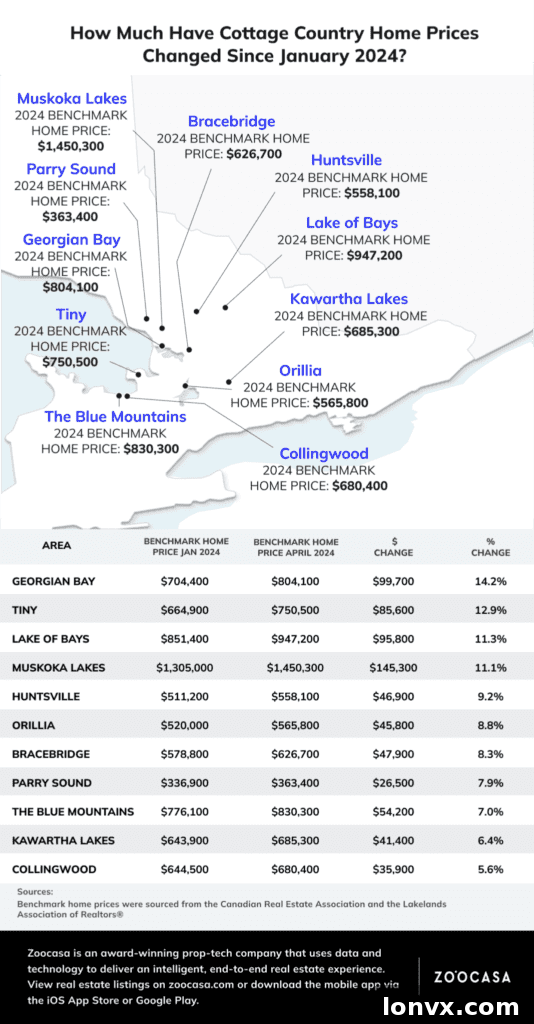
Several areas stood out with particularly strong performance. Benchmark prices in highly sought-after locations such as Georgian Bay, Tiny, Lake of Bays, and Muskoka Lakes have soared by over 11 per cent since January alone. To put this into perspective, in Muskoka Lakes, this translates to an increase of more than $140,000 in just a few months. Similarly, homeowners in Lake of Bays and Georgian Bay have seen their property values climb by over $90,000. This level of price appreciation is truly remarkable, especially when compared to the growth rates observed in Canada’s major urban centers.
For instance, Toronto, one of the country’s hottest real estate markets, saw its benchmark home price increase by 5.9 per cent from January, while Vancouver experienced a more modest 3.8 per cent rise. The fact that Ontario’s cottage country markets are witnessing growth rates more than double those of these bustling metropolitan areas underscores the unique and powerful demand for recreational properties. This trend highlights the increasing value placed on lifestyle and leisure assets, and the competitive nature of acquiring a piece of Canada’s beloved natural landscapes.
Waterfront Properties: A Deeper Dive into Price Dynamics, Inventory, and Sales
While the overall benchmark prices across Ontario’s cottage country have shown significant upward momentum, a closer examination of the waterfront property segment reveals a more nuanced picture. Waterfront homes, often considered the pinnacle of recreational real estate, exhibit distinct trends that warrant careful consideration, particularly in the context of recent market shifts and policy changes.
Despite the substantial jumps in benchmark prices for the broader cottage market, the median price for all waterfront properties within the Lakelands region has experienced a more complex trajectory. While there was a healthy increase of 6.2 per cent since January, suggesting strong recent demand, the year-over-year median price actually saw a slight decrease of 1.9 per cent. This indicates a potential cooling or rebalancing in this specific, high-value segment when viewed over a longer period.
Further breaking down the Lakelands region, specific sub-markets show varying performances. In Lakelands Central and Lakelands North, for instance, the median price for waterfront properties dropped by 4.0 per cent and 0.7 per cent respectively, compared to the previous year. This suggests that certain areas may be experiencing price adjustments or increased supply affecting their value proposition. Conversely, Lakelands West bucked this trend, reporting a robust 16.1 per cent increase in its median waterfront property price, reaching $905,000. This significant appreciation, however, comes with a caveat: Lakelands West typically has far fewer properties for sale, meaning that a smaller number of high-value transactions can disproportionately influence the median price.
The inventory of waterfront properties also tells an interesting story. There has been a marked and widespread increase in new listings across the Lakelands, signaling a potential shift in seller behavior. In Lakelands North, new listings surged by an impressive 61 per cent year-over-year in April. Lakelands West and Lakelands Central also saw substantial increases in new listings, rising by 48.6 per cent and 40 per cent respectively, compared to the same period last year. This influx of properties could be a response to high demand and attractive pricing, or it could reflect homeowners’ anticipatory reactions to policy changes, particularly the impending capital gains tax increase.
Coinciding with this rise in inventory, waterfront home sales have also shown positive movement. Both Lakelands West and Lakelands North recorded an increase in year-over-year sales, indicating that the heightened supply is being met with active buyer interest. This suggests a healthy, albeit complex, market where sellers are responding to favorable conditions, and buyers are eager to secure prime waterfront real estate. The interplay between increased listings, fluctuating prices, and active sales points to a market segment that is highly sensitive to both economic conditions and policy adjustments.
The Capital Gains Tax: A New Factor in the Recreational Property Market
The recent announcement of an increased capital gains inclusion rate introduces a critical new element into the already dynamic recreational property market. While it remains challenging to definitively link the surge in new listings solely to the impending tax change—especially given that spring traditionally marks a busy selling season in cottage country—the timing suggests a potential influence. The new tax structure, effective June 25, 2024, may indeed be exerting additional pressure on secondary homeowners who were previously undecided about whether to retain or sell their recreational properties.
For many, the prospect of a higher tax burden on profits realized from the sale of their cherished cottage could be a significant motivator to act before the deadline. Homeowners who have seen substantial appreciation in their secondary properties over the years might be considering crystallizing those gains under the current, lower inclusion rate. This rush could contribute to the observed increase in market activity, creating a temporary spike in supply as sellers aim to optimize their financial outcomes.
The federal government, in its Budget 2024, outlined that the capital gains inclusion rate increase is expected to primarily affect a very specific segment of the population. According to government projections, only 0.13 per cent of Canadians, primarily those with an average income of $1.4 million, are anticipated to pay more each year because of this policy adjustment. This framing suggests the measure is targeted at higher-income individuals and entities, aiming to enhance tax fairness and generate additional revenue for public services.
However, even if the direct financial impact is concentrated, the psychological effect on the broader market should not be underestimated. The discussion surrounding capital gains taxes can create uncertainty and prompt a re-evaluation of long-term investment strategies among a wider group of secondary property owners. This could lead to a strategic repositioning of assets, with some choosing to divest before the new rules take full effect, while others might choose to hold, anticipating continued market appreciation or simply valuing the lifestyle benefits of their properties above short-term tax considerations.
Ultimately, the true long-term impact of the capital gains tax increase on Canada’s recreational property market will unfold over time. It will be influenced by a complex interplay of factors including interest rate trends, overall economic health, regional demand, and individual homeowner decisions. Nevertheless, for the foreseeable future, secondary property owners, particularly in bustling markets like Ontario’s cottage country, must carefully consider the implications of this new tax environment when making their real estate plans.
For more detailed insights and analysis, read the full report here.
Enjoying this article?
Get the latest REM articles in your inbox 3x week so you stay up to date on the latest in the Canadian real estate industry