
Canada’s housing market is currently exhibiting tentative signals of a potential recovery, as highlighted in a recent comprehensive report by Robert Hogue, Assistant Chief Economist at RBC. This analysis provides a crucial snapshot of the evolving real estate landscape across the nation, suggesting a nuanced shift in market dynamics after a period of significant uncertainty. The report delves into the intricate interplay of economic factors, consumer sentiment, and regional variations that are collectively shaping the future trajectory of Canadian homeownership.
Data compiled from various local real estate boards across the country indicates a discernible upward trend in sales activity during May. Several key cities, which had previously experienced a noticeable pullback in transactions, now report an increase, hinting at a cautious resurgence within a sector that has contended with the compounding pressures of global trade disputes and persistent economic instability. This nascent recovery is particularly significant given the backdrop of fluctuating consumer confidence, tighter lending conditions, and the lingering effects of inflationary pressures on household budgets. It suggests a growing adaptation to the new economic realities by both buyers and sellers.
Among the cities leading this hesitant rebound are major urban centres such as Toronto, Ottawa, Calgary, Edmonton, Fraser Valley, Saskatoon, and Regina. These markets collectively witnessed a partial recuperation in the volume of transactions, clawing back some of the considerable declines recorded earlier in the year. This broad geographic spread of improving sentiment suggests that while challenges remain, pockets of resilience are emerging across the Canadian real estate tapestry. The varied performances underscore the importance of understanding local market conditions rather than relying solely on national averages.
Robert Hogue noted the importance of broader economic shifts influencing this market sentiment. “The de-escalation of tariffs has taken centre stage since May, alleviating some of the worst fears about the potential economic fallout even though recent doubling of steel and aluminum tariffs increases risks in some communities,” Hogue stated. He emphasized the need for more time to fully assess the situation, adding, “We expect to get a clearer view in the coming months.” This statement underscores the cautious optimism that characterizes the current outlook, acknowledging both positive developments and lingering risks. The influence of external economic factors, such as international trade policies and global supply chain dynamics, remains a critical component in understanding the domestic housing market’s vulnerabilities and strengths.
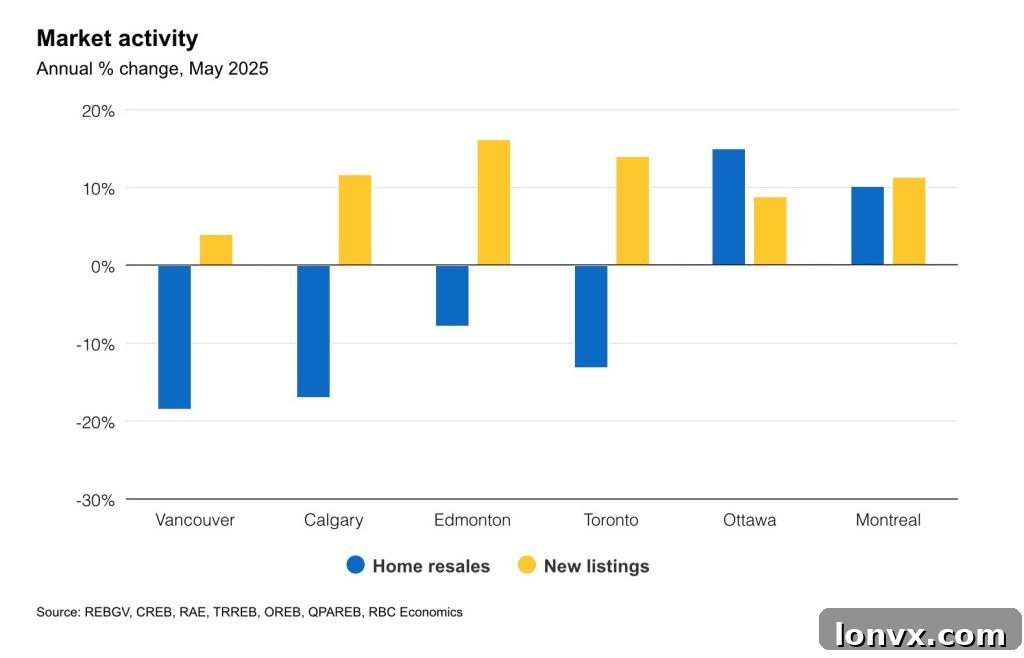
A Diverging Landscape: Regional Real Estate Stories Across Canada
While the overall Canadian housing market shows signs of life, the recovery is far from uniform. The narrative of real estate across the country is highly fragmented, with distinct trends emerging in different regions. This divergence is largely attributable to local economic conditions, affordability levels, population growth patterns, and varying degrees of sensitivity to interest rate fluctuations. Understanding these regional nuances is key to appreciating the complex state of Canada’s property market.
Markets situated in Southern Ontario and certain parts of British Columbia continue to represent the country’s least affordable areas. These regions, characterized by historically high property values and intense competition, remain notably soft. According to RBC’s analysis, activity in many of these urban centers is hovering close to cyclical lows, indicating that a substantial and sustained rebound to more robust levels will likely require considerable time. Buyers in these areas are exercising caution, and sellers face increased pressure, contributing to a more balanced or even buyer-favored environment in some segments. The deep roots of high prices in these regions mean that even minor economic shifts can have pronounced effects on buyer behaviour and market sentiment, leading to a slower and more protracted recovery phase.
These particularly sensitive markets are also experiencing the most significant downward pressure on home prices. The MLS Home Price Index (HPI), a key benchmark for real estate values, continued its decline in several of these markets from April to May. Notable examples include the Greater Toronto Area, Hamilton, Kitchener-Waterloo, Cambridge, Vancouver, and the Fraser Valley. This persistent downward trend reflects the enduring impact of higher interest rates, stricter mortgage qualification rules, and a gradual shift in buyer expectations, which are now more aligned with long-term affordability rather than speculative gains. The supply-demand imbalance, exacerbated by an increase in available inventory, provides buyers with more leverage than seen in recent years.
In stark contrast, other parts of the country are demonstrating a relatively sturdier performance. Prairie markets, including Edmonton, Saskatoon, and Regina, alongside some regions in Quebec, such as Quebec City, and the Atlantic provinces, like St. John’s, have largely held their ground. These markets, while not entirely immune to the broader economic anxieties, particularly those stemming from trade-induced concerns, have shown greater stability. Their resilience is often linked to more attractive affordability, steady local economies, and less exposure to the extreme price surges seen in Canada’s most expensive urban centers during the pandemic-era boom. This intrinsic stability makes them less susceptible to rapid price corrections and offers a more predictable environment for both homeowners and investors.
Southern Ontario and British Columbia: Persistent Affordability Challenges
The highly populated and historically expensive regions of Southern Ontario and British Columbia are grappling with profound affordability challenges that continue to impede a swift market recovery. Cities like Toronto and Vancouver, once synonymous with rapidly appreciating property values, are now navigating a period of significant adjustment. High average home prices, coupled with elevated interest rates, have severely impacted borrowing power and overall housing accessibility for many potential buyers, especially first-time entrants. This combination of factors has led to prolonged market softness, characterized by reduced sales volumes and increasing inventory levels. The demand that drove previous booms has been tempered by financial realities, forcing a re-evaluation of homeownership goals for many.
The MLS Home Price Index in these regions reflects this ongoing struggle, showing consistent declines. In the Greater Toronto Area, Hamilton, Kitchener-Waterloo, and Cambridge, as well as Vancouver and the Fraser Valley, homeowners have seen their property values soften. This trend is not merely a correction but a reflection of a broader recalibration, where demand is moderated by financial constraints and a more cautious consumer sentiment. The market here is moving towards a more buyer-friendly landscape, offering more choice and negotiation power, a stark departure from the intense bidding wars of previous years. The impact of the mortgage stress test further constrains purchasing power, extending the period of adjustment for these high-value markets.
The Resilient Periphery: Strength in the Prairies, Quebec, and Atlantic Canada
In contrast to the challenges faced by Canada’s most expensive markets, regions like the Prairies, Quebec, and Atlantic Canada are showcasing remarkable resilience. These areas often offer more attainable home prices, making them attractive to buyers seeking affordability and a better quality of life. Cities such as Edmonton, Saskatoon, and Regina in the Prairies, along with Quebec City in Quebec and St. John’s in the Atlantic region, have sustained relatively stable markets, proving less susceptible to the sharp downturns observed elsewhere. This stability is a testament to different market fundamentals at play.
The underlying strength in these markets can be attributed to several factors, including diverse local economies, steady population growth, and, in some cases, a robust inter-provincial migration driven by job opportunities and lower cost of living. While not entirely immune to global economic anxieties, their housing markets are less reliant on speculative investment and are instead driven by fundamental demand for shelter. This foundational stability has allowed them to weather economic uncertainties with greater ease, maintaining a more balanced supply-demand dynamic and, in turn, more predictable price trends. The relative affordability acts as a significant buffer against economic shocks, fostering a more sustainable housing environment.
Deeper Dive into Key Metropolitan Markets
To fully grasp the intricate dynamics of Canada’s housing landscape, it’s essential to examine the performance of individual major cities, each presenting its own unique story of recovery or continued adjustment. These detailed analyses provide a granular view of the forces shaping urban real estate.
Toronto: A Cautious Rebound Amidst Inventory Surge
Toronto, Canada’s largest metropolitan area and a bellwether for the national market, appears to be gradually regaining its footing, albeit with caution. Home resales in the region increased by a notable 8.4 percent in May compared to April, after seasonal adjustments. This marks the second consecutive month of increase, signaling a potential shift in buyer sentiment and a gradual return to market activity. While the current volume of transactions remains considerably below the peak levels experienced before the pandemic, this upward trend suggests that the market may be finding a new equilibrium, albeit one tempered by persistent affordability issues.
Despite the uptick in sales, buyers in Toronto continue to benefit from significant leverage. The market is currently characterized by an inventory level that is among the highest seen in decades. This abundance of available properties translates into more choice for prospective buyers and consequently places considerable pressure on sellers. Home prices, as reflected by the MLS Home Price Index, remain under stress, registering a 4.5 percent decline from May of the previous year. However, a slight month-over-month increase in May suggests that price stabilization may be on the horizon, or that the rate of decline is slowing, offering a glimmer of hope for sellers who have been facing downward pressure. This dynamic indicates a delicate balance between renewed buyer interest and ample supply.
Montreal: Sustained Stability in a Balanced Market
Montreal’s real estate market has demonstrated remarkable steadiness amidst the prevailing economic turbulence, setting it apart from some of its more volatile counterparts. Resale activity in the city experienced only a modest slip of 2 percent between April and May, indicating a robust underlying demand. Crucially, Hogue notes that activity levels in Montreal remain at “solid pre-pandemic levels,” suggesting that the market has largely absorbed recent shocks without significant disruption. The city’s reasonably balanced market conditions, characterized by a healthy alignment of supply and demand, have been instrumental in maintaining upward pressure on prices, illustrating a healthy equilibrium.
This stability is further evidenced by price appreciation across various property types. Single-family homes in Montreal saw an impressive 8.6 percent year-over-year price increase in May, while condo prices also rose by a solid 4.3 percent during the same period. This consistent growth underscores the market’s fundamental strength and desirability, supported by strong local employment and population growth. However, as more sellers are anticipated to enter the market in the coming months, Hogue expects this pace of price increase to moderate, transitioning towards a more sustainable growth trajectory, rather than rapid escalation. This moderation would contribute to long-term market health and continued affordability.
Vancouver: Extended Downturn with Swelling Inventory
Vancouver, renowned for its picturesque setting and high cost of living, continues to experience a protracted slowdown in its housing market. May marked the sixth consecutive month of declining resales, signaling a sustained period of reduced activity. This consistent dip in transactions highlights the ongoing challenges faced by one of Canada’s most expensive markets. Compounding this challenge, the city’s housing inventory has swelled to a 12-year high, largely fueled by an influx of unsold condo completions. This surplus of available properties has created a significant imbalance between supply and demand, further exacerbating the market downturn and intensifying competition among sellers.
The direct consequence of this imbalance is persistent downward pressure on prices. Vancouver’s MLS Home Price Index (HPI) was down 2.9 percent from a year ago in May, reflecting the significant adjustments taking place in property valuations. Market analysts, including those at RBC, anticipate that this downward momentum will continue in the near term, as the market works to absorb the elevated inventory and align prices with current buyer affordability and sentiment. For prospective buyers, this period presents opportunities for negotiation, while sellers may need to temper their price expectations and consider strategic pricing to attract offers in a more competitive environment. The interplay of high interest rates and increased supply is proving to be a potent force for price correction.
Calgary: A Beacon of Strength Driven by Growth
Calgary stands out as a unique anomaly in the broader Canadian housing narrative, defying the prevailing trends of slowdown and price moderation seen in many other major cities. Following three consecutive months of declines, May saw a significant resurgence in resale activity, jumping by more than 8 percent. This robust rebound underscores the underlying strength of Calgary’s market, which is primarily driven by dynamic demographic and economic factors unique to the region. The city’s economic diversification beyond oil and gas, coupled with its attractive lifestyle, continues to draw new residents.
The city’s rapid population growth, consistently among the fastest in Canada, coupled with exceptional job growth—registering three times the national average—continues to fuel strong housing demand. This sustained influx of new residents and job seekers translates directly into increased competition for available properties across various segments of the market. While Calgary’s MLS HPI did experience a modest dip of 2.5 percent year-over-year, the ongoing construction of new homes has played a crucial role in managing price inflation. This steady supply of new builds helps to keep the market relatively balanced, preventing prices from spiraling out of control while simultaneously meeting the burgeoning demand, thus maintaining buyer confidence and market stability. This strategic balance positions Calgary for sustained, healthy growth.
Macroeconomic Influences and Future Outlook for Canadian Real Estate
The trajectory of the Canadian housing market is inextricably linked to broader macroeconomic forces. Interest rates remain a dominant factor; elevated rates increase borrowing costs, reducing affordability and tempering demand across the country, particularly in highly leveraged markets. The Bank of Canada’s future decisions on rates will significantly shape the market’s path, with any further hikes likely extending the period of adjustment, while cuts could stimulate demand. Inflation, while showing signs of cooling, still impacts household budgets, affecting savings and discretionary spending, including the ability to save for down payments and manage mortgage payments.
Population growth, particularly through robust immigration targets, continues to be a crucial driver of demand, especially in major urban centers. However, the supply of new housing has struggled to keep pace with this influx, contributing to ongoing affordability challenges and ensuring that even in softer markets, underlying demand remains strong. Government policies, such as the mortgage stress test and various first-time buyer incentives, also play a role in shaping market accessibility and stability, aiming to balance consumer protection with market liquidity. Globally, lingering trade tensions and geopolitical uncertainties can introduce volatility, impacting economic confidence and investment, and by extension, the housing market. RBC’s outlook suggests that while a full-fledged boom is unlikely, a gradual, regionally diverse recovery is the most probable scenario, with continued vigilance against economic headwinds being essential for all stakeholders.
Navigating the Market: Advice for Buyers and Sellers
In this evolving Canadian housing market, both buyers and sellers must navigate with informed strategies tailored to current conditions. For prospective buyers, especially in softer markets like Toronto and Vancouver, patience and diligent research are paramount. The increased inventory offers more choice and potential for negotiation, allowing buyers to take a more considered approach rather than succumbing to bidding wars. Securing pre-approval for mortgages and understanding the full scope of carrying costs are vital steps to ensure financial readiness. For those in more stable markets like Montreal or Calgary, acting swiftly once a suitable property is found might be beneficial due to ongoing demand, but without compromising due diligence and a thorough home inspection.
Sellers, particularly in regions experiencing price adjustments, should approach the market with realistic expectations regarding property valuations. High inventory levels in some areas mean that homes need to be competitively priced and well-prepared for showings to attract serious buyers. Emphasizing unique features, staging homes effectively, and leveraging digital marketing can significantly enhance a property’s appeal. Working with experienced real estate professionals who possess deep local market knowledge is crucial for setting appropriate prices and developing effective marketing strategies. Understanding current market trends and being adaptable to feedback can significantly impact a property’s saleability and final price, ultimately leading to a successful transaction even in a more challenging environment.
Conclusion: A Nuanced Path to Recovery for Canadian Housing
In conclusion, the Canadian housing market is embarking on a complex and nuanced path toward recovery. The signs of revival identified by RBC’s Robert Hogue, evidenced by an uptick in sales activity in several key cities in May, offer a cautious optimism after a challenging period. However, this recovery is far from uniform, manifesting in distinct regional narratives. While less affordable markets in Southern Ontario and British Columbia continue to face headwinds with persistent softness and downward price pressure, regions like the Prairies, Quebec, and Atlantic Canada demonstrate greater resilience, often buoyed by more accessible affordability and stable local economies. This dichotomy highlights the diverse economic and social factors influencing real estate across the vast Canadian landscape.
The detailed examination of metropolitan markets—Toronto’s hesitant rebound amidst high inventory, Montreal’s sustained stability, Vancouver’s extended slowdown, and Calgary’s remarkable growth-driven strength—underscores the diverse forces at play. Macroeconomic factors, including interest rates, inflation, and population growth, will continue to shape these regional trajectories, demanding ongoing monitoring and adaptive strategies from all market participants. As the market continues to adjust, both buyers and sellers are advised to engage with informed strategies, recognizing that a universal boom or bust scenario is unlikely. Instead, Canada’s housing future appears to be one of careful recalibration, with its ultimate direction becoming clearer only in the months ahead, as Hogue rightly suggests, emphasizing the dynamic and ever-evolving nature of this vital economic sector.