
Navigating Canada’s Housing Market: A Slowing Path to Affordability
Homeownership in Canada, a long-cherished dream for many, has seen a modest easing in affordability over recent quarters. However, the latest analysis from RBC Assistant Chief Economist Robert Hogue reveals a critical juncture: the pace of improvement is decelerating significantly, leaving prospective buyers still grappling with challenging conditions. While some relief has emerged on the national scale, the journey towards truly accessible housing remains arduous, marked by a complex interplay of interest rates, fluctuating home prices, and household incomes.
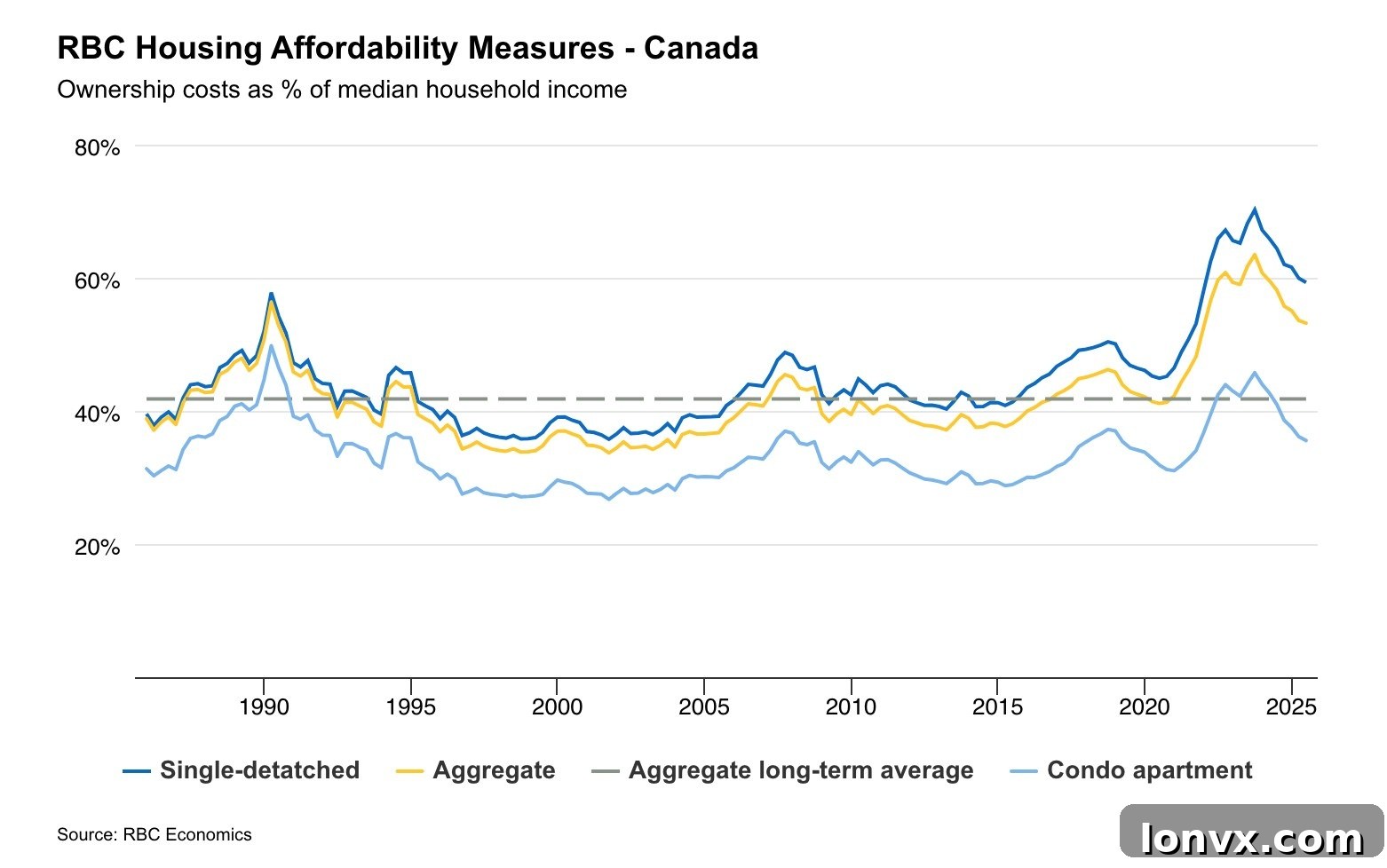
According to RBC’s comprehensive national aggregate affordability measure, which gauges the share of pre-tax household income required to cover typical ownership costs, a slight improvement was observed for the seventh consecutive quarter in the third quarter of 2025. This persistent, albeit gradual, trend has offered a glimmer of hope. Yet, the report highlights a crucial caveat: this recent drop was the smallest since the affordability landscape began to show signs of improvement in early 2024. This signals that the market might be reaching a plateau in its recovery phase, with the easiest gains now potentially behind us.
The Deceleration of Progress: A Closer Look
The RBC index, a key indicator tracking housing affordability, registered 53.2 per cent in the most recent quarter. This figure represents a notable improvement from its all-time peak of 63.5 per cent recorded in 2023, a period characterized by unprecedented housing market exuberance and subsequent affordability erosion. Despite this overall positive trajectory from its peak, the quarter-over-quarter decline of only 0.4 percentage points was remarkably slim. Robert Hogue characterizes this as “the slimmest this cycle,” primarily attributing the slowdown to the stabilization of mortgage rates, which has limited the potential for further, more substantial progress in reducing ownership costs.
The earlier period of affordability gains was largely fueled by a combination of factors, including initial interest rate cuts by the Bank of Canada, coupled with some moderate corrections in home prices across various markets and steady, albeit modest, household income growth. Hogue emphasizes that while these elements collectively contributed to easing the affordability crunch, their impact has only partially reversed the monumental surge in housing costs witnessed during the COVID-19 pandemic. The historic spike in prices fundamentally altered the landscape, pushing homeownership out of reach for a significant segment of the population, and the current adjustments are proving insufficient to fully recalibrate the market to pre-pandemic accessibility levels.
Understanding the nuances of this deceleration is crucial for both policymakers and potential homeowners. The stability in mortgage rates, while providing predictability, also means that one of the most powerful levers for affordability improvement—lower borrowing costs—is currently static. Future improvements will therefore heavily rely on other market forces, primarily sustained growth in household incomes that outpaces inflation, and further, more significant, price corrections in overvalued markets.
The journey towards re-establishing a balanced and accessible housing market in Canada is far from over. While the headline numbers suggest a continuous trend of improvement, the diminishing pace indicates a more complex and challenging road ahead, demanding strategic responses from all stakeholders to ensure the dream of homeownership remains attainable for future generations of Canadians.
A Mosaic of Experiences: Regional Affordability Dynamics
While the national aggregate figures offer a broad overview, the lived experience of housing affordability in Canada is a complex and varied tapestry, highly dependent on geographical location. The slight relief seen at the national level masks significant disparities and, in some cases, deteriorating conditions across major urban centres and provinces.
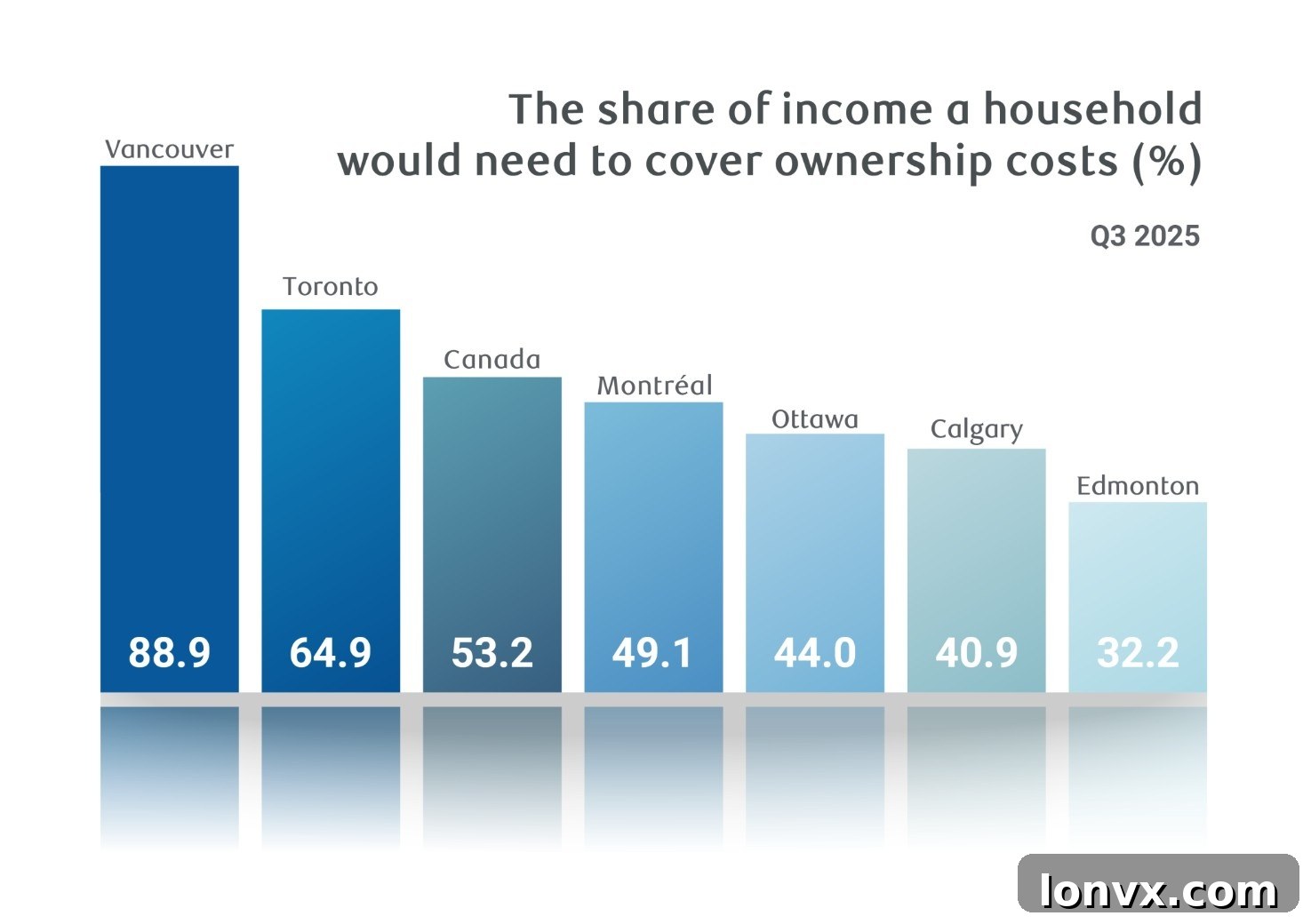
The lion’s share of the overall improvement in affordability was concentrated in Canada’s most expensive and previously overheated markets, specifically Vancouver and Toronto. These metropolitan areas experienced more pronounced softening in home prices following the peak of the pandemic-era boom, which, combined with some income growth, allowed their affordability metrics to ease more substantially than elsewhere. However, even with these gains, homeownership in these cities remains extraordinarily challenging, reflecting the profound price increases they endured.
Smaller, but still welcome, gains were also recorded in other key regions, including Victoria, British Columbia; Halifax, Nova Scotia; and Saint John, New Brunswick. These markets, while not reaching the extreme price points of Vancouver or Toronto, also saw periods of rapid appreciation, and their recent adjustments signal a slight easing of pressure.
Despite these improvements, the overarching reality remains stark: owning a home in many of these cities continues to be significantly more expensive than it was before the onset of the pandemic. The RBC report underscores this by noting that in Vancouver, ownership costs are still approximately 24 percentage points higher relative to pre-pandemic levels (late 2019), and in Victoria, they are about 19 percentage points higher. These figures vividly illustrate the magnitude of the affordability gap that still needs to be closed for these markets to return to a more balanced state.
In contrast to these softening markets, other regions of the country presented a flatter, or even worsening, affordability picture in the third quarter of 2025. Quebec City, for instance, registered one of the largest quarterly increases in the share of income needed for homeownership, indicating rising pressures in that market. Montreal and Ottawa, despite experiencing modest market shifts that might have theoretically favored buyers, also continued to exhibit tight affordability conditions, suggesting that demand remains strong and price adjustments are insufficient to create meaningful relief.
Meanwhile, some cities offered a glimpse of relative stability. Saskatoon and Edmonton came closest to their pre-pandemic affordability norms, although even in these markets, costs remain elevated compared to their historical averages. This suggests that while they may not have experienced the same extreme fluctuations as the coastal giants, the broader trend of rising housing expenses has left its mark across the Canadian landscape.
This regional divergence highlights the complexity of Canada’s housing market. A national policy or economic trend can have vastly different impacts from one city to another, making a one-size-fits-all approach to housing affordability challenging. Local economic conditions, population growth, housing supply, and historical pricing patterns all contribute to these localized experiences, demanding tailored solutions and an understanding of specific market dynamics.
Source: RBC
The Road Ahead: Modest Gains and Lingering Challenges
Looking to the future, the outlook for Canadian housing affordability, according to RBC, points towards a continued trajectory of small, incremental gains rather than significant leaps. This tempered forecast is largely predicated on the expectation that interest rates are likely to remain steady for the foreseeable future. The Bank of Canada’s approach to monetary policy, balancing inflation control with economic stability, suggests that dramatic cuts that could substantially reduce mortgage costs are not imminent.
Given this scenario of stable interest rates, the RBC report suggests that any meaningful improvements in housing affordability will primarily hinge on two critical factors: robust household income growth and sustained price corrections in select, overvalued markets. For affordability to truly improve, the average Canadian household’s earning power must increase at a pace that outstrips the rise in housing expenses. Simultaneously, a further softening of home prices, particularly in high-demand areas where values soared unsustainably, would be necessary to recalibrate the market.
Robert Hogue further elaborates on this, suggesting that Canada, or at least certain regions within it, may be nearing the “end of the recuperation phase.” This implies that the ‘low-hanging fruit’ or the relatively easy gains in affordability, largely driven by initial price adjustments and rate stabilizing, may now be behind the market. Moving forward, more substantial improvements would necessitate either a sharper and more widespread decline in home prices – a scenario that could have broader economic implications – or a faster-than-forecast acceleration in household incomes, boosting purchasing power more significantly.
Despite the observed easing in some areas and the overall national trend, RBC unequivocally stresses that housing remains considerably less affordable than it was before the pandemic era. The dramatic escalation of prices and interest rates has left a lasting legacy, with many prospective buyers still struggling under the heavy burden of elevated costs. The gap between current affordability levels and those pre-2020 remains substantial, creating a persistent barrier for first-time buyers and those looking to move up the property ladder.
Hogue succinctly captures the sentiment pervading the market: “It’s no surprise many prospective buyers remain hesitant. They have yet to see a full reversal of the earlier massive loss of purchasing power.” This hesitancy is not merely anecdotal; it reflects the deep-seated impact of the affordability crisis on consumer confidence and purchasing decisions. Many individuals and families are still far from recovering the purchasing power they lost when home prices surged and borrowing costs escalated. The stress tests for mortgages, higher down payment requirements, and the sheer psychological barrier of daunting home prices continue to deter many from entering the market.
In conclusion, while the Canadian housing market has shown a trend towards modest affordability improvement, the latest data points to a slowdown in this progress. The path forward is expected to be gradual, primarily driven by income growth and targeted price adjustments. The dream of homeownership, while perhaps slightly less distant for some, remains a significant challenge for many Canadians, underscoring the ongoing need for sustained efforts and innovative solutions to address the fundamental imbalances in the housing landscape.