Quebec’s Real Estate Market Surges in Q3 2024: A Comprehensive Analysis of Key Trends
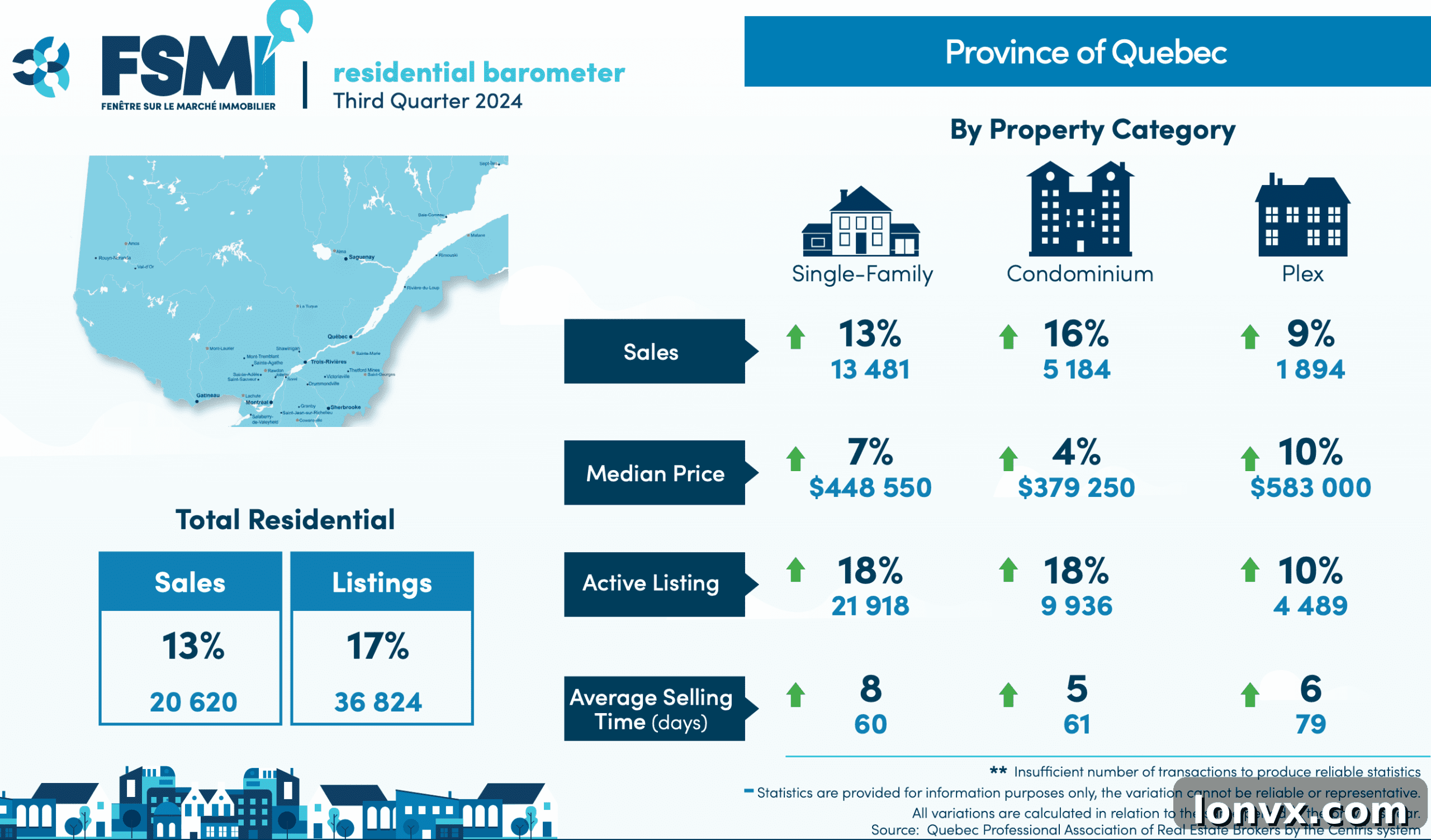
The Quebec real estate market demonstrated remarkable resilience and growth in the third quarter of 2024, significantly surpassing previous year’s figures and historical averages. According to the latest statistics released by the Quebec Professional Association of Real Estate Brokers (QPAREB), a robust 20,620 residential sales were recorded across the province. This impressive volume represents a 13 percent increase compared to the same period in 2023, signaling a vibrant recovery and renewed buyer confidence in the region’s housing sector.
This heightened transactional activity not only outpaced the immediate past but also comfortably exceeded the long-term historical averages typically observed during this quarter. Such a strong performance underscores a pivotal shift in market dynamics, reflecting a growing appetite for property ownership and investment within Quebec.
Charles Brant, Director of Market Analysis at QPAREB, provided insightful commentary on these trends, noting, “The Quebec resale real estate market was exceptionally robust in the third quarter. We’ve seen transactional activity return to levels well above the historical average for this time of year in most metropolitan areas and agglomerations, indicating a broad-based recovery.” Brant attributed this surge in part to favorable monetary policy adjustments. “With the key interest rate dropping 75 basis points since the beginning of the summer, there was a sharp and immediate rise in the consumer confidence index, particularly in regard to major purchases such as property,” he explained.
Furthermore, Brant highlighted a critical aspect of the current financing landscape that has significantly influenced buyer behavior: “It is also worth noting that the decline in fixed mortgage rates, which have already reached attractive levels, has occurred more quickly and decisively than that of variable rates.” This rapid adjustment in fixed rates has provided a clear advantage to prospective buyers, offering predictability and affordability that were less apparent in earlier periods.
The decline in financing costs has had a dual positive effect on the market. Beyond stimulating new sales, Brant also pointed out its crucial role in stabilizing distressed situations. He observed that the rapid reduction in borrowing expenses has effectively helped to curb the growing number of forced sales or repossessions, even in a broader economic environment where job losses have been on the rise. This suggests that homeowners facing financial pressure have found some relief, preventing a cascade of properties entering the market through distress sales and thus contributing to overall market stability.
Sales Trends: A Deep Dive into Market Segments and Buyer Behavior
The third quarter of 2024 revealed fascinating shifts within various segments of the Quebec real estate market, illustrating distinct patterns of demand and growth. According to Charles Brant’s analysis, the most significant price increases within the single-family home category were concentrated in transactions exceeding $500,000, which saw a remarkable 29 percent surge. Condominiums mirrored this trend, with a similar dynamic playing out in their higher price brackets.
Brant elaborated on this phenomenon, stating, “This price segment, notably above the provincial median price of $448,550, now accounts for a substantial 40 percent of all transactions in this property category.” This indicates a robust demand for more premium properties, challenging the notion of a universally tight market across all price points. “On one hand, the market continues to be predominantly driven by repeat buyers, who leverage existing equity and often seek larger or more upscale properties. On the other hand, the high-end market, encompassing properties priced above $1 million, is experiencing a noticeable rebound, indicating renewed confidence among affluent buyers and investors,” Brant highlighted.
Conversely, the entry-level segment, defined by properties priced at $300,000 and below, presented a different picture. These transactions constituted only 23 percent of total sales, marking a 6.0 percent decrease from the previous year. This decline is largely attributable to a persistent lack of sufficient listings in this affordable category, creating fierce competition for the few available properties. The scarcity of inventory at lower price points poses significant challenges for first-time homebuyers or those with more modest budgets.
Brant further analyzed the implications for accessibility: “The mid-range price segment, while experiencing slightly above-average growth and benefiting from the recent drop in interest rates, still largely limits homeownership access to more affluent or strategically positioned first-time homebuyers. These individuals often find themselves in direct competition with repeat buyers, both from Quebec and elsewhere, who benefit from established financial standing and market experience.” This suggests that despite improving market conditions, affordability remains a critical hurdle for many aspiring homeowners, particularly those navigating the market for the very first time.
The robust performance in the higher-end market, coupled with the challenges in the entry-level segment, paints a picture of a stratified real estate landscape in Quebec. While overall sales figures are encouraging, the distribution of this growth reveals underlying socioeconomic factors and market forces at play, emphasizing the importance of diverse housing strategies to cater to all buyer demographics.
Quarterly Highlights: Regional Performance and Property Type Growth
The third quarter of 2024 showcased varying degrees of growth across different property types and geographical regions within Quebec, illustrating the nuanced nature of the province’s real estate market. Among property categories, condominiums led the charge, experiencing the highest sales growth with a significant 16 percent increase in transactions. This robust performance suggests a strong appeal for condos, likely driven by their relative affordability in certain urban centers and evolving lifestyle preferences.
Single-family homes, the traditional backbone of the residential market, also demonstrated healthy growth, with sales rising by 13 percent. This indicates sustained demand for detached properties, reflecting ongoing interest in space and privacy. Plexes, typically small-income properties comprising two to five units, recorded a more modest but still positive increase of 9.0 percent. The slower growth in plexes might be attributed to their specific investment profile and potentially higher entry costs or management complexities.
Turning to Census Metropolitan Areas (CMAs), Sherbrooke emerged as the standout performer, boasting an impressive 26 percent rise in sales. This exceptional growth positions Sherbrooke as a particularly dynamic market, possibly benefiting from its attractive lifestyle, economic opportunities, and comparatively lower housing costs relative to larger urban centers. Other major CMAs, including Montreal, Quebec City, and Gatineau, also contributed positively to the provincial total, each experiencing increases of 12-13 percent. These figures underscore the continued vitality of Quebec’s largest urban markets, which remain key drivers of economic activity and population growth. Meanwhile, Trois-Rivières and Drummondville posted more modest growth rates, suggesting a steadier, albeit less explosive, market trajectory in these regions.
Beyond the CMAs, several smaller cities recorded truly remarkable sales surges, highlighting pockets of intense market activity. Rouyn-Noranda led with an astonishing 53 percent increase in sales, followed closely by Lachute, which saw sales surge by 47 percent. Such dramatic growth in these areas could be fueled by a variety of factors, including increased regional investment, improved infrastructure, or a spillover effect from higher-priced markets as buyers seek more affordable alternatives. Other cities like Shawinigan, Thetford Mines, and Saint-Georges also reported substantial gains, with increases ranging from 37 to 41 percent. These localized booms demonstrate the diverse and geographically widespread nature of Quebec’s real estate recovery, extending well beyond the traditional metropolitan hubs and offering attractive prospects for both buyers and sellers in these burgeoning communities.
Inventory, Pricing, and Market Conditions: A Detailed Look at Supply and Demand
The interplay of inventory levels, pricing adjustments, and market conditions forms the core of understanding the Quebec real estate landscape in Q3 2024. Active listings across the province saw a notable increase of 17 percent compared to the same period last year, reaching a total of 36,824 units. While this represents a welcome boost in available properties, it’s crucial to contextualize this figure. Despite the quarterly increase, the current inventory remains significantly below the historical average of 46,645 listings. This persistent scarcity of available homes continues to be a defining characteristic of the market, indicating that demand still outstrips supply, thus exerting upward pressure on prices and intensifying competition among buyers. The gap between current and historical listing averages suggests that the market is still in a rebuilding phase regarding inventory, after years of tight supply.
Median prices across all property types reflected this ongoing imbalance between supply and demand, posting solid gains. The median price for single-family homes rose by 7.0 percent, reaching $448,550. Condominiums also experienced an increase, with their median price climbing by 4.0 percent to $379,250. Small-income properties, such as plexes, saw the most significant jump in their median price, soaring by 10 percent to $583,000. This substantial growth in plex prices underscores the strong demand for investment properties and multi-unit dwellings, potentially driven by investors seeking rental income or families looking for co-living arrangements. The upward pressure on these median prices was predominantly fueled by the robust growth in sales of properties priced above $500,000, confirming the strength in the higher-end market segments discussed earlier.
Market velocity, as measured by the average number of days properties remained on the market before selling, also provided valuable insights. On average, single-family homes took 60 days to sell in the third quarter of 2024. This represents an increase of eight days compared to the previous year, suggesting that while demand is strong, buyers might be exercising a bit more caution or taking slightly longer to make decisions in a recovering market. Condominiums and small-income properties also experienced longer selling times. Condominiums spent an average of 61 days on the market, an increase of five days from last year, while small-income properties took 79 days to sell, also an increase of five days. These extended selling periods, while still relatively quick in a historical context, might indicate a gradual normalization of the market, moving away from the frenzied pace observed during peak demand periods. It suggests that buyers now have a bit more time to evaluate their options, although competitive bidding situations likely persist for highly desirable properties in prime locations. The slight increase in days on market, combined with rising prices, points to a market that is active and growing, yet perhaps slightly more balanced than in recent memory, offering both buyers and sellers a dynamic environment to navigate.
For a complete and detailed breakdown of these statistics, including a comprehensive analysis by each Census Metropolitan Area, readers are encouraged to review the full Q3 2024 report provided by QPAREB. This report offers invaluable data and further insights into the specific trends shaping Quebec’s diverse real estate markets.
Enjoying this article?
Get the latest real estate market insights and industry updates directly in your inbox, delivered three times a week. Stay informed on the dynamic Canadian real estate landscape.