
The Greater Toronto Area (GTA) real estate market finds itself at a critical juncture, with recent data from the TRREB Market Watch report painting a stark picture that challenges prevailing narratives of an imminent recovery. Far from offering comfort, the October figures provide compelling evidence of not merely a soft market, but a significant and ongoing structural deterioration in the delicate balance between housing supply and demand. This detailed analysis delves beyond the headlines, uncovering the profound shifts that are reshaping one of Canada’s most dynamic housing markets.
The core indicators are unambiguous: sales activity plummeted by nearly 10 percent year-over-year, active listings soared to the highest October level ever recorded, and pricing softened across virtually every major property type and geographical region within the GTA. These are not merely statistical fluctuations; they are the hallmarks of a market grappling with fundamental disequilibrium. The prevailing conditions indicate a market struggling intensely to clear its inventory, signaling a deeper underlying correction rather than a temporary pause.
For much of the preceding year, particularly in 2025, there was a discernible trend where falling home prices seemed to stimulate increased sales activity. The logic was straightforward: as property values declined, a broader segment of buyers perceived homes as more affordable, prompting a surge in purchase decisions. However, October dramatically disrupted this pattern, witnessing sales activity significantly slower than the previous year, even as supply continued its upward trajectory and demand noticeably receded. Should this critical divergence persist, the GTA market is poised to delve deeper into buyer’s market territory, inevitably exerting further downward pressure on prices. This shift reflects a cautious retreat by potential buyers, who are increasingly prioritizing financial safety in the face of renewed trade tensions, a rising tide of unemployment, and an unsettling increase in mortgage delinquencies, all contributing to widespread uncertainty.
Paradoxically, TRREB’s official report headline, “More Choice, Greater Affordability for Buyers,” endeavors to frame these developments positively, emphasizing improved affordability attributed to lower mortgage rates and reduced selling prices. However, such a framing risks obscuring the true magnitude and implications of the profound shift currently underway. When home sales decline sharply and inventory accelerates simultaneously, the issue extends far beyond simply presenting “buyer opportunity.” It signifies a deeper erosion of purchasing conviction among potential homeowners and a widening disconnect between what sellers perceive their homes to be worth and the prices buyers are genuinely willing to commit. The preceding decade of ultra-liquid market conditions, characterized by rapid transactions and robust demand, has unequivocally given way to an environment where market liquidity itself is faltering, creating significant challenges for both buyers and sellers.
The Numbers Don’t Lie: A Market Losing Its Floor Amidst Rising Inventory
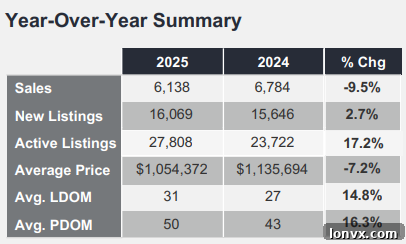
A closer examination of the raw data from October 2026 reinforces the gravity of the situation. The Greater Toronto Area recorded a mere 6,138 sales, marking the third-weakest October performance since at least 2010. The only other Octobers with lower sales figures were 2022 and 2023, both widely acknowledged as periods of significant recessionary pressures within the real estate sector. This consistent pattern of low sales volume points to a persistent underlying weakness rather than a temporary blip.
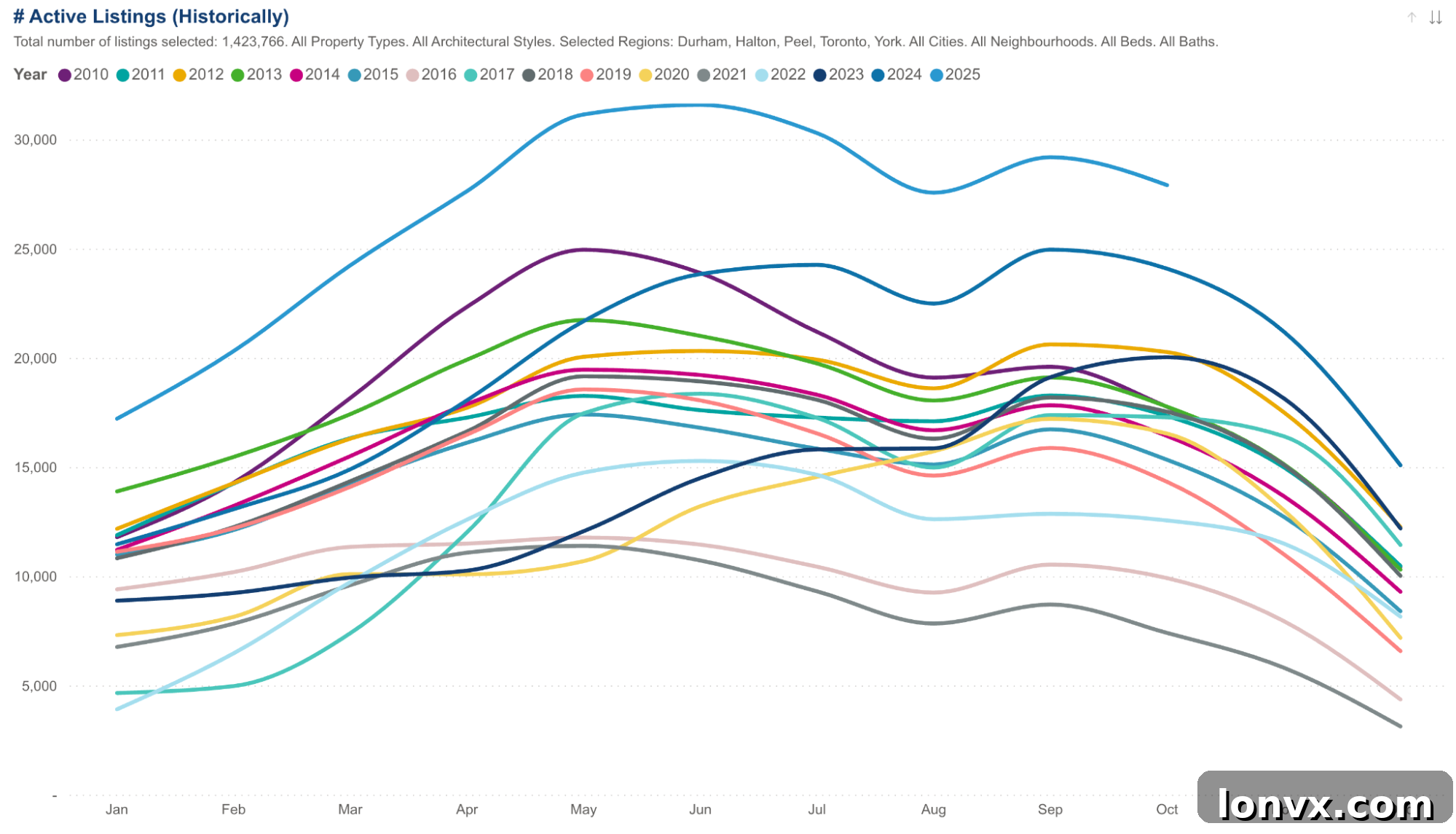
Concurrently, active listings surged dramatically, surpassing 27,800 properties available on the market. This represents a substantial 17 percent increase compared to the previous year and stands as the largest October inventory level ever officially published by TRREB. This unprecedented accumulation of unsold homes underscores a critical imbalance: new listings have not significantly collapsed, indicating sellers are still bringing properties to market. Instead, the primary driver of this swelling inventory is a sharp and sustained contraction in demand, leading to homes sitting longer on the market and contributing to the mounting supply overhang.
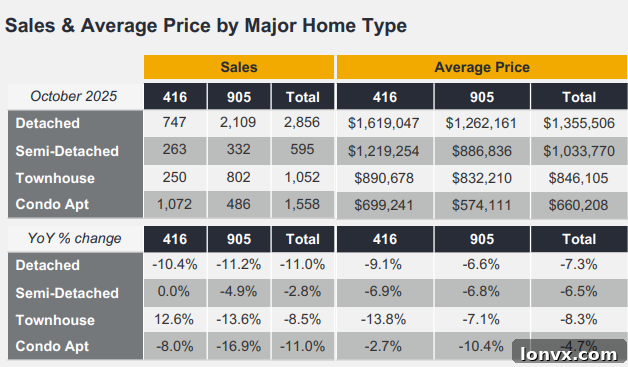
Predictably, prices are mirroring these trends. The average selling price across the GTA saw a significant decline of more than seven percent year-over-year. The MLS Home Price Index (HPI) composite, a more stable measure of price trends, also fell by five percent, indicating a broad-based softening. Detached homes in the 416 area code, historically a bastion of strong appreciation, experienced an even steeper decline of over nine percent. Even condominiums, long considered the most accessible entry point into homeownership and often seen as resilient, posted double-digit declines in sales volume and continued to exhibit price softness. This widespread decline signals that even market segments once assumed to be supply-constrained or offering relative stability are no longer insulated from the broader downturn, suggesting a comprehensive market re-evaluation is underway.
A healthy housing market typically possesses the capacity to absorb falling prices effectively when turnover rates are robust and new buyers enter with a strong sense of confidence and financial security. Regrettably, this is not the current state of the GTA market. Homes are consistently taking much longer to sell, and the frequency of relist cycles is notably increasing, indicating properties are not finding buyers easily at their initial asking prices. Public sentiment surveys further corroborate this, revealing heightened anxiety among consumers regarding employment security and the significant risks associated with mortgage renewals at potentially much higher rates. Crucially, the conventional conditions that typically signal the bottom of a real estate cycle—such as rapid absorption of inventory, a visible re-entry of opportunistic investors, and the return of competitive bidding wars in specific market segments—remain conspicuously absent, suggesting the market has yet to find its true floor.
A Deeper Look: Why TRREB’s Framing Misses the Mark on Affordability
TRREB’s emphasis on lower monthly mortgage payments as a positive market development, while logically sound on the surface, presents an incomplete and potentially misleading picture of true affordability. While it is accurate that monthly payments are indeed falling, this reduction stems from a confluence of factors: both borrowing costs (interest rates) and asset values (home prices) are declining in tandem. This phenomenon should not be interpreted as definitive evidence of restored affordability or a healthy market normalization. Instead, it is more accurately characterized as a direct symptom of waning buyer demand meeting an accelerating inventory of available homes. For a household, a lower monthly payment offers little empowerment or genuine relief if they lack trust in the stability of their future income or if they anticipate that the reduced asking price of a property is still poised to fall further in the coming months.
The assertion that the current market environment predominantly favors buyers is accurate only in the very narrow sense that buyers now undoubtedly wield greater negotiating leverage than in recent memory. They have more options, less competition, and increased power to dictate terms. However, for sellers, the implications are far harsher and more complex. Each successive month of elevated inventory levels exerts incremental and persistent downward pressure on pricing expectations, particularly for those sellers who are facing looming refinancing deadlines, investors looking to exit their positions on specific timelines, or individuals experiencing job insecurity. In this environment, true price discovery—the process by which the market determines the fair value of an asset—has not yet concluded its course. The sheer depth of unsold stock currently available ensures that this critical process of price adjustment will continue for the foreseeable future.
Furthermore, the TRREB report implicitly suggests that a more predictable macroeconomic backdrop, including greater clarity on complex trade relations with key partners such as the United States and China, could act as a catalyst to unlock “pent-up demand” in the housing market. This perspective, however, significantly underestimates the extent to which buyer confidence has already been fractured and fundamentally altered. The prevailing challenge is not merely uncertainty about external economic conditions, though these certainly play a role. It is, more profoundly, a fundamental shift in perception regarding the long-term trajectory and stability of housing as an asset class. This follows years in which sustained price appreciation was widely treated as an almost guaranteed and immutable outcome, leading to unrealistic expectations that are now being severely tested.
The Profound Implications of Excess Supply: A Market Under Pressure
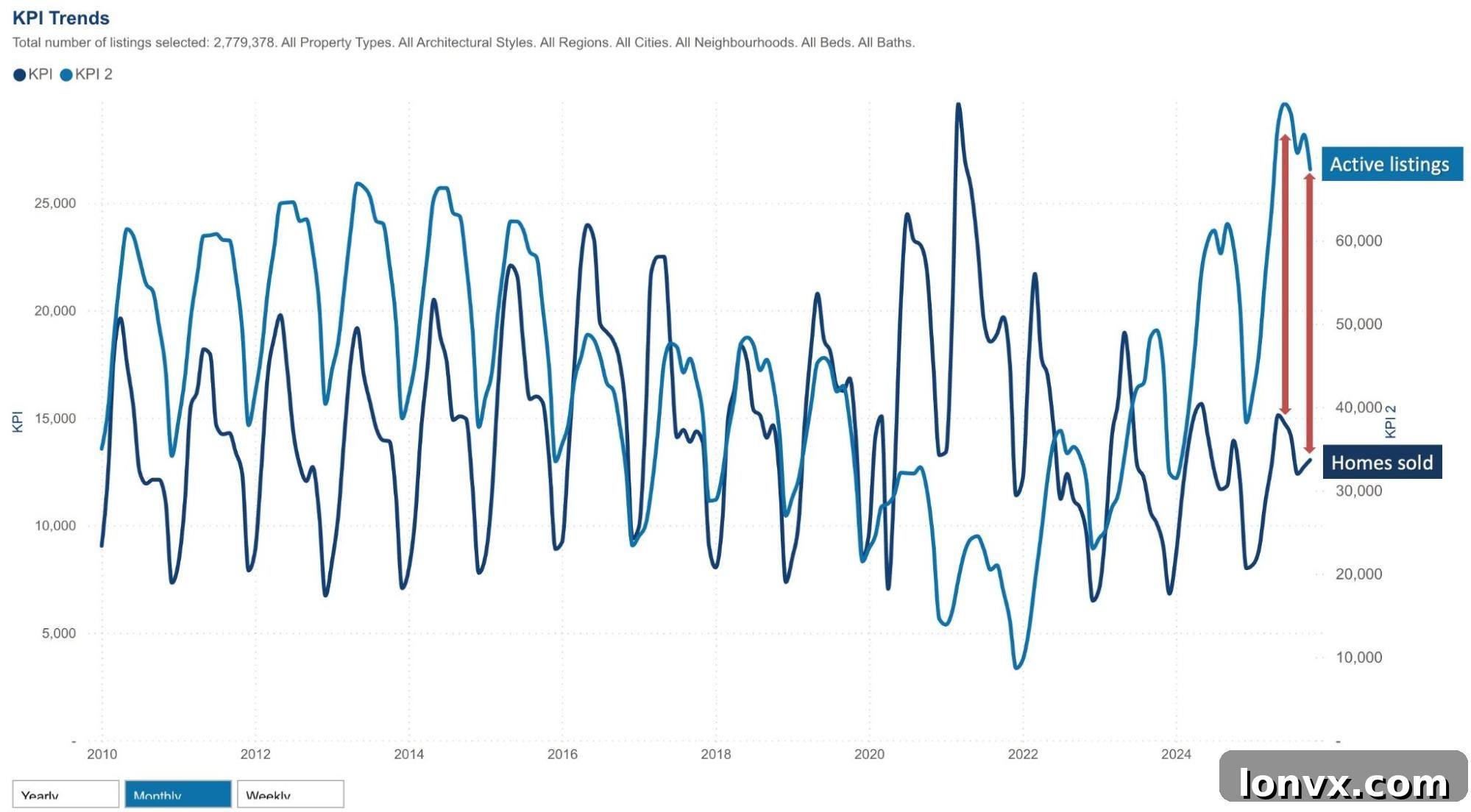
A particularly concerning trend revealed by the data is the unprecedented gulf that has emerged between the number of active listings and the volume of actual transactions. This spread is now the widest ever recorded in the market’s data history, indicating a severe disconnect. This widening gap is not merely an interesting statistic; it holds profound significance because housing markets rarely correct solely on price. More often, they correct over time, a process that can be protracted and painful. As listing windows inevitably stretch longer and the accumulated carrying costs for property owners continue to mount, the likelihood of “forced selling” accelerates significantly.
Early warning signs of this forced selling are already becoming visible, particularly within investor-held properties. Many mortgages originated during the low-interest rate environment of 2020 and 2021 are now rapidly approaching renewal, often at interest rates two to three times higher than their initial terms. If existing wage growth and rent increases fail to adequately offset these substantially higher financing adjustments, a greater volume of supply will inevitably be introduced into the market, not out of preference or strategic timing, but purely out of financial pressure and necessity.
For policymakers, this complex situation significantly complicates the conventional prescription to simply “build more housing.” While supply expansion undeniably remains an essential long-term strategy for enhancing overall affordability, the immediate and near-term problem is less about insufficient construction and more about insufficient absorption of existing and new housing stock. Programs specifically aimed at accelerating new housing starts risk backfiring dramatically if they are implemented into a declining demand environment coupled with a credit market that remains restrictively tight. The next phase of effective housing policy must, therefore, evolve beyond merely stimulating supply. It critically needs to focus on stabilizing the underlying economic and financial conditions under which that new supply can be realistically financed, confidently purchased, and sustainably retained by homeowners. Recent proposals, such as those in Ontario aiming to reduce upfront costs for first-time buyers, represent one small step in this direction, though their impact remains to be fully seen.
For prospective buyers, while the emerging opportunity presented by a softening market is undeniably real, it necessitates an extraordinary degree of discipline and strategic foresight. Lower prices and reduced competition do not automatically translate into optimal or strategic entry points. History shows that markets undergoing a correction rarely move in perfectly straight lines; they are often characterized by false bottoms, temporary rebounds, and periods of prolonged stagnation. The prudent buyer in this environment will evaluate not just the headline-grabbing prices, but also the overall trajectory of inventory levels, the stability of employment conditions, and the critical likelihood that financing conditions could shift again before their mortgage term matures. The perceived “discount” available in the market today may very well expand even further tomorrow.
For sellers, the present market environment dictates that realism is no longer an optional approach but an absolute necessity. List-to-sale ratios are already reverting towards levels reminiscent of the challenging market conditions seen in the early 1990s, indicating properties are taking longer to sell and often for less than asking. Simultaneously, the pool of buyers capable of purchasing homes without significant financing friction is perceptibly narrowing. In this landscape, the critical difference between successfully selling a property and enduring repeated relistings now hinges entirely on “pricing to the current market realities,” rather than clinging to the perhaps nostalgic, and now outdated, memory of peak 2021 valuations.
What Comes Next: The Path to True Market Stability and Recovery
The next decisive turn in the GTA housing market will not be triggered by a singular interest rate cut, nor will it be marked by a cosmetic or short-lived rebound in monthly sales figures. A genuine and sustainable recovery will only materialize when a confluence of crucial conditions is met. This includes, first and foremost, when the accumulated inventory begins to clear at a sustained and healthy pace, indicating a renewed balance. Secondly, and equally important, it will require buyers to regain a profound sense of conviction in the long-term trajectory of their own financial balance sheets and the overall economic outlook, allowing them to make significant purchase decisions with confidence. Regrettably, neither of these essential conditions is currently firmly in place.
While the October report may be interpreted by some as evidence of a turning point towards improved affordability, a more rigorous and nuanced reading confirms precisely the opposite: the market correction still has significant room to run its course. Real estate markets do not bottom out based on mere hope or optimistic sentiment. They find their floor only after reaching a state of market exhaustion, where all speculative excess has been purged, and prices have fully adjusted to the underlying economic realities. The comprehensive data presented unequivocally shows a market still actively searching for that elusive threshold, suggesting a protracted period of adjustment lies ahead before stability can truly be restored.