
Canadian Housing Market: A Detailed Look at Housing Starts in H1 2022 Across Major CMAs
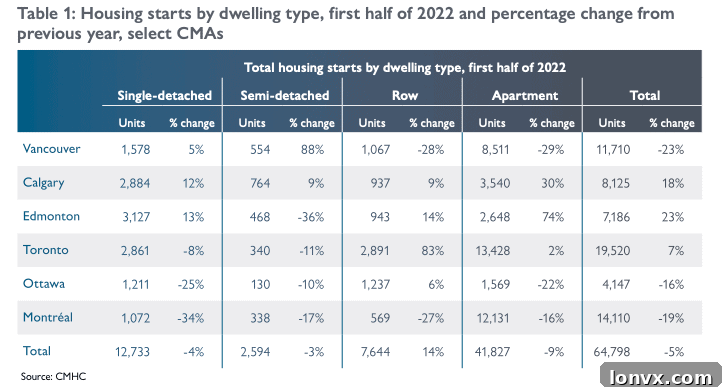
After experiencing a significant boom throughout 2021, Canada’s housing market began to show signs of cooling in the first half of 2022. A recent analysis from the Canada Mortgage and Housing Corporation (CMHC) reveals a noticeable downturn in new housing construction across the nation’s six largest Census Metropolitan Areas (CMAs). Specifically, housing starts in Vancouver, Calgary, Edmonton, Toronto, Ottawa, and Montreal collectively saw a 5 percent decrease during the initial six months of 2022, signaling a shift in the dynamic landscape of residential development.
The primary catalyst for this overall decline was a substantial 9 percent decrease in apartment construction. This trend is a key highlight from the latest edition of CMHC’s comprehensive Housing Supply Report, a vital resource that meticulously examines new housing construction patterns and trends across these pivotal Canadian urban centers. The report underscores the complex interplay of economic factors, changing market preferences, and regional specificities that are shaping the nation’s housing supply.
While the national aggregate points to a slowdown, the picture is far from uniform across the country. The report clearly indicates a fragmented market, where robust gains in new housing construction within Toronto, Calgary, and Edmonton were effectively offset by significant declines observed in Vancouver, Montreal, and Ottawa. This disparity highlights the localized nature of housing market forces, where varying economic conditions, demand pressures, and supply challenges lead to distinctly different outcomes for developers and prospective homeowners alike.
National Trends and Underlying Drivers
The 5 percent dip in overall housing starts and the more pronounced 9 percent drop in apartment construction represent a significant recalibration following the frenetic pace of 2021. This deceleration can be attributed to several macroeconomic headwinds that began to gain traction in early 2022. Rising interest rates, an increasingly inflationary environment, and general economic uncertainty collectively started to dampen buyer sentiment and alter investment strategies for developers. Apartment projects, in particular, are often more sensitive to these shifts due to their reliance on pre-sales, larger financing requirements, and longer construction timelines. As the cost of borrowing increased and potential buyers became more hesitant, the viability of initiating new multi-unit residential developments faced greater scrutiny.
Furthermore, the record-breaking construction levels seen in 2021 in many areas created a high baseline, making any subsequent decline appear more stark. The initial half of 2022 marked a period where the housing market began to absorb the impacts of monetary policy tightening, shifting from a seller’s market characterized by intense competition to a more balanced, albeit uncertain, environment. Understanding these overarching dynamics is crucial for interpreting the diverse regional performances detailed in the CMHC report.
Regional Insights: A Diverse Landscape of Housing Development
The CMHC’s Housing Supply Report provides invaluable regional highlights, showcasing the distinct trajectories of housing construction in each of Canada’s largest CMAs. These insights are critical for understanding the localized challenges and opportunities shaping the nation’s housing supply.
Vancouver: A Shift Towards Rental Resilience
The Vancouver CMA experienced one of the most significant contractions, with housing starts declining by approximately 25 percent in the first half of 2022. This substantial slowdown was primarily driven by a considerable decrease in the number of condominium apartments started. In a more uncertain economic environment, characterized by rising mortgage rates and inflationary pressures, prospective buyers became more cautious, leading to a tempering of demand for ownership units.
However, Vancouver’s persistent low vacancy rate in the rental market spurred a notable counter-trend. Residential property developers strategically pivoted towards the rental segment, initiating a greater number of rental apartments. This shift reflects developers’ responsiveness to market signals; with strong and consistent demand for rental housing, building purpose-built rental units offered a more stable investment in a period of economic flux. The move towards rental construction aims to address the chronic shortage of affordable rental options while also providing developers with a more predictable revenue stream compared to speculative condo sales.
Montreal: Navigating Post-Pandemic Adjustments
The Montreal area observed a widespread decrease in housing starts across almost all dwelling types. Following a temporary but robust rebound in activity at the beginning of the pandemic, which was largely driven by a significant change in household preferences for more space and suburban living, the construction of single-detached and semi-detached houses sharply declined. This earlier surge, fueled by remote work trends and a desire for larger homes, proved unsustainable as market conditions normalized and borrowing costs rose.
Furthermore, apartment starts in Montreal, after reaching historic levels in the previous year, also experienced a decline. This suggests a market adjusting from peak activity, possibly due to a combination of factors including increased supply saturation in some areas, escalating construction costs, and a tempering of investor demand. The comprehensive decline underscores a period of recalibration for the Montreal housing market, moving away from its pandemic-induced boom.
Toronto: Leading the Way with Diversified Growth
Defying the national trend, the Toronto CMA recorded the highest number of housing starts in the first half of 2022, with 19,520 new units initiated – representing a robust 7 percent increase. This strong performance highlights Toronto’s enduring demand and its ability to adapt to changing market conditions. While the construction of generally less affordable housing types, such as single-detached and semi-detached houses, decreased, this was more than compensated by a significant increase in the construction of apartments and row houses.
This shift towards higher-density housing types reflects a pragmatic response to ongoing affordability challenges and the city’s continuous need for diverse housing options. Apartments and row houses typically offer more accessible price points compared to detached homes, aligning with the financial realities of many buyers, especially amid rising interest rates. Toronto’s strategic focus on increasing density and providing a broader range of housing types ensures a more resilient construction sector, capable of sustaining growth even when traditional single-family home demand wavers.
Ottawa: Rental Sector Provides a Silver Lining
In Ottawa, housing starts declined across nearly all dwelling types, mirroring some of the broader national trends. The decrease was particularly pronounced in the single-detached and condominium apartment segments, which had experienced very high levels of construction activity between January and June of 2021. This suggests that the market was either correcting from an unsustainable pace of growth or that demand for these specific housing types had softened due to affordability concerns and higher borrowing costs.
Conversely, the rental apartment segment in Ottawa recorded a significant increase in starts. This surge was primarily stimulated by persistently low vacancy rates, indicating strong and unmet demand for rental housing in the capital. Developers, recognizing the stability and profitability of the rental market, channeled their resources into purpose-built rental projects. This strategic shift helps to address the critical need for more rental supply and offers a crucial safety net for those unable or unwilling to enter the ownership market, showcasing the rental sector’s pivotal role in Ottawa’s housing ecosystem.
Calgary and Edmonton: Western Canada’s Growth Engines
In stark contrast to some eastern CMAs, both the Calgary and Edmonton CMAs experienced impressive growth in housing starts, increasing by approximately 20 percent since the beginning of the year. This robust expansion positions Alberta’s two largest cities as significant drivers of new housing supply in Canada.
In Calgary, the increase in construction was broad-based, encompassing all types of housing. This strong performance can be attributed to several factors: persistently low housing stock, which had been a challenge for years, coupled with strong demand fueled by population growth and relatively better affordability compared to Vancouver and Toronto. The attractiveness of Calgary as a destination for interprovincial migration, often due to economic opportunities and a lower cost of living, has created a dynamic environment for developers. Similarly, Edmonton has seen consistent demand and growth, maintaining its reputation for housing accessibility and a steady development pipeline. Both cities benefit from vibrant economies and a renewed sense of confidence that translates into sustained housing demand across various segments.
Overall Market Dynamics and Future Outlook
The first half of 2022 presented a complex and fragmented picture of the Canadian housing market, as evidenced by the CMHC’s comprehensive report. While the aggregate numbers point to a cooling trend after a period of intense growth, primarily driven by a slowdown in apartment construction, the regional variations are profound. This suggests that while national economic forces like rising interest rates and inflation play a significant role, local demographics, affordability levels, existing housing stock, and specific development policies heavily influence construction activity.
The shift towards rental construction in markets like Vancouver and Ottawa highlights a crucial adaptation by developers to meet immediate housing needs and mitigate risks in an uncertain ownership market. Meanwhile, the sustained growth in Toronto, Calgary, and Edmonton underscores regions with robust underlying demand and, in some cases, relatively better affordability or more diversified economic bases. As Canada continues to grapple with housing affordability and supply challenges, understanding these nuanced regional trends becomes paramount for policymakers, urban planners, developers, and prospective homeowners alike.
Looking ahead, the trajectory of housing starts will likely remain sensitive to economic indicators, particularly interest rate policies and employment figures. The ability of developers to pivot to high-demand segments, such as purpose-built rentals or more affordable ownership options like row houses and smaller apartments, will be key to sustaining momentum. The CMHC’s ongoing research and reports remain essential tools for navigating these evolving market dynamics and informing strategies for a more balanced and accessible housing supply across Canada.
For a complete and in-depth understanding of these trends and more detailed data, you can read the full Housing Supply Report directly on the CMHC-SCHL website. This report offers granular insights into the forces shaping Canada’s residential construction landscape and is an invaluable resource for anyone involved in or impacted by the housing market.
You can access the complete Housing Supply Report here.