
The Canadian real estate market is bracing for a period of unexpected stagnation and tempered growth, as the Canadian Real Estate Association (CREA) has significantly revised its forecasts for home sales activity and average prices in both 2025 and 2026. This substantial adjustment, attributed to a confluence of mounting economic uncertainties and escalating global trade tensions, paints a more cautious outlook than previously anticipated for Canada’s vital housing sector. The revised projections underscore a noticeable shift in market sentiment, signaling a challenging environment for both prospective buyers and sellers across the country, particularly after earlier expectations of a more robust recovery.
In its latest quarterly report, CREA highlighted the unprecedented scale of this adjustment, noting it represents the “largest revision in between quarterly forecasts on record going back to the 2008-2009 financial crisis.” This statement alone speaks volumes about the gravity of the current economic climate and its profound impact on the housing market’s trajectory. Concerns surrounding the potential implications of new tariffs, broader economic instability, and the unpredictable nature of inflation have evidently eroded market confidence. This has prompted many potential homebuyers to adopt a more cautious approach, either delaying significant purchase decisions or choosing to remain on the sidelines until a clearer economic picture emerges. The uncertainty casts a long shadow over market activity, leading to a palpable hesitancy among consumers and investors alike.
Canadian Home Sales Expected to Remain Flat in 2025 Amidst Economic Headwinds
CREA’s updated forecast for 2025 projects approximately 482,673 homes will be sold across Canada. This figure indicates virtually no change—a mere 0.02 percent decrease—compared to 2024 sales volumes. This stark forecast stands in sharp contrast to CREA’s January prediction, which had confidently projected an 8.6 percent increase in sales for the year. The dramatic shift underscores the rapid evolution of economic conditions and the challenges facing the Canadian housing market. Such stagnation, particularly after earlier hopes for a robust rebound, reflects a deeper underlying anxiety about the nation’s economic resilience and consumer spending power, significantly altering the landscape for Canadian homebuyers and sellers.
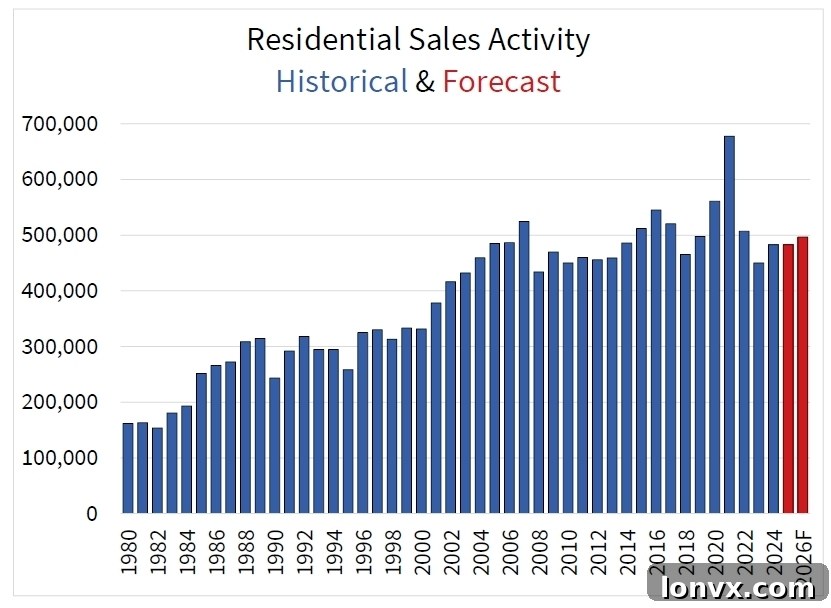
The anticipated flattening of sales activity for 2025 is largely a reflection of mounting worries surrounding several key economic factors. Foremost among these are the potential impacts of new tariffs, which could disrupt supply chains, increase the cost of goods, and dampen overall economic growth. Alongside this, the pervasive risk of stagflation—a challenging economic scenario characterized by slow growth, high unemployment, and rising prices—continues to loom large, creating a complex environment for economic recovery. Furthermore, the persistent uncertainty surrounding interest rate movements throughout the year plays a critical role. Potential buyers, facing higher borrowing costs and a less predictable economic future, are likely to delay purchases, contributing directly to the projected stagnation. This cautious sentiment, fueled by a complex interplay of domestic and global economic forces, is fundamentally reshaping buying patterns and market expectations for the year ahead, impacting everything from buyer confidence to housing inventory.
National Average Home Prices See Significant Downward Adjustment for 2025
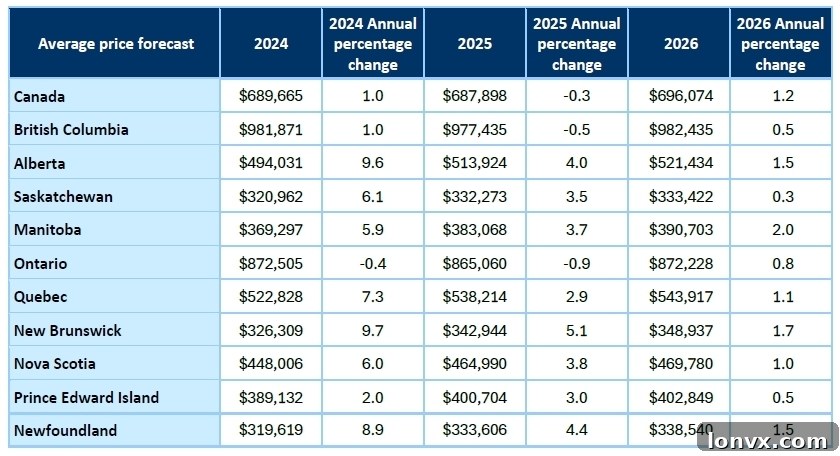
The national average home price in Canada is now expected to experience a slight decline of 0.3 percent in 2025, settling at an average of $687,898. This figure represents a notable adjustment of approximately $30,000 lower than what CREA had projected in its earlier forecasts. This downward revision signals a cooling trend in price appreciation, particularly in some of the country’s most historically vibrant markets. The moderation in prices reflects the broader economic headwinds and a shift towards greater buyer caution, suggesting a move away from the rapid price escalations observed in previous years.
Specifically, British Columbia and Ontario, provinces that have long been at the forefront of Canada’s robust real estate growth, are now expected to see price reductions. These key markets, often bellwethers for national trends, are particularly sensitive to shifts in economic sentiment and affordability pressures, where even slight changes can have significant repercussions. While other provinces are still projected to experience moderate price growth, their earlier expectations have also been significantly scaled back. Instead of robust increases, these regions are now looking at more modest gains, typically in the range of a 3 percent to 5 percent increase. This widespread recalibration of price expectations across the country underscores a collective response to heightened economic uncertainty and a move towards more balanced, albeit less dynamic, market conditions. This trend affects both established homeowners and those aspiring to enter the property ladder, demanding a strategic approach to real estate investments.
Factors Driving the Downgrade: A Deeper Look into Economic Uncertainties
The significant downgrade in CREA’s forecast is not a standalone event but rather a consequence of several interconnected global and domestic economic pressures. Understanding these multifaceted factors is crucial for grasping the current state and future trajectory of the Canadian housing market, as they collectively shape consumer behavior and investment decisions.
Global Trade Tensions and Tariffs Impacting Canadian Real Estate
One of the primary concerns cited by CREA is the mounting global trade tensions and the potential imposition of new tariffs. Such measures, particularly those involving key trading partners like the United States or China, can significantly disrupt international supply chains, leading to increased costs for imported goods and reduced overall economic efficiency. For the housing sector, this could directly translate into higher costs for essential construction materials, thereby increasing development expenses and potentially impacting the affordability of new homes. Moreover, protracted trade disputes can dampen broader business confidence and investment, slowing down job creation and wage growth, which are crucial drivers of housing demand and household financial stability. When businesses face an uncertain economic future, they often delay expansion plans, directly affecting the economic health that underpins a strong and vibrant real estate market.
The Specter of Stagflation Risks and Its Influence on Housing
The re-emergence of stagflation risks presents a particularly challenging economic environment for real estate. Stagflation is characterized by a dangerous combination of high inflation, slow economic growth, and relatively high unemployment. In such a scenario, the purchasing power of consumers erodes due to persistently rising costs for everyday goods and services, while job security becomes a significant concern for many households, making significant, long-term investments like home purchases less appealing or even financially unfeasible. High inflation could also compel central banks to keep interest rates higher for longer or even increase them, further impacting mortgage affordability, even as overall economic growth struggles. This difficult combination creates a dilemma for policymakers and a substantial hurdle for market recovery. Buyers are caught between rising living costs and increasing borrowing expenses, severely limiting their capacity to enter or move within the housing market, leading to reduced transaction volumes.
Uncertainty in Interest Rate Movements and Mortgage Affordability
The Bank of Canada’s monetary policy and the trajectory of interest rates remain a pivotal factor influencing the Canadian housing market. While there has been ongoing speculation about potential rate cuts to stimulate the economy, the persistent inflation and complex global economic pressures introduce considerable uncertainty into this outlook. Any delay in anticipated rate reductions, or even further rate hikes if inflation proves stubbornly persistent, would directly impact mortgage rates, significantly increasing the cost of borrowing for both new and renewing homebuyers. Even modest increases can dramatically reduce affordability, especially in Canada’s high-priced urban centers. Conversely, clarity and a stable outlook on declining rates could inject much-needed confidence into the market, but until such a definitive trend emerges, the wait-and-see approach adopted by many potential buyers is likely to persist. The unpredictability makes long-term financial planning for homeownership challenging and influences market liquidity.
Consumer Confidence and Lingering Affordability Challenges
Ultimately, these macroeconomic factors coalesce to erode consumer confidence, which is vital for a thriving real estate market. When job markets are unstable, prices are rising for everything from groceries to gasoline, and future economic prospects are unclear, households tend to prioritize saving over discretionary spending, particularly on large assets like homes. Affordability remains a critical issue in many Canadian cities, and with interest rates still elevated and economic growth slowing, the barrier to entry for first-time buyers becomes even higher. Existing homeowners might also defer plans to move or upgrade, leading to fewer new listings and slower market turnover. This collective hesitancy plays a significant role in the projected stagnation of sales and the downward adjustment of prices, creating a less dynamic market environment overall.
Mild Recovery Expected in 2026, Still Below Historical Peaks
Looking further ahead, CREA anticipates a cautious and measured recovery in 2026 for the Canadian housing market. The forecast suggests that home sales will increase by 2.9 percent, reaching approximately 496,487 units. While this indicates a modest improvement from the flat activity in 2025, the report critically notes that “sales would fail to crack the half-million mark for the fourth straight year.” This is a significant observation, given the historical context: “Historically, since 2007, national home sales have surpassed 500,000 units seven times.” Remaining below this key threshold for an extended period highlights the enduring challenges faced by the Canadian housing market and suggests that a return to previous boom levels is not imminent.
The national average price is also forecast to see a slight uptick in 2026, projected to increase by 1.2 percent over 2025, reaching $696,074. This represents a very modest rebound, suggesting that while the market may begin to stabilize, a return to the robust, double-digit growth seen in previous years is not on the immediate horizon. The recovery is expected to be gradual, heavily influenced by how effectively the aforementioned economic uncertainties are addressed and how quickly consumer and investor confidence can be restored. A prolonged period of modest growth would redefine expectations for Canadian real estate investors and homeowners alike, prompting a re-evaluation of long-term strategies.
Implications for Buyers, Sellers, and the Broader Canadian Economy
These revised forecasts carry significant implications for various stakeholders across the Canadian real estate landscape. For prospective homebuyers, particularly first-time buyers navigating persistent affordability challenges, the projected stagnation in sales and modest price adjustments in certain regions might offer a glimmer of opportunity. A less frenzied market could mean less competition and potentially more bargaining power, though high interest rates would still significantly impact overall affordability and monthly mortgage payments. For existing homeowners, especially those in British Columbia and Ontario, the prospect of price reductions or minimal appreciation necessitates a careful review of their equity positions and future housing plans. Sellers might need to adjust their expectations regarding listing prices and the speed of sale, adapting to a market where buyers hold more leverage.
On a broader economic scale, a subdued housing market can have ripple effects throughout the Canadian economy. The real estate sector is a significant contributor to GDP, supporting numerous related industries from construction and renovation to finance and retail. A slowdown in housing activity can temper overall economic growth, potentially impacting job creation and consumer spending in other areas. Policymakers will be closely watching these trends, as a healthy and stable housing market is often seen as a cornerstone of national economic stability and prosperity. The next CREA forecast update, scheduled for July 15, will be eagerly awaited for further insights into these evolving market dynamics and potential shifts in the economic landscape, guiding future decisions for all involved.