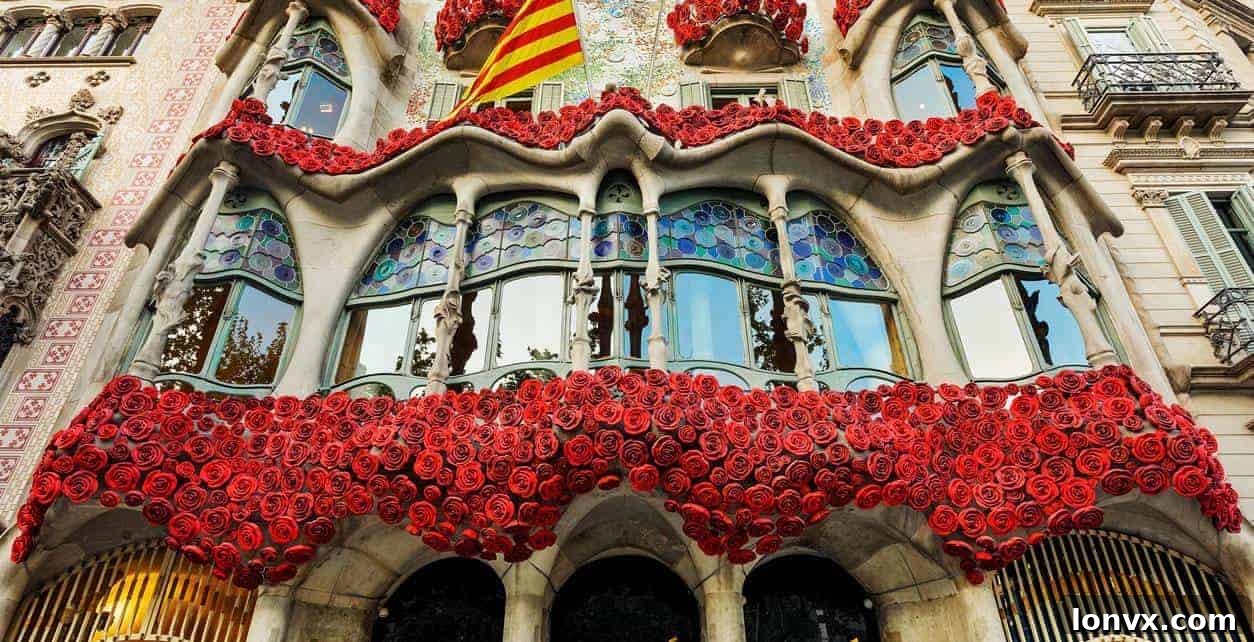
Nestled in the heart of Barcelona’s illustrious Passeig de Gràcia, Casa Batlló stands as a breathtaking testament to architectural genius, captivating passersby daily with its whimsical and otherworldly facade. A symphony of vibrant stone, iridescent glass, and intricate ceramics, the building’s exterior evokes comparisons to a living, breathing artwork, often likened to the impressionistic brushstrokes of a Monet painting. Its skeletal columns and striking, mask-like cast iron balconies seem to guard secrets, drawing a constant stream of curious onlookers and admirers.
This architectural marvel, known affectionately as Casa Batlló, is the brainchild of Antoni Gaudí, the legendary architect behind Barcelona’s iconic La Sagrada Familia. Widely regarded as one of his quintessential masterpieces, Casa Batlló has earned its rightful place on the UNESCO World Heritage list. UNESCO lauded Gaudí’s innovative contributions, stating that his work “anticipated and influenced many of the forms and techniques that were relevant to the development of modern construction in the 20th century.” Indeed, Casa Batlló transcends mere building; it is a profound exploration of form, light, and nature.
Casa Batlló has sometimes been called the “house of the dragon” or the “house of bones,” reflecting its enigmatic and organic design.
The Enigmatic Allure of Casa Batlló: A Gaudí Masterpiece in Barcelona
More than just a building, Casa Batlló is an experience, open year-round to visitors eager to delve into Gaudí’s imaginative world. While its beauty shines in every season, the house takes on an extraordinary glow on April 23rd, coinciding with Saint George’s Day (Sant Jordi in Catalan). On this special occasion, the magnificent five-story facade is adorned with hundreds of cascading red roses, transforming the building into a vibrant floral spectacle. This annual tradition multiplies the usual crowds, drawing countless more admirers to witness the breathtaking sight.
Unraveling the Legend: Saint George, Roses, and the Dragon House
The tradition of decorating Casa Batlló with roses on April 23rd is deeply rooted in Catalan legend and culture. Saint George, revered as the patron saint of Catalonia, is famed for his heroic deed: slaying a fearsome dragon that threatened a princess and her kingdom. From the dragon’s spilled blood, a rose bush is said to have miraculously sprung forth, from which Saint George plucked a rose to offer the grateful princess. This powerful tale of chivalry and renewal forms the emotional core of Sant Jordi celebrations.
Consequently, every year on April 23rd, the streets of towns and cities across Catalonia burst into a tapestry of red as roses – both fresh and artistically rendered – are sold and exchanged as tokens of love and appreciation. The day holds additional cultural significance, as it also marks the anniversary of the deaths of two literary giants, William Shakespeare and Miguel de Cervantes. This serendipitous alignment has led to April 23rd being celebrated as “the day of books and roses,” where the dual gifts of literature and flowers are lovingly exchanged, fostering a unique blend of romance and intellectual appreciation.
While Antoni Gaudí himself never explicitly revealed the precise meanings behind the myriad symbols woven into Casa Batlló’s design, popular interpretation strongly links the house to the legend of Saint George. The undulating, arch-shaped roof, dramatically scaled and iridescent, is frequently likened to the very back of the dragon, its multi-coloured ceramic tiles with their metallic sheen evoking the creature’s formidable scales. The four-armed cross, rising majestically from the roof, is often seen as representing the hilt of Saint George’s sword, poised triumphantly over the vanquished beast. In this narrative, the building’s distinctive bone-shaped columns are thought by some to commemorate the dragon’s victims, giving rise to its evocative nicknames: “the house of the dragon” or “the house of bones.” These interpretations underscore the profound narrative potential embedded within Gaudí’s organic and symbolic architecture.
A Phoenix from the Ashes: Casa Batlló’s Architectural Metamorphosis
The building that stands today on Passeig de Gràcia bears little resemblance to its original form. Constructed in 1877 as a conventional townhouse, its destiny changed dramatically in 1903 when it was acquired by Josep Batlló y Casanovas, a prominent textile industrialist. Batlló, known for his refined taste and avant-garde sensibilities, commissioned Antoni Gaudí for a complete renovation. He granted Gaudí unprecedented creative freedom, even offering him the option to demolish the existing structure and build anew. In a move characteristic of his respect for existing forms and his genius for transformation, Gaudí chose to work with the original building, reimagining its facade, adding two new floors, and meticulously reconfiguring the internal partitioning to maximize light and space.
One of Gaudí’s most brilliant interventions was the expansion of the central light well. Adorned with eye-catching ceramic tiles that gradient from deep blues at the top to lighter hues at the bottom, this ingenious design feature not only dramatically increased the influx of natural light into every level of the building but also served as the shaft for a magnificent wooden elevator, which remarkably remains in use today. This blend of aesthetic beauty and functional innovation is a hallmark of Gaudí’s architectural philosophy, where every detail serves a purpose, both practical and poetic.
Stepping Inside Casa Batlló: An Interior World of Wonders
The interior of Casa Batlló is a captivating journey into Gaudí’s boundless imagination, where conventional straight lines are conspicuously absent. Instead, visitors are enveloped by a world of organic forms, fluid spaces, and an exquisite array of natural motifs. Everywhere, curving lines define the flow of rooms, complemented by irregular oval windows that frame views like living paintings. Sculpted stonework adorns walls and ceilings, while ergonomically designed doorknobs and banisters invite touch, perfectly fitting the human hand. The mosaics, crafted from broken ceramic tiles in a technique known as trencadís, shimmer with iridescent beauty, reflecting and refracting light in a dazzling display.
Innovative Design and Natural Inspiration
Gaudí’s profound reverence for nature is evident in almost every corner of Casa Batlló. The wavy ceiling in the main noble floor evokes the gentle undulations of the sea, creating a tranquil, dreamlike atmosphere. In the study, a whimsical, mushroom-shaped fireplace provides both warmth and a touch of playful fantasy. Skylights in the entrance hall cleverly resemble the intricate patterns of tortoise shells, filtering light in soft, organic ways. Perhaps most strikingly, the series of 60 catenary arches in the loft, constructed with remarkable structural efficiency, ingeniously represent the ribcage of an animal, creating an awe-inspiring, almost skeletal aesthetic that reinforces the “house of bones” moniker. These elements seamlessly integrate the natural world into the very fabric of the building, blurring the lines between art, architecture, and ecology.
The Iconic Roof and Terrace: A Panoramic Masterpiece
The roof and terrace of Casa Batlló represent one of the home’s most iconic and breathtaking features, offering a dramatic conclusion to the architectural narrative. It is here that the famous “dragon’s back” design truly comes alive, its iridescent scales shimmering under the Barcelona sun. Dominating this fantastical landscape is the four-armed cross, oriented to the cardinal directions, symbolizing a guiding light or, as some suggest, the ultimate triumph of good over evil. Surrounding this central feature are four distinctively shaped chimney stacks, each an artistic sculpture in its own right, meticulously designed not only for aesthetic appeal but also with practical ingenuity to prevent back draughts. From this elevated vantage point, visitors are treated to panoramic views of Barcelona, offering a unique perspective of Gaudí’s genius against the backdrop of the city.
Visiting Casa Batlló Today: An Immersive Cultural Experience
The journey of Casa Batlló continued through the decades. By the 1990s, the property was acquired by the Bernat family, who embarked on a meticulous restoration process before opening its doors to the public. Today, Casa Batlló is one of Barcelona’s most sought-after cultural attractions, welcoming over one million visitors annually from across the globe. The experience is designed to be immersive and engaging, with visitors often provided with augmented reality video guides that bring Gaudí’s vision to life, animating the house’s features and revealing hidden details and symbolic meanings as they wander at their leisure.
The house’s innovative design and its rich narrative offer a multi-sensory journey, from the captivating play of light and shadow to the organic textures and vibrant colors. Every corner tells a story, making the visit not just an architectural tour but a deep dive into art, history, and legend. It stands as a vibrant testament to Gaudí’s enduring legacy and Barcelona’s rich cultural heritage.
Beyond Modernism: Casa Batlló’s Enduring Legacy
While Casa Batlló is undeniably a product of the Modernisme movement that flourished in Catalonia at the turn of the 20th century, its unparalleled originality and daring innovation set it apart. Many argue that Casa Batlló transcends the confines of any single architectural style, inhabiting a class entirely its own. Its unique fusion of functional design with fantastical symbolism, its pioneering use of light and space, and its deep connection to natural forms continue to inspire architects and artists worldwide.
This enduring appeal is precisely why Casa Batlló remains one of Barcelona’s most visited sites, a beacon of architectural ingenuity and artistic expression. It is not merely a house; it is a living sculpture, a narrative woven in stone, glass, and ceramic, an enduring symbol of creativity that continues to captivate and enchant all who encounter its extraordinary beauty. Casa Batlló stands as a timeless masterpiece, inviting future generations to marvel at the boundless possibilities of human imagination.