
Navigating Canada’s Rising Property Taxes: A Deep Dive into Major Cities
As Canadian municipalities across the country meticulously finalize their budgets for the upcoming fiscal year, a consistent and increasingly urgent theme is emerging: significant increases in property taxes. From the bustling urban centers of British Columbia to the expansive communities of Ontario, homeowners are currently bracing for adjustments that could range anywhere from a modest 2% to a more substantial 15%. This widespread trend signals a critical shift in the financial landscape for property owners nationwide, driven by a complex interplay of factors including persistent inflation, escalating infrastructure demands, and the rising cost of delivering essential public services.
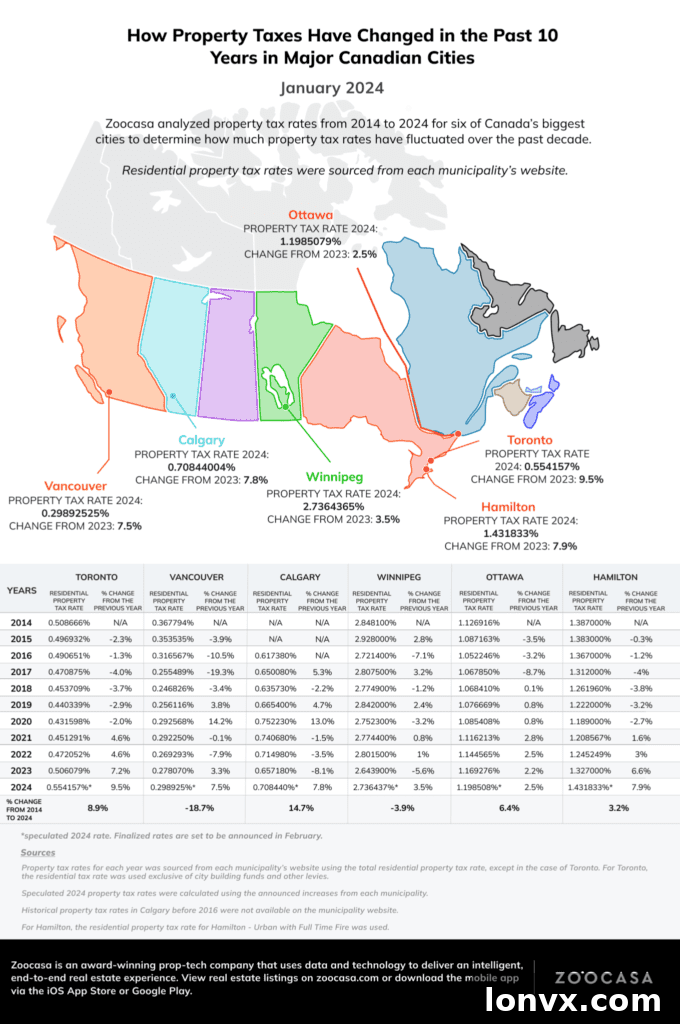
To truly grasp the magnitude and nuances of these impending changes, it is essential to look beyond the immediate headlines and examine both historical patterns and current projections. A recent and comprehensive analysis conducted by Zoocasa offers invaluable insights by shedding light on the trajectory of property tax rates over the past decade in six major Canadian real estate markets. This detailed study provides a crucial framework for understanding how this year’s proposed increases stack up against long-term trends, revealing unique stories for each urban center.
This in-depth article will delve into the key findings of this analysis, meticulously exploring the distinct situations unfolding in Vancouver, Calgary, Winnipeg, Toronto, Hamilton, and Ottawa. We will examine the specific factors contributing to these evolving property tax landscapes, quantify the direct financial impact on homeowners, and critically assess what these trends signify for the future of real estate affordability and municipal finance in Canada. Prepare for an insightful journey into the heart of Canadian homeownership costs.
Calgary and Vancouver: Divergent Paths in Property Tax Evolution
While both Vancouver and Calgary are currently grappling with proposed property tax increases exceeding 7% for the 2024 fiscal year, a closer examination of their historical property taxation rates reveals remarkably contrasting narratives. This striking divergence underscores the differing economic priorities, unique demographic pressures, and distinct fiscal strategies influencing these two prominent Western Canadian cities.
Vancouver’s Evolving Tax Burden: A Decade of Decline, Now Shifting
A decade ago, in 2014, Vancouver’s residential property tax rate was recorded at 0.367794%. As we look towards 2024, the proposed rate stands at 0.298925%. On the surface, this represents a significant 18.7% decline over the ten-year period. This long-term downward trend can largely be attributed to the city’s exceptionally rapid appreciation in property values; as property assessments soar dramatically, municipalities can often collect equivalent or even increased revenue with a lower nominal tax rate, effectively shifting the tax burden while ensuring robust overall revenue streams.
However, the narrative for 2024 tells a more complex and immediate story. Despite the long-term decline in the tax rate, Vancouver’s property tax rate has consistently remained below 0.3% since 2017. The anticipated 2024 rate, if officially approved, is poised to be the highest recorded since 2016. This upward trajectory suggests that while property values in Vancouver continue their ascent, the city is simultaneously confronting intensified operational costs and growing demands for public services, which collectively necessitate a higher tax rate than has been seen in recent years to maintain fiscal balance.
For homeowners in Vancouver, these figures translate directly into tangible financial commitments that significantly contribute to the overall cost of living. For instance, a property assessed at $500,000 could incur approximately $1,495 in annual property taxes. For those who own properties valued at $1,000,000, the projected annual tax bill could reach around $2,989. While these figures may appear relatively modest when compared to some other major Canadian cities, they nonetheless represent a substantial component of the overall financial outlay required for homeownership in what remains one of the world’s most expensive real estate markets.
Calgary’s Steady Ascent: A Response to Growth and Development
Calgary, in contrast to Vancouver, presents a starkly different trajectory in its property tax history. Since 2016, the city has experienced a substantial 14.7% increase in its residential property tax rate. This consistent upward trend is indicative of Calgary’s unique economic landscape, which, while steadily diversifying, has historically been deeply intertwined with the energy sector. Furthermore, a rapidly expanding population consistently demands expanded and improved municipal services, which naturally contributes to higher tax requirements. The proposed 7.8% increase for 2024, if fully implemented, will see the rate climb from 0.657180% in 2023 to an estimated 0.70844% in 2024. This consistent rise underscores the city’s proactive efforts to balance its budget amidst evolving financial pressures and an ever-growing need for enhanced urban services and infrastructure.
The financial implications for Calgary homeowners are quite significant and deserve careful consideration. For a property assessed at $500,000, the projected 2024 taxes would amount to approximately $3,542. This figure is more than double the amount a Vancouver homeowner would typically pay for a similarly assessed property, dramatically illustrating the considerable difference in tax burdens between these two prominent Western Canadian urban centers. The higher tax rate in Calgary, often coupled with generally lower average property values when compared to Vancouver, means that a larger percentage of a property’s assessed value is collected in taxes annually, affecting overall housing affordability in a distinct manner that differs from Vancouver’s high-value, lower-rate model.
Winnipeg: High Rates with a Decelerating Long-Term Trend
Winnipeg stands out among the analyzed Canadian cities for possessing the highest residential property tax rate. Despite this distinguishing characteristic, the city has paradoxically experienced a general downward trend in its nominal tax rate over the past decade, with overall taxes decreasing by 3.9% since 2014. The residential tax rate, which was recorded at 2.8481% in 2014, is now anticipated to settle around 2.736437% in 2024. However, it is crucial to observe that the proposed 2024 rate does represent a 3.5% increase from the previous year, indicating that while the long-term trajectory has been downwards, immediate fiscal pressures are still compelling year-over-year increases to meet current municipal needs.
The consistently high base rate in Winnipeg, even in light of its long-term decline, provides significant insight into the city’s distinct approach to funding its comprehensive suite of municipal services. A multitude of factors, including extensive infrastructure needs, robust social programs, and a wide array of public services, collectively contribute to maintaining this rate. For homeowners in Winnipeg, understanding this rate within the context of the city’s relatively lower average property values is paramount. A higher percentage rate applied to a comparatively lower base assessment can still result in tax bills that are manageable and contribute to overall housing affordability, even though the percentage itself might appear strikingly high when directly compared to the rates observed in other major Canadian cities.
Ontario Cities: A Spectrum of Property Tax Adjustments Reflecting Diverse Urban Dynamics
Ontario, as Canada’s most populous province and a significant economic engine, showcases a remarkably diverse range of property tax adjustments across its major urban centers. These variations are a direct reflection of differing municipal priorities, distinct rates of population and economic growth, and unique local economic conditions that shape the financial realities of each city.
Toronto: Leading the Surge in Property Taxes Amidst Rapid Growth
Toronto, Canada’s largest city and a dominant economic powerhouse, is projected to experience one of the most substantial property tax increases in the country. With a proposed 9.5% hike for 2024, this would mark the largest single-year increase the city has witnessed since 2023. Furthermore, when examining the past decade, Toronto has registered the second-largest 10-year increase among all the analyzed cities, at a significant 8.9%—a figure surpassed only by Calgary.
This substantial upward trajectory in Toronto’s property taxes can be attributed to a confluence of pressing factors. Rapid and sustained population growth continuously demands extensive and ongoing investment in public transit infrastructure, essential urban services, critical social programs, and increasingly vital affordable housing initiatives. Moreover, the pervasive effects of inflation impact the cost of delivering these fundamental services, thereby placing additional and considerable pressure on municipal budgets. For Toronto homeowners, these persistent increases translate directly into significant financial commitments that must be factored into their household economics:
- A property assessed at $500,000 could incur approximately $2,771 in annual property taxes.
- For properties valued at $1,000,000, the projected annual tax burden could rise to around $5,542.
These figures starkly underscore the mounting financial pressure on households in an already high-cost-of-living city, profoundly influencing housing affordability and necessitating meticulous household budgeting strategies for millions of its residents. The combination of high property values and increasing tax rates creates a challenging environment for both existing and prospective homeowners.
Hamilton: Balancing Growth with Gradual Property Tax Increases
Hamilton, a rapidly growing city often heralded as a more accessible and affordable alternative to its larger neighbor, Toronto, follows closely with the next-largest year-over-year increase from 2023 to 2024, proposing a significant rate of 7.9%. However, when its property tax evolution is viewed over the broader span of the past decade, Hamilton’s landscape has been characterized by notably more moderate changes. From 2014 to 2024, the city’s residential property tax rate increased by a comparatively modest 3.2%, indicating a slower, more controlled growth in tax rates when contrasted with its more sprawling and rapidly expanding regional counterparts.
This more balanced approach suggests that while Hamilton is indeed experiencing considerable growth-related pressures, its municipal planning and fiscal policies have historically managed to distribute the tax burden more evenly over time, perhaps by leveraging new development charges or other revenue streams more effectively. For homeowners in Hamilton, a property assessed at $500,000 would typically face an annual property tax bill of around $7,159. This specific figure illustrates that while the percentage increase might appear significant on a year-over-year basis, the cumulative impact over a decade has demonstrated less volatility than in other major urban centers, reflecting potentially different assessment methodologies or distinct municipal fiscal management strategies.
Ottawa: Modest Hikes in the Nation’s Capital Offering Predictability
Ottawa, Canada’s distinguished capital city, is anticipated to have the smallest property tax increase from 2023 to 2024 among the analyzed cities, with a proposed rate of 2.5%. This relatively modest year-over-year hike stands in stark contrast to the more aggressive increases observed in dynamic markets such as Toronto and Hamilton. Nevertheless, when taking a longer-term perspective, the speculated 2024 residential property tax rate of 1.198508% still marks a 6.4% boost from the 2014 property tax rate, indicating a steady, albeit slower and more predictable, upward trend over the decade.
Ottawa’s more stable and predictable tax environment can largely be attributed to its unique status as a government-centric city, which often benefits from a more robust and predictable economic base compared to cities heavily reliant on more volatile sectors like finance or manufacturing. The city’s municipal revenues might therefore be less susceptible to the rapid fluctuations and intense pressures often seen in markets driven by speculative real estate or significant industrial shifts. Homeowners in Ottawa can generally anticipate paying approximately $5,993 in annual property taxes for a property assessed at $500,000. This stable and gradual increase provides a welcome degree of predictability and financial security for residents, a quality highly valued in a major urban center.
The Broader Impact of Rising Property Taxes Across Canada: A Multifaceted Challenge
The intricate trends observed and meticulously analyzed in these six major Canadian cities are not merely isolated incidents but rather profound reflections of broader economic, demographic, and political forces that are actively shaping the entire country. Gaining a comprehensive understanding of these underlying factors is not only crucial but absolutely essential for homeowners, prospective buyers, property investors, and policymakers alike, as it informs responsible decision-making and sustainable urban development.
Why Are Property Taxes Steadily Rising Across the Nation?
A combination of several key and interconnected factors contributes to the escalating property tax burden experienced by Canadian homeowners:
- Inflation and the Soaring Cost of Services: The relentless rise in the cost of living directly impacts municipal operations. Everything from employee wages and benefits to the price of essential materials for critical infrastructure projects—such as roads, sewers, public transit systems, and public buildings—is increasing. This inflationary pressure inevitably compels cities to seek additional revenue to maintain their current service levels.
- Rapid Population Growth and Intensified Urbanization: The continuous and rapid population growth in major urban centers necessitates the constant expansion and meticulous maintenance of an ever-growing array of public services. A larger resident base demands more comprehensive public transit options, larger and better-maintained parks, additional schools, more efficient waste management systems, enhanced emergency services, and a wider variety of recreational facilities, all of which come with significant and escalating costs.
- Aging Infrastructure and Modernization Needs: A substantial portion of Canadian cities possess aging infrastructure that requires considerable investment for urgent upgrades, critical repairs, and comprehensive modernization. These capital-intensive projects are incredibly expensive and are typically funded through a complex combination of provincial grants and local property taxes, placing a direct burden on homeowners.
- Shifts in Provincial Funding Models: Any changes in provincial funding models or reductions in transfer payments and grants to municipalities can significantly increase the financial onus on local governments. This often forces them to rely more heavily on their primary stable revenue source: property tax revenue.
- Growing Demand for Enhanced Public Services: Citizens increasingly expect not only higher quality but also a broader range of municipal services, spanning from enhanced public safety initiatives and efficient transportation networks to improved environmental programs and robust social support systems. Meeting these elevated expectations inevitably requires a stable and growing tax base.
Profound Implications for Homeowners and the Housing Affordability Crisis
The continuous and often unpredictable rise in property taxes has profound and far-reaching implications for homeowners and the broader housing market across Canada:
- Increased Overall Cost of Homeownership: Property taxes represent a significant and unavoidable recurring expense for homeowners, often ranking second only to mortgage payments for many households. Consequently, any hikes in these taxes directly impact household budgets, effectively reducing disposable income and altering financial planning.
- Exacerbating the Affordability Crisis: In Canadian real estate markets already grappling with severe housing affordability challenges, rising property taxes add yet another formidable layer of financial strain. This makes it increasingly difficult for first-time buyers to enter the market and poses significant challenges for existing homeowners, particularly those on fixed incomes, to retain their properties in the face of escalating costs.
- Significant Budgeting Challenges: Unpredictable or substantial annual increases in property taxes make accurate long-term financial planning exceedingly difficult for families and individuals, leading to budgetary uncertainties and stress.
- Impact on Property Investors: For those who own rental properties, higher property taxes can significantly reduce investment returns and may, in turn, lead to increased rental rates, thereby further impacting the affordability of rental housing for tenants.
- Exaggerated Regional Disparities: As this detailed analysis clearly demonstrates, the impact of property tax changes varies significantly by city and region. Homeowners in high-tax-rate cities like Winnipeg, or those in cities experiencing rapidly increasing rates such as Toronto and Calgary, face fundamentally different financial realities compared to their counterparts in cities with more stable or even declining rates.
Conclusion: Navigating the Complex Future of Canadian Property Taxes
The current landscape of property taxes in Canada is undeniably one of increasing complexity, characterized by growing financial pressures and diverse regional dynamics. While some major cities, such as Vancouver, have experienced long-term rate declines driven by soaring property values, others like Calgary and Toronto are witnessing significant year-over-year and decade-long increases. These upward trends are propelled by a combination of escalating operational costs, critical infrastructure demands, and sustained population growth. Meanwhile, Winnipeg, despite maintaining the highest nominal rate, shows an interesting long-term decelerating trend, while Hamilton and Ottawa present more nuanced pictures of managed growth and relative stability.
For Canadian homeowners, staying meticulously informed about local municipal budgets, understanding the intricate factors influencing property tax rates, and engaging with local governance are more critical than ever before. These taxes are not merely administrative fees; they are absolutely vital contributions to the quality of life, the comprehensive public services, and the essential infrastructure that collectively define and sustain our communities. As municipalities across Canada continue to grapple with persistent economic pressures, the imperative to maintain existing services, and the ever-increasing demands of a growing and evolving population, property tax adjustments will undoubtedly remain a fundamental and indispensable mechanism for funding these essential services.
The invaluable data and insights presented by Zoocasa offer a crucial snapshot of these evolving trends, empowering homeowners to anticipate future costs, actively participate in civic discussions, and make more informed and strategic decisions regarding their investments in the dynamic and challenging Canadian real estate market. The narrative of property taxes is far from static; it is a continuously unfolding story of urban development, prudent fiscal responsibility, and the collective commitment to building and maintaining vibrant, sustainable, and prosperous communities for all residents.
Review the full report here.
Enjoying this article?
Get the latest REM articles in your inbox 3x week so you stay up to date on the latest in the Canadian real estate industry