
The dynamic Calgary real estate market is undergoing a significant transformation, driven primarily by an unprecedented surge in housing supply. According to the latest comprehensive data from the Calgary Real Estate Board (CREB), this influx of new listings is exerting considerable downward pressure on home prices across various segments. While some property types are experiencing more pronounced adjustments, the overall trend points towards a more balanced market, offering increased choice for prospective buyers and signaling a departure from the seller-dominated conditions of recent years.
The August 2025 market report, released this week, provides a detailed snapshot of this evolving landscape. The data reveals that apartment-style condominiums and row-style homes are witnessing the most substantial price corrections. In contrast, the more insulated detached and semi-detached property categories are experiencing only modest declines, or in some instances, maintaining their values. This divergence underscores the nuanced nature of the market, where different housing segments react distinctly to changes in supply and demand.
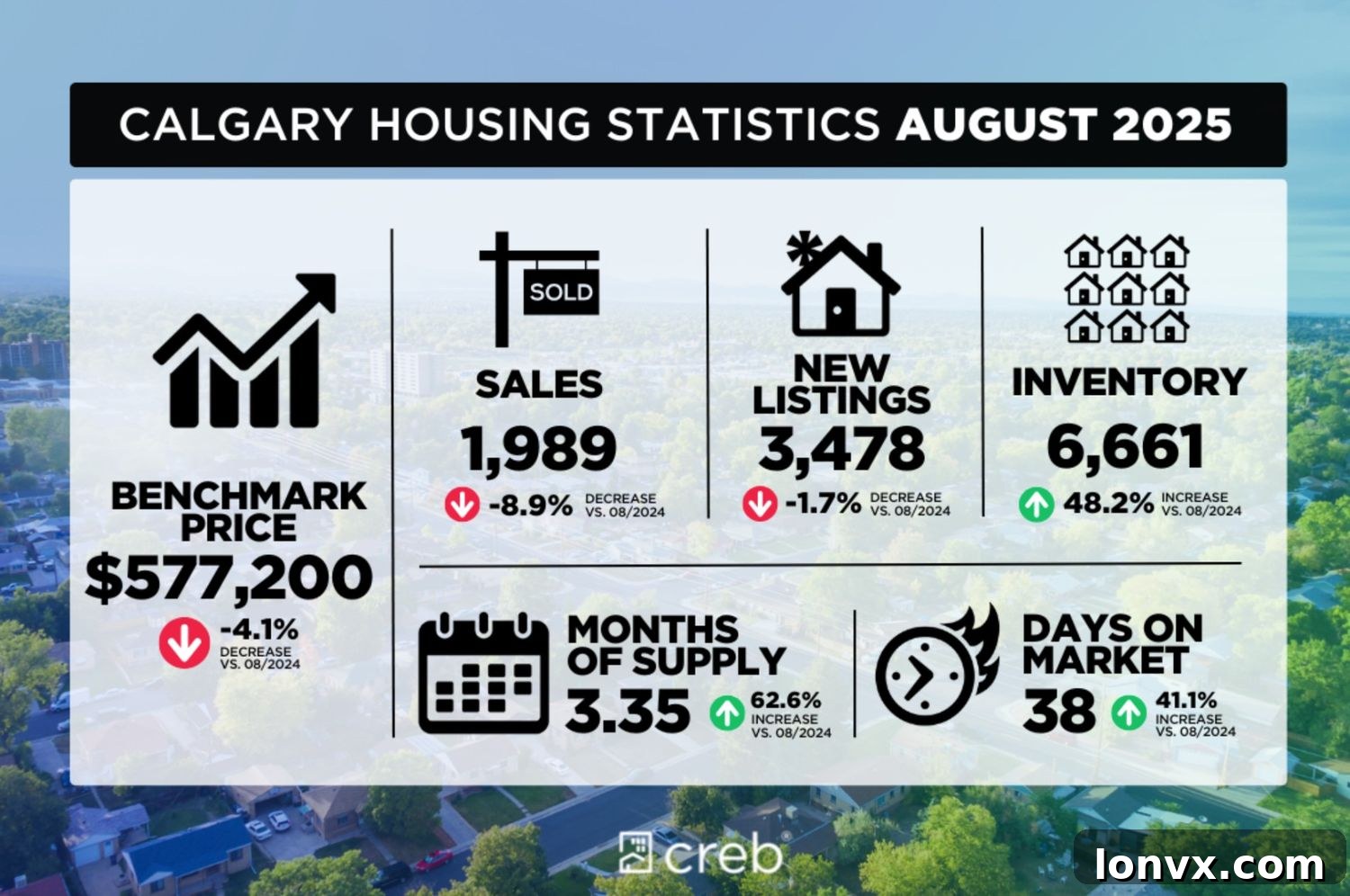
Specifically, the unadjusted total residential benchmark price for Calgary registered at $577,200 last month. This represents a four percent decrease compared to August 2024, highlighting a clear cooling trend in average property values. This adjustment, while significant, requires careful interpretation within the broader context of Calgary’s recent real estate history, as emphasized by industry experts.
Understanding Price Adjustments Across Property Types
Ann-Marie Lurie, CREB’s chief economist, urges for perspective when analyzing these price adjustments. “Perspective is needed when it comes to price adjustments,” Lurie stated, elaborating that the most substantial drops are concentrated within high-density housing categories, such as row homes and apartment-style condos. This correlation is directly linked to these segments seeing the most significant gains in available supply. New construction, particularly in the multi-family sector, has introduced a substantial number of units, providing buyers with more options and subsequently tempering price growth.
Lurie further explained, “Meanwhile price adjustments in the detached and semi-detached markets range from modest price growth in some areas to larger price declines in areas with large supply growth.” This statement highlights the micro-market dynamics at play. Even within the broader detached and semi-detached categories, performance can vary considerably based on specific neighborhoods, localized inventory levels, and price points. Crucially, Lurie emphasized that “Overall, recent price adjustments have not offset all the gains that have occurred over the past several years.” This suggests that despite the current deceleration, property values in Calgary largely remain elevated compared to pre-boom levels, indicating a correction rather than a collapse.
Breaking down the price trends by property type, the unadjusted benchmark prices for row houses in August recorded a five percent year-over-year decline. The apartment-style condo segment experienced an even sharper correction, with prices sliding six percent compared to the previous year. In contrast, the detached and semi-detached markets demonstrated resilience, with their prices remaining relatively flat from 2024 levels. This stability in the single-family segment can be attributed to its comparatively tighter supply and persistent demand, often from families seeking more space or those migrating from other, more expensive Canadian cities.
Sales Activity: Sustained Demand Meets Expanding Inventory
While prices are adjusting, sales activity in Calgary’s housing market presents a more complex picture. August recorded 1,989 residential sales, a nearly nine percent decrease compared to the same month last year. This slowdown in transactions suggests that buyers are taking more time to make decisions, no longer facing the intense bidding wars and swift sales that characterized the market in recent memory. However, it’s vital to note that despite easing from the peak highs observed over the past four years, sales activity remains robust and above long-term historical trends. This indicates a foundational level of strong demand persists within the city, supported by factors such as robust population growth, inter-provincial migration, and Calgary’s relative affordability compared to other major Canadian urban centers.
The most significant and defining change in the current market lies squarely in the supply side. A notable surge in new listings has been a primary driver of the shift. This elevated volume of homes entering the market has pushed the sales-to-new-listings ratio below 60 percent. A ratio below this threshold is generally indicative of a market shifting away from seller-friendly conditions towards one that offers more leverage to buyers. This increased choice has, in turn, allowed the total inventory of available properties to swell to 6,661 units in August – the highest level recorded for this month since 2019. This substantial growth in inventory marks a critical turning point for buyers, providing them with unprecedented options and reducing the urgency to make immediate decisions.
With a greater selection of homes available and a moderated pace of sales, the “months of supply” metric has risen to 3.4 in August. This figure represents the time it would take to sell all current listings at the prevailing rate of sales. An increase in months of supply is a clear indicator of a market transition. It signifies a significant shift away from the severely constrained seller’s market conditions that defined the past four years, where months of supply were often critically low, fueling rapid price appreciation. While the current level of 3.4 months points towards a more balanced environment, it is crucial to recognize that it still remains well below the levels characteristic of a buyer’s market seen before the global pandemic, which typically features five to six months of supply or more. This suggests that while conditions are improving for buyers, it is not yet a heavily discounted market.
Navigating the Evolving Calgary Real Estate Landscape
The overarching assessment is that Calgary’s real estate market is becoming more balanced compared to the frantic pace of the previous year. However, this balance is not uniform. Market conditions continue to exhibit considerable variation depending on a multitude of factors, including the specific property type, the prevailing price range, and the geographical location within the city and its surrounding areas. For instance, while entry-level condos might be facing stiffer competition from new inventory, premium detached homes in desirable central neighborhoods could still command strong interest, albeit with longer market times than before. Buyers and sellers alike must therefore engage with a keen understanding of these localized dynamics rather than relying on broad market averages.
Several macro-economic factors are also influencing Calgary’s real estate trajectory. Interest rates, while not explicitly detailed in the report, play a pivotal role in buyer affordability and borrowing capacity. Higher rates can cool demand by increasing the cost of mortgages, directly impacting how much buyers can afford. Economic forecasts for Alberta, including oil prices and employment growth, also contribute to consumer confidence and, by extension, the housing market. Calgary’s strong job market and continued influx of inter-provincial migrants remain key pillars of demand, even as supply expands. This underlying strength prevents a drastic downturn and instead fosters a period of recalibration.
For buyers, the current market offers an opportune moment characterized by greater selection and less intense competition. This allows for more considered decisions, the possibility of negotiating prices, and the ability to include conditions in offers, which was a rarity in recent years. For sellers, adapting to the new reality of a balanced market means realistic pricing, strategic marketing, and potentially longer market times. Homes that are well-maintained, appropriately priced, and effectively showcased are more likely to attract interest in this competitive environment.
The image below illustrates the current landscape of Calgary’s housing market, emphasizing the increased inventory that is now shaping buyer opportunities and price trends.
Looking Ahead: What to Expect in Calgary’s Housing Market
As Calgary continues to navigate this period of market adjustment, the interplay between increasing supply and resilient, albeit moderating, demand will be critical. The emphasis on high-density housing growth is likely to continue, further diversifying the housing stock and potentially keeping upward pressure on condo and row home prices at bay. Detached and semi-detached markets may see continued stability or minor adjustments, particularly in highly sought-after areas that still face supply constraints.
The insights from the Calgary Real Estate Board underscore a clear message: the market is not contracting, but rather rebalancing. This creates a more sustainable environment in the long run, moving away from the unsustainable rapid appreciation of previous years. Stakeholders in the Calgary real estate market—whether homeowners, prospective buyers, investors, or developers—will need to remain agile and informed, recognizing that while the overall trend is toward equilibrium, localized conditions will continue to present unique challenges and opportunities. The coming months will undoubtedly offer further clarity on the longevity and depth of these emerging trends, shaping the future of homeownership in one of Canada’s most dynamic cities.