
Canadian Housing Market Poised for Stability and Growth in 2025
After a period of significant volatility, the Canadian housing market is expected to enter a new phase of stability and growth in 2025. This optimistic outlook is largely driven by declining interest rates, strategic adjustments to lending rules, and a renewed surge in buyer confidence, as highlighted in Royal LePage’s comprehensive Market Survey Forecast. The report projects a robust market recovery, signaling a return to more predictable, long-term trends for property values across the nation.
A Resurgent Market: Royal LePage Forecasts Significant Gains
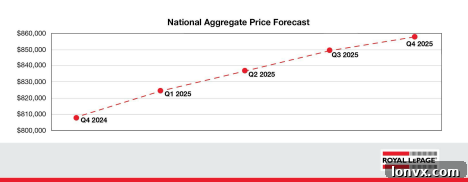
Royal LePage’s forecast for 2025 paints a positive picture for Canadian homeowners and prospective buyers. The company predicts that the average price of a home in Canada will experience a notable rise of 6 percent year-over-year, reaching an estimated $856,692 by the fourth quarter of 2025. This increase is not merely a rebound but a recalibration that aligns closely with historical long-term growth trajectories, suggesting a healthier and more sustainable market environment.
The forecast further distinguishes between different property types, reflecting varied demand and market dynamics. Single-family detached homes are anticipated to lead this growth, with a projected price increase of 7 percent, pushing their median value to $900,833. This segment continues to benefit from strong demand for space and privacy, a trend that solidified during recent years. Meanwhile, the condominium market is also expected to see positive momentum, with prices forecasted to grow by 3.5 percent, reaching an average of $605,993. This segment remains a crucial entry point for many first-time buyers and those seeking urban living solutions.
“The sustained backlog of Canadians ready and able to purchase homes has been a significant underlying factor, waiting for the right conditions to re-enter the market,” states Phil Soper, president and CEO of Royal LePage. “Upcoming modifications to mortgage lending rules are set to further enhance Canadians’ borrowing power, acting as a powerful catalyst for this pent-up demand.” This confluence of factors is expected to unlock a wave of transactions, driving the market forward in a controlled and positive manner.
The Driving Force: Monetary Policy and Economic Rebalancing
A pivotal element underpinning this market optimism is the Bank of Canada’s recent shift in monetary policy. As Phil Soper succinctly puts it, the central bank has transitioned from its role as an “inflation fighter” to an “economy booster.” This strategic pivot, marked by a 50-basis-point rate cut at the start of the fourth quarter, injected a much-needed dose of confidence into the market.
Soper observes, “Following the Bank of Canada’s rate adjustment, we witnessed a marked increase in market activity. This immediate response suggests that buyers, for the most part, now believe home prices have reached their floor and are ready to embark on an upward trajectory.” This sentiment is critical, as it eliminates the ‘wait-and-see’ approach that characterized recent periods of uncertainty, encouraging more decisive action from prospective buyers and sellers alike. Lower interest rates directly translate to more affordable mortgage payments, making homeownership more attainable and broadening the pool of eligible buyers. This economic rebalancing is designed to stimulate investment and consumer spending, with the housing market being a primary beneficiary.
Regional Variances: Diverse Growth Across the Canadian Landscape
While the national forecast points to overall growth, the Royal LePage report highlights significant regional variances, reflecting the diverse economic and demographic landscapes of Canada. These regional price trends are expected to mirror strong local demand and unique market conditions, with some cities set to outperform the national average.
Leading the Charge: Emerging Hotspots
Quebec City is projected to lead the country with an impressive 11 percent increase in home prices, underscoring robust local demand and relative affordability compared to larger urban centers. Following closely are Edmonton and Regina, both anticipated to experience strong gains of 9 percent. These cities in the Prairies and Quebec are often more accessible for first-time buyers and attract inter-provincial migration, contributing to heightened demand and upward price pressure.
Steady Growth in Major Metros
In contrast, Canada’s major metropolitan areas—Greater Montreal, the Greater Toronto Area (GTA), and Metro Vancouver—are expected to see more moderate but still healthy increases. Greater Montreal is forecasted to experience a 6 percent rise, slightly outpacing the GTA’s projected 5 percent gain and Metro Vancouver’s 4 percent increase. These major markets have grappled with unique challenges, including high baseline prices and a delicate balance between supply and demand.
Soper elaborates on the dynamics in these high-value markets: “Over the past several months, supply has been gradually building in the Toronto and Vancouver real estate markets as sellers responded to early interest rate cuts by listing their homes. However, with home prices in these cities remaining significantly high, many sidelined buyers continued to wait patiently for more favourable borrowing conditions and further signs of market stability.” This created a temporary “stalemate” where inventory lingered, and buyers hesitated to commit, driven partly by fears of overpaying. “By mid-fall,” Soper notes, “this dynamic began to shift as buyers, sensing the bottom of the market and the easing of lending conditions, re-engaged with the market with renewed vigour.” This renewed engagement is a critical indicator of returning confidence and heralds the start of sustained growth in these typically competitive markets.
Empowering First-Time Buyers: Expanded Lending Rules
A crucial component of the anticipated market recovery, particularly for increasing accessibility, comes from the expanded mortgage lending rules set to take effect on December 15, 2024. These changes are specifically designed to provide greater access to housing for first-time buyers and those looking to purchase newly constructed homes, addressing a long-standing challenge in the Canadian market.
The key adjustments include eligibility for 30-year amortizations on insured mortgages, a significant extension from the previous standard, and an increase in the mortgage insurance cap from $1-million to $1.5-million. These changes are transformative for aspiring homeowners. A longer amortization period reduces the size of monthly mortgage payments, making homeownership more affordable on a day-to-day basis. The increased insurance cap, meanwhile, allows buyers to access more expensive properties with the benefit of mortgage insurance, which is often crucial for those with smaller down payments.
“First-time buyers will undoubtedly be the primary beneficiaries of these forward-thinking initiatives,” Soper affirms. “Their ability to borrow more for less, requiring a smaller down payment, will significantly help them overcome financial barriers and move closer to achieving their first home purchase.” This policy shift is not just about helping individuals; it’s also a strategic move to stimulate the broader housing ecosystem. “We firmly believe that the return of these buyers to the market will powerfully encourage builders to ramp up new construction, triggering a much-needed wave of fresh supply across the country,” Soper concludes. This interplay between increased buyer capacity and stimulated supply is vital for creating a balanced and sustainable housing market in the long term.
External Factors: Policy and Economic Influences
While the internal dynamics of the Canadian housing market appear positive, the forecast also acknowledges the potential for external disruptions emanating from political and economic shifts, both domestically and internationally. These factors, though outside the direct control of the housing market, could have ripple effects on consumer confidence and investment decisions.
Domestically, the anticipation of a federal election in Canada could introduce new housing policies depending on the outcome. Different political parties often propose varying strategies for addressing housing affordability, supply shortages, or taxation, which could create periods of uncertainty or new incentives for buyers and sellers. Phil Soper flags these potential changes as a factor to monitor, suggesting that significant policy shifts could either accelerate or temper market trends.
Internationally, the trade agenda of the incoming Trump administration in the U.S. is identified as another potential source of disruption. Any protectionist trade policies, tariffs, or economic tensions emanating from the United States could directly impact Canada’s export-driven economy, potentially affecting employment rates, GDP growth, and overall consumer purchasing power. Such shifts could, in turn, indirectly influence interest rates, investor confidence, and the housing market’s trajectory. Maintaining stable international trade relations is crucial for Canada’s economic health, and any threats to this stability warrant careful observation from a housing market perspective.
The Road Ahead: Quarterly Outlook for 2025
Looking ahead into 2025, the housing market is expected to exhibit a predictable pattern of growth, with the strongest gains front-loaded in the earlier part of the year. The first quarter of 2025 is forecast to see the most robust activity, driven largely by an early spring market. National home prices are projected to increase by 2 percent from Q4 2024 to Q1 2025, reflecting renewed buyer enthusiasm and favorable borrowing conditions as the year begins.
Following this initial surge, the market is expected to settle into a pattern of more moderate, yet consistent, gains. The second and third quarters of 2025 are each projected to see a 1.5 percent increase in national home prices. This sustained growth indicates a healthy, rebalancing market rather than an overheated one, suggesting that price appreciation will be steady and measured. The final quarter of the year is anticipated to close with a 1 percent gain, solidifying the overall stability and gradual upward trend established throughout the year.
Phil Soper encapsulates the sentiment for the upcoming year: “After several years of unusual volatility and unpredictable swings in the real estate market, all key indicators now point to a welcome return to a state of stability and normalcy in 2025.” This normalcy implies a market where buyers and sellers can make decisions with greater confidence, supported by predictable trends and a healthier economic environment. It signifies an end to extreme fluctuations and the beginning of a more balanced, sustainable growth period for Canadian real estate.
Conclusion: A Balanced and Optimistic Future
The Canadian housing market stands at the precipice of a promising new chapter in 2025. Fueled by declining interest rates, strategic governmental adjustments to mortgage lending rules, and a reinvigorated sense of buyer confidence, the market is poised for a period of stability and sustainable growth. While regional variations will persist, the overarching trend points towards a healthier and more accessible real estate landscape for many Canadians.
The anticipated return to normalcy, after years of unprecedented volatility, offers a breath of fresh air for both prospective homeowners and industry stakeholders. Although external political and economic factors warrant careful monitoring, the foundational elements for a strong market recovery are firmly in place. This outlook underscores a collective anticipation for a balanced market where demand meets increasing supply, facilitated by policies designed to empower buyers, particularly those entering the market for the first time.
For a deeper dive into these insights and detailed regional highlights, we encourage you to read Royal LePage’s full report.
Enjoying this article?
Get the latest REM articles in your inbox 3x week so you stay up to date on the latest in the Canadian real estate industry