Maximize Home Efficiency: A Comprehensive Guide to High-Efficiency Water Heaters
In the modern home, few appliances work harder or consume more energy than the water heater. It’s often an overlooked giant, quietly accounting for a significant portion of household utility bills. In many Canadian homes, for instance, a typical hot water heater can be responsible for up to one-fifth of the total energy used. This substantial energy footprint translates directly into ongoing operational costs and environmental impact, making the choice of your next hot water heater a critically important decision for both your wallet and the planet.
Historically, many homeowners opted for conventional, gas-fired hot water tanks primarily due to their lower initial purchase price. However, a deeper dive into the economics reveals a different story. Over the lifespan of a water heater, its initial upfront cost often represents a surprisingly small fraction of the total expenditure—as little as 12 percent, with the remaining 88 percent being attributed to energy consumption. This stark reality underscores the immense financial and environmental benefits of investing in a high-efficiency model, particularly as energy prices continue their upward trend and carbon levies become more prevalent.
Recognizing the paramount importance of maximizing efficiency, we sought expert advice to navigate the landscape of modern water heating solutions. Ken McCullough from Think Mechanical in Edmonton, a seasoned professional in home mechanical systems, guided us through three leading high-efficiency choices: the conventional-style high-efficiency power-vented tank, the innovative on-demand tankless system, and the cutting-edge hybrid heat pump water heater. As McCullough aptly puts it, “The more people you have in your home, the more hot water you’re going to use. It’s important to know that you have the highest efficiency that you can possibly have. Otherwise, you’re just throwing money out of the window.”
Understanding Water Heater Efficiency: Key Metrics and What They Mean
Before diving into specific models, it’s crucial to understand how water heater efficiency is measured. Modern hot water heaters come with standardized ratings designed to help consumers make informed decisions. Two key metrics stand out:
Energy Factor (EF) and Uniform Energy Factor (UEF)
For many years, the primary indicator of a water heater’s energy performance was its Energy Factor (EF). This rating represented the percentage of energy converted into usable hot water. An EF of 1.00 would signify a perfectly efficient tank, meaning all energy input is successfully transferred to heat the water. For context, a standard, conventional tank typically has an efficiency rating of about 60 to 65 percent. This means a substantial 35 to 40 percent of the energy is lost, either venting up the flue or radiating from the tank as the water sits idle, waiting to be used.
More recently, the industry has transitioned to a new, more comprehensive metric: the Uniform Energy Factor (UEF). Introduced in 2017, UEF provides a more accurate and consistent measure of energy efficiency across different types of water heaters. It considers various factors like hot water draw patterns and standby losses, offering a better real-world performance indicator. When comparing models, looking for a higher UEF rating is key to identifying the most efficient units.
Recovery Rate and First Hour Rating (FHR)
Beyond how efficiently a water heater operates, you’ll also want to consider its ability to meet your household’s hot water demands. This is where recovery rate and First Hour Rating (FHR) become important. The recovery rate indicates how quickly the system can heat a specific volume of fresh, incoming water. A higher recovery rate means the heater can replenish its hot water supply faster, significantly reducing the likelihood of running out of hot water during periods of heavy use, such as consecutive showers or simultaneous appliance operation.
For traditional storage tank water heaters, the First Hour Rating (FHR) is particularly useful. This metric tells you how many gallons of hot water the heater can deliver in an hour, starting with a full tank of hot water. A higher FHR is essential for larger families or homes with multiple hot water demands, ensuring a consistent supply even during peak times.
With these efficiency metrics in mind, let’s explore three excellent choices that can dramatically boost your home’s water heating performance and contribute to significant long-term savings.
High-Efficiency Power-Vented Water Heaters: A Familiar Upgrade
For homeowners who appreciate the reliability and familiarity of a conventional tank-style water heater but seek vastly improved efficiency, the high-efficiency power-vented tank presents an ideal solution. While it may resemble its older counterparts, typically featuring a 50-gallon tank, its internal workings and venting mechanism are significantly more advanced.
How They Work
Unlike traditional tanks that rely on natural draft to expel combustion gases through a vertical chimney, power-vented units utilize a specialized fan to force exhaust gases through a side-vented pipe. This forced venting system allows for a sealed combustion chamber, minimizing heat loss and enabling much more flexible installation options, often similar to a high-efficiency furnace. This innovative design significantly reduces the amount of heat escaping through the flue, ensuring more energy is directed towards heating your water.
Benefits and Considerations
- Enhanced Efficiency: These systems boast efficiency ratings (UEF) of up to 90 percent, a substantial improvement of approximately 30 percent over traditional tanks. This means less wasted energy and more money saved on your utility bills.
- High Recovery Rate: Power-vented models often feature very high recovery rates, ensuring a consistent and ample supply of hot water. For instance, some models can recover 80 percent of their capacity in just one hour, making them suitable for active households.
- Flexible Installation: The forced-venting system allows for more versatile placement within your home, as it doesn’t require a traditional chimney or vertical flue.
- Safety: Sealed combustion systems reduce the risk of combustion by-products entering your living space.
While the initial investment for a high-efficiency power-vented tank is higher than standard models, the long-term energy savings quickly offset the cost. You can expect models ranging from $2,700 for a 79-percent efficient unit to over $4,800 installed for the highest efficiency variants. This option provides a comfortable bridge for those hesitant to adopt entirely new technologies, offering significant efficiency gains within a familiar framework.
Tankless On-Demand Water Heaters: The Future of Instant Hot Water
For many, the concept of an on-demand tankless hot water heater represents the pinnacle of modern water heating. As its name suggests, this innovative system eliminates the need for a bulky storage tank altogether. Instead, it heats water instantaneously as you need it, providing a continuous and virtually endless supply of hot water.
How They Work
When a hot water tap is turned on, a flow sensor within the tankless unit detects the water moving through it. This triggers a powerful burner (in gas models) or heating elements (in electric models) to rapidly heat the water as it passes through a heat exchanger. The unit precisely modulates the flame or power output to maintain a consistent temperature, delivering hot water directly to your fixtures without any waiting or storage.
Key Advantages and Practical Considerations
- Endless Hot Water: One of the most compelling benefits is the ability to enjoy an uninterrupted supply of hot water. This means no more rushing showers or coordinating laundry and dishwashing to avoid running out. McCullough affirms, “You’re going to turn on your tap and you’ll get hot water.”
- Superior Efficiency: Tankless units boast impressive efficiency ratings (UEF) of 95-97 percent, making them among the most efficient natural-gas water heaters available. By heating water only when needed, they virtually eliminate the standby heat losses common in traditional tank systems.
- Space Saving: Without a large tank, these compact units free up significant space in your utility room or basement, offering greater flexibility in home design.
- Extended Lifespan: Tankless water heaters typically have a longer lifespan, often 20 years or more, compared to 10-15 years for conventional tanks, contributing to long-term value.
- Cost Savings: While the initial installed price, around $3,700 for a 95-percent efficient model, is higher than a conventional tank, the substantial long-term energy savings often balance this out within a few years.
However, tankless systems do come with specific considerations. They require a minimum flow rate to activate and maintain operation, which can be an issue with very low-flow fixtures. Installation can also be more complex, often requiring larger gas lines or dedicated electrical circuits. Regular descaling maintenance is also crucial in areas with hard water to prevent mineral buildup and ensure optimal performance.
Hybrid Heat Pump Water Heaters: Tapping into Ambient Energy
For those seeking the absolute pinnacle of energy efficiency and environmental performance, the hybrid heat pump water heater represents the state of the art. McCullough introduced us to these ingenious devices, which visually resemble a conventional tank but feature a distinct cap on top housing the heat pump mechanism.
How They Work
Unlike traditional electric water heaters that generate heat, a heat pump water heater operates more like a refrigerator in reverse. It draws heat from the surrounding air (typically in a warm mechanical room, basement, or garage) and transfers that heat to the water inside the tank. It uses a small amount of electricity to move heat rather than create it, making it incredibly efficient. This process allows the heater to achieve an extraordinary efficiency rating (UEF) of up to 330 percent, meaning the heat energy delivered to the water is more than triple the amount of electricity consumed.
Environmental and Economic Benefits
- Unmatched Efficiency: This remarkable efficiency translates into significantly lower operating costs, making it the cheapest way to heat water electrically.
- Reduced Carbon Footprint: As an entirely electric system, a heat pump water heater is an ideal choice for net-zero homes or those looking to minimize their reliance on fossil fuels. It eliminates the need for a gas hookup, potentially saving homeowners around $60 per month on gas-line administration and delivery charges.
- Government Incentives: Due to their environmental benefits, heat pump water heaters are often eligible for various government rebates and incentives, further reducing the upfront cost.
Priced around $4,400 installed, this option is often slightly cheaper than the highest-efficiency power-vented tanks. While early adopters are increasingly installing these in conventional homes, there are specific considerations. The primary drawback is its relatively slower recovery rate, typically around 80 liters (21 gallons) per hour. This means proper sizing is crucial to ensure it meets your household’s peak demand. Additionally, it performs best when installed in an unconditioned space (like a basement or garage) that maintains a temperature above 7°C (45°F) year-round, as drawing heat from very cold air reduces its efficiency. The unit also produces cool air as a byproduct, which can be a benefit in summer but a consideration in winter for certain spaces, and there can be a slight operational noise.
Making the Right Choice: Factors to Consider for Your Home
Choosing the best high-efficiency water heater for your home involves carefully balancing various factors unique to your situation. A qualified contractor is an invaluable resource who can help you weigh your needs, budget, and environmental aspirations to make the most informed decision.
Key Factors to Evaluate:
- Household Size and Hot Water Demand: Consider how many people live in your home, how many bathrooms you have, and your peak hot water usage patterns. This will help determine the appropriate recovery rate or FHR needed.
- Fuel Type Availability and Cost: Assess whether natural gas, propane, or electricity is readily available and most cost-effective in your area.
- Installation Requirements and Space: Each system has unique venting, electrical, and spatial requirements. Tankless units need adequate gas lines or electrical circuits. Heat pump models require sufficient ambient air and vertical clearance.
- Upfront Budget vs. Long-Term Savings: While high-efficiency units have a higher initial cost, their operating savings over the life of the appliance are substantial. Calculate your potential return on investment.
- Environmental Goals: If reducing your carbon footprint is a priority, electric heat pump water heaters are often the most eco-friendly option, especially when powered by renewable energy.
- Climate Considerations: Heat pump water heaters perform optimally in certain temperature ranges; consider your local climate and where the unit will be installed.
- Maintenance Requirements: Understand the maintenance schedule for each system, such as descaling for tankless units or air filter cleaning for heat pumps, to ensure longevity and efficiency.
- Government Incentives and Rebates: Always research local, provincial, or federal programs that offer rebates or tax credits for installing energy-efficient water heaters. These incentives can significantly lower your effective purchase price.
Beyond the technical specifications, selecting a reputable contractor is paramount. An experienced and proud installer will ensure your chosen system is sized correctly, installed safely, and operating at peak efficiency. Always shop around, request multiple quotes, and read product and installer reviews to ensure you’re making a sound investment. Remember this crucial advice: spending more upfront on a high-efficiency system almost invariably leads to greater savings over its entire lifespan.
Our Personal Experience: Embracing the Tankless Revolution
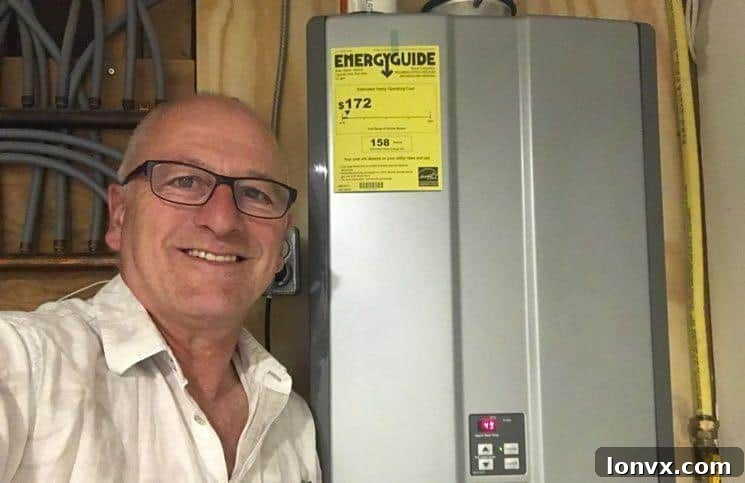
After thorough research and expert consultation, we ultimately chose a Rinnai tankless water heater for our own home. As early adopters, we were particularly drawn to the promise of an endless supply of hot water and the significant space-saving benefits. The availability of an Energy Efficiency Alberta rebate at the time was an added incentive that certainly helped solidify our decision.
So far, our experience has been overwhelmingly positive, though like any new technology, it presented a few initial quirks. Our daughter’s first shower, for instance, started out hot but quickly turned surprisingly cold. The culprit turned out to be our low-flow showerhead; it became clear that on-demand heaters require a certain minimum flow rate to activate and maintain continuous operation. Without sufficient flow, the unit would cycle off, leading to an unexpected cold burst.
Fortunately, this situation was easily remedied with a simple adjustment. By lowering the water heater’s temperature setting from 60°C to 49°C, we effectively increased the proportion of hot water required for a comfortable shower. This minor tweak ensured the water flow rate through the tankless unit remained above the minimum threshold, keeping the heating elements engaged. This adjustment had the added benefit of saving even more energy, as the unit now operates at a slightly lower target temperature. We’ve even been able to enjoy two showers running simultaneously without any loss of hot water!
It’s true that there’s a slight delay—a few seconds longer—for the hot water to reach the tap compared to a traditional tank, where pre-heated water is instantly available. However, once it arrives, it continues to flow consistently and abundantly for as long as needed, a truly liberating experience.
That said, please don’t tell our daughter she can now shower for hours!