
A comprehensive report from RBC Economics reveals crucial insights into the evolving landscape of Canada’s housing market. The analysis suggests that the ongoing housing market correction is significantly moderating, with strong indications that a definitive bottom will be established within the next few months. This anticipated stabilization marks a pivotal moment for potential buyers, current homeowners, and the broader Canadian economy, offering a glimpse into the future trajectory of real estate across the nation.
The report projects an overall peak-to-trough decline of 15 percent in the national RPS Home Price Index. This forecast implies that roughly half of the expected price depreciation has yet to materialize, suggesting that while the worst of the downturn may be behind us in terms of pace, further adjustments are still on the horizon. This period of recalibration is essential for the market to absorb the significant shifts experienced over the past couple of years.
While RBC economists anticipate a gradual and cautious recovery phase commencing later this year, it’s tempered by persistent affordability challenges and a broader economic slowdown that continues to restrain buyer activity. However, the outlook brightens considerably for 2024. As the Canadian economy navigates and eventually clears its current “soft patch,” inflation retreats closer to target levels, and the Bank of Canada potentially reverses some of the substantial interest rate hikes imposed since March 2022, the pace of recovery is expected to gain significant momentum, leading to a more robust and sustained upturn.
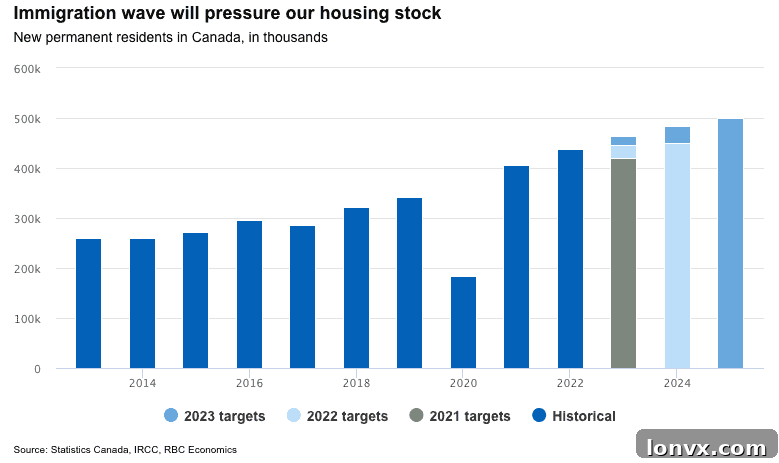
A critical long-term driver for the Canadian housing market remains immigration. Projected to fuel demand throughout the medium term and potentially beyond, sustained high levels of immigration present both an opportunity and a challenge. While it ensures a steady influx of new households seeking homes, it also raises the specter of severe supply shortages if the rate of new housing starts fails to keep pace with this demographic expansion. Addressing this imbalance will be paramount for maintaining market stability and affordability in the years to come.
The Bottom Is Near: Limited Downside Risk Unless Economic Conditions Deteriorate Significantly
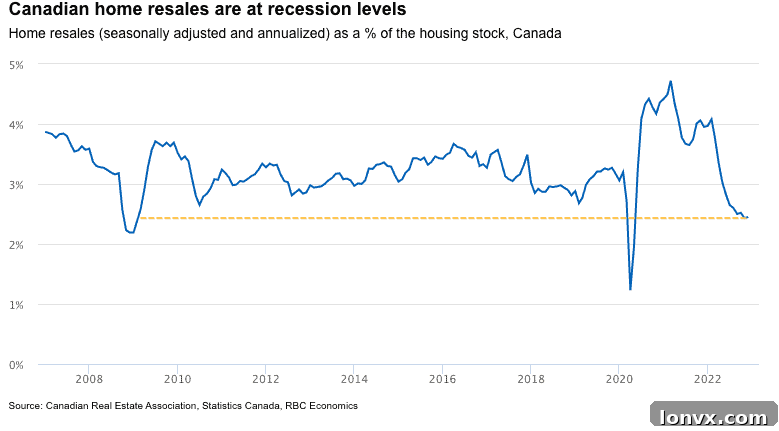
The Canadian housing market experienced a frenetic two-year period, characterized by unprecedented demand and soaring prices, which abruptly ended with a steep slide in home resales starting in March 2020. This dramatic slowdown has, however, largely stabilized since the fall, signaling a potential shift towards equilibrium. RBC Economics now firmly believes that unless the broader economy experiences a severe downturn – a scenario often referred to as “cratering” – the remaining downside risk for home prices and sales is quite limited. This sentiment offers a glimmer of hope for market participants seeking stability after a period of intense volatility.
When accounting for the natural growth in housing stock, nationwide home resales are currently at their lowest levels since the 2008-2009 global financial crisis, excluding the extraordinary lockdown period of spring 2020. This historical context underscores the depth of the recent market correction but also suggests that the market is nearing a baseline, from which recovery can begin. While the national trend indicates a nearing bottom, RBC predicts regional variations. Markets in provinces like Ontario and potentially Atlantic Canada might be leading the recovery charge, forming a bottom sooner due to their unique demand dynamics and economic conditions. Conversely, regions such as the Prairies and Quebec may experience a slight lag, with their market bottoms materializing somewhat later.
Bank of Canada’s Stance: No Further Rate Hikes Expected, But No Immediate Cuts Either
A pivotal factor influencing the housing market is the monetary policy set by the Bank of Canada. RBC’s analysis indicates that the Bank of Canada’s aggressive rate hiking cycle, which saw the policy rate increase by an astonishing 425 basis points in less than a year to reach 4.5 percent, is now likely on hold. The 25 basis-point hike in January 2023 is anticipated to be the final move in this historic campaign to combat inflation. This pause offers some predictability, albeit with continued high borrowing costs, for consumers and businesses alike.
Despite the cessation of rate hikes, RBC economists believe that the interest rate environment will remain restrictive for an extended period. The Bank of Canada is not expected to initiate any rate cuts until well into 2024. This prolonged period of elevated interest rates means that mortgage costs will remain high, impacting buyer affordability and influencing investment decisions throughout the real estate sector. This cautious approach by the central bank reflects its commitment to bringing inflation sustainably back to its target range, even if it means tempering economic growth and housing market activity in the near term.
Persistent Affordability Issues: A Significant Hurdle to Rapid Market Rebound
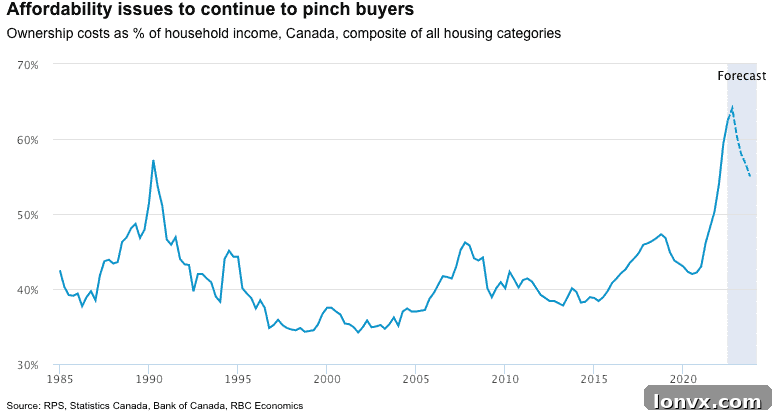
One of the most pressing and enduring challenges facing the Canadian housing market is the issue of affordability. Prospective buyers, particularly in Canada’s most expensive urban centers, will continue to contend with steep financial hurdles. RBC’s report highlights that the dramatic deterioration in housing affordability observed since 2021 is not expected to unwind quickly. This means that despite recent price corrections, the cost of homeownership relative to income remains exceptionally high for many Canadians.
Lingering affordability issues are poised to act as a significant drag on any swift market rebound. The elevated burden of mortgage payments, coupled with high initial home prices and general cost-of-living increases, will continue to constrain buyers’ budgets. This persistent challenge will materially limit the pace at which buyer demand can re-enter the market robustly, thereby preventing a rapid acceleration in home sales and price appreciation. A sustainable market recovery will, in part, depend on a gradual improvement in the affordability equation, which may require a combination of lower interest rates, income growth, and adjustments in housing supply.
Further Price Declines Ahead: Regional Variations in Downside Risk
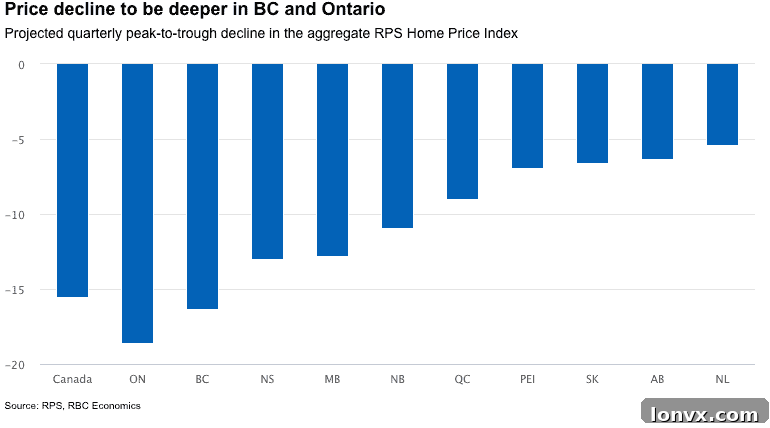
Even as the market correction slows, RBC’s report anticipates that home prices across Canada will experience further declines in the coming months. The national RPS Home Price Index is projected to fall by an additional eight percent by the third quarter of this year, building on the adjustments seen since the fourth quarter of last year. This continued downward pressure will likely be most pronounced in markets that saw the most aggressive price growth during the pandemic-era boom, and consequently, now carry the largest downside risk.
Specifically, markets in British Columbia and Ontario are expected to bear the brunt of these further adjustments, reflecting their higher valuations and greater sensitivity to interest rate changes. RBC’s peak-to-trough price forecasts illustrate this regional disparity: a substantial -19 percent decline is projected for Ontario and -16 percent for British Columbia. In contrast, provinces like Alberta and Newfoundland and Labrador are expected to experience relatively milder corrections, with forecasts of -6 percent and -5 percent, respectively. This highlights the diverse economic and housing market dynamics at play across Canada.
It is also noteworthy that other widely used price measures, such as the MLS Home Price Index (HPI) and the MLS average sales price, have already exceeded RBC’s national peak-to-trough forecast of -15 percent. This divergence can be attributed to the inherent volatility of these measures. They tend to soar higher during dramatic market surges and respond more quickly to downturns, a pattern consistently observed in previous market cycles. The RPS HPI, often considered a more stable and representative index, provides a more smoothed-out view of price trends, offering a clearer picture of the underlying market value adjustments.
Solid Fundamentals Underpin Canada’s Housing Market Long-Term Resilience
Despite the recent period of significant swings and corrections, analysts from RBC maintain that the fundamental underpinnings of the Canadian housing market remain robust. The volatility observed over the past few years can largely be attributed to a confluence of unique factors: the unprecedented circumstances of the global pandemic, which spurred a flight to larger homes and suburban areas, combined with exceptionally low interest rates that made borrowing incredibly cheap. These unusual conditions created an unsustainable boom, and the current correction is a necessary return to more rational market dynamics.
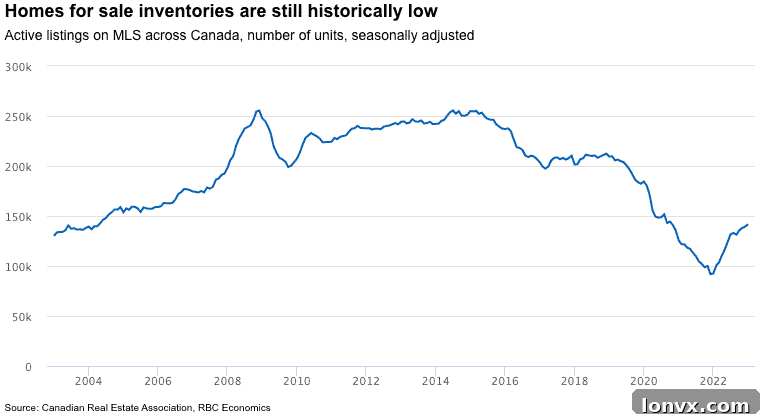
Once the market fully adjusts to the new reality of higher interest rates, analysts predict that these solid fundamentals will reassert themselves as the primary drivers of market activity, particularly starting in 2024. A key indicator bolstering this optimistic long-term view is the historically low inventory of homes for sale across the country. RBC explicitly states that “there are no signs of overbuilding virtually anywhere in the country.” This scarcity of available housing acts as a natural floor for prices and prevents a more severe market collapse, even during periods of reduced demand.
This low inventory is particularly significant when considering Canada’s rapid population growth. The nation has experienced its largest population increase in generations over the past year, fueled significantly by booming immigration. This trend is not expected to abate; robust immigration levels are projected to continue over the medium term. This sustained demographic expansion ensures a consistent and strong underlying demand for housing, providing a powerful counterweight to any temporary market weakness and reinforcing the long-term stability of Canadian real estate.
Addressing Supply Shortages: The Long-Term Imperative for a Balanced Market
While Canada’s housing market benefits from strong fundamentals, analysts caution that the persistent lack of adequate supply poses a significant long-term challenge. Despite an observable pickup in home building activity across Canada over the past three years, the current rate of construction is simply insufficient to meet the supercharged demand for housing, driven largely by the country’s growing population and high immigration targets.
To put this into perspective, analysts estimate that the national housing stock must expand by at least 270,000 units per year by 2025. This ambitious target is not merely to alleviate the existing housing affordability crisis prevalent in many Canadian cities but is a baseline requirement simply to accommodate the projected growth in households. Falling short of this target risks exacerbating current affordability issues, intensifying competition for available homes, and potentially leading to higher price pressures in the future.
A critical question, however, looms over the feasibility of achieving this necessary increase in housing production: does the Canadian construction industry possess the capacity to ramp up production to such an extent? The sector currently faces significant headwinds, including widespread labour shortages, rising material costs, and complex regulatory frameworks at municipal levels. Overcoming these challenges will require concerted efforts from all levels of government, industry stakeholders, and innovative approaches to construction to ensure that Canada can build enough homes for its growing population and secure a balanced, affordable housing market for the future.
For a detailed understanding of these projections and the underlying data, readers are encouraged to review RBC Economic’s full report, authored by Robert Hogue, here.