
Quebec’s Residential Real Estate Market: A Strong Rebound in Q1 2024
The Quebec Professional Association of Real Estate Brokers (QPAREB) has released its comprehensive analysis of the residential real estate market in Quebec for the first quarter of 2024. The report highlights a period of remarkable growth and shifting dynamics, signaling a potential turning point for the province’s housing sector. With a notable surge in transactional activity, both buyers and sellers are navigating an evolving landscape influenced by broader economic factors and regional specificities.
According to QPAREB’s detailed findings, province-wide residential sales soared to 21,337 units during the first three months of 2024. This impressive figure represents a substantial 17 percent increase when compared to the corresponding period in 2023. While this surge is a clear indicator of renewed market vigor, it is important to note that current sales levels, despite their significant year-over-year growth, still sit just below the historical average for this specific time of year. This nuance suggests a market in recovery, but one that is not yet fully returned to its long-term equilibrium.
First Quarter Since 2021 Marks a Double-Digit Sales Increase
The first quarter of 2024 stands out as a pivotal moment, marking the first time since 2021 that Quebec’s residential real estate market has experienced a double-digit rise in sales. This phenomenon has been absent from market reports for the past ten quarters, underscoring the significance of this latest data. Charles Brant, QPAREB’s market analysis director, emphasized this point, stating, “This rebound in activity was observed in all CMAs (Census Metropolitan Areas) across the province, with the exception of Gatineau and Trois-Rivières.” This widespread recovery, affecting the majority of Quebec’s major urban centers, paints a picture of broad-based renewed confidence.
However, Brant also urged a balanced perspective on these encouraging figures. He cautioned, “Although the number of sales seems to indicate a recovery, which will have to be confirmed in the second quarter, it remains slightly below the historical average for this period of the year.” This careful interpretation suggests that while the market is undeniably gaining momentum, a sustained trend will be crucial for a definitive declaration of full recovery. Factors such as ongoing economic adjustments and consumer sentiment will continue to play a vital role in shaping the market’s trajectory through the remainder of the year.
The resurgence in market activity can be attributed to a confluence of economic factors. Brant highlighted the recent decline in the Consumer Price Index (CPI), which has offered some relief to household budgets, as well as optimistic signals emanating from the Bank of Canada. Speculation and expectations surrounding potential interest rate cuts have undoubtedly infused a new sense of urgency and confidence among prospective buyers, many of whom have been waiting on the sidelines for more favorable borrowing conditions.
A Clear Movement Towards Recovery in Many Markets
Beyond the impressive sales figures, Brant further highlighted another crucial development: a notable increase in the number of properties listed for sale across many markets. This expansion in inventory is a positive sign, indicating a move towards greater market fluidity and a more balanced environment for transactions. Increased choice for buyers, especially in segments like small-income properties (plexes), suggests that the intense competition characteristic of recent years might be gradually easing.
A more robust supply of properties on the market typically offers more opportunities for buyers, allowing them more time to make informed decisions and potentially negotiate better terms. This shift is particularly beneficial for first-time homebuyers or those seeking more affordable entry points into the market. However, Brant also tempered this optimistic outlook by pointing out that certain markets, such as the Quebec City CMA, continue to exhibit unbalanced conditions that still predominantly favor sellers. This regional disparity underscores the importance of local market analysis, as the provincial trend does not always apply uniformly across all areas.
First-Quarter Provincial Highlights: A Detailed Overview
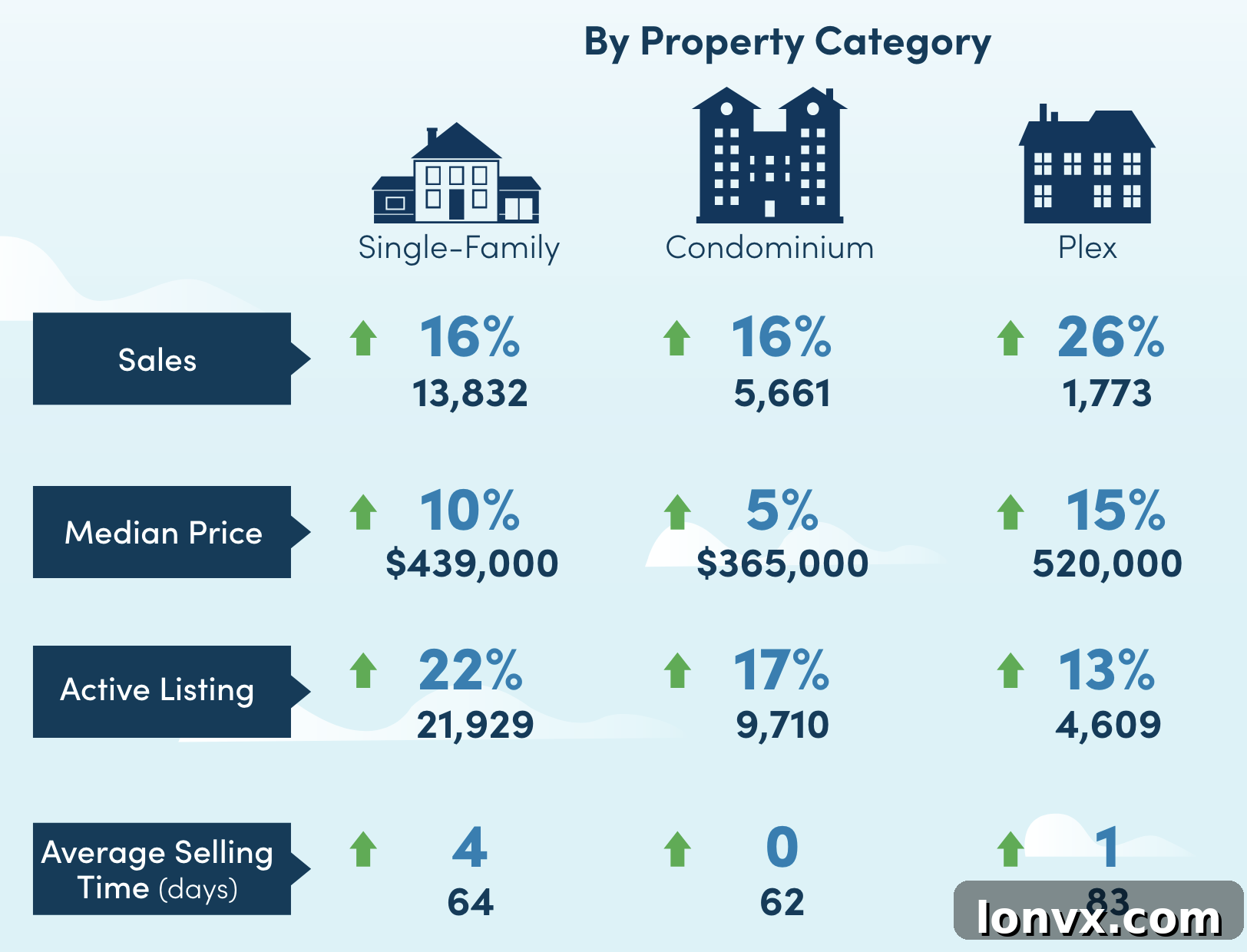
To provide a clearer picture of Quebec’s residential real estate performance, QPAREB’s report breaks down key indicators:
Source: QPAREB
Sales Performance Across Property Categories
Transactional activity demonstrated strong growth across all major property categories. Single-family homes, condominiums, and small-income properties (plexes) all recorded significant increases. Plexes, in particular, experienced a remarkable 26 percent surge in sales, indicating robust demand in the investment property segment. Condominiums and single-family homes also saw substantial gains, with increases ranging from 16 percent to 26 percent respectively, showcasing broad-based market enthusiasm.
Geographically, the growth in sales was most pronounced in specific CMAs. Sherbrooke led the charge with a 34 percent increase, followed closely by Saguenay with 28 percent, and Quebec City with a 21 percent rise. These figures highlight the localized strength of the recovery. Conversely, while many urban centers like Rawdon and Saint-Hyacinthe recorded substantial sales gains, some smaller markets, such as Riviere-du-Loup and Victoriaville, unfortunately witnessed notable declines, illustrating the varied regional landscape of Quebec’s real estate market.
Active Listings: A Boost for Buyer Choice
A crucial factor in balancing the market is the supply of available properties. The first quarter of 2024 saw a significant increase in active listings, surging by 20 percent compared to the same period in 2023. Province-wide, the total number of active listings reached 36,666. This expansion in inventory offers buyers more options and could contribute to a more sustainable and less overheated market in the coming quarters. Increased listings are vital for moderating price growth and providing more time for buyers to evaluate properties.
Median Prices: Sustained Growth
Despite the increase in listings, median prices continued their upward trajectory across all property types, reflecting persistent demand and underlying value appreciation. Single-family homes saw their median price jump by 10 percent year-over-year, while condominiums experienced a 5 percent increase. Small-income properties, perhaps buoyed by investor interest, recorded the most substantial rise in median price, climbing by an impressive 15 percent compared to the previous year. These price movements indicate a healthy appreciation, but also present affordability challenges in certain segments.
Market Conditions: Still Favoring Sellers
Even with the encouraging increase in active listings, the market continues to exhibit characteristics that largely favor sellers. The “number of months required to sell inventory” is a key metric for understanding market balance. At 5.1 months for all property categories combined, this figure remains relatively low, indicating that properties are still being absorbed at a brisk pace. A truly balanced market typically sees this figure closer to 6-7 months. This means that while buyers have more options, sellers still hold a stronger negotiating position in many areas, particularly for well-priced and desirable properties.
Selling Times: Consistency Amidst Change
Interestingly, despite the significant shifts in sales volume and listings, average selling times for different property types remained remarkably consistent when compared to the previous year. Single-family homes averaged 64 days on the market, condominiums averaged 62 days, and small-income properties averaged 83 days. This consistency suggests that while the volume of transactions has increased, the efficiency of the sales process has remained stable, indicating a well-functioning market that is adapting to new levels of activity without significant delays in closing deals.
Regional Nuances and Future Outlook
The QPAREB report clearly illustrates that while the provincial trend is positive, the real estate experience can vary significantly from one region to another. The robust growth in CMAs like Sherbrooke and Saguenay contrasts with slower activity in others, emphasizing the importance of hyper-local market analysis for both buyers and sellers. Factors such as local employment rates, population shifts, and specific housing supply constraints continue to shape regional market dynamics.
Looking ahead, the Quebec residential real estate market appears to be on a path of cautious recovery. The optimism surrounding potential interest rate adjustments by the Bank of Canada, coupled with improving affordability metrics (such as a declining CPI), could sustain the positive momentum observed in Q1. However, challenges such as persistent affordability concerns in high-demand areas and the need for new housing construction to meet long-term demand will remain critical considerations. Market participants should continue to monitor QPAREB’s insights and consult with local real estate professionals to navigate this evolving landscape effectively.
For more detailed statistics and comprehensive analysis, you can review the full reports:
- Province’s first quarter statistics
- March 2024 statistics
Enjoying this article?
Get the latest real estate market insights directly in your inbox multiple times a week to stay up to date on industry news and trends across Canada.