
Shifting Tides: How Rising Interest Rates Are Reshaping Canada’s Homeownership Dream and Investment Outlook
The landscape of Canada’s housing market is undergoing a significant transformation, largely influenced by the sustained rise in interest rates. Recent comprehensive data from the Canada Mortgage and Housing Corporation (CMHC), a national housing agency, offers crucial insights into this evolving dynamic. A pivotal CMHC survey of 4,000 mortgage holders, conducted in January 2023, starkly reveals a noticeable shift in how Canadians perceive homeownership – moving away from its traditional role as an unfailing investment.
A Declining Confidence: Homeownership as an Investment
For decades, owning a home in Canada has been widely considered a cornerstone of financial stability and a robust long-term investment strategy. However, the latest findings from CMHC challenge this deeply ingrained belief. The survey highlights a clear declining trend in the conviction that homeownership is inherently a good investment, signaling a period of introspection and reconsideration among both current homeowners and prospective buyers.
CMHC’s ongoing analysis of consumer sentiment, spanning the last five years, pinpoints 2023 as a critical juncture. It represents a low point in overall perceptions concerning the complexities of the mortgage process and, more broadly, the tangible benefits historically associated with homeownership. While a significant majority—81 percent of Canadians—still hold the view that a home is a sound long-term financial asset, this figure marks a notable descent from 91 percent recorded in 2022. This 10-percentage-point drop within a single year underscores the profound impact that escalating interest rates and persistent affordability challenges are having on the collective psyche of the Canadian populace.
Furthermore, the report casts a revealing light on future expectations regarding property values. Only slightly more than half of all respondents (55 percent) anticipate that their home’s value will appreciate over the subsequent 12 months. This represents a dramatic decline from the 84 percent who held similar optimistic views in 2022. Such a drastic shift in sentiment has far-reaching implications, potentially influencing market activity, selling decisions, and investment strategies across the nation. The erosion of this confidence signals a more cautious and perhaps realistic outlook among Canadians regarding real estate as an investment vehicle, particularly in volatile economic conditions.
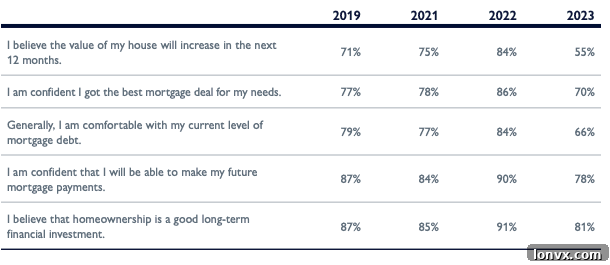
The last 5 years in trends: How mortgage consumers are feeling, CMHC
Navigating Uncharted Waters: Increasing Uncertainty in the Homebuying Journey
Beyond investment perceptions, the rising interest rate environment is injecting a substantial degree of uncertainty into the practical aspects of the homebuying process itself. The CMHC report vividly illustrates how these economic pressures are reshaping Canadians’ financial stability and their approach to property acquisition.
A substantial 61 percent of Canadians—a figure encompassing both first-time purchasers and repeat buyers—explicitly voice their apprehension and uncertainty about the intricate homebuying process. This widespread sentiment reflects a challenging market where previous assumptions about predictable outcomes no longer hold. For both segments of buyers, the paramount concern cited is the risk of ‘paying too much’ for a property, a worry intensified by fluctuating interest rates that directly impact borrowing costs and overall affordability. This fear is rooted in the memory of recent market peaks and the current environment where property values may not always justify the elevated purchase prices when coupled with high borrowing costs.
The financial journey of homeownership often comes with unforeseen hurdles. The survey revealed that over a third of existing homeowners (35 percent) encountered unexpected costs during their property acquisition. These can range from unforeseen repair expenses discovered post-inspection, escalating legal fees, adjustments in property taxes, appraisal discrepancies, or even sudden increases in insurance premiums. Such additional expenditures can significantly strain a buyer’s budget and contribute to substantial financial stress, especially for those already stretching their finances to enter the market.
In a testament to the escalating financial barriers to entry, nearly 40 percent of recent buyers who received a monetary gift to facilitate their home purchase explicitly stated that they would not have been able to secure a home meeting their needs without this crucial financial assistance. This statistic highlights a growing reliance on external support, often from family, indicating that the dream of homeownership is becoming increasingly inaccessible for many Canadians relying solely on their own income and savings. It underscores a widening gap between aspiration and financial reality for a significant portion of the population.
Interest Rates and the Erosion of Financial Stability
The Bank of Canada’s proactive measures to combat inflation through successive interest rate hikes have had a direct and palpable impact on the financial well-being of Canadian households. The CMHC survey quantifies this effect, revealing a significant segment of the population grappling with the immediate and anticipated consequences.
Approximately half of all survey respondents (50 percent) reported already experiencing the adverse effects stemming from the increase in mortgage interest rates. This could manifest as higher monthly payments for those with variable-rate mortgages, or renewed mortgages at significantly elevated rates. Compounding this immediate pressure, a substantial 74 percent anticipate facing future impacts, suggesting a broad-based expectation of continued financial strain as more mortgages come up for renewal or as the full effect of variable rates is felt across the economy. This widespread concern highlights a collective anxiety about future household budgets.
Among those who have already felt the pinch of rising rates, a worrying 49 percent admit to facing difficulties in maintaining their various debt payments, which prominently include their mortgage obligations. This statistic paints a concerning picture of household vulnerability, where increased housing costs are squeezing budgets to the point of compromising other financial commitments like credit card payments, car loans, or lines of credit. Such widespread debt servicing challenges could have broader implications for consumer spending, overall economic stability, and potentially lead to an increase in defaults if not adequately addressed by individual financial planning or supportive policies.
The Broader Economic Context: Inflation, Affordability, and Policy
Understanding these shifts requires an appreciation of the broader economic environment in Canada. The Bank of Canada, in its persistent fight against stubbornly high inflation, has systematically raised its policy rate. While these measures aim to cool the economy and bring price stability, their ripple effect has been most acutely felt in the housing sector. Mortgage rates, directly tied to the central bank’s actions, have surged, leading to a dramatic increase in borrowing costs. This has, in turn, severely impacted affordability, pushing homeownership further out of reach for many and adding significant financial pressure on existing homeowners who must navigate renewed mortgages at significantly higher rates.
The repercussions of these economic changes are not uniform across all demographics. First-time homebuyers, often relying on maximum borrowing capacity and having less accumulated equity, are disproportionately affected. They face a double whammy of higher interest rates and still-elevated home prices, making the down payment and subsequent mortgage payments formidable hurdles. Existing homeowners with variable-rate mortgages have seen their monthly payments jump, forcing many to re-evaluate their household budgets. Those with fixed-rate mortgages nearing renewal face the prospect of significantly higher payments, sometimes hundreds or even thousands of dollars more per month, creating a significant ‘payment shock’ that can destabilize household finances.
While the CMHC survey provides a national overview, it’s crucial to acknowledge that the impact of rising rates and affordability challenges can vary significantly across different Canadian regions. Major metropolitan areas like Toronto and Vancouver, which historically boast some of the highest home prices, tend to experience these pressures more acutely due to their already high cost of living. However, even in traditionally more affordable markets, the sudden increase in borrowing costs has eroded purchasing power, impacting local real estate dynamics and buyer confidence. This regional disparity underscores the complex and varied challenges facing Canada’s diverse housing landscape.
Navigating the Future: Strategies for Homebuyers and Homeowners
In light of these challenging market conditions, both aspiring homebuyers and current homeowners are being compelled to adopt more cautious and strategic approaches to their housing decisions.
Prospective homebuyers are increasingly advised to conduct thorough financial planning, including stress-testing their budgets against even higher potential interest rates. Exploring options like extended amortization periods, where feasible, or considering more affordable property types and locations may become necessary to achieve homeownership. Financial literacy, understanding complex mortgage terms, and seeking professional advice from reputable mortgage brokers and financial advisors are more crucial now than ever before to make informed decisions and avoid financial distress. Building a larger down payment and having an emergency fund are also prudent steps in this uncertain climate.
Current homeowners, particularly those with variable-rate mortgages or fixed rates nearing renewal, should proactively engage with their lenders. Options such as locking into a fixed rate for stability, increasing payment frequency to reduce overall interest, making lump-sum payments if possible, or even exploring refinancing options might be considered to mitigate the impact of rising costs. Reassessing household budgets and identifying areas for saving can also provide a crucial buffer against increased mortgage expenses, ensuring long-term financial resilience.
CMHC’s Role and Future Outlook
The Canada Mortgage and Housing Corporation plays a vital role in monitoring, analyzing, and reporting on the health of the Canadian housing market. Their regular surveys and reports serve as essential barometers, guiding policy-makers, industry professionals, and consumers alike. The data from this recent survey underscores the urgent need for continued vigilance and potentially innovative policy solutions to address the deepening affordability crisis and restore confidence in the housing sector. CMHC’s insights are indispensable for fostering a stable and accessible housing market for all Canadians.
The findings from the CMHC survey paint a clear picture: Canada’s housing market is at a crossroads. The era of viewing homeownership as an automatic, surefire investment is being tempered by new economic realities. Rising interest rates have not only tightened household budgets but have also fostered a climate of uncertainty regarding the future trajectory of property values and the accessibility of homeownership. As the nation grapples with these evolving dynamics, the focus will undoubtedly shift towards sustainable housing solutions that balance market stability with the fundamental human need for affordable and secure shelter. This will require a concerted effort from all stakeholders – government bodies, financial institutions, and individuals – to navigate these challenging waters and build a more resilient housing future for all Canadians, ensuring that the dream of homeownership remains attainable and sustainable for generations to come.