
Unifying Ontario’s Real Estate Market: The Push for Province-Wide MLS Data Access
For far too long, the real estate landscape in Ontario has been characterized by a fragmented approach to MLS data access, creating significant hurdles for realtors across the province. This intricate web of disparate systems has become a persistent challenge, limiting efficiency, hindering comprehensive market understanding, and ultimately impacting client service. However, a powerful call for change is resonating throughout the industry, championed by Information Technology Systems Ontario (ITSO). This not-for-profit corporation is leading the charge for province-wide access to MLS data, recognizing that a unified system is not merely an improvement, but an essential step forward for the modern real estate professional.
ITSO is not just identifying a problem; it’s actively seeking solutions. To this end, the organization recently hosted a pivotal all-day meeting in Toronto, bringing together key real estate boards and associations from across Ontario. The objective was clear: to foster collaborative dialogue and forge a pathway towards a seamless, province-wide data access model. This initiative underscores a collective realization that the current state of affairs is unsustainable and that the time for a unified approach is now.
Allison McLure, the executive director of ITSO, articulates the core principle behind this movement with unwavering clarity: “Realtors are licensed in the province of Ontario, so realtors should have access to all data in the entire province, full stop.” This statement encapsulates the fundamental belief that a provincial license should inherently grant access to provincial market information, ensuring that every realtor can operate with the full scope of available data, regardless of their specific board affiliation.
ITSO plays a crucial role in the existing data ecosystem, currently managing MLS listing content for 18 member boards and associations within Ontario. Furthermore, it extends data access to an additional 24 associations through carefully established data-sharing agreements. This foundational experience positions ITSO uniquely to understand the complexities and potential solutions involved in expanding data access on a truly provincial scale, leveraging its existing network and expertise to facilitate this ambitious transformation.
The Burden of Fragmentation: Disjointed Systems and Escalating Costs
The current state of fragmented MLS data access imposes a significant burden on Ontario’s real estate professionals. McLure emphasizes that for realtors to effectively fulfill their fiduciary duties to clients, partial access to listings is simply inadequate. “It’s not good enough to have 50 per cent of listings or 90 per cent of listings. You have to have all of them,” she asserts. This isn’t just a matter of convenience; it’s a fundamental requirement for providing accurate, comprehensive advice and ensuring clients make informed decisions based on the entire market picture. Without a complete data set, realtors risk overlooking crucial opportunities or providing advice based on an incomplete understanding of market dynamics.
The provincial landscape is dotted with independently operating systems. McLure points out that major hubs like the Toronto Regional Real Estate Board (TRREB) and Ottawa maintain their own distinct regional systems. Similarly, other significant regions such as Chatham-Kent, Sarnia-Lambton, and Windsor-Essex also operate separately. While some reciprocal agreements exist to bridge gaps between certain boards, McLure notes that genuine, broad-scale collaboration beyond these individual groups remains notably limited. This creates a patchwork effect, forcing realtors to navigate a labyrinth of different databases and protocols.
A direct consequence of this fragmentation is the substantial financial strain placed upon realtors. To access data beyond the confines of their primary “home” boards, professionals are often compelled to pay additional subscriber fees, interboard fees, or even obtain dual or multiple memberships. These costs are not static; they continue to climb, eating into realtors’ profit margins and creating an unfair competitive disadvantage for those operating across regional boundaries. However, as McLure rightly affirms, the issues extend far beyond mere financial implications.
The ITSO executive highlights a significant erosion of consumer trust. Many consumers, seeking a holistic view of the market, frequently bypass their realtors’ MLS systems and instead turn to virtual office websites or popular platforms like Realtor.ca. Their perception is often that these public-facing portals offer a more comprehensive range of listings compared to what their own realtor can provide directly through a segmented MLS system. This disparity reflects negatively on the entire real estate industry, diminishing the perceived value of a realtor’s expertise and comprehensive market knowledge. McLure insists that realtors must be equipped to offer their clients unfettered access to all available listings, reinforcing their role as trusted, knowledgeable advisors. The current limitations not only frustrate realtors but also undermine their professional standing in the eyes of the public.
“Without access to a comprehensive data set for the entire area, realtors face challenges when it comes to pricing properties and conducting comparative analyses.”
– Tyson Hinschberger, President, GDAR
Tyson Hinschberger, President of the Guelph and District Association of Realtors (GDAR) and an ITSO member association, openly acknowledges the immense benefits that come with seamless access to data across different municipalities. Such access is crucial for understanding broader market trends, identifying opportunities, and advising clients effectively regardless of their specific geographical interest. However, Hinschberger also clearly identifies that the current fragmented structure of associations across the province acts as a significant impediment, preventing realtors from efficiently and easily transacting business in diverse markets. This friction not only slows down the process but also adds unnecessary complexity to what should be straightforward transactions.
He further elaborates on the critical professional implications of this data gap: “Without access to a comprehensive data set for the entire area, realtors face challenges when it comes to pricing properties and conducting comparative analyses.” This lack of complete data directly impacts a realtor’s ability to perform accurate Comparative Market Analyses (CMAs), a cornerstone of their service. Inaccurate pricing, whether too high or too low, can lead to prolonged listing periods, missed sales opportunities, or financial detriment for clients. A unified data source is essential for providing robust, evidence-based valuations that instill confidence in both buyers and sellers.
Ken Dekker, President of the Ottawa Real Estate Board, while noting that his board is not currently an ITSO member, unequivocally expresses his support for an agreement that would grant all Ontario realtors access to province-wide data. His endorsement highlights the widespread recognition of this issue even among boards not directly affiliated with ITSO’s current operations. Dekker articulates the core professional responsibility: “Our responsibility to a client is to find any property that may suit their requirements that they’ve given us. And if that requires being members of multiple boards to search for the data, then that’s something under our fiduciary responsibility we need to do.” He remains confident that transitioning to a single, comprehensive source of data would efficiently resolve this existing challenge, enabling realtors to fully meet their ethical and professional obligations without undue burden.
The Toronto Regional Real Estate Board (TRREB), a behemoth in the Ontario real estate market, operates its own extensive MLS system and maintains partner boards throughout the Greater Toronto Area (GTA) and surrounding regions. When approached for comments regarding this province-wide initiative, a representative for TRREB stated that the board had no official comment at that time. However, their confirmation of attendance at the highly anticipated meeting signifies a crucial engagement with the ongoing dialogue. Their participation is vital, given their significant influence and the sheer volume of data they manage. McLure confirmed the strong interest in the initiative, with representatives from 28 out of the province’s 34 real estate boards and associations agreeing to attend the meeting. This overwhelming participation underscores the widespread recognition of the problem and a collective appetite for finding a workable solution across the industry.
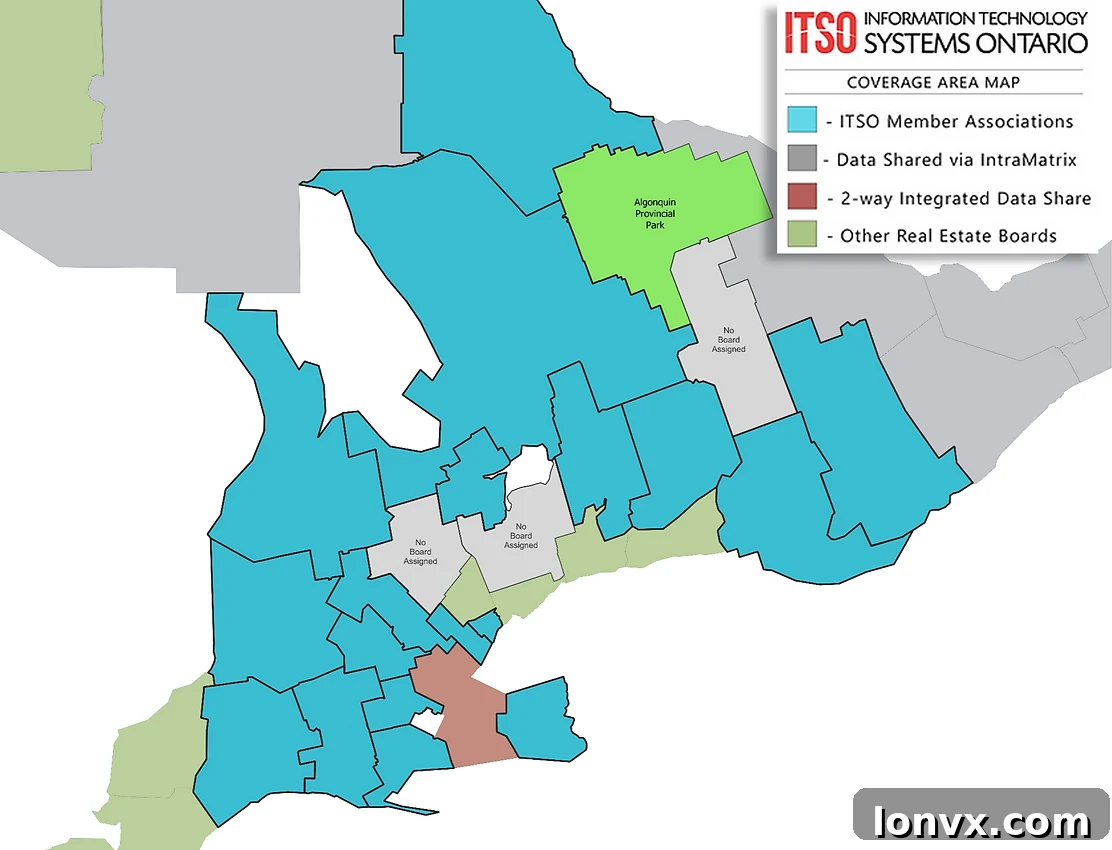
Source: ITSO
Navigating the Path Forward: Challenges and Complexities in Data Unification
While the aspiration for province-wide MLS data access garners significant support, the journey towards its realization is fraught with inherent challenges and complexities. McLure explains that different boards and associations across Ontario hold varying philosophical approaches when it comes to data sharing. Some institutions adopt a more restrictive stance, viewing their data as a proprietary asset to be guarded closely, often driven by concerns over competitive advantage or revenue streams derived from data access. Conversely, other boards are more open to the concept of broader data sharing, recognizing the collective benefit it can bring to the entire real estate community and, by extension, to consumers. Reconciling these divergent philosophies represents the initial, and perhaps most significant, hurdle in reaching a consensus.
Even once a general agreement among the boards for comprehensive data sharing is achieved, this marks merely the first step. Several substantial challenges must be systematically addressed and overcome before any practical implementation can take place. The sheer scale and diversity of the existing systems present a formidable task, requiring meticulous planning and execution.
McLure highlights the profound technological complexities involved in opening up access to data across a multitude of disparate real estate systems. Each MLS system may have its own unique data structures, taxonomies, and operational protocols. Aligning data from these various systems, ensuring consistency, accuracy, and interoperability, is not a trivial undertaking. It demands significant technological investment, the development of robust integration platforms, and a meticulous process of data standardization. These are not issues that can be resolved overnight; they require dedicated resources, expert technical teams, and a phased approach to implementation.
Beyond the technical intricacies, Ken Dekker also raises critical concerns regarding data security. He emphasizes that the data currently held within the MLS systems is owned by the local boards, and any expansion of access must be accompanied by stringent safeguards. There is a paramount need for comprehensive data agreements and robust security protocols to prevent misuse, unauthorized access, or breaches of sensitive property and client information. These agreements would need to define clear terms of use, establish accountability mechanisms, and outline strict compliance requirements to protect data integrity and privacy. Building a secure, trusted, and unified data environment is as important as the unification itself.
Fostering Collaboration: Enlisting Experts for a Unified Future
Recognizing the multifaceted nature of these challenges and the importance of expert guidance, ITSO has proactively enlisted seasoned professionals to facilitate the ongoing dialogue. To ensure productive discussions at the recent meeting, Matt Fullbrook from Fullbrook Board Effectiveness was brought in. Fullbrook’s expertise in governance and board dynamics is invaluable for guiding diverse stakeholders toward common ground and fostering an environment conducive to consensus-building. The meeting also featured a compelling presentation by Sam DeBord, Chair of the Real Estate Standards Organization (RESO). DeBord’s insights into industry standards, data interoperability, and technological advancements in real estate are crucial for informing the practical aspects of implementing a province-wide data solution, drawing from best practices established globally.
Hinschberger expresses considerable optimism about the potential for an open and truly productive discussion between all stakeholders involved. His perspective underscores the prevailing sentiment that despite past obstacles, there is a strong collective will to move forward. He articulates this hope, stating, “In the spirit of collegiality and collaboration for the benefit of the consumer, I think it’s good to have those dialogues and see if we can find common ground on some of the issues that may have plagued things in the past.” This focus on collegiality and the ultimate benefit to the consumer is a powerful driving force, suggesting that the industry is ready to set aside historical fragmentation in favor of a more unified and client-centric approach.
The pivotal meeting represents a critical and tangible step in addressing the long-standing issue of fragmented access to MLS data in Ontario. McLure clearly states ITSO’s overarching goal: to conceptualize and implement a robust solution that empowers realtors with seamless access to comprehensive data sets across the entire province. This vision extends beyond mere data sharing; it aims to revolutionize how real estate professionals operate, enhancing their capabilities and efficiency.
By systematically removing the artificial barriers and limitations imposed by the current regional systems, ITSO believes that realtors will be able to significantly improve their operational efficiency, enhance their bottom line through reduced costs and increased market reach, and most importantly, deliver a vastly superior level of service to their clients. A unified MLS data system is not just an technological upgrade; it is an investment in the professionalism, competitiveness, and future success of the entire real estate industry in Ontario, positioning it for continued growth and innovation in a rapidly evolving market. This collaborative effort promises to unlock unprecedented opportunities for both real estate professionals and the communities they serve.