
The Canadian Real Estate Association (CREA) began 2026 with a notable announcement: home sales experienced a 5.8 percent month-over-month decline in January, a downturn they largely attributed to a “historic winter storm” impacting Central Canada. This explanation, while convenient, prompts a deeper inquiry into the underlying health of the national housing market.
However, a closer examination of the data suggests that attributing this significant shift solely to inclement weather might be an oversimplification. The reality on the ground appears to be far more complex, pointing towards structural adjustments rather than fleeting environmental influences.
The Numbers Tell a Different Story: Beyond the Weather Excuse
January’s national housing data paints a picture that significantly diverges from the narrative of mere weather-induced suppression. The figures reveal trends that suggest a more profound rebalancing is underway in the Canadian real estate landscape.
- Sales: Down 5.8% month-over-month, indicating a tangible cooling in buyer activity.
- Sales: A substantial 16.2% decrease year-over-year, a statistic that weather events alone struggle to explain comprehensively.
- New Listings: An increase of 7.3% month-over-month, showing a significant surge in properties entering the market.
- Home Price Index (HPI): A decline of 0.9% month-over-month, signaling a nascent downward pressure on home values.
- Home Price Index (HPI): A 4.9% decrease year-over-year, reflecting a broader trend of price softening across the nation.
- Average Price: Reached $652,941, representing a 2.6% drop year-over-year.
A 16.2 percent year-over-year decline in sales cannot logically be explained by a single month’s snowstorm. Furthermore, severe weather typically localized to Central Canada would not cause a nationwide deterioration across multiple provinces. Nor would it compel sellers across two-thirds of the nation’s markets to suddenly introduce a rush of new inventory. These statistics challenge the notion of a temporary blip, instead hinting at something more fundamental.
If anything, January’s performance looked less like suppressed activity due to a snowstorm, and considerably more like a significant structural shift that market participants should begin to acknowledge and adapt to. While it might feel slow when compared to the frenetic pace of the “new normal” market conditions many became accustomed to during the pandemic era, the truth is that Canada’s housing market appears to be reverting to an “old normal” state—characterized by a slower, more measured, and steady pace. This return to historical averages signifies a period of crucial re-evaluation for both buyers and sellers.
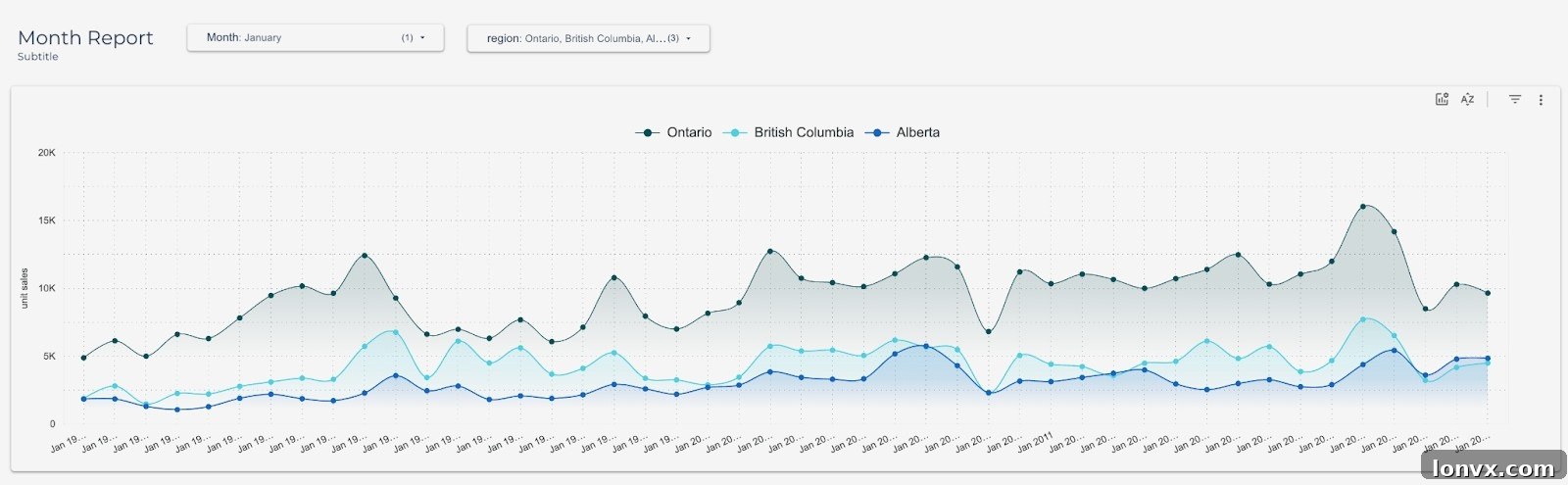
Source: Daniel Foch, Valery.ca calculations
Supply Is Rising, Demand Is Hesitating: A Clear Market Shift
One of the most compelling pieces of evidence against the snowstorm narrative is the significant jump in new listings. They surged by 7.3 percent in just one month, a movement that is far from subtle and impossible to attribute to adverse weather conditions. Sellers, unlike potential buyers, are not typically deterred by heavy snowfall when deciding to list their properties. This surge in supply, therefore, indicates an intrinsic change in market sentiment among homeowners.
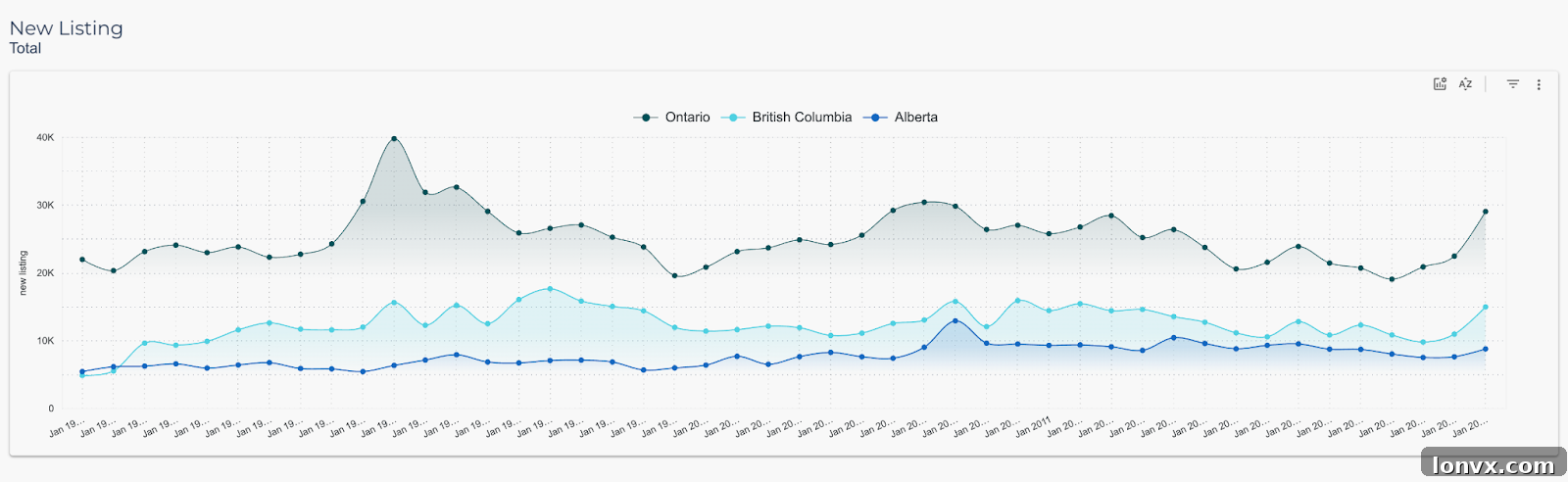
Source: Daniel Foch, Valery.ca calculations
Even more critically, this upward trend in new listings was not confined to a single region like Ontario, which might have been disproportionately affected by a storm. Instead, it was led by a diverse array of major Canadian metropolitan areas, including:
- Montreal, Quebec
- Quebec City, Quebec
- Calgary, Alberta
- Greater Vancouver, British Columbia
- Victoria, British Columbia
The widespread nature of this increase in supply, coupled with a national decline in transactional activity, unequivocally signals a shift in market leverage. It is not about weather; it is about the balance of power moving from sellers to buyers. This fundamental change is a critical indicator for the direction of the Canadian housing market.
The sales-to-new listings ratio, a key metric for gauging market balance, plummeted sharply to 45 percent in January, a significant drop from 51.3 percent recorded at the close of 2025. For context, the long-term average for this ratio typically hovers around 54.8 percent. A balanced market is generally considered to exist when this ratio falls between 45 percent and 65 percent. The current positioning at the very bottom of this “balanced” territory, bordering on buyer’s market conditions, is highly indicative. As markets lean more towards buyers, the process of price discovery intensifies, leading to further adjustments in home values.
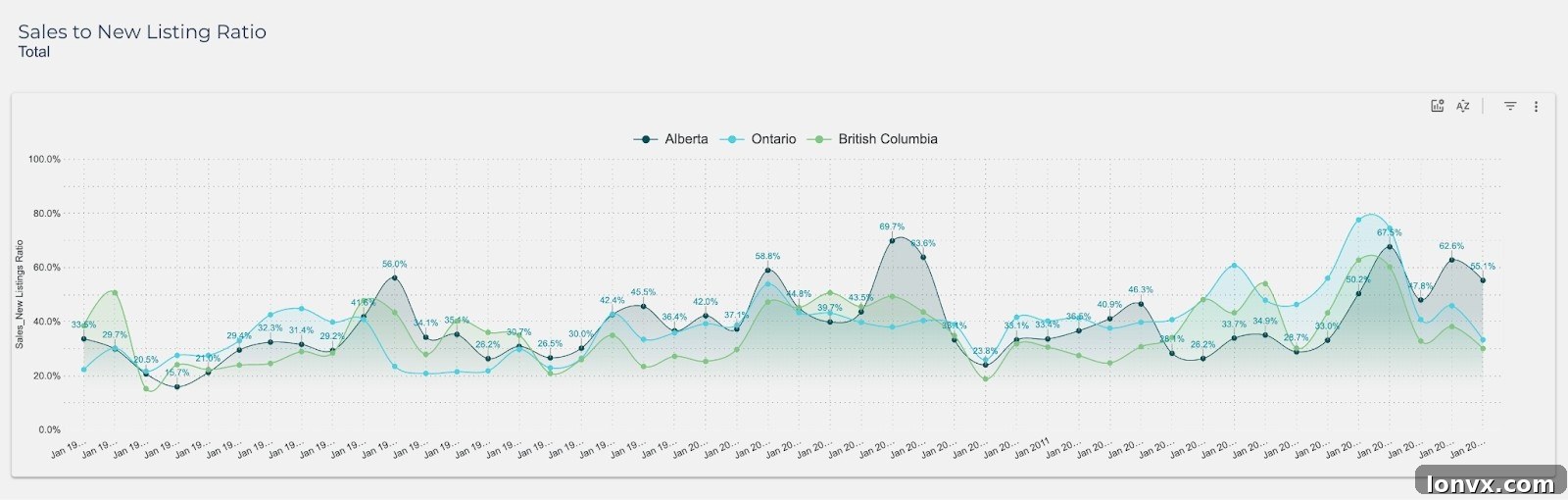
Source: Daniel Foch, Valery.ca calculations
Furthermore, the months of inventory, another vital indicator of market supply relative to demand, increased to 4.9 months, up from 4.6. This metric indicates how long it would take to sell all current listings at the current rate of sales. As previously noted, the market is finding its way back to an “old normal,” where the long-term average for months of inventory typically sits around five months. A market with less than 3.6 months of inventory is generally considered a seller’s market, while anything above 6.4 months would suggest a buyer’s market. While not yet fully entrenched in a buyer’s market, the current behavior and psychology strongly resemble one, a sentiment that has been palpable for the past year. Housing markets are profoundly influenced by momentum and psychological factors. When prospective buyers perceive that they have ample time, they tend to wait, anticipating further favorable shifts. Conversely, when sellers detect hesitation among buyers, competition intensifies, prompting them to adjust their expectations. This dynamic precisely mirrors the market conditions observed in January. This is the very reason why economists often express concern about deflationary spirals: improving prices can lead to a belief that prices will continue to improve, incentivizing buyers to delay purchases further, thus perpetuating the downward trend.
The Slow Grind Phase: Understanding Housing Market Corrections
There is a prevalent misunderstanding regarding the mechanics of housing downturns. Contrary to popular belief, they seldom manifest as a single, dramatic collapse, unless triggered by exceptionally violent spikes in interest rates, such as those witnessed in 2022. Instead, the typical progression of a market correction follows a more predictable sequence:
- Initial slowing of transactional activity.
- A gradual, yet steady, build-up of inventory.
- Subsequent pressure on prices begins to emerge.
- A prolonged “grind downward” phase commences.
The sharp, sudden drop in market activity and prices was indeed observed in 2022. What we are now experiencing is the subsequent, enduring “grind” phase. The MLS Home Price Index, a reliable measure of home values, fell by 0.9 percent month-over-month in January. If this monthly volatility were to be aggressively extrapolated over a year, it could imply an annualized decline of 10 to 12 percent, though such aggressive extrapolation should be tempered with caution due to the inherent monthly fluctuations. Nonetheless, it signals significant ongoing pressure.
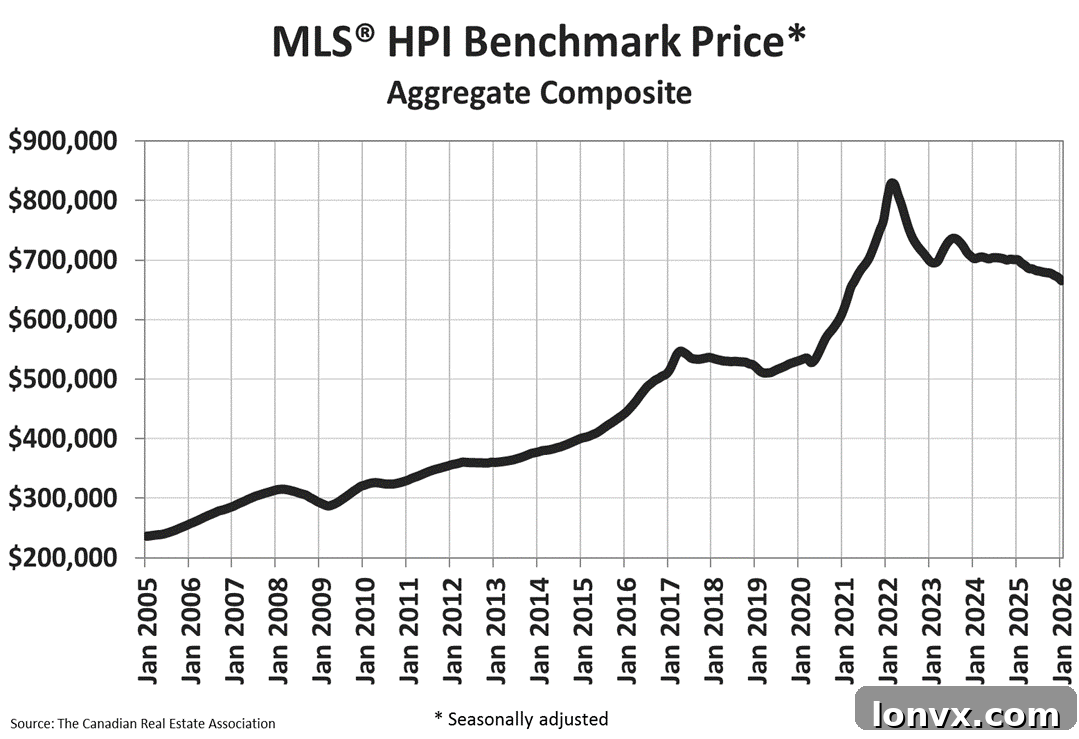
On a year-over-year basis, home prices have now declined by 4.9 percent. More dramatically, from their peak, the national average price has fallen by approximately 30 percent. This represents a massive erasure of equity for many sellers, yet simultaneously presents a significant improvement in odds for potential buyers. The lingering question remains: if conditions are improving for buyers, why are so many still remaining on the sidelines, waiting to enter the market?
Regional Fragmentation: A Late-Cycle Market Pattern Emerges
The geographic spread of price declines further reinforces the idea of a market correction rather than a weather-induced anomaly. Year-over-year price declines have become increasingly apparent across a broad spectrum of Canadian provinces, including:
- British Columbia
- Alberta
- Ontario
- New Brunswick
- Nova Scotia
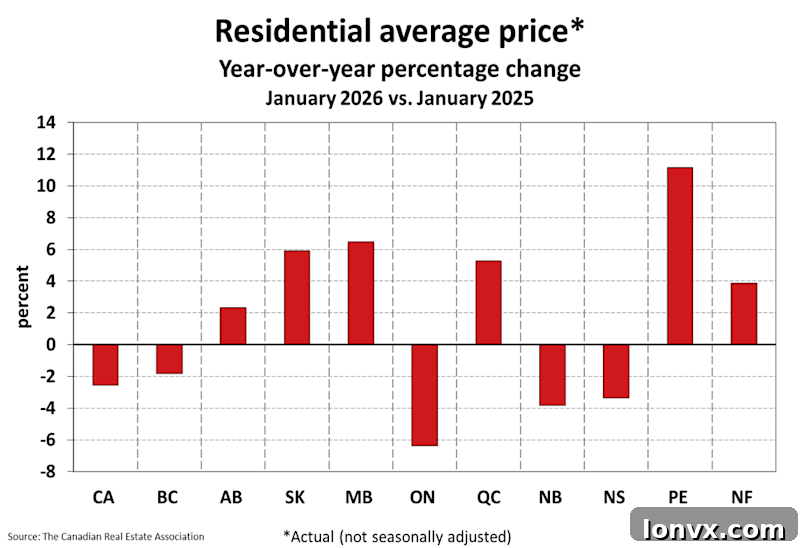
Conversely, smaller, more affordable markets such as Sudbury, Quebec City, and St. John’s have actually posted gains. This pattern underscores a crucial market dynamic: affordability remains the primary stimulant for housing activity in challenging environments. When peripheral, more budget-friendly markets begin to outperform established core urban centers, it often serves as a significant signal of late-cycle market dynamics. In such periods, capital typically retreats from higher-beta, highly leveraged markets first, seeking safer, more accessible investment opportunities. These trends, combined with Ontario’s unemployment rate hovering around seven percent, Canada’s household leverage remaining among the highest in the G7, and restrictive mortgage rates, paint a clear picture. Mere centimeters of snow cannot alter these deep-seated economic realities. The housing market, it appears, is merely progressing through a necessary and inevitable cycle of completion.
The “Pent-Up Demand” Question: A Closer Look
CREA continues to assert that 2026 will ultimately be characterized by a surge in pent-up demand, particularly from first-time homebuyers. While this may eventually prove true, its realization is contingent upon several critical factors that are currently not optimally aligned. Pent-up demand only translates into tangible market activity if:
- Prospective buyers are able to qualify for mortgage financing under current, often stringent, conditions.
- Buyers feel a strong sense of security in their employment, minimizing economic uncertainty.
- Buyers genuinely believe that home prices are poised to rise, providing an incentive for immediate action.
- Buyers perceive a genuine sense of urgency, fearing being priced out or missing opportune entry points.
At present, affordability remains significantly stretched for many Canadians. Income growth has not accelerated materially enough to offset rising housing costs and high interest rates. Investor activity, a historical driver in certain segments, is largely subdued outside of government-insured multi-unit programs. Furthermore, population growth, while still positive, has slowed sharply, potentially reducing a key source of demand. Most critically, buyers simply do not feel any sense of urgency in the current climate, and given the prevailing market dynamics, they have little reason to. The theoretical concept of pent-up demand does not translate into actual transactions if buyers face qualification hurdles or lack confidence in the economic outlook. And frankly, there isn’t a great deal to feel confident about in Canada’s broader economy right now. Could this situation change later this year once the CUSMA agreement is finalized and clearer? Only time will tell. However, it would be premature to foster excessive excitement based on this potential shift alone.
Less Like Snow, More Like Normalization: Back to the “Old Normal”
When one steps back and observes the broader trends in the Canadian housing market charts, a compelling pattern emerges: January 2026 does not look like a catastrophic collapse, but rather a discernible return to normalization. For the better part of the last five years, many sectors, including real estate, constantly spoke of a “new normal.” However, the housing market appears to be bucking this trend, instead reverting to what might be termed the “old normal.”
Current sales volumes are now aligning with long-term historical averages. Similarly, inventory levels are approaching their long-term average marks. The sales-to-new listings ratio, while appearing weak when compared to the exceptionally hot markets of recent years, still falls within historical ranges, signifying a more balanced market environment. What has undeniably shifted, however, is the direction of travel. We are no longer operating within the confines of a post-pandemic scarcity market, characterized by intense bidding wars and rapidly escalating prices. Nor are we in the era where “rates are zero, buy now or be priced out forever” was the prevailing mantra. Instead, Canada’s real estate market is now characterized by a new set of dynamics:
- Supply is consistently meeting buyer hesitation, leading to longer market times.
- Buyers are increasingly gaining leverage, allowing for more negotiation power.
- Price growth is significantly capped, with many areas experiencing declines.
- Market expectations for both buyers and sellers are undergoing a fundamental reset.
2026: A More Challenging Year Than 2025?
January 2026 proved to be significantly weaker than January 2025. It is important to remember that 2025 itself was already recognized as one of the slowest years on record in several major Canadian markets. This sluggish start to 2026, therefore, carries considerable weight. Even if interest rate cuts were to materialize, they would likely arrive in response to deteriorating economic conditions, rather than a sign of robust growth. Historically, individuals are not inclined to aggressively leverage themselves to purchase homes during periods of economic recession or significant uncertainty. As it stands, this January marks the second-slowest start to the year in the last 15 years, a stark indicator of current market sentiment and activity.
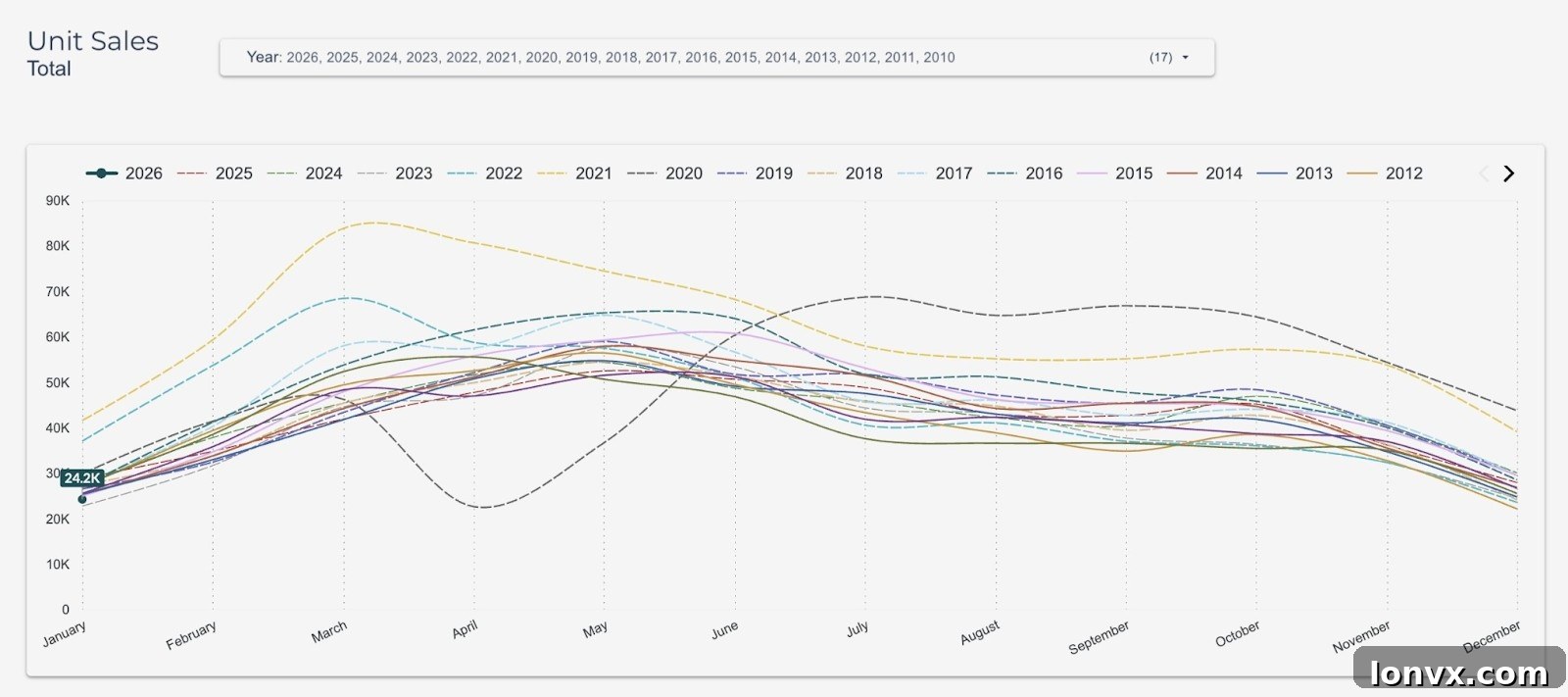
While the weather in January may indeed have been cold, the comprehensive data strongly suggests that the slowdown in the Canadian housing market runs far deeper than mere meteorological conditions. The more pressing question for 2026 is not whether a snowstorm temporarily delayed demand. Instead, it is whether Canada’s housing market is finally undergoing a fundamental transition from a period of artificial scarcity and exuberance to one of sustainable balance. Crucially, this transition raises the further question of whether achieving such a sustainable balance will necessitate further price adjustments before true, robust activity can genuinely recover.