
In an era defined by economic shifts, the Canadian housing market has demonstrated remarkable resilience. Despite a series of interest rate hikes that began to ripple through major Canadian housing markets in 2022, homeowners are surprisingly well-positioned to navigate the evolving economic landscape. A recent report released by Re/Max Canada highlights that this stability is largely attributable to significantly lower loan-to-value (LTV) ratios on new mortgages, a trend that strengthens the financial foundation of many Canadian households.
The comprehensive Re/Max Canada 2023 Canada Housing Barometer Report delved deep into the nation’s real estate dynamics. It meticulously analyzed average home prices and new mortgage values, drawing data from CMHC-Equifax Canada across 12 prominent markets spanning from British Columbia to New Brunswick. The core objective of this extensive study was to conduct a decade-long comparison of LTV ratios, specifically examining the period between Q3 2012 and Q3 2022. The findings offer valuable insights into how homeowner equity has evolved and contributed to the overall health of the Canadian housing sector.
A pivotal discovery from the report reveals a broad trend of declining LTV ratios. Across 67 percent of the examined markets—a total of eight regions—LTV ratios have seen a considerable reduction over the past decade. This downward trajectory signifies that homeowners are financing a smaller proportion of their property’s value, thereby possessing greater equity. The most pronounced drops were observed in London and Moncton, each registering an impressive 21 percent decline. Other significant reductions include Halifax (15 percent), Hamilton (14 percent), Toronto (10 percent), and Ottawa-Gatineau (9 percent). These figures underscore a robust build-up of equity, providing a crucial buffer against market fluctuations and higher borrowing costs.
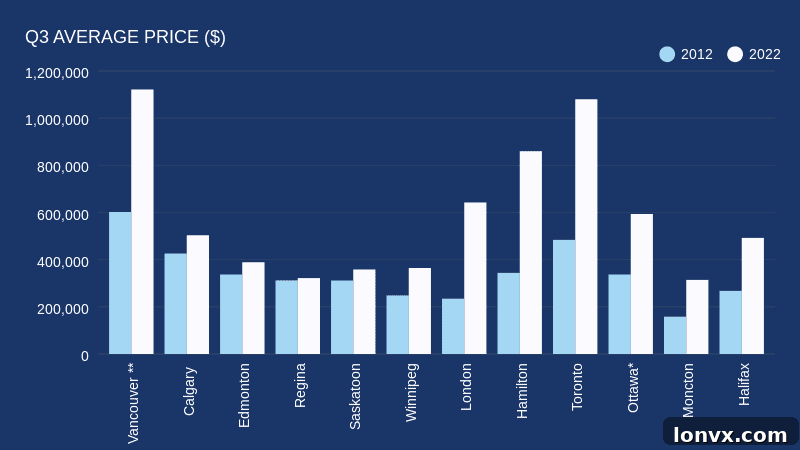
Source: CMHC-Equifax Canada Average Value of New Mortgage Loans; Canadian Real Estate Association; Fraser Valley Real Estate Board; Calgary Real Estate Board; Toronto Regional Real Estate Board; Quebec Professional Association of Real Estate Brokers; RE/MAX Canada
Notes regarding average prices:
*Ottawa-Gatineau contains blended data to reflect the Ottawa-Gatineau CMA. The earliest statistics available for the Gatineau region are from 2014, creating an eight-year history for the CMA.
** Greater Vancouver contains data blended with Fraser Valley to reflect Vancouver CMA
Understanding Loan-to-Value Ratios: A Key Indicator of Market Health
Loan-to-value (LTV) ratio is a critical financial metric in real estate, representing the proportion of a property’s value that is financed through a mortgage. A lower LTV ratio indicates that the homeowner has a larger equity stake in their property, which is generally a sign of reduced risk for both the borrower and the lender. This metric becomes particularly important during periods of economic uncertainty, as it directly impacts a homeowner’s ability to withstand market downturns or rising interest rates without going “underwater”—owing more on their mortgage than their home is worth.
While the majority of Canadian markets saw a decline in LTV ratios, four markets experienced an increase compared to 2012 levels: Calgary, Edmonton, Saskatoon, and Regina. Re/Max Canada anticipates a reversal of this trend in the coming years, driven by the anticipated economic momentum in Alberta and Saskatchewan. As these provincial economies strengthen and fuel greater homebuying activity, it is expected that increased demand and property values will contribute to lower LTVs over time, aligning them with the national trend of increased homeowner equity.
Interestingly, the report highlights a clear correlation between market expense and LTV ratios. The lowest LTV ratios were consistently found in Canada’s most expensive markets, underscoring the substantial equity homeowners have accumulated in these high-value areas. Vancouver led with an impressive 50 percent LTV, followed closely by Toronto at 53 percent, and Hamilton at 54 percent. This suggests that despite the high entry cost, buyers in these markets have, on average, been able to secure larger down payments or benefit from significant appreciation, fortifying their financial position. Conversely, the highest LTV ratios were observed in Regina (88 percent) and Edmonton (83 percent), indicating that homeowners in these regions tend to finance a larger portion of their home’s value. Nationally, the average loan-to-value ratio stood at a healthy 57 percent, a figure that paints a positive picture of the overall stability of the Canadian housing market.
Christopher Alexander, President of Re/Max Canada, emphasizes the significance of these findings. “While challenges certainly exist in today’s high-interest rate environment, risk factors for the overall housing market are greatly reduced when homeowners own a larger proportion of their homes,” he explains. “With half of loan-to-value ratios falling within the 50- and 60-percent range in Canadian markets, homeowners are better able to withstand downward pressure on housing values and fewer will find themselves underwater, carrying upside-down loans.” This perspective underscores the protective effect of robust equity during economic headwinds, suggesting that the market’s foundation is stronger than many might perceive.
Driving Forces Behind Lower LTVs: Equity, Remote Work, and Wealth Transfer
The substantial downward pressure on loan-to-value ratios over the past decade, as identified by the Canada Housing Barometer Report, can be attributed to a confluence of three significant factors. These forces have collectively reshaped the financial landscape for Canadian homeowners, fostering greater equity and market stability. The primary drivers include significant equity gains experienced across the housing market, the transformative impact of the pandemic in facilitating remote work and migration to smaller markets, and the accelerating transfer of intergenerational wealth.
Firstly, the considerable equity gains observed in Canadian real estate have played a pivotal role. A prolonged period of appreciating property values allowed many homeowners to build substantial equity, reducing their effective LTV over time. When these properties were either refinanced or sold, the increased equity translated into larger down payments for subsequent purchases, naturally leading to lower LTVs on new mortgages. This wealth creation cycle has been instrumental in strengthening individual homeowner balance sheets and, by extension, the overall market.
Secondly, the global pandemic catalyzed a profound shift in work patterns, normalizing remote employment for a vast segment of the workforce. This newfound flexibility allowed many Canadians to reconsider their residential locations, often opting to move from expensive urban centers to smaller, more affordable markets. By purchasing homes in regions with lower average prices, these buyers were able to make larger proportional down payments or acquire more property for their money, which directly contributed to lower LTV ratios in these emerging popular areas. This geographic redistribution of demand has diversified the market and supported LTV reductions in various locales.
Thirdly, the transfer of intergenerational wealth has become an increasingly significant factor, particularly in the latter half of the last decade and the early 2020s. As older generations pass on wealth, a portion of these inheritances or financial gifts is often directed towards assisting younger family members with down payments on their first homes or helping them upgrade their existing properties. This influx of capital allows buyers to secure mortgages with lower LTVs from the outset, significantly reducing their financial leverage and strengthening their position in the market.
Elton Ash, Executive Vice President of Re/Max Canada, further elaborates on additional measures contributing to market health. “Government-implemented measures to reduce risk to the country’s housing markets, including the much-maligned stress test, have also gone a long way in maintaining the overall health of the Canadian market,” he explains. “The housing market in Canada has a reputation for stability relative to other international markets, and prudent policy plays a substantial role.” This highlights the crucial interplay between market dynamics and regulatory frameworks in fostering a resilient housing sector.
The Re/Max report further confirms that Canadian buyers are considerably better qualified than they were a decade ago. A separate report from CMHC-Equifax Canada corroborated a significant reduction in the number of buyers with credit scores under 660 over the past ten years. Nationally, this figure dropped from eight percent a decade ago to a mere 4.7 percent in the third quarter of 2022. Ottawa-Gatineau boasted the lowest share of new mortgage holders with sub-660 credit scores at 3.9 percent, while Winnipeg registered the highest at 6.4 percent. This broad improvement in buyer creditworthiness, alongside declining LTVs across all markets from decade-ago levels, paints a picture of a more financially robust and responsible homebuying populace.
Moreover, mortgage delinquency rates have also seen a widespread decline across most markets throughout the country. The national percentage now stands at an exceptionally low 0.14 percent—representing a remarkable decrease of just over 63 percent from levels reported in 2012. The lowest delinquency rates are found in Ontario and British Columbia, where they remain below 0.08 percent. These low delinquency figures are a testament to the stringent mortgage qualification standards and the robust financial health of Canadian homeowners, further reinforcing the market’s stability against potential economic shocks.
The Interplay of Population Growth and Interest Rates: Shaping Future Demand
Over the past decade, rapid population growth has been identified as a primary catalyst driving homebuying activity across Canada. From Q3 2012 to Q3 2022, the national quarterly population estimate surged by an impressive 12.1 percent. This continuous influx of new residents, whether through immigration or natural growth, has created a consistent and strong demand for housing, acting as a fundamental support mechanism for the market. The federal government’s ongoing commitment to increasing immigration levels suggests that this population-driven demand will continue to be a significant factor in the years ahead, underpinning the long-term need for housing across the nation.
Interest rates have also played a starring role in shaping the Canadian housing market over the same period. The overnight rate saw a dramatic drop to 0.25 percent in May 2009 and largely maintained relatively low levels throughout the 2010s. While there was a modest climb in 2018 and 2019, rates subsequently fell again to 0.25 percent in 2020 in response to the economic uncertainties triggered by the pandemic. This prolonged period of historically low borrowing costs made mortgages more affordable, encouraging homeownership and fueling significant market activity and price appreciation. Such an environment allowed many homeowners to secure financing with favorable terms, contributing to both affordability and equity accumulation.
Looking ahead, while population growth is expected to persist as a key driver of demand due to federal immigration targets, the interest rate environment presents a contrasting picture. It is anticipated that interest rates will likely remain relatively high in the foreseeable future. This elevated cost of borrowing is expected to temper homebuying activity to some extent, particularly during the first half of the year as buyers adjust to the new financial realities. The balance between strong demographic tailwinds and higher financing costs will define the market’s trajectory in the short to medium term.
Elton Ash offers a forward-looking perspective: “As we head into 2023, there are likely to be challenges, but a healthy number of homebuyers are expected to continue to enter the country’s housing markets from coast to coast.” He also notes a continuation of existing trends: “The trend toward smaller markets should continue to play out in Atlantic Canada, Ontario, and Western Canada — areas where in-migration from more expensive markets has occurred recently.” This suggests that affordability will continue to drive internal migration, supporting housing markets in regions offering greater value. Major centers in Alberta and Saskatchewan, in particular, are expected to experience strong growth in the year ahead, as their provincial economies are projected to continue operating robustly, attracting both new residents and investment.
Navigating Emerging Risks: Challenges and Regulatory Responses
While the overall outlook for the Canadian housing market remains broadly positive, the Re/Max report also prudently acknowledges potential challenges and emerging risks that could impact specific segments. One concern pertains to larger markets experiencing an uptick in “over-extended” buyers – individuals who may have stretched their finances to enter highly competitive markets. These buyers could be more vulnerable to rising interest rates or economic downturns, potentially facing increased financial strain.
Another area of concern highlighted is the increased financial hardships for parents who have assisted their children with homeownership by utilizing Home Equity Line of Credits (HELOCs). While well-intentioned, this strategy can expose parents to higher debt burdens, particularly if interest rates on HELOCs increase, adding another layer of risk to family finances and potentially impacting their own financial stability. It underscores the importance of careful financial planning and understanding the implications of such borrowing.
Despite these specific concerns, the report maintains that the overall risk to the broader Canadian housing market remains low. However, given real estate’s substantial impact on the Canadian economy—accounting for 10 to 17 percent of GDP growth in recent years—risk mitigation remains a top priority for regulators. The government’s OSFI stress test is a prime example of the additional measures implemented to reinforce the country’s real estate market against vulnerabilities, as noted by Re/Max. This regulatory foresight aims to prevent systemic risks and maintain the market’s long-term health.
The regulatory landscape is continually evolving. Discussions are underway for potential further refinements to the mortgage stress test. While still in development, these enhancements would likely address three key factors: scrutinizing mortgage size and overall debt load more closely, introducing new debt service ratios to ensure borrowers can comfortably manage their payments, and potentially incorporating a new interest rate stress test methodology. These considerations reflect a proactive approach to fine-tuning policies to meet dynamic market conditions.
The success of the existing stress test, which has qualified buyers at two percent above posted rates since 2018, clearly demonstrates the invaluable role of prudent constraints in maintaining market stability. However, Re/Max also cautions that while such measures are beneficial, further tightening could inadvertently make it increasingly difficult for some Canadians to achieve the dream of home ownership. Finding the right balance between safeguarding the market and ensuring accessibility remains a critical challenge for policymakers.
Christopher Alexander wisely encapsulates the core philosophy underpinning these market dynamics: “At the end of the day, what’s evident by the loan-to-value ratios and by policies to discourage speculation and over-extension is that real estate is and will always be a long-term hold.” This statement reinforces the idea that strategic, long-term thinking, supported by strong equity positions and sensible regulation, is fundamental to a healthy and sustainable housing market.
A Positive Long-Term Outlook for Canadian Homeownership
The collective evidence from the Re/Max Canada 2023 Housing Barometer Report paints a compelling picture of a resilient Canadian housing market, fundamentally supported by strong homeowner equity and prudent regulatory frameworks. Despite the immediate headwinds posed by rising interest rates, the underlying drivers and structural safeguards position the market for sustained stability and growth over the long term.
Christopher Alexander concludes with an optimistic yet realistic assessment: “The bottom line is that the dream and desire for home ownership is unmistakable. The mechanisms in place to underpin stability are working, and although more challenging conditions in 2023 may cause some to temporarily take pause, the longer-term outlook remains positive.” This perspective acknowledges the cyclical nature of real estate, recognizing that periods of adjustment are a natural part of a healthy market. He further asserts, “Once the Bank of Canada has signaled that it is done with quantitative tightening, the market is expected to return to more normal levels of homebuying activity overall.” This forecast suggests a future normalization, where market activity will once again align with the strong underlying demand driven by population growth and the enduring aspiration for homeownership.
The Canadian housing market, characterized by lower LTV ratios, improved buyer qualifications, and robust equity gains, demonstrates a strong capacity to withstand economic pressures. While short-term adjustments are inevitable, the foundational strength built over the past decade, coupled with ongoing regulatory vigilance and demographic tailwinds, provides a confident outlook for Canadian homeownership. For those seeking deeper regional analysis and comprehensive data, the full report is an invaluable resource.
Read the full report, including regional summaries, here.