
Ottawa Housing Market Gains Momentum: A Deep Dive into July 2024 Trends
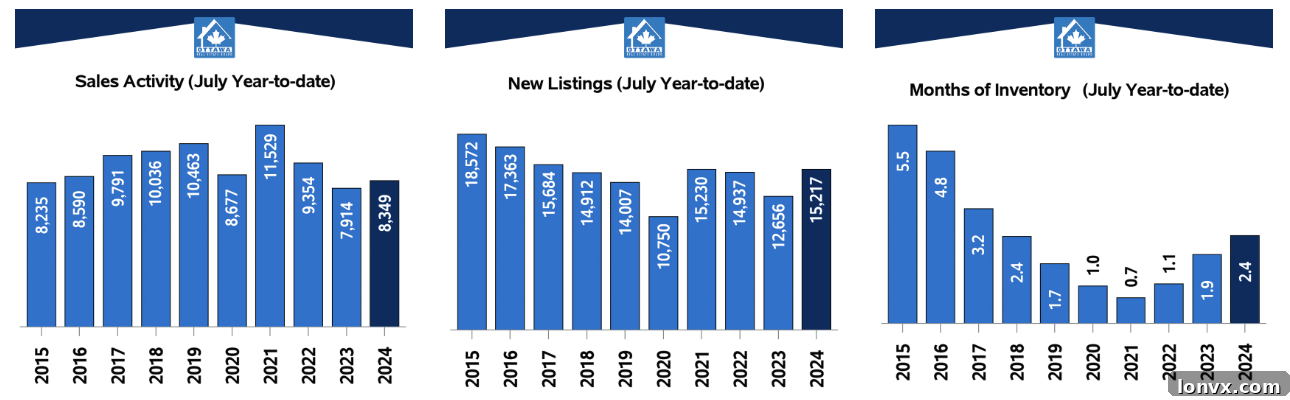
The Ottawa housing market demonstrated encouraging resilience in July, with a notable surge in activity that signals potential positive shifts. According to the Ottawa Real Estate Board (OREB), a total of 1,241 homes were successfully sold through the Multiple Listing Service (MLS) System last month. This figure represents a robust 13.6% increase compared to July of the previous year, highlighting a period of increased buyer engagement and transaction volume across the capital region. While this uptick offers a hopeful outlook, it’s essential to view these numbers in broader historical context. Despite the monthly increase, home sales in July 2024 remained 7.1% below the five-year average and 8.8% below the 10-year average for the same month, indicating that the market is still finding its footing compared to pre-pandemic peaks and sustained growth periods. Looking at the year-to-date performance, total home sales reached 8,349 units by the end of July, marking a 5.5% increase over the identical period in 2023. This cumulative growth suggests a slow but steady recovery throughout the year, laying the groundwork for more substantial gains in the latter half of 2024.
Encouraging Activity Amidst Persistent Supply-Side Challenges
Curtis Fillier, president of the OREB, expressed optimism regarding July’s performance, noting its significance as the market typically experiences a summer slowdown. “As the market pace typically slows in the summer, July’s activity is encouraging and could be a sign of more gains ahead,” Fillier stated. This sentiment reflects a growing confidence among prospective buyers, who are gradually returning to the market. Concurrently, sellers continue to contribute a consistent flow of new listings, helping to replenish inventory. However, Fillier emphasized that the true impact on transaction volumes ultimately depends on the availability of diverse property types and varying price points within Ottawa’s communities, as deep-rooted issues of supply and affordability continue to challenge both buyers and sellers.
Recent policy developments offer a glimmer of hope for some segments of the market. Fillier highlighted two key measures: “Two consecutive interest rate cuts by the Bank of Canada, coupled with the federal government’s introduction of 30-year amortization periods on mortgages for first-time homebuyers purchasing newly built homes, will help some buyers.” These demand-side policies are designed to make homeownership more accessible and affordable for specific groups, potentially stimulating demand further. Reduced interest rates lower borrowing costs, while extended amortization periods can decrease monthly mortgage payments, making high property prices seem more manageable. Despite these positive interventions, Fillier underscored a critical distinction: “However, these are demand policies, and Ottawa — as well as many cities across the country — needs action on the supply side.” This stark reminder points to the fundamental imbalance between housing availability and population growth, suggesting that without significant efforts to increase housing stock, affordability challenges will persist, even with demand-side support.
Addressing the supply shortage in Ottawa is paramount for sustainable market health. Demand-side interventions, while helpful in the short term, can sometimes inadvertently inflate prices if the supply remains constrained. The long-term solution lies in creating more homes across various price points and types. This requires a concerted effort from all levels of government and industry stakeholders to streamline development processes, reduce barriers to construction, and encourage diverse housing forms. Without substantial supply growth, the Ottawa housing market will continue to experience a competitive environment, making it challenging for many residents to find suitable and affordable housing options.
Overcoming Housing Supply Growth Challenges and OREB’s Strategic Response
The persistent challenges in housing supply growth are not unique to Ottawa, but they are particularly acute in the region. The Bank of Canada’s Monetary Policy Report has consistently identified significant impediments, notably municipal zoning restrictions and high development fees. These regulatory and financial barriers often prolong the development timeline and escalate the cost of new housing projects, ultimately impacting the final price for consumers. Local data further substantiates these concerns: recent figures from the Ontario government reveal that Ottawa has only managed to build 1,593 homes out of its ambitious target of 12,583 for 2024. This substantial shortfall highlights the severity of the supply crisis and the urgent need for more effective strategies to accelerate housing construction.
In response to these critical challenges, the Ottawa Real Estate Board (OREB) and its dedicated member realtors have become proactive advocates for systemic change. OREB is actively championing a range of solutions aimed at alleviating the housing crisis and fostering a more balanced market. Among their key proposals is the advocacy for allowing four units per lot. This policy change would significantly increase housing density in existing neighborhoods, promoting gentle intensification and making more efficient use of urban land. By permitting multiplexes or townhouses on lots traditionally zoned for single-family homes, this approach can create a greater variety of housing options and price points without extensive urban sprawl.
Furthermore, OREB is pushing for a reduction in high development fees. These fees, imposed by municipalities, are often passed directly onto homebuyers, increasing the overall cost of new homes. By lowering these charges, the cost burden on developers can be eased, potentially making new housing projects more viable and affordable. OREB believes that collaborative efforts, including policy adjustments at the municipal and provincial levels, are essential to dismantle these barriers and foster an environment conducive to robust housing supply growth. Their ongoing advocacy underscores a commitment to addressing the root causes of Ottawa’s housing challenges, ensuring that the city can accommodate its growing population with diverse and affordable housing solutions for years to come.
Source: OREB
Comprehensive Analysis of July 2024 Housing Prices in Ottawa
Understanding the pricing landscape is crucial for both buyers and sellers navigating the Ottawa housing market. In July 2024, the overall MLS Home Price Index (HPI) composite benchmark price registered at $648,900. This figure represents a slight but encouraging increase of 0.1% compared to July 2023, signaling a stabilization trend after previous market fluctuations. The HPI is considered a more accurate reflection of true market value because it adjusts for differences in property type and size, providing a consistent measure over time.
Delving into specific property categories reveals varied performance across the market segments. Single-family homes, often the most sought-after property type in Ottawa, saw their benchmark price stand at $734,700. This marked a marginal decrease of 0.1% year-over-year, suggesting that while the demand remains robust, prices in this segment have largely plateaued. This stability could offer a window of opportunity for buyers who have been waiting for a more balanced market.
Conversely, the townhouse/row units category demonstrated notable strength, recording a healthy 3.4% increase, with a benchmark price of $506,100. This growth indicates sustained demand for more compact and often more affordable housing options, which are particularly appealing to first-time homebuyers or those looking to downsize. The apartment segment experienced a slight contraction, with its benchmark price reaching $422,800, a 0.9% decrease from the previous year. This minor adjustment in apartment pricing could be influenced by various factors, including increased rental inventory or buyers opting for other housing types.
When considering the average price of all homes sold in July 2024, the figure stood at $679,610, representing a 2.1% decrease from July 2023. While the HPI provides a refined benchmark, the average price offers a broader perspective on the transactional value of properties. Despite this monthly dip, the year-to-date average price held strong at $681,082, marking a 1.0% increase compared to the same period last year. This cumulative increase underscores a gradual appreciation in property values over the course of the year, indicating underlying market health and continued investment interest in Ottawa real estate.
Analyzing July’s Inventory and New Listings: A Shifting Market Landscape
The supply side of the Ottawa housing market experienced significant movement in July 2024, with new residential listings showing a substantial increase. A total of 2,231 new listings entered the market, marking a robust 17.1% increase compared to July of the previous year. This surge in new inventory is a welcome development for buyers, offering them a broader selection of properties to choose from. Furthermore, this figure was 6.3% above the five-year average and 6.9% above the 10-year average for the month of July, indicating a stronger influx of properties than typically observed during this period. The increased availability suggests that more homeowners are feeling confident enough to list their properties, or perhaps are adjusting to market conditions that favor more active selling.
By the end of July, active residential listings reached 3,480 units, reflecting an impressive 37% increase from the previous year. This substantial growth in active inventory is a critical indicator of a market potentially shifting towards a more balanced state. Higher inventory levels generally translate to less competition among buyers and potentially more negotiating power. This particular inventory level was 50.6% above the five-year average for July, yet remained 2.3% below the 10-year average. This nuance suggests that while inventory has recovered significantly from recent lows, it has not yet reached the levels seen during periods of historically greater supply.
Crucially, the months of inventory also rose in July, reaching 2.8 months, up from 2.3 months during the same time in 2023. Months of inventory represent the theoretical time it would take to sell all currently available homes at the current rate of sales. A market is generally considered balanced when months of inventory are between four and six months. While Ottawa’s 2.8 months still indicates a seller’s market, the increase is a positive sign for buyers, providing them with more time to make decisions and reducing the urgency often associated with highly competitive markets. This trend towards increasing inventory and months of supply points to a more sustainable and potentially less volatile market environment for the remainder of the year, offering opportunities for both buyers and sellers to navigate the Ottawa real estate landscape with greater confidence.
Outlook and Future Projections for Ottawa Real Estate
Looking ahead, the Ottawa housing market appears to be on a path of cautious but steady recovery. The encouraging activity observed in July, particularly the rise in new listings and active inventory, suggests a market striving for equilibrium. While demand-side policies like interest rate cuts and extended amortization periods are providing some relief for buyers, the long-term health of Ottawa’s housing market hinges on robust supply-side solutions. The continued advocacy by OREB for increased density and reduced development fees highlights the critical need for policy changes that facilitate new construction and address the widening gap between housing supply and demand.
For prospective homebuyers, the increase in inventory could translate into more choices and potentially less intense bidding wars, though competitive segments will likely persist. Sellers, while benefiting from sustained buyer interest, may need to adjust expectations as the market becomes less frantic than in previous peak years. Investors will continue to monitor the balance between rental demand and property value appreciation, seeking opportunities in a market that remains fundamentally strong due to population growth and economic stability in the region. As the year progresses, all stakeholders will closely watch for further policy developments, interest rate adjustments, and construction progress, which will collectively shape the trajectory of Ottawa’s dynamic housing market.
For a comprehensive understanding of the market data and further insights, review the full report here.
Enjoying this article?
Get the latest real estate articles and market insights delivered directly to your inbox 3x a week, keeping you fully up-to-date on the Canadian real estate industry.