
Calgary’s Evolving Real Estate Landscape: CREB Revises 2025 Forecast Amidst Economic Shifts
The Calgary real estate market, renowned for its dynamic shifts, is currently navigating a period of significant recalibration. What began in January with an optimistic forecast from the Calgary Real Estate Board (CREB) for 2025 sales, predicting a robust 20% surge above the long-term trend, has now undergone a substantial revision. The initial projections painted a picture of sustained growth and high demand, fueled by factors such as a burgeoning population, strong inter-provincial migration, and a relatively resilient local economy.
However, the economic landscape has proven to be more volatile than anticipated. In its recently released spring report, CREB presented a more conservative outlook for the remainder of the year and into 2025. This downward adjustment in projections primarily accounts for the elevated economic uncertainty that has become more pronounced in recent months, notably influenced by rising tariffs and broader inflationary pressures. These macroeconomic headwinds have a tangible impact on consumer confidence, purchasing power, and ultimately, the trajectory of the housing market.
At the start of the year, CREB’s initial forecast for 2025 estimated sales to reach an impressive 26,000 residential units across the Calgary region. This figure reflected a market still carrying momentum from previous strong periods. The updated spring report, however, has tempered these expectations, with revised sales forecasts now hovering closer to 23,000 units. This adjustment represents a notable decrease, signaling a shift towards more subdued activity compared to earlier predictions. While a reduction of 3,000 units might seem moderate on the surface, it signifies a crucial change in market dynamics, suggesting that the pace of transactions will be slower than initially envisioned.
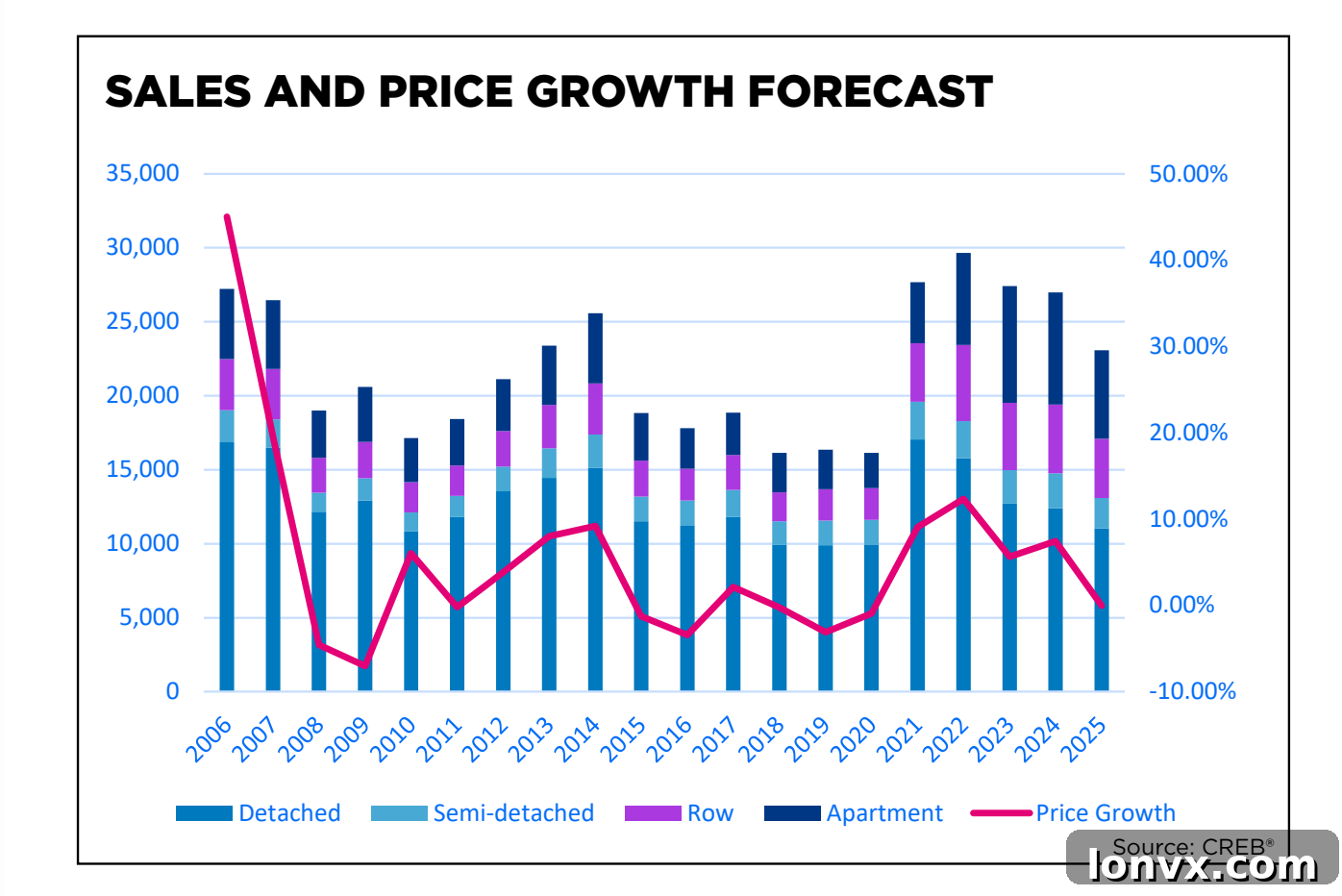
The report elaborates on this revised outlook, stating, “Sales in Calgary were forecasted to ease slightly in 2025. However, the heightened uncertainty throughout the spring months is expected to result in a higher-than-expected decline in annual sales.” This statement underscores the sensitivity of the market to external economic factors. The interplay of global trade policies, interest rate fluctuations, and domestic economic performance creates a complex environment for both buyers and sellers.
Crucially, the report also offers perspective on the anticipated slowdown: “While sales are not expected to ease to the lower levels reported during the 2015-2020 period, sales are expected to slow to levels more consistent with long-term trends.” This distinction is vital. The 2015-2020 period in Calgary’s real estate history was characterized by significant market challenges, often linked to fluctuations in oil prices and broader economic downturns. The current projection, while indicating a slowdown, suggests that the market will find a new equilibrium that aligns more with historical averages rather than entering a period of prolonged weakness. This implies a healthier, albeit less frenetic, pace of activity.
Delving deeper into specific housing segments, the data reveals pronounced shifts. In the City of Calgary, sales of detached and semi-detached houses have experienced a notable decline, registering a 12 percent drop year-to-date compared to 2024. These categories often serve as bellwethers for the broader market, reflecting consumer confidence and affordability challenges. The decrease in sales for these traditional housing types suggests that potential buyers are either pausing their purchasing decisions or shifting their focus to more affordable options within the market.
What About Property Prices in Calgary?
Price trends are another critical aspect of the real estate market, and here too, CREB’s revised forecast presents a significant departure from earlier predictions. In January, the expectation was that price growth, which had seen substantial gains over the preceding three years, would moderate to an annual gain of three percent in 2025. This was considered a healthy and sustainable rate of appreciation following a period of rapid escalation.
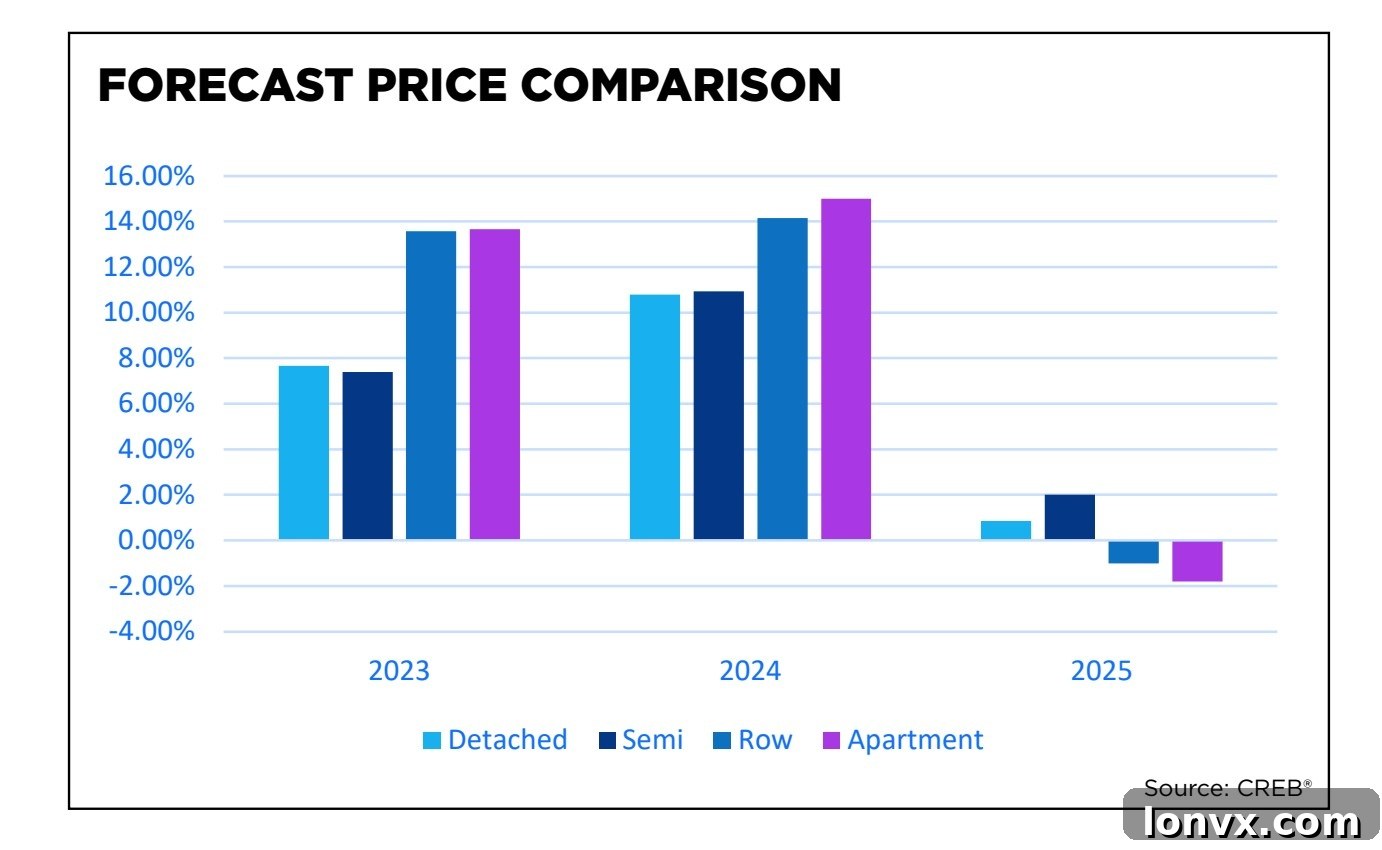
However, the latest report indicates a more conservative outlook for property values. Prices are now generally expected to remain relatively stable, staying about the same as 2024 levels. This marks a notable shift from modest growth to a more plateaued market. This stability, while perhaps not as exciting for sellers hoping for continued rapid appreciation, can be beneficial for market health, preventing speculative bubbles and making homeownership more predictable for buyers.
The report provides a nuanced view of price performance across different housing types. Semi-detached homes are anticipated to lead in price growth, albeit modestly, with a projected increase of two percent. Detached homes are expected to see a one percent gain. These slight increases suggest that demand for these property types remains resilient, though not as strong as in previous years. Conversely, rowhouses and apartments are forecast to experience slight declines of one and two percent, respectively. This divergence in price performance can be attributed to several factors, including the increasing supply of multi-family units and shifting buyer preferences towards more spacious living conditions, even if the absolute price point of apartments might initially seem more accessible.
The underlying dynamics driving these price adjustments are clear. As the report highlights, “Easing sales combined with rising inventory are expected to support more balanced conditions in our housing market, a significant change from the extreme seller’s market conditions experienced over the past two years.” An extreme seller’s market is characterized by high demand, low inventory, and competitive bidding, leading to rapid price increases. The transition to more balanced conditions implies that the scales are evening out, with neither buyers nor sellers having a dominant advantage. This equilibrium is generally considered healthier for the long-term sustainability of the market.
This shift will have a tangible impact on property values: “This will take much of the pressure off home prices, which are expected to be relatively stable this year, compared to the modest growth that was previously expected.” For buyers, this means potentially less urgency, more choice, and perhaps the ability to negotiate more effectively. For sellers, it necessitates a more realistic approach to pricing and a longer time on the market.
Concrete data from May reinforces this trend. The benchmark price in Calgary dipped to $589,900, a slight decrease from April and two percent below May 2024 levels. The benchmark price is a crucial indicator as it represents a typical property in the market, making it a reliable measure of overall price movements. This slight decline confirms the moderation in price growth and aligns with the forecast for increased stability rather than continued appreciation.
Inventory Levels Rising to More “Normal” Conditions
One of the most significant factors contributing to the market’s rebalancing act is the substantial increase in housing inventory. CREB’s analysis indicates that record-high housing starts over the past few years have consistently augmented the supply side of the market. This surge in construction activity, particularly in multi-family dwellings, has been a strategic response to Calgary’s rapid population growth and the enduring need for more housing options.
A considerable portion of this new supply is higher density, including apartment complexes and townhouses, and much of it has been specifically targeted at the rental market. This focus on rental units aims to alleviate pressures in that sector, but its impact extends beyond rentals. As these new units reach completion and become available for occupancy, they create a ripple effect throughout the entire housing ecosystem. The report explains, “Nonetheless, as these units are completed, the additional supply choice for renters, potential owners, and existing homeowners is causing supply to rise in the resale market.” This means that new construction, even if initially aimed at rentals, eventually frees up existing properties as renters become homeowners, or homeowners move into newer developments, thereby increasing the overall pool of homes available for resale.
However, CREB stresses the importance of context when evaluating these inventory gains. “However, like sales, the inventory gains need perspective. While inventory has doubled over last year’s levels, they are rising from near record lows, and inventory levels are returning to normal levels.” This nuance is crucial. The fact that inventory has doubled is a significant development, but it’s essential to remember that it started from an exceptionally low base. For much of the recent past, Calgary has experienced critically low inventory levels, which contributed to the intense seller’s market conditions and rapid price increases. The current increase, therefore, is not necessarily indicative of an oversupply but rather a necessary correction towards healthier, more balanced market conditions.
The return to “normal levels” signifies a market where buyers have more options and less pressure to make hasty decisions. It means an end to the frantic bidding wars that characterized the peak of the seller’s market. For sellers, it implies that strategic pricing and property presentation will become even more critical to attract buyers. This normalization of inventory is a positive development for market stability, fostering a more sustainable environment for both buying and selling properties in Calgary.
In conclusion, Calgary’s real estate market is undergoing a significant transition. While the initial optimism of early 2025 has been tempered by economic realities, the revised forecasts suggest a move towards a more balanced and sustainable market. Lower sales volumes and stable prices, coupled with rising inventory, indicate a healthier environment for long-term growth. Buyers can anticipate more choice and less competition, while sellers will need to adjust their expectations to align with the evolving market dynamics. The coming months will be crucial in observing how these trends solidify and shape the future of Calgary’s vibrant property landscape.