
Has the Canadian housing market weathered its storm, or are further shifts on the horizon? The answer, as many experts now agree, is far from uniform. Canada’s vast and diverse real estate landscape is experiencing a significant divergence, where regional performance tells vastly different stories. Understanding these intricate differences is crucial for homeowners, prospective buyers, and investors navigating the complexities of the current market landscape.
A recent and insightful report from Robert Kavcic, Senior Economist with the Bank of Montreal (BMO), succinctly captured this evolving narrative on September 29. His analysis highlights how localized factors are increasingly dictating market momentum, creating a patchwork quilt of booms and corrections across the country. This growing regionalization means that a ‘one-size-fits-all’ perspective on the Canadian housing outlook is no longer viable. Instead, a granular examination of specific provincial and city markets is essential to grasp the true state and future trajectory of real estate values and activity, offering a more precise understanding of Canada’s dynamic housing sector.
Canadian Housing Outlook: A Mosaic of Regional Performance
Calgary’s Resurgent Real Estate Market: A Beacon of Strength and Affordability
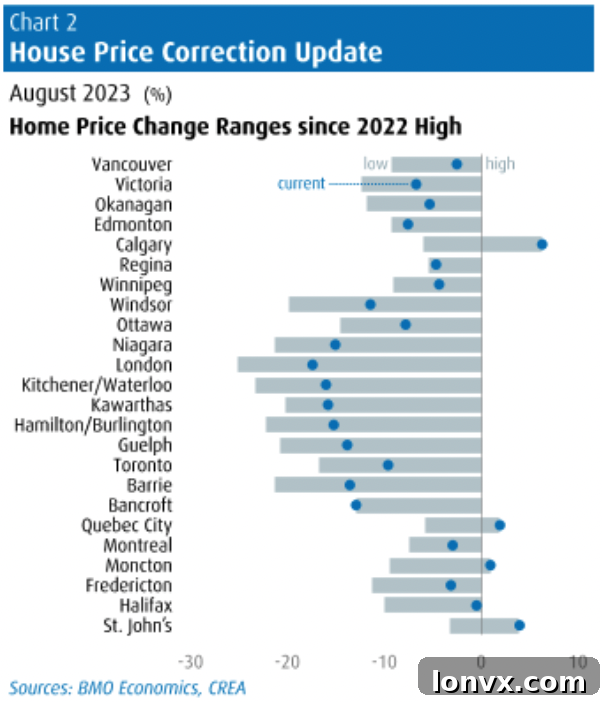
Amidst a backdrop of national uncertainty and fluctuating interest rates, Calgary stands out as a remarkable outlier, consistently ranking as Canada’s strongest housing market. The city’s real estate sector has demonstrated exceptional resilience and growth, driven by a confluence of favorable conditions that distinguish it from other major urban centers. Its sales-to-new listings ratio, a key indicator of market heat and buyer demand, is currently running at a robust 82.4 per cent – a figure economists describe as “hot.” This elevated ratio signifies strong buyer activity relative to the available supply of new homes entering the market, leading to competitive conditions and sustained upward pressure on prices.
Prices in Calgary have not only recovered from previous dips but have soared, now sitting more than 6.0 per cent above their 2022 pre-correction peak. This significant rebound defies the cooling trends observed in many other major Canadian cities. The underlying drivers for Calgary’s exceptional performance are multifaceted, primarily stemming from its relative affordability compared to prohibitively expensive markets like Vancouver and Toronto, coupled with robust net provincial migration inflows. As Alberta’s energy sector shows signs of resurgence and the provincial government actively promotes economic diversification, Calgary continues to attract interprovincial migrants seeking both abundant employment opportunities and a more attainable cost of living. This steady influx of new residents fuels demand for housing across all segments, supporting prices and sales volumes significantly.
Beyond Calgary, several markets within Atlantic Canada are also experiencing a notable resurgence. Cities like Halifax and Moncton, for instance, have seen housing levels exceed even their pandemic-era highs. These regions benefit from similar dynamics: attractive affordability relative to Canada’s most expensive urban centers, alongside a continued trend of migration from larger provinces, albeit at a slightly slower pace than the initial pandemic rush. The blend of lifestyle appeal, lower living costs, and growing local economies contributes to their sustained market strength and resilience, making them increasingly appealing destinations for new residents.
Ontario and the West: Grappling with Persistent Corrections and Elevated Risk
In stark contrast to the vibrancy of Calgary and parts of Atlantic Canada, regions like Southwestern Ontario continue to navigate a protracted and profound correction. Many cities in this sprawling region are still grappling with price declines exceeding 15 per cent from their peak, marking some of the deepest corrections nationwide. The aggressive price growth experienced in these areas during the pandemic boom, fueled by ultra-low interest rates and the widespread adoption of remote work, rendered them particularly vulnerable to the subsequent tightening of monetary policy. Buyers who entered the market at the peak are now facing significant challenges, including substantially higher mortgage payments and diminished home equity, creating a palpable sense of financial strain.
Toronto, Canada’s largest and most influential housing market, has shown signs of making up some lost ground recently, indicating a modest recovery from its deepest slump. However, despite these recent gains, prices in the Greater Toronto Area (GTA) remain approximately 10 per cent below their peak recorded in February of last year. Toronto’s market, characterized by notoriously high property values, intense competition, and significant household debt, remains acutely sensitive to shifts in interest rates and broader economic sentiment. The path to a full recovery for Toronto and other major Ontario markets is expected to be gradual and challenging, contingent on easing interest rates, improving affordability, and sustained economic growth. These regions face an uphill battle in regaining their pre-correction momentum.
What Drives the Disparity? The Magnetic Pull of Affordability and Migration
The stark divergence in regional housing market performance across Canada can largely be attributed to a powerful and interconnected combination of relative affordability and robust net provincial migration inflows. As Robert Kavcic’s report highlights, people are increasingly “flocking to areas where they can live affordably.” This fundamental principle is profoundly reshaping demographic patterns and, by extension, real estate demand across Canada, creating winners and losers in the current market cycle.
In high-cost markets like Vancouver and Toronto, years of escalating prices have pushed homeownership beyond the reach of a significant portion of the population, particularly first-time buyers and young families struggling to save for down payments. This affordability crisis has prompted a significant exodus towards regions offering more attainable housing options and a lower cost of living. Calgary, with its comparatively lower average home prices, strong job market, and absence of a provincial land transfer tax, has become a prime beneficiary of this interprovincial migration. Similarly, parts of Atlantic Canada offer attractive lifestyle choices combined with housing costs that are a mere fraction of those in the country’s most expensive urban centers, making them increasingly popular destinations for those seeking value.
These migration trends are not merely about securing cheaper homes; they also reflect a broader search for a better quality of life and opportunities where economic gains are not immediately eroded by exorbitant housing costs. Provinces that effectively balance promising job prospects with reasonable housing affordability are thus strategically positioned to attract and retain residents, underpinning sustained demand in their housing markets for the foreseeable future. Conversely, regions where affordability has become severely stretched are witnessing a consistent outflow of residents, contributing to softer demand, increased inventory, and more prolonged price corrections. This demographic reshuffling is a critical factor influencing the future trajectory of Canadian real estate.
Navigating the Headwinds: Challenges for the Canadian Housing Market Through 2024 and Beyond
While certain regions shine brightly, the broader Canadian housing market is poised to encounter several significant challenges through 2024 and potentially extending into 2025 and 2026. These macroeconomic and structural factors could collectively temper market activity and put downward pressure on prices in vulnerable areas, even if some regions manage to sustain their momentum. Understanding these headwinds is crucial for a comprehensive Canadian housing market forecast.
Economic Factors and Supply Dynamics Influencing Canadian Real Estate
- Softer Job Market Conditions: A cooling labor market, characterized by slower job creation, increased unemployment rates, or even modest job losses in some sectors, could significantly dampen consumer confidence and reduce the pool of eligible buyers. Job security is a crucial determinant of purchasing power and willingness to take on large mortgages, and any significant weakening could lead to reduced demand for housing across the board.
- Increased Listing Availability: After a prolonged period of historically low inventory that fueled aggressive price growth, there are now increasing signs of expanded listing availability in many markets. A rise in supply, whether from new construction projects coming online or existing homeowners choosing to sell due to financial pressures or changing life circumstances, can alleviate buyer competition and shift pricing power away from sellers. This rebalancing of supply and demand could lead to more moderate price growth or even modest declines in certain areas, particularly those that saw rapid appreciation.
The Looming Impact of Rising Mortgage Rates and the Mortgage Reset Wave
Perhaps the most significant and pervasive challenge facing Canadian homeowners and the broader housing market is the ongoing and intensifying wave of mortgage resets. As the Bank of Canada aggressively raised its policy rate to combat persistent inflation, millions of Canadians with variable-rate mortgages or fixed-rate mortgages nearing renewal are confronting substantially higher borrowing costs. This financial squeeze is expected to intensify through 2026, creating a prolonged period of adjustment and potential distress for many households.
The BMO report highlights the severity of this impending challenge. For households renewing their mortgages in 2024, if current interest rates hold steady, payment increases could range dramatically from 25 per cent to an astonishing 40 per cent. This represents a substantial additional financial burden for families already contending with elevated costs of living, including food and energy. The situation is projected to become even more acute in 2025 and 2026, as a larger cohort of fixed-rate mortgages, secured during the ultra-low rate environment of 2020-2021, mature and reset at significantly higher rates. While economists like Kavcic “assume rates will back off by then,” the precise timing and magnitude of any future rate cuts remain uncertain, leaving many homeowners in a precarious financial position. The impact of these mortgage resets will undoubtedly test the financial resilience of Canadian households and influence their spending patterns, potentially leading to broader economic ripple effects across the economy.
Provinces at the Epicenter of Risk: High Leverage and Real Estate Exposure
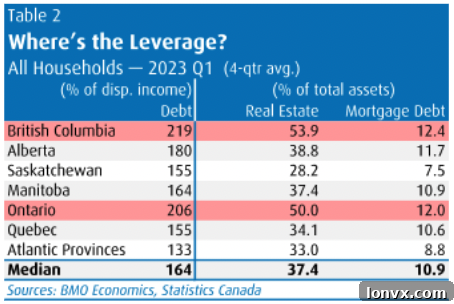
Not all provinces are equally susceptible to the adverse effects of a potential real estate downturn or broader economic weakness stemming from the mortgage market. The BMO analysis clearly identifies British Columbia and Ontario as the provinces most exposed to these risks. This heightened vulnerability is rooted in their above-average household leverage and a disproportionately high exposure to real estate as a component of total household assets, making them particularly sensitive to market fluctuations.
British Columbia and Ontario: High Household Debt and Market Fragility
Both British Columbia and Ontario experienced exceptionally “frothy” housing markets during the boom years, characterized by rapid price appreciation, aggressive bidding wars, and a widespread belief in continuously rising property values. This period encouraged significant borrowing, pushing household debt levels to historic highs relative to income. These markets were highly speculative, and the subsequent interest rate hikes have exposed their underlying fragilities.
British Columbia, in particular, stands out with Canada’s highest household debt-to-disposable income ratio, a staggering 219 per cent. This means that for every dollar of after-tax income, BC residents carry $2.19 in debt. Ontario follows closely behind with an equally concerning ratio of 206 per cent. These figures are significantly higher than the national median of 164 per cent, underscoring the precarious financial position of many households in these provinces. Such high debt loads leave homeowners with less disposable income and reduced flexibility to absorb unexpected expenses or rising mortgage payments.
As Kavcic further elaborates, in these two provinces, real estate and mortgage debt constitute an unusually large share of total household assets compared to other regions. This concentration means that a significant portion of residents’ wealth is tied directly to property values, making them highly sensitive to any market corrections. A downturn could not only erode personal wealth but also trigger broader economic instability as consumers, burdened by high debt and reduced equity, curb spending. The implications for consumer confidence, retail sales, and overall economic growth are profound, making these provinces critical areas to monitor for systemic risk in the coming years.
Relative Resilience: Quebec, Atlantic Canada, and Alberta’s Housing Market Stability
Conversely, Quebec and Atlantic Canada generally carry a relatively low exposure to these measures of household leverage and real estate risk. This reduced vulnerability is partly attributable to demographic factors, as these populations tend to be older, often with lower mortgage burdens or outright homeownership, having paid off their homes. Additionally, historical market dynamics in these regions have typically been more moderate, avoiding the extreme speculative bubbles seen elsewhere, leading to a more stable and predictable housing environment.
Alberta, while having above-median readings for household leverage, appears to carry less overall risk compared to BC and Ontario. This resilience is largely due to the unique market conditions within the province, particularly in Calgary. Strong interprovincial migration, comparative affordability, and a more diversified, albeit still commodity-influenced, economy have provided a stronger buffer against market volatility. The recent price gains and robust activity in Alberta suggest a more stable foundation and better capacity to absorb economic shocks compared to the highly leveraged markets of BC and Ontario, making it an interesting case study in regional resilience.
Conclusion: A Regionally Divided Future for Canadian Housing
The Canadian housing market is at a pivotal juncture, defined by a dramatic regional divergence that demands a nuanced understanding from all stakeholders. While certain cities like Calgary and regions in Atlantic Canada are experiencing robust growth fueled by compelling affordability and sustained migration, other major markets in Ontario and British Columbia grapple with lingering corrections and heightened financial vulnerabilities. The overarching narrative for the coming years will undoubtedly be shaped by the interplay of evolving interest rates, the ongoing wave of mortgage resets, shifts in the job market, and changes in housing supply. Navigating these complexities will require a careful and informed approach.
The insights from BMO Economics underscore the critical importance of a localized perspective. For homeowners, investors, and policymakers alike, monitoring regional economic indicators, affordability trends, and household debt levels will be paramount to making sound decisions. As the country navigates these complex dynamics, the ability of highly leveraged markets to absorb future payment shocks without broader economic fallout remains a central concern. The future of Canadian housing is not singular but a rich tapestry of diverse regional outcomes, each with its unique challenges and opportunities that will continue to evolve. Staying informed about these regional nuances is key to understanding the broader Canadian real estate landscape.
For a deeper dive into the economic factors influencing these trends, you can read the full report from BMO Economics.