
The Ottawa real estate market exhibited increased dynamism in August, recording 1,100 home sales according to the Ottawa Real Estate Board (OREB). This robust activity signifies a notable 10.2 percent surge compared to August of the previous year (2023). While this uptick is encouraging, the sales volume still remained below the historical benchmarks, specifically 11.4 percent lower than the five-year average and 14.1 percent below the ten-year average for the month. This nuanced performance indicates a market finding its footing, balancing a renewed interest from buyers with lingering historical patterns and evolving economic conditions.
Looking at the broader picture, Ottawa has seen a steady recovery throughout the year. As of August, year-to-date home sales reached 9,444 units in 2024, marking a healthy 6.0 percent increase from the same period last year. This cumulative growth suggests a gradual strengthening of buyer confidence and market participation, laying a foundation for continued activity as the year progresses.
Ottawa’s Housing Market in August: Navigating Growth Amidst Caution
Market Dynamics and Expert Insights: A Balanced Perspective
The seasonal nature of the real estate market often sees a lull during peak summer months. However, the sustained level of activity witnessed throughout this past summer in Ottawa is indeed a positive sign for the market’s underlying strength. Paul Czan, OREB president-elect, highlighted this encouraging trend, noting, “Being a seasonal market, it’s very encouraging to see sustained levels of activity throughout the whole summer.” This consistency, coupled with strategic shifts in monetary policy, paints an optimistic outlook for the coming months.
A significant factor fueling this optimism is the Bank of Canada’s decision regarding interest rates. Following a third consecutive interest rate drop, the financial landscape for prospective homebuyers has become marginally more favorable. Lower interest rates typically translate into reduced borrowing costs, making mortgages more affordable and potentially stimulating demand. Czan’s anticipation of “a heated market in the fall” is largely predicated on this monetary policy adjustment, suggesting that buyers who have been on the sidelines may now feel more emboldened to enter the market.
Despite these positive indicators, buyer caution remains a defining characteristic of the current Ottawa market. Affordability continues to be a paramount concern for many individuals and families aiming to purchase a home. While new listings have been consistently flowing into the market and prices have shown signs of stability rather than rapid escalation, buyers are approaching transactions with a discerning eye. This environment necessitates a thoughtful and strategic approach from both sides of the transaction.
For sellers, patience and close collaboration with real estate professionals are more critical than ever. In a market where buyers are cautious and have more options, accurately pricing a home is paramount. An overpriced property risks extended market time and potential price reductions down the line. As Czan advises, sellers must “remain patient and work closely with realtors to price their homes appropriately and develop strong selling strategies.” This includes effective marketing, professional staging, and a clear understanding of market comparables to ensure a competitive and appealing listing.
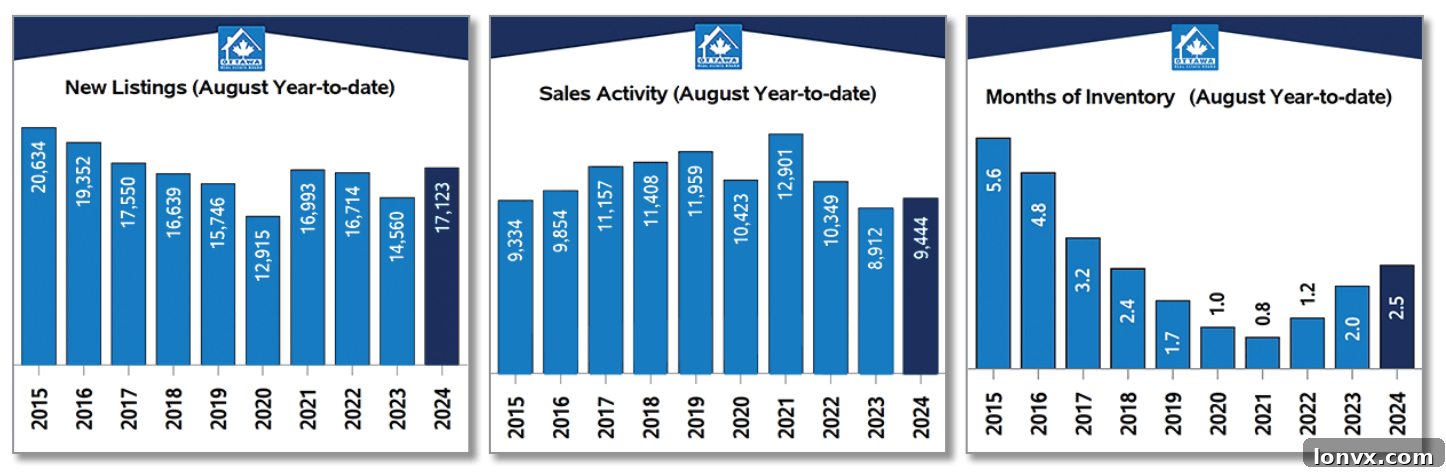
Source: OREB (Ottawa Real Estate Board)
Analyzing Price Trends Across Ottawa’s Diverse Property Types
August’s price trends in the Ottawa real estate market revealed a nuanced picture, reflecting varied demand and supply dynamics across different housing segments. The area’s composite benchmark price, a key indicator for overall market value, was recorded at $646,000. This represented a marginal year-over-year decrease of 0.3 percent, signaling a period of relative price stability rather than significant depreciation or appreciation.
Delving deeper into specific property types, single-family homes, often the most sought-after category, saw their benchmark price settle at $732,500. This also reflected a slight 0.3 percent decline compared to the previous year, suggesting that even in this desirable segment, prices are holding firm with only minor adjustments. The slight dip could be attributed to increased inventory, buyer caution, or a natural market correction after periods of rapid growth.
Conversely, the townhouse/row unit segment experienced a modest uptick, with its benchmark price reaching $502,200, a 0.3 percent increase year-over-year. This positive movement indicates a resilient demand for more affordable ground-oriented housing options, especially as single-family home prices remain higher. Townhouses often present an attractive compromise for buyers seeking more space than an apartment but at a lower price point than detached homes.
Apartments, or condominium units, recorded a benchmark price of $416,800, marking the largest decrease among the property types at 1.2 percent year-over-year. This downward pressure on apartment prices might be influenced by a higher supply of new condominium developments, a shift in buyer preferences, or the impact of higher interest rates disproportionately affecting first-time buyers who frequently enter the market through condominiums.
Beyond benchmark prices, which offer a consistent measure of value, the average price of homes sold in August provided another perspective. This figure stood at $660,341, representing a modest 0.3 percent increase from the previous year. The slight difference between the benchmark and average price movements indicates that the mix of homes sold in August might have skewed towards slightly higher-priced properties compared to the broader market, or that specific segments performed better in terms of transaction value.
Cumulatively, the year-to-date average home price in Ottawa has reached $678,327, reflecting a 0.9 percent increase from the preceding year. This steady, albeit small, increase in the year-to-date average reinforces the notion of a gradually appreciating market over the longer term, despite monthly fluctuations and segment-specific adjustments. For both buyers and sellers, understanding these nuanced price trends is crucial for making informed decisions in Ottawa’s diverse housing landscape.
Inventory & Listings: A Shifting Landscape Towards Buyer Opportunity
The dynamics of inventory and new listings are pivotal in determining market balance, and August saw notable shifts in Ottawa’s housing supply, signaling a potentially more favorable environment for prospective buyers. The month recorded 1,907 new residential listings, a marginal yet positive increase of 0.2 percent compared to the previous year. While this specific monthly increase is slight, its contribution to the overall active listings has been substantial.
A more significant indicator of market evolution is the robust growth in active listings, which soared by an impressive 25.8 percent to reach 3,324 units. This considerable increase means that buyers now have a much wider selection of homes available for purchase compared to the same period last year. A higher volume of active listings typically translates into reduced competition among buyers and potentially more negotiating leverage, moving the market away from the intense seller-favorable conditions seen in recent years.
The metric of “months of inventory” further illuminates this shift. In August, months of inventory rose to 3.0, up from 2.6 in August 2023. Months of inventory represents the theoretical time it would take to sell all currently active listings at the current rate of sales if no new properties were added to the market. Generally, 4 to 6 months of inventory is considered a balanced market, while anything below indicates a seller’s market, and above points to a buyer’s market. Ottawa’s movement from 2.6 to 3.0 months, though still within seller’s market territory, shows a clear trend towards greater balance. This implies that while sellers still hold some advantage, buyers are gaining more breathing room and choice.
This growing inventory can be attributed to several factors. Some sellers might be capitalizing on the relatively stable prices before potential market shifts, while others may have been waiting for interest rates to stabilize or even drop, creating more favorable conditions for their own next purchase. Furthermore, the sustained construction of new housing units also contributes to the overall supply, gradually alleviating pressures in a city experiencing consistent population growth. This expanding inventory is a healthy sign for the market, providing much-needed options for a diverse pool of homebuyers and contributing to greater market equilibrium.
Ottawa’s Enduring Appeal and Future Market Outlook
Beyond the immediate statistics, Ottawa continues to hold significant appeal as a real estate investment and lifestyle destination. As the nation’s capital, it benefits from a stable employment base, particularly within the government sector, which often acts as a buffer against broader economic fluctuations. The city’s burgeoning tech industry, world-class educational institutions, and high quality of life further contribute to its desirability, attracting talent and families from across Canada and beyond. These foundational strengths provide a robust backdrop for the real estate market, ensuring long-term stability and growth potential.
Looking ahead, the Ottawa real estate market is poised for an interesting fall season. The Bank of Canada’s recent interest rate adjustments are likely to be a major catalyst, potentially unlocking demand that has been held back by affordability concerns. While Paul Czan anticipates a “heated market,” this enthusiasm will likely be tempered by the growing inventory and continued buyer caution. The market may not experience the frenzied bidding wars of previous years but rather a more active and competitive, yet stable, environment. Factors to watch include further movements in interest rates, inflation trends, and overall consumer confidence, which can swiftly influence market sentiment and activity.
For **buyers**, this period of increased inventory and more stable prices presents a unique opportunity. With more choice and potentially less intense competition, now might be an opportune time to find a property that aligns with their needs and budget. Engaging with a local realtor who possesses deep market knowledge is crucial to navigate the nuances, understand property values, and secure favorable terms.
**Sellers** should focus on strategic positioning. While demand is expected to rise, the increased supply means that homes must stand out. Professional staging, high-quality photography, effective marketing, and, most importantly, realistic pricing based on current market comparables will be key to attracting serious offers and achieving a successful sale. Patience and flexibility in negotiations could also be beneficial.
**Investors** may find opportunities in specific segments, particularly those showing slight price adjustments or steady demand. Analyzing rental market trends, vacancy rates, and the long-term growth prospects of different neighborhoods will be essential for making informed investment decisions. Ottawa’s consistent population growth generally supports a strong rental market, offering potential for both capital appreciation and rental income.
Conclusion: A Market in Transition
Ottawa’s real estate market in August demonstrated a clear trajectory towards increased activity and a more balanced environment. While sales figures showed a healthy year-over-year increase, they also revealed that the market is still operating below its historical peaks, hinting at a return to more sustainable growth patterns. The influence of interest rate adjustments, coupled with a significant surge in active listings, is reshaping the landscape, offering more choices for buyers and requiring strategic approaches from sellers.
The insights from the Ottawa Real Estate Board underscore the ongoing importance of expert guidance in this dynamic market. Whether you are buying, selling, or investing, understanding the local trends, price variations across property types, and the implications of inventory shifts will be paramount. As Ottawa moves into the fall, the market is expected to remain active, but with a renewed sense of balance and opportunity for those who are well-informed and strategically advised.