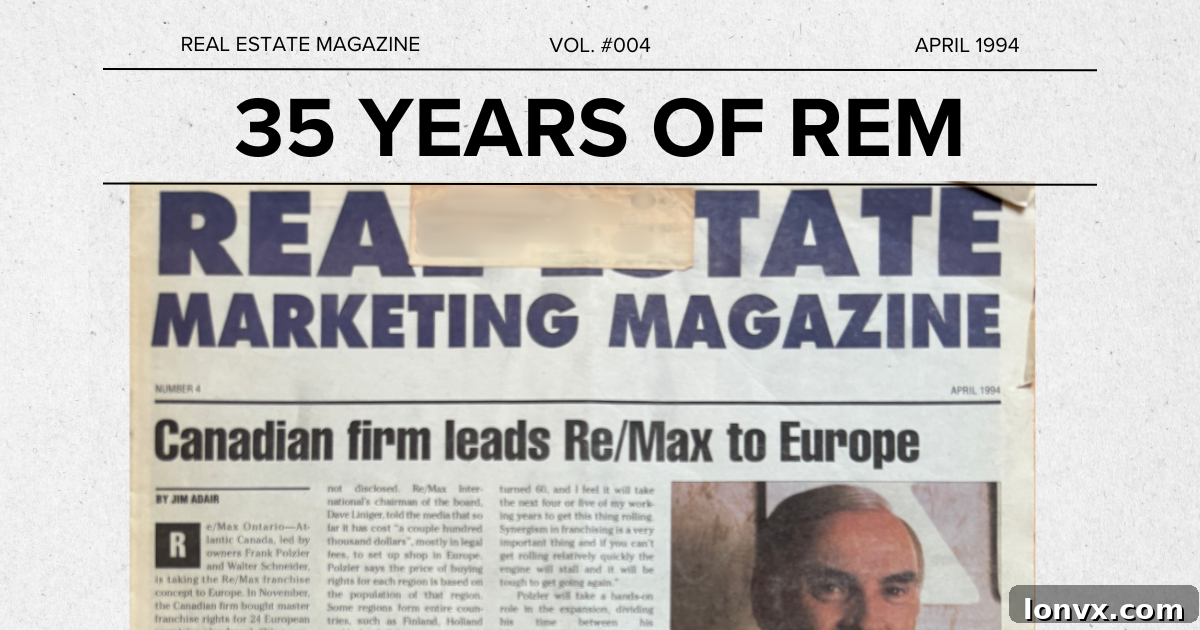
This article, originally published in issue #004 in April 1994 and penned by REM’s Founding Editor, Jim Adair, is being revisited to commemorate 35 years of Real Estate Magazine. It offers a fascinating glimpse into a pivotal moment in global real estate, detailing a bold expansion by Re/Max.
Re/Max’s Ambitious Leap: Pioneering Modern Real Estate Across Europe in 1994
In a move that marked a significant turning point for international real estate franchising, Re/Max Ontario–Atlantic Canada, under the visionary leadership of owners Frank Polzler and Walter Schneider, embarked on an ambitious journey to introduce the Re/Max concept to the European continent. This strategic expansion unfolded in November 1993, when the Canadian firm successfully acquired the master franchise rights for a staggering 24 European countries, in addition to Israel.
Frank Polzler, reflecting on the magnitude of the undertaking, articulated the immense potential: “It’s a consumer market of 390 million people, stacked in an area the size of the northeastern United States, Canada, and Quebec.” This statement underscores not only the sheer scale of the demographic but also highlights the geographical compactness, suggesting a high-density market ripe for streamlined real estate operations.
Unlocking Europe’s Vast Potential: A Strategic Investment
A Market of Millions Awaiting Modernization
The strategic acquisition positioned Re/Max to tap into a largely underserved and fragmented European real estate landscape. Polzler and Schneider immediately began the complex process of marketing regional franchises across 16 Western European countries. While the primary focus initially lay on Western Europe, Re/Max also laid the groundwork for future expansion into Eastern Bloc regions, with plans set for 1998. Even prior to this, interest from investors in Poland had already begun to surface, indicating the widespread appeal and perceived opportunity of the Re/Max model.
The pace of development was swift, with deals for regional franchises nearing completion in key countries such as Israel, Austria, France, Germany, Greece, and Spain. This aggressive rollout demonstrated the firm’s confidence in its ability to adapt and thrive in diverse European markets. The potential for growth was immense, considering the vast consumer base and the nascent state of organized real estate services in many of these territories.
The Financial Commitment Behind Global Real Estate Expansion
The financial details of purchasing the master franchise rights from Re/Max International, headquartered in Denver, Colorado, remained undisclosed. However, Dave Liniger, chairman of the board for Re/Max International, publicly indicated that the initial setup costs for establishing operations in Europe had already reached “a couple hundred thousand dollars,” predominantly attributed to legal fees and administrative overhead. This figure merely represented the foundational investment, hinting at much larger capital outlays to come.
Polzler further elaborated on the tiered investment structure, explaining that the cost of acquiring rights for each specific region was meticulously calculated based on its population. This tailored approach allowed for flexibility, with some smaller nations like Finland, Holland, and Ireland forming entire regions. In contrast, larger, more populous countries such as France were strategically segmented into multiple regions—three in its case—to optimize market penetration and management. Polzler acknowledged the substantial financial commitment required for the long haul, estimating that the total investment “by the time we are up and running” could soar to as much as $10 million. This level of investment underscored the long-term vision and the scale of the commitment by Re/Max Ontario–Atlantic Canada.
Pioneering a Modern Approach in a Traditional European Real Estate Landscape
Navigating a Contrasting Landscape: Challenges and Opportunities
While Re/Max was not the first North American real estate franchise to venture into Europe – competitors like Century 21 and Realty World had already established a presence – the Re/Max Ontario–Atlantic Canada plan distinguished itself through its sheer ambition and aggressive scale. Polzler candidly admitted to the dual emotions accompanying such a monumental undertaking: “It’s exciting, but it is a little scary because of the size of the project.”
At 60 years old at the time, Polzler committed the next “four or five of my working years to get this thing rolling,” emphasizing the critical importance of rapid momentum. He stressed that “Synergism in franchising is a very important thing, and if you can’t get rolling relatively quickly the engine will stall, and it will be tough to get going again.” This highlighted the urgency and strategic imperative of a swift, impactful launch. To ensure hands-on guidance, Polzler planned to divide his time between his Mississauga, Ontario offices and the newly established European headquarters near Zurich, Switzerland.
Even without its European expansion, Re/Max Ontario–Atlantic Canada was already a formidable entity, controlling sales territories across Ontario, the Maritime provinces, and nine U.S. states (including Minnesota, Wisconsin, Indiana, and several in New England). With 450 offices and approximately 6,700 sales representatives, it stood as Re/Max International’s largest sub-franchisor, demonstrating a robust operational foundation and proven capacity for large-scale management.
Re/Max’s Vision for Modernization and Trust Building
Born in Austria, Polzler possessed a unique understanding of the profound differences between European and North American real estate markets. He observed that “About 70 percent of all real estate trades in central Europe are private,” a stark contrast to the agent-driven model prevalent in North America. This indicated a significant cultural and procedural gap that Re/Max aimed to bridge.
Polzler described the European real estate industry of the time as “very backward.” He noted the scarcity of formal real estate organizations, the limited presence of large, structured brokerages, and critically, the absence of centralized real estate boards. While brokers often exchanged listing information informally, the industry as a whole lacked comprehensive organization and standardization. Furthermore, a “strong mistrust of real estate people” pervaded the market, attributed to a historical perception that agents “have not provided service and integrity.”
To overcome this deep-seated skepticism and transform the public perception, Re/Max devised a multi-pronged strategy. This involved combining a stringent code of ethics – a cornerstone of Re/Max’s brand identity – with robust, public-facing marketing programs designed to educate consumers about the tangible advantages of utilizing a professional real estate agent. This initiative sought to elevate the perceived value and trustworthiness of agents, shifting the paradigm from private sales to facilitated transactions.
Key North American concepts earmarked for introduction included comprehensive training and ongoing educational programs for agents and brokers, fostering a culture of continuous professional development. Additionally, Re/Max planned to implement a regionalized computer listing system, a revolutionary concept for many European markets, alongside sophisticated management information systems to enhance operational efficiency. Polzler clarified their approach: “We don’t want to ‘North Americanize’ the European marketplace. We want to leave some of the local practices in place but modernize them.” This nuanced strategy aimed to integrate global best practices while respecting and adapting to local customs and legal frameworks.
Lessons from the North American Playbook: Strategies for European Success
The Quebec Paradigm Shift: A Blueprint for Change
Polzler drew heavily on his extensive experience in Canada to guide the European expansion strategy. He cited the transformation of the Quebec real estate market as a compelling parallel. Two decades prior, approximately 60 percent of the Quebec market consisted of private sales, a figure remarkably similar to the contemporary situation in Central Europe. Through sustained efforts to professionalize the industry and educate the public, that percentage had dramatically fallen to about 25 percent by 1994. This demonstrated that a market historically dominated by private transactions could indeed be converted through strategic intervention and the establishment of professional agency services. This success story provided a powerful proof of concept for the European undertaking.
The Power of Persistent Promotion: Marketing as a Market Driver
Another crucial lesson from the North American experience, Polzler emphasized, was the indispensable role of robust marketing. He pointed to Re/Max’s impressive growth in the Greater Metropolitan Toronto area as a testament to this principle. In 1990, Re/Max held a market share of roughly 24 percent; by 1994, this had surged to 32.9 percent. Polzler attributed this significant gain to “the productivity and quality of our salespeople and our ongoing promotion machine.” Crucially, he noted, “Everyone pretty well stopped advertising during the recession. We continued our promotion and convinced the public that Re/Max is the premier real estate company.” This steadfast commitment to marketing, even during economic downturns, cemented Re/Max’s brand image and market leadership, a strategy they intended to replicate in Europe.
Championing Agent Productivity: The Rise of the ‘Super-Agent’
A core tenet of the Re/Max model, and a key factor in their success, was the exceptional productivity of their agents. Polzler proudly stated that Re/Max agents across North America were, on average, three times more productive than their counterparts in other brokerages. An average Re/Max agent typically facilitated about 22 transactions per year, significantly higher than the national average of seven or eight transactions. This superior productivity was not just a point of pride but a fundamental economic advantage, enabling agents to earn more and, in turn, attracting top talent to the Re/Max network.
Adapting to a Changing Real Estate World: Foresight and Future Proofing
Polzler also articulated another compelling rationale for expanding into Europe: the evolving and “shrinking” North American real estate marketplace. He presciently observed, “I think the number of transactions will shrink—just like people are keeping their cars longer, they will also keep their houses longer.” This long-term trend of extended homeownership would inevitably lead to fewer transactional opportunities, a challenge that necessitated diversification and expansion into new markets.
In this contracting market, Polzler predicted a consolidation within the industry: “The number of deals will shrink, and the number of people chasing this pie will also shrink. Thousands of people have left the industry in the last three or four years, and this will continue.” He painted a clear picture of the future, where “Only the most productive people, using the latest technology in their operation, will succeed in the long term.” This vision underscored the critical importance of efficiency, technological adoption, and high performance for survival and success in an increasingly competitive environment.
Polzler’s forecast extended to the very nature of the real estate profession. He envisioned an industry where “People who can’t cut it will either become assistants to good agents, or will leave the industry.” This marked the advent of “the era of the super-agent,” a professional capable of high volume and superior service. He issued a stark warning: “Anyone who can’t do at least $70,000 to $100,000 a year will not be around in real estate in the next five or six years.” This highlighted the rising bar for success and the imperative for agents to maximize their productivity and embrace professional development.
The Road Ahead: Establishing a European Foothold
The establishment of the European headquarters in Switzerland was slated for April 1, 1994, marking a crucial step in operationalizing the grand expansion. Polzler expressed optimism that some regional operations would commence business as early as September or October of the same year. This aggressive timeline reflected the urgency and confidence with which Re/Max was approaching its European venture. The insights from 1994 reveal a strategic foresight and a bold entrepreneurial spirit that set the stage for Re/Max’s enduring international presence. This expansion was not merely about growth; it was about fundamentally transforming how real estate was bought and sold in Europe, ushering in an era of professionalism, transparency, and enhanced service.