
The Canadian real estate market has experienced unprecedented volatility throughout the current year, posing significant challenges for hopeful home seekers aiming to enter or navigate this dynamic landscape. A confluence of factors, including steadily increasing property prices, persistent inflationary pressures, and recent sharp spikes in mortgage rates, has collectively left a profound and indelible mark on the aspirations and budgets of countless individuals and families across the nation. Understanding the shifting priorities and financial realities of these buyers is more crucial than ever.
In response to this evolving market, new and comprehensive online search data compiled by Point2Homes offers an illuminating and remarkably clear picture. This valuable research meticulously details not only who is actively searching for homes but also what their primary priorities and non-negotiable requirements are when contemplating their future living spaces. Such insights are instrumental for both prospective buyers and industry professionals alike.
To construct this detailed market overview, expert analysts at Point2Homes undertook an extensive examination of over five million unique online property searches. This vast dataset was collected during the critical first six months of 2022, a period marked by considerable economic shifts. The analysis specifically focused on key metrics: the most frequently searched-for price ranges, the preferred space requirements and property sizes, and the essential home features that buyers considered an absolute must in today’s competitive market.
Affordability Takes Center Stage: The Most Sought-After Price Range
One of the most striking revelations from the Point2Homes research underscores the pervasive impact of affordability concerns on Canadian home buyers. The data unmistakably shows that more than 75 percent of all online home searches were concentrated within price ranges significantly below the latest national average, which stood at approximately $640,000 at the time of the study. This overwhelming preference for lower-priced properties serves as a powerful indicator of the tight budgets and financial constraints many buyers are currently navigating.
Specifically, the research highlighted that the most intensely searched-for price range across Canada during the first half of 2022 fell squarely between $200,000 and $300,000. This demographic trend suggests a strong demand for entry-level homes, potentially by first-time buyers, or those looking to relocate to more affordable regions. The disconnect between aspirational homeownership and the soaring costs of properties in major urban centers is stark, compelling a vast majority of prospective buyers to set their sights on more attainable price points. This budget-conscious approach reflects a strategic adaptation to a challenging economic environment, where every dollar counts and financial prudence is paramount.
The Rise of the Millennial Home Hunter: Demographics of Online Searchers
The digital realm of house hunting is unequivocally dominated by the Millennial generation, solidifying their position as the most active demographic in the Canadian real estate market. Point2Homes’ data reveals that almost 44 percent of all online property searches were initiated by individuals aged between 25 and 44. Within this broad age bracket, the most energetic cohort of home seekers proved to be younger Millennials, typically in their late 20s and early 30s. This finding aligns with a life stage often characterized by career progression, family formation, and the natural desire to establish a permanent home.
While Millennials lead the charge, other generations also contribute significantly to the online search volume. Home seekers aged 55 and above constituted a notable 24 percent of all searchers, indicating a diverse range of motivations, from downsizing in retirement to seeking investment properties or even assisting younger family members with their housing needs. Interestingly, the data also pointed to an equitable split between genders in online home searching, with an almost even distribution between women and men actively exploring the market. This broad participation across age groups and genders underscores the universal appeal and necessity of homeownership, even as the market presents formidable hurdles.
Further narrowing down the preferences, the study found that a substantial 62 percent of all searchers were specifically looking for houses, rather than condominiums or townhouses. These buyers also exhibited a clear size preference, with homes ranging between 1,000 and 2,000 square feet being the most popular. Complementing this, their ideal home typically included three or more bedrooms and two to three bathrooms, signaling a demand for ample living space suitable for families, accommodating home offices, or providing room for guests. These specifications paint a picture of buyers seeking comfortable, functional, and family-oriented homes that can adapt to their evolving lifestyle needs.
Beyond the Basics: Must-Have Amenities in the Modern Home
In today’s competitive housing market, certain amenities transcend mere preferences to become “must-haves” for prospective buyers. The Point2Homes analysis unequivocally identified two key features that stood out as essential for those envisioning their future living spaces: a garage and a waterfront view. These amenities, while seemingly disparate, reflect both practical necessities and aspirational desires that significantly influence purchasing decisions.
A garage, for instance, is often seen as a crucial practical addition. Beyond merely parking vehicles, it offers invaluable storage space, protection from harsh Canadian weather elements, and often serves as a workshop or hobby area. Its inclusion can enhance a home’s functionality and perceived value, especially in regions with colder climates where vehicle protection is a priority. On the other hand, a waterfront view speaks to a different kind of aspiration. It evokes a sense of tranquility, offers aesthetic appeal, and promises a unique lifestyle. While often associated with luxury, the desire for a waterfront vista suggests buyers are seeking homes that offer more than just shelter – they are looking for properties that enhance their quality of life and provide a scenic retreat.
The study also highlighted interesting geographical divergences in property preferences. In Burnaby, British Columbia, for example, condominiums surprisingly emerged as more popular than traditional houses. This trend can likely be attributed to the city’s urban density, its proximity to Vancouver, and the relative affordability of condos compared to detached homes in a highly competitive and expensive market. Conversely, a starkly different picture emerged in the Ontario cities of Brampton and Windsor. Here, houses overwhelmingly dominated search queries, with as many as 84 percent of all searches targeting detached homes. This preference in Ontario reflects a demand for more suburban living, larger lots, and potentially more family-oriented properties that are still relatively more accessible than in Toronto’s immediate vicinity.
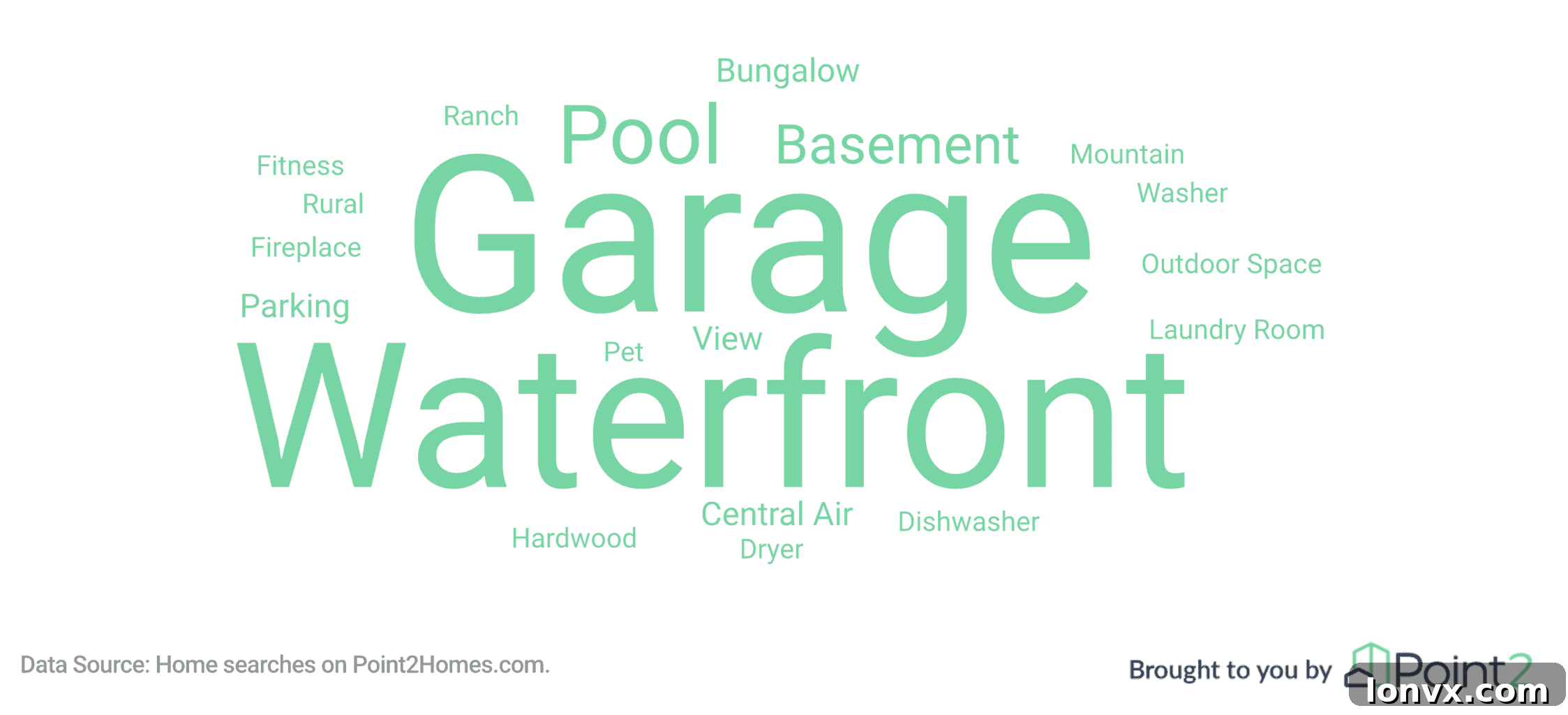
Most searched-for amenities and features; image courtesy Point2Homes.com
Bridging Aspiration and Reality: The Evolving Canadian Homeownership Dream
The extensive data compiled by Point2Homes paints a remarkably clear and compelling portrait of the quintessential Canadian homebuyer in 2022. This individual is typically a young Millennial, actively engaged in the exciting yet challenging hunt for a house. Their ideal property is envisioned as a comfortable space, approximately 1,000 to 2,000 square feet in size, and, most notably, sought after within the highly competitive price range of $200,000 to $300,000. Furthermore, this dream home is expected to boast a practical layout, featuring two to three bathrooms and more than three bedrooms, ideal for growing families or those requiring extra space for work or hobbies. Crucially, the wish list extends to highly desirable amenities, ideally including a functional garage and, for many, the picturesque allure of an outdoor amenity, perhaps even a coveted waterfront view.
While this profile eloquently captures the aspirations of a significant segment of the Canadian population, it also highlights the profound gap between desire and the stark realities of the current market. Securing a property with such a comprehensive set of features, particularly at the specified price point, can be exceptionally challenging, if not outright unrealistic, within Canada’s most populous and expensive urban centers. The current economic climate, characterized by elevated inflation and surging interest rates, further complicates this equation, eroding purchasing power and making affordability an even more pressing concern.
However, the dream is not entirely out of reach. For those determined home seekers, the data implicitly suggests a strategic avenue for success: a willingness to look beyond the bustling, high-demand metropolitan areas. By exploring smaller towns, exurban communities, and more rural regions, buyers may discover markets where property values align more closely with their tighter budgets and where the availability of desired features like garages and spacious yards is more prevalent. The rise of remote work has also empowered many to consider locations further afield, unlocking opportunities in areas that were once considered too distant for daily commutes. Ultimately, while the Canadian homeownership dream in 2022 is ambitious, a flexible approach to location and a careful re-evaluation of market realities can significantly improve the chances of finding that ideal living space.