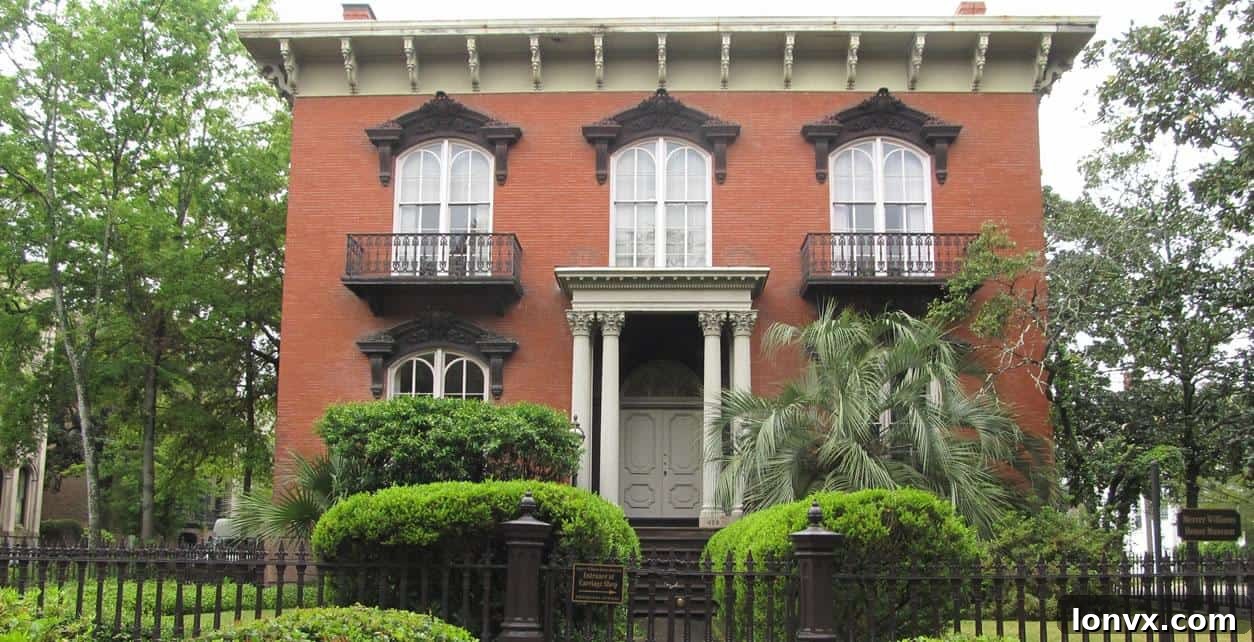
Nestled in the heart of Savannah’s enchanting Historic District, the iconic Mercer Williams House stands as a testament to architectural splendor and a magnet for curious visitors. This magnificent rose-hued, two-story mansion, accompanied by its meticulously maintained sunken garden and a substantial carriage house, commands an entire city block, presenting an unforgettable sight across from the serene, tree-lined expanse of Monterey Square. Far more than just an elegant residence, the Mercer Williams House has cemented its place as a must-visit landmark, drawing travelers from across the globe to unravel the layers of history, mystery, and cultural significance that permeate its very walls in beautiful Savannah, Georgia. Its striking façade and prime location make it instantly recognizable, embodying the unique charm and dramatic allure that defines this historic Southern city.
The profound allure of the Mercer Williams House is inextricably linked to its most famous resident, Jim Williams, an acclaimed art dealer and dedicated restorationist whose life and tragic saga became the central narrative of John Berendt’s enormously popular 1994 book, Midnight in the Garden of Good and Evil. This literary sensation, which captivated readers worldwide and spent over 200 weeks on the prestigious New York Times best-seller list, transformed Savannah from a hidden gem into a global tourist destination. The subsequent film adaptation, directed by the legendary Clint Eastwood and featuring a star-studded cast, further amplified the house’s fame, cementing its status as a cultural touchstone and a cornerstone of Savannah tourism.
Jim Williams was not merely an art collector; he was a pioneering force in Savannah’s historic preservation movement, a visionary who saw the inherent beauty in the city’s aging structures. His dedication to preserving Savannah’s architectural heritage began early in his life. At the remarkably young age of 24, in 1955, Williams embarked on his lifelong passion, restoring dilapidated houses to their former glory. Over the span of three decades, his tireless efforts breathed new life into more than 50 historic properties, not only within Savannah’s city limits but also throughout the picturesque Lowcountry region. His meticulous attention to detail and unwavering commitment to historical accuracy set a new standard for preservation, earning him a revered place in the city’s history.
The Crown Jewel: 429 Bull Street’s Transformation
Among his numerous restoration projects, the stately residence at 429 Bull Street, located within Savannah’s acclaimed Historic District, was unequivocally Jim Williams’s “crown jewel.” This grand house, which would later become known as the Mercer Williams House, captivated his imagination from the moment he first laid eyes on it. After remaining vacant for approximately a decade, Williams seized the opportunity to acquire the property in 1969 for a sum of $55,000 – a significant investment at the time. He then dedicated two arduous yet passionate years to its comprehensive restoration, transforming the once-neglected mansion into his magnificent personal residence. “I wanted this house the first time I saw it,” Williams is famously quoted as saying in the brochure promoting the house, a sentiment that perfectly encapsulates his deep personal connection to this architectural masterpiece.
However, the tranquil elegance of Williams’s meticulously ordered life was shattered in the early morning hours of May 2, 1981. It was on this fateful night, within the hallowed walls of his beloved mansion, that Williams shot and killed his 21-year-old, part-time employee, Danny Hansford. This shocking event plunged the house, and indeed the entire city of Savannah, into a sensational true-crime saga that would grip the nation. Williams steadfastly maintained that his actions were an act of self-defense, a claim that led to an unprecedented series of legal battles. He endured not one, but four gruelling murder trials, a legal marathon that captivated the public and ultimately culminated in his acquittal. Yet, this hard-won victory proved tragically short-lived. Less than a year after his final acquittal, Jim Williams passed away at the age of 59, leaving behind a legacy forever intertwined with the grandeur and mystery of the Mercer Williams House.
For sale in the carriage house gift shop are copies of the Bird Girl statue, which appears on the cover of the book Midnight in the Garden of Good and Evil, alongside the book itself.
A Glimpse Inside: Art, Architecture, and Enduring Mystery
Today, the Mercer Williams House is owned by Jim Williams’s sister, Dorothy Kingery, who has graciously opened its doors to the public, offering guided tours that invite visitors to step back in time. While the tours gracefully navigate around the more sensational aspects of the murder and subsequent trials, they instead shine a spotlight on Williams’s truly impressive and eclectic art collection. This deliberate focus allows guests to appreciate the sophisticated taste and extensive knowledge of the man who painstakingly restored and adorned this magnificent home, transforming it into a living museum of his passions.
Visitors to the Mercer Williams House are treated to an exquisite display reflecting two of Williams’s major interests: 18th and 19th-century English and American portraits, and an exceptional array of Chinese export porcelain. Both categories are magnificently represented throughout the house, showcasing pieces of remarkable quality and historical significance. Beyond these primary collections, other rooms reveal treasures such as rare Audubon engravings, imposing ivory tusks, and an intriguing collection of shells sourced from Cabbage Island, which served as Williams’s personal shark fishing retreat. As our knowledgeable guide, Alex, notes with a warm smile, “That’s Cookie,” when a sleek black cat saunters through the front door, adding a touch of domestic charm to the historic setting, “He has the whole place to himself.”
The architectural details of the Mercer Williams House are as captivating as its contents. Upon arriving at the bust of King Edward VII, positioned near the intricately carved mahogany stair rail – a remarkable piece crafted by skilled shipbuilders from Maine – visitors are encouraged to direct their gaze upwards. The sight that greets them is often a total surprise: a breathtaking and original stained-glass dome, bathing the grand stairwell in a kaleidoscope of colors. Such a feature is a rare and exquisite testament to the home’s unique grandeur and the era of its construction, leaving many to ponder, “How many homes truly possess such an architectural marvel?”
Throughout its illustrious history, the Mercer Williams House has been a silent witness to countless significant moments, having welcomed a distinguished roster of dignitaries and esteemed visitors from across the globe. Among those who have graced its elegant halls are influential figures such as Margaret Thatcher, the iconic Jacquelyn Kennedy Onassis, Ladybird Johnson, and the respected Colin Powell. These visits underscore the house’s standing as a venue of historical importance and enduring allure, far beyond the dramatic events that brought it widespread notoriety.
On a side table in one of the front rooms, visitors can find a poignant collection of photographs, capturing Jim Williams in happier, more carefree times. These personal glimpses offer a humanizing perspective on the man at the center of the house’s most famous story. Additionally, the collection includes behind-the-scenes photographs of Clint Eastwood and Kevin Spacey, taken during the filming of the movie adaptation of Midnight in the Garden of Good and Evil. The film, which utilized the house itself as a primary location, brought a new level of authenticity to the screen. The guide often explains that, for the purposes of filming, meticulous copies were made of all the valuable artwork, ensuring the preservation of the originals by temporarily placing them in secure storage, a testament to the care taken with Williams’s treasured collection.
Architectural Origins and Enduring Legacy
The design of the Mercer Williams House is attributed to the renowned New York architect John S. Norris. Construction commenced in 1860 for General Hugh W. Mercer, who was the great-grandfather of the celebrated singer/songwriter Johnny Mercer, known for penning classics like Moon River and many other famous tunes. The outbreak of the Civil War unfortunately interrupted the building process. Following the war’s conclusion, General Mercer sold the unfinished structure to John R. Wilder, who ultimately completed the grand residence in 1868. Contrary to a pervasive popular belief, no member of the Mercer family ever actually resided in the house that proudly bears their name, adding another layer of intriguing historical nuance to its story.
According to the detailed brochure provided for the home, Norris masterfully incorporated “Renaissance Revival elements into his standard mix of Greek and Italiante” architectural styles, creating a unique and visually striking edifice. The house and its complementary carriage house are constructed from distinctive deep rose-colored bricks, affectionately known as “Philadelphia Reds.” These specific bricks were a marvel of logistical effort, transported to Savannah aboard barges that were towed by sailing vessels, highlighting the scale and expense involved in constructing such a magnificent 19th-century mansion. This choice of material contributes significantly to the Mercer Williams House’s unique aesthetic and its warm, inviting exterior.
Norris’s genius extended to the interior design, characterized by a harmonious symmetrical layout. He ingeniously combined soaring 15-foot ceilings with elegant floor-length windows, allowing natural light to flood the expansive rooms. The first-floor plan is anchored by an impressive 60-foot entrance hall, a grand entryway that still retains its original ceramic tile work, meticulously crafted in England at the famous Stoke-on-Trent. These original tiles are not just functional elements; they are historical artifacts, offering a tangible connection to the skilled artisans and sophisticated materials used in the house’s initial construction, contributing to its enduring charm and historical authenticity.
The Carriage House: A Hub of Local Culture
For many years, the handsome carriage house, an integral part of the Mercer Williams estate, served as Jim Williams’s bustling antique shop. It was here that he cultivated his expertise and passion, dealing in the exquisite pieces that would later form the foundation of his personal collection. Today, this historic structure has been thoughtfully transformed into a vibrant gift shop, welcoming visitors to browse a curated selection of items. The shop features original works by talented Southern artists, offering a taste of local contemporary culture, alongside a diverse array of books on Savannah’s rich history and captivating stories, including, of course, Berendt’s seminal work, Midnight in the Garden of Good and Evil.
Among the most recognizable and sought-after items found in the gift shop are replicas of the memorable Bird Girl statue. This ethereal figure gained iconic status after gracing the cover of Berendt’s book, becoming instantly synonymous with Savannah’s mystique. The original statue was initially located at Savannah’s historic Bonaventure Cemetery, where it quickly became an incredibly popular, almost pilgrimage-worthy, stop for tourists. However, the sheer volume of visitors and mounting concerns for its safety and long-term preservation eventually prompted its relocation. The original Bird Girl now resides in the protective custody of the Telfair Museums’ Jepson Center for the Arts, where it can be appreciated by the public in a secure and climate-controlled environment, preserving its beauty for generations to come while its image continues to draw fascination.
Delving Deeper: Jim Williams’s Enduring Impact on Savannah
For visitors eager to delve further into the profound impact of Jim Williams’s extensive home restoration efforts, a compelling resource is available: More Than Mercer House: Savannah’s Jim Williams and his Southern Houses. This insightful book is a collection of essays written by Williams himself, offering a unique first-person perspective on his most important restoration projects. It provides an unparalleled look into his vision, methods, and the sheer scale of his contributions to preserving Savannah’s architectural treasures. The book is further enriched with more than 27 pages of historical photographs and detailed illustrations specifically focused on the Mercer Williams House, allowing readers to gain a deeper appreciation for the meticulous work that went into transforming this landmark property. It highlights his lasting legacy, showing how his dedication transcended individual properties to shape the very character of Savannah’s Historic District.
In conclusion, the Mercer Williams House remains an extraordinary destination within Savannah, Georgia, offering visitors a multi-faceted experience that transcends a simple house tour. It stands as a magnificent example of 19th-century architecture, a repository of exquisite art and antiques, and a poignant site forever intertwined with a compelling true-crime narrative. Its connection to Midnight in the Garden of Good and Evil ensures its place in popular culture, drawing countless visitors eager to walk through the rooms where history, mystery, and elegance converge. Whether one is drawn by the architectural grandeur, the allure of a notorious story, or the sheer beauty of Jim Williams’s curated world, the Mercer Williams House is an essential and unforgettable stop for anyone exploring the unique charm and deep history of Savannah’s Historic District. It truly offers a profound glimpse into a bygone era, touched by both beauty and undeniable drama, making it a compelling attraction for all who visit this enchanting Southern city.