
Canada’s major housing markets are experiencing a significant shift this spring, signaling a potential recovery after several months of subdued activity. Early indicators from real estate boards across the country reveal a noticeable surge in buyer interest and transaction volumes, accompanied by an upward tick in property prices. This resurgence suggests that the market may have finally turned a corner, offering a glimmer of optimism for sellers and a renewed sense of urgency for buyers.
“There were hints for some time that the cyclical bottom would be reached this spring, but April pretty much sealed the deal,” explains Robert Hogue, Assistant Chief Economist at RBC Economics, in a recent report. His analysis underscores a pivotal moment, with strong indications that local markets have indeed begun their recovery phase. This newfound momentum is largely attributed to a crucial development: the Bank of Canada’s decision to pause its aggressive interest rate hike campaign.
The temporary cessation of rate increases has injected a much-needed dose of confidence into the market, empowering prospective homebuyers who had previously been sidelined by rising borrowing costs. With greater clarity on interest rates, buyers are re-engaging in the hunt for properties. Concurrently, April saw a modest, albeit limited, increase in new listings, offering more choices for the revitalized demand. Leading this recovery charge are major urban centers such as Toronto, Vancouver, and Calgary, with Montreal also demonstrating a strong resurgence. However, Hogue prudently cautions that despite these positive gains, housing affordability remains a significant and pressing issue, particularly for first-time buyers navigating the competitive landscape.
Looking ahead, Hogue anticipates an intriguing period. “The other side of the valley promises a better environment for sellers who might have previously been reluctant to sell in a down market,” he notes. This improved sentiment among sellers could potentially unlock much-needed supply, helping to alleviate historically low inventory levels that have characterized the Canadian market. The economist suggests that the perceived end of price corrections will also incentivize market-timing buyers, those who wait for optimal conditions, to make their purchases, thereby potentially extending April’s gains into the coming months. Nevertheless, the persistent challenge of affordability is expected to be a critical constraint, severely limiting the pace and breadth of any potential market recovery, especially in its initial stages.
Toronto’s Market Picks Up Significant Steam
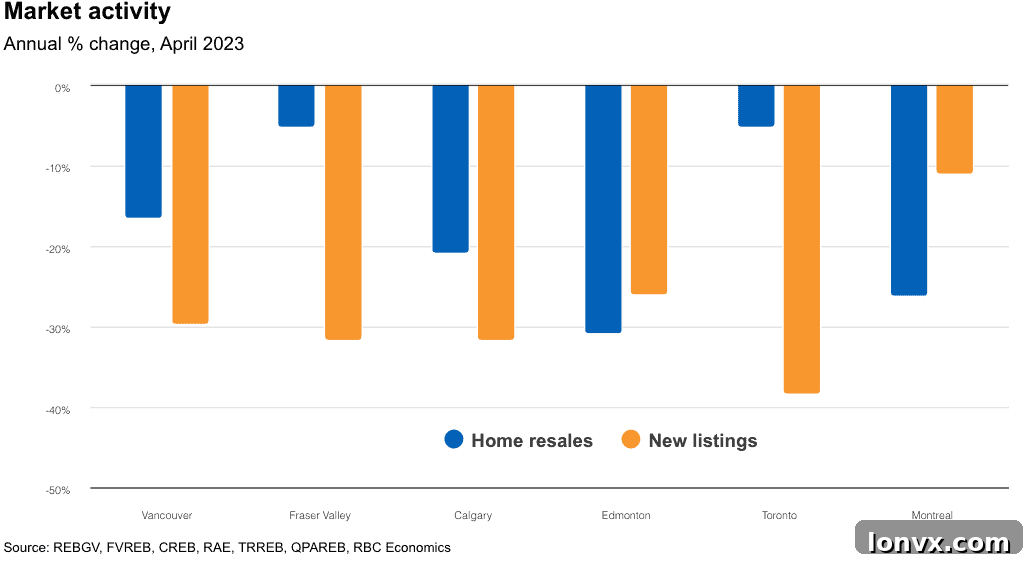
Toronto’s dynamic housing market, a bellwether for national trends, experienced a notable acceleration in April. Resale transactions within the Greater Toronto Area (GTA) surged by an impressive 27 percent from March, on a seasonally adjusted basis, reflecting a robust return of buyer activity. A 6.5 percent rise in new listings during the same period provided homebuyers with a broader selection of properties, yet this increase only partially met the rebounding demand. This imbalance led to a fifth consecutive month of tightening demand-supply conditions, reaching levels reminiscent of those before the market’s downturn. Such tight conditions have been a primary catalyst in propelling the price recovery forward.
The GTA’s MLS Home Price Index (HPI) recorded its second consecutive monthly increase in April, climbing by 2.4 percent month-over-month. Should these tight market conditions persist, Hogue anticipates further increases in property values. He emphasizes the pivotal role sellers will play in shaping the market’s trajectory: “Sellers hold the key to the market’s trajectory to a large extent. Much will depend on the degree to which they make their way back into the game and reshape (currently low) inventories.” Hogue’s outlook suggests that as property values continue their upward trend, a growing number of homeowners will likely feel encouraged to list their homes for sale. This anticipated influx of new supply, if substantial enough, could help to keep any significant price appreciation relatively contained, fostering a more balanced market environment.
Montreal Sees a Promising Spring Revival
With the arrival of warmer temperatures, Montreal’s real estate market has also emerged from its deep slumber, experiencing a significant spring revival. The Bank of Canada’s decision to pause its rate hikes served as a crucial catalyst, igniting renewed activity in April. Resale transactions in Montreal surged by an estimated 12 percent month-over-month, partially reversing a sharp 34 percent decline observed since early 2022. This impressive rebound signifies a growing perception that the market is bottoming out, invigorating both buyers and sellers.
The renewed confidence has resulted in fiercer competition for available properties, a direct contributor to ending the year-long price slide that had impacted the region. Median prices for both single-family homes and condominiums registered modest but meaningful increases between March and April, indicating a stabilization and initial recovery of values. Hogue predicts that these tightening demand-supply conditions are likely to continue, providing sustained support for further slight increases in prices in the period ahead. This positive outlook suggests Montreal could be on a steady path to recovery, balancing renewed buyer enthusiasm with a measured return of seller confidence.
Vancouver’s Correction Appears to Be Over
Vancouver, one of Canada’s most competitive and expensive housing markets, witnessed a notable uptick in activity in April, signaling the apparent conclusion of its recent correction phase. More buyers confidently returned to the market, likely sensing that the period of price adjustments had run its course. While there was an influx of new properties listed for sale, adding some excitement for buyers, the increase in new listings was significantly outpaced by the robust demand. Resales jumped by an estimated 30 percent or more, creating an imbalance where demand rose much faster than available supply, thereby putting upward pressure on prices.
After falling nearly 10 percent from its March 2022 peak, the Vancouver area’s MLS Home Price Index (HPI) has now trended upward for the past two consecutive months, including a substantial 2.3 percent month-over-month gain in April. Hogue anticipates that these tightening demand-supply conditions will likely keep prices on an upward trajectory in the foreseeable future. However, he also provides a crucial caveat: “But we continue to believe that extremely poor affordability will significantly limit the speed at which they will rise.” This highlights the persistent challenge of high property values relative to incomes in Vancouver, which will undoubtedly temper the pace of recovery despite strong market fundamentals.
Calgary’s Market Remains Remarkably Robust
Calgary’s housing market stands out for its impressive resilience, having weathered the broader economic and interest rate storms remarkably well. According to RBC calculations, home resales in Calgary rebounded a strong 28 percent month-over-month in April, demonstrating robust buyer confidence. This renewed activity also translated into higher prices, with the benchmark price for a home in Calgary reaching a new record high.
Throughout the past year, even amidst a general slowdown across Canada, Calgary’s market maintained an impressively robust performance. Resales consistently remained above pre-pandemic levels, a stark contrast to many other regions. Furthermore, the MLS HPI in Calgary largely held a steady pattern, defying the declining trend observed in virtually every other major Canadian market. This unique stability can be attributed to several factors, including a relatively more affordable entry point compared to Vancouver and Toronto, strong inter-provincial migration, and a stable energy sector. With market conditions tightening over the past three months and now clearly favoring sellers, Hogue fully expects prices in Calgary to appreciate further in the period ahead, solidifying its position as a standout performer in the national housing landscape.
Navigating the Future: Cautious Optimism Amidst Challenges
The spring awakening across Canada’s major housing markets marks a significant turning point, characterized by renewed buyer confidence, increased activity, and a gradual recovery in prices. The Bank of Canada’s pause on interest rate hikes has undoubtedly provided a crucial impetus, shifting market sentiment from apprehension to cautious optimism. While cities like Toronto, Vancouver, Montreal, and Calgary are leading this resurgence with their unique market dynamics, a common thread woven through the recovery narrative is the persistent challenge of affordability. This issue remains a formidable barrier, especially for first-time homebuyers, and is expected to moderate the pace of recovery despite strong underlying demand.
The trajectory of the Canadian housing market in the coming months will largely depend on a delicate balance: the sustained return of sellers to boost critically low inventory levels, the continued stability of interest rates, and the broader economic performance. Should supply respond adequately to demand, and affordability concerns be addressed through a combination of market forces and potential policy interventions, the current upswing could evolve into a more sustainable growth phase. However, any unexpected shifts in inflation, economic slowdowns, or a resumption of rate hikes could quickly dampen this nascent recovery. Stakeholders, from policymakers to prospective homeowners, will need to carefully monitor these evolving dynamics as Canada’s housing market navigates its complex path forward.