Understanding GFCI and AFCI: Essential Electrical Safety Devices for Your Home
In the intricate world of home electrical systems, safety is not merely a feature; it’s a fundamental requirement. Modern electrical codes and technologies have significantly advanced to protect residents from common yet dangerous electrical hazards. Among the most crucial innovations are Ground-Fault Circuit Interrupters (GFCIs) and Arc-Fault Circuit Interrupters (AFCIs). While both are designed to enhance safety, they tackle distinctly different threats, acting as silent guardians within your electrical infrastructure.
This comprehensive guide aims to demystify GFCI and AFCI devices, explaining their unique functionalities, operational mechanisms, and the specific hazards they protect against. We will delve into where these critical safety components are required by current electrical codes, differentiate between their roles, and highlight why understanding and maintaining them is paramount for every homeowner seeking to ensure a safe living environment.
Ground-Fault Circuit Interrupter (GFCI): Your Primary Defense Against Electrical Shock
A Ground-Fault Circuit Interrupter, or GFCI, is an incredibly fast-acting circuit breaker designed to automatically shut off electric power in the event of a ground-fault. A ground-fault occurs when electricity, instead of following its intended path through the wiring, finds an unintended route to the ground. This often happens through water, damaged appliance casings, or, most dangerously, through a person who accidentally becomes the path to ground for the electricity. GFCIs are specifically engineered to protect against this most common form of electrical shock hazard, which can be lethal.
How GFCIs Operate: Detecting Current Imbalance
The core principle behind a GFCI’s operation is continuous monitoring of electrical current flow. It meticulously compares the amount of current flowing out on the “hot” wire with the amount returning on the “neutral” wire. In a healthy circuit, these two currents should be perfectly equal. If the GFCI detects an imbalance as small as four or five milliamperes (mA)—a current much lower than what a standard circuit breaker would trip on—it signifies that electricity is leaking out of the circuit through an unintended path. Upon detecting this imbalance, the GFCI instantly trips the circuit, cutting off power within as little as 1/40th of a second. This rapid response is crucial, as it can prevent serious injury or death from electrical shock.
Unlike standard circuit breakers, which protect against overcurrents and short circuits (typically reacting to currents of 15,000 mA or more), a GFCI’s sensitivity to minute current leakages provides a unique and vital layer of personal protection, especially in environments where water increases the risk of ground-faults.
Beyond Shock: Additional Protective Benefits
While their primary role is to prevent ground-fault shocks, GFCIs also offer secondary benefits that contribute to overall electrical safety:
- Fire Prevention: Ground-faults can generate significant heat as current seeks an unintended path, potentially igniting surrounding materials or causing wire insulation to break down. By interrupting the power, GFCIs mitigate this fire risk.
- Overheating and Damage Prevention: Prolonged current leakage, even at low levels, can lead to overheating of wires and components, potentially damaging appliances and the electrical system itself. GFCIs prevent this cumulative damage.
Mandatory GFCI Locations According to Electrical Codes
Given their life-saving capabilities, GFCI protection is mandated by electrical codes—such as the National Electrical Code (NEC) in the U.S. and the Canadian Electrical Code (CEC)—in specific areas of a home where the risk of ground-faults is elevated. These “wet” or potentially damp locations include:
- All outlets in bathrooms.
- Outlets serving kitchen countertops and those within 6 feet of a sink.
- All outlets in garages, detached storage buildings, and sheds (with some exceptions for dedicated appliance outlets).
- All outdoor outlets, including those on patios, decks, and balconies.
- Outlets in unfinished basements and crawl spaces.
- Outlets in laundry rooms, specifically for washing machines and nearby receptacles.
- Outlets within 6 feet of wet bar sinks.
- All outlets in boathouses, marine hoists, and docks.
These requirements underscore the commitment of modern codes to proactively safeguard against shock hazards where people are most likely to interact with electricity in potentially hazardous conditions.
Types and Evolution of GFCI Technology
GFCIs are commonly found in several forms:
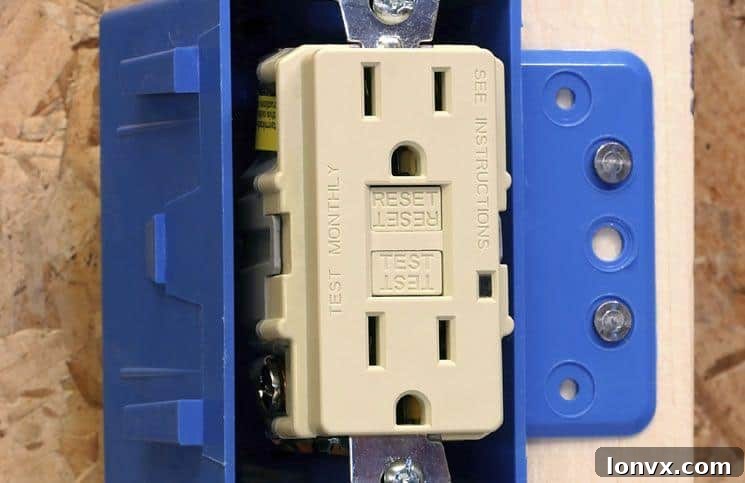
- GFCI Receptacles: These are outlets with integrated GFCI protection, identifiable by their prominent “Test” and “Reset” buttons. They protect not only devices plugged directly into them but also any standard outlets wired “downstream” on the same circuit.
- GFCI Breakers: Installed within the main electrical panel, a GFCI circuit breaker offers protection for the entire circuit it controls, extending to all wiring and every outlet connected to that circuit.
- Portable GFCIs: These units plug into a standard outlet, providing temporary GFCI protection for power tools or appliances used in outdoor or other high-risk environments.
A significant safety enhancement for GFCIs introduced after mid-2006 dictates that all newly manufactured GFCIs must include an “end-of-life” feature. This design ensures that if the GFCI’s internal sensing mechanism fails, the device will permanently trip, cutting off power and signaling the need for replacement, thereby preventing a false sense of security.
Arc-Fault Circuit Interrupter (AFCI): Protecting Your Home from Electrical Fires
While GFCIs target shock hazards, Arc-Fault Circuit Interrupters, or AFCIs, are specialized devices designed to protect against electrical fires caused by dangerous arcing. An electrical arc is a high-temperature electrical spark that occurs when electricity jumps between two conductors, or from a conductor to ground, through an unintended path. These uncontrolled sparks can reach extreme temperatures, often exceeding 2,000 degrees Fahrenheit (over 1,100 degrees Celsius), which is hot enough to rapidly ignite insulation, wood, or other combustible materials within a home, leading to devastating fires.
Understanding Arc Faults and Their Common Causes
Arc faults typically arise from damaged or deteriorated electrical wiring or connections. They are generally categorized into:
- Series Arcs: Occur when a conductor is unintentionally broken, corroded, or has a poor connection, creating a gap in the series path of the current. Examples include a frayed appliance cord, a loose terminal connection in an outlet, or a wire partially severed by a nail or screw.
- Parallel Arcs: Occur when current jumps between two different conductors (e.g., hot and neutral, or hot and ground) due to compromised insulation. This can be caused by rodent damage, crushing of wires, insulation degradation from age or heat, or accidental piercing.
Crucially, arc faults often do not draw enough current to trip a traditional circuit breaker, which is designed to react to overloads or short circuits. This is why AFCIs are essential: they employ sophisticated electronic circuitry to constantly analyze the electrical waveform for specific “signatures” or noise patterns that are characteristic of dangerous arcing. When these unique patterns are detected, the AFCI instantly trips the circuit, interrupting power before the arc can generate enough heat to start a fire.
Expanding AFCI Requirements in Electrical Codes
The importance of AFCI protection has led to its steady expansion within electrical codes. The Canadian Electrical Code (CEC) began requiring AFCI circuits in 2003, typically aligning with the U.S. National Electrical Code (NEC). Today, AFCIs are mandated for most living spaces within a home, particularly areas where occupants sleep, relax, or entertain. This typically includes:
- All bedrooms.
- Family rooms, living rooms, dining rooms, dens, parlors, libraries, and sunrooms.
- Hallways and closets within these areas.
- Recreation rooms and similar general-use areas.
- Laundry areas (often in combination with GFCI protection or as dual-function devices).
- Many areas of kitchens (often requiring combination AFCI/GFCI protection).
The broad application of AFCI requirements aims to protect against hidden wiring damage, faulty appliance cords, or loose connections that might otherwise go undetected until a catastrophic fire erupts.
Forms of AFCI Devices
AFCIs, like GFCIs, are available as:
- AFCI Breakers: Installed in the main electrical panel, these breakers protect all wiring and every outlet on the circuit they control from arc faults. They provide comprehensive protection for the entire circuit from the point of origin.
- AFCI Receptacles: These outlets provide localized arc-fault protection for devices plugged into them and any standard outlets wired downstream. A significant convenience of AFCI receptacles is the ability to reset the circuit directly at the point of the trip, eliminating the need to visit the main electrical panel for minor issues.
AFCI breakers and receptacles typically feature a “Test” button (often green or blue, though older versions might be yellow) that allows homeowners to verify their functionality. Regular testing, as recommended by manufacturers, is essential to ensure these devices remain fully operational and effective.
GFCI vs. AFCI: Understanding Their Distinct Roles and Combined Safety
While both GFCI and AFCI devices are indispensable for modern electrical safety, it is crucial to recognize that they protect against different types of hazards. They are not interchangeable, but rather complementary components of a comprehensive safety strategy.
Key Distinctions at a Glance:
| Feature | GFCI (Ground-Fault Circuit Interrupter) | AFCI (Arc-Fault Circuit Interrupter) |
|---|---|---|
| Primary Protection Against | Life-threatening electrical shock from ground-faults. | Electrical fires caused by dangerous arc faults. |
| Hazard Detection Method | Monitors current imbalance between hot and neutral wires (current leakage). | Analyzes electrical waveforms for patterns indicative of dangerous arcing (sparks). |
| Common Causes of Trip | Current finding an unintended path to ground (e.g., faulty appliance, water contact). | Damaged wiring, loose connections, frayed cords, pierced insulation. |
| Required Locations (Typical) | Wet/damp environments: bathrooms, kitchens (countertops), outdoors, garages, basements, laundry rooms, near sinks. | Most living areas: bedrooms, living rooms, family rooms, dining rooms, hallways, dens, closets. |
| Primary Benefit | Prevents electrocution and severe shock injuries. | Prevents devastating residential electrical fires. |
The Emergence of Dual Function Devices
Recognizing that some areas, like kitchens and laundry rooms, present risks for both ground-faults (due to water proximity) and arc-faults (due to high-power appliances and potential wiring stress), manufacturers have developed “Dual Function” AFCI/GFCI breakers and receptacles. These innovative devices ingeniously combine the protective capabilities of both technologies into a single unit, providing comprehensive protection against both shock hazards and fire risks on a single circuit. This simplifies installation and offers the highest level of safety in these high-risk zones.
Ensuring Comprehensive Home Electrical Safety: Why GFCI and AFCI Matter More Than Ever
The data on electrical accidents and home fires clearly demonstrates that electrical faults are a significant cause of property damage, injuries, and fatalities each year. The widespread integration of GFCI and AFCI technologies into electrical codes represents a monumental leap forward in consumer safety. These devices are not just regulatory mandates; they are proactive, life-saving innovations that continuously monitor your home’s electrical system, acting as vigilant guardians against unseen dangers that standard breakers simply cannot detect.
By ensuring your home is equipped with the appropriate GFCI and AFCI protection and by complying with the latest electrical codes, you are making a critical investment in the safety and longevity of your property, as well as the health and well-being of your family. These devices significantly reduce the risk of:
- Fatal and non-fatal electrical shocks, particularly in wet environments.
- Residential fires originating from faulty wiring, damaged cords, or deteriorated electrical connections.
- Extensive property damage and costly repairs that result from electrical incidents.
In today’s electrically reliant world, understanding and embracing these advanced protective devices is no longer optional. A truly safe and modern home is one where GFCI and AFCI technologies are correctly installed, regularly maintained, and fully integrated into its electrical infrastructure.
Installation, Testing, and Maintenance for Optimal Safety
The effectiveness of GFCI and AFCI devices hinges on proper installation and consistent maintenance. Adhering to best practices ensures these critical safety mechanisms are ready to protect when it matters most.
The Importance of Professional Installation
While the allure of DIY projects can be strong, electrical work carries inherent risks and requires specialized knowledge. For the installation of GFCI and AFCI devices, it is always strongly recommended to engage a qualified, licensed electrician. A professional will ensure:
- Correct wiring and circuit identification, preventing misinstallations that can compromise safety.
- Full compliance with local and national electrical codes, avoiding potential fines or safety hazards.
- Thorough testing upon installation to confirm proper functionality.
- Safe handling of your home’s electrical system, minimizing risks to property and personal safety.
Routine Testing: Your Role in Maintaining Safety
Both GFCI and AFCI devices are equipped with a “Test” button, and manufacturers recommend regular testing to confirm they remain fully operational:
- GFCI Testing: It is advisable to test GFCI receptacles and breakers monthly. Simply press the “Test” button; the power to the protected outlet or circuit should immediately trip off. Then, press “Reset” to restore power. If the GFCI fails to trip, or if it trips but cannot be reset, it indicates a malfunction and must be replaced promptly. Remember the crucial “end-of-life” feature on post-2006 GFCIs, which will prevent them from resetting if they fail.
- AFCI Testing: AFCI breakers and receptacles should be tested annually. The process is similar to GFCIs: press the “Test” button, and the power should interrupt. Press “Reset” to re-energize the circuit. If the device fails to trip or reset properly, contact an electrician for diagnosis and replacement.
Addressing Frequent Trips: Don’t Ignore the Warning Signs
Frequent tripping of a GFCI or AFCI is a clear indication of an underlying electrical problem, not necessarily a faulty device (unless it fails its test). It is imperative not to simply reset the device repeatedly without investigating the cause, as this can mask a dangerous condition:
- For GFCIs: If a GFCI trips, unplug all appliances from the circuit. If it then resets successfully, plug items back in one by one to identify the faulty appliance causing the ground-fault. If the GFCI still trips with nothing plugged in, there’s likely a wiring issue within the circuit itself, requiring professional attention.
- For AFCIs: If an AFCI trips, inspect connected cords and appliances for obvious signs of damage. Loose connections, overloaded circuits, or minor arc faults can cause nuisance trips. If the source of the trip isn’t immediately apparent, it is crucial to call a qualified electrician. Frequent AFCI trips strongly suggest the presence of a potentially dangerous arc fault condition that needs professional diagnosis and repair.
Ignoring tripped safety devices or attempting to bypass them can have severe and life-threatening consequences, including serious electrical shocks, property damage from fires, and invalidation of insurance policies.
Conclusion: The Foundation of Modern Electrical Safety
GFCI and AFCI technologies are indispensable cornerstones of contemporary electrical safety standards. While they are designed to protect against distinct types of hazards—GFCI against life-threatening ground-fault shocks and AFCI against devastating electrical fires caused by arcing—both are absolutely essential components of a safe and compliant home electrical system. Their widespread integration into national and local electrical codes underscores a collective commitment to minimizing preventable accidents and ensuring greater peace of mind for homeowners and their families.
By understanding what these critical devices do, where they are required, and how to properly maintain them, you empower yourself to make informed decisions about your home’s electrical infrastructure. Always prioritize safety, adhere to the latest code requirements, and when in doubt, consult with a qualified, licensed electrician. Their expertise will ensure that your home’s electrical system remains a beacon of safety and reliability, protecting your most valuable assets and loved ones.