Unveiling the Past: A Journey Inside a Neolithic Longhouse in Jersey
Step back over 6,000 years to explore the remarkable ingenuity and daily life of our ancient ancestors through an authentic Stone Age dwelling replica.
From Primitive Shelter to Permanent Home: Understanding Stone Age Dwellings
Imagine a world without the conveniences we take for granted today: no running water, central heating, or even basic plumbing. In the distant Stone Age, homes were a far cry from modern residences, lacking intricate flooring or a multitude of rooms. Yet, these ancient dwellings, painstakingly crafted from natural materials, represented a monumental leap in human civilization. When constructing an exterior wall took months of laborious effort, meticulously building with mud and twigs, simply having a sturdy shelter was a profound achievement and a testament to early human resourcefulness.
While the concept of a home warranty, a multi-listing service (MLS), or real estate agents would have been alien to our Neolithic forebears, their ingenuity laid the foundation for settled communities. These early structures, often made from organic materials, rarely survived the ravages of millennia, leaving modern historians and archaeologists with a challenging puzzle. However, dedicated experts continue to piece together the evidence, drawing insights from regions like the Danube basin and recent discoveries in Brittany, France, to reconstruct a vivid picture of these ancient homes.
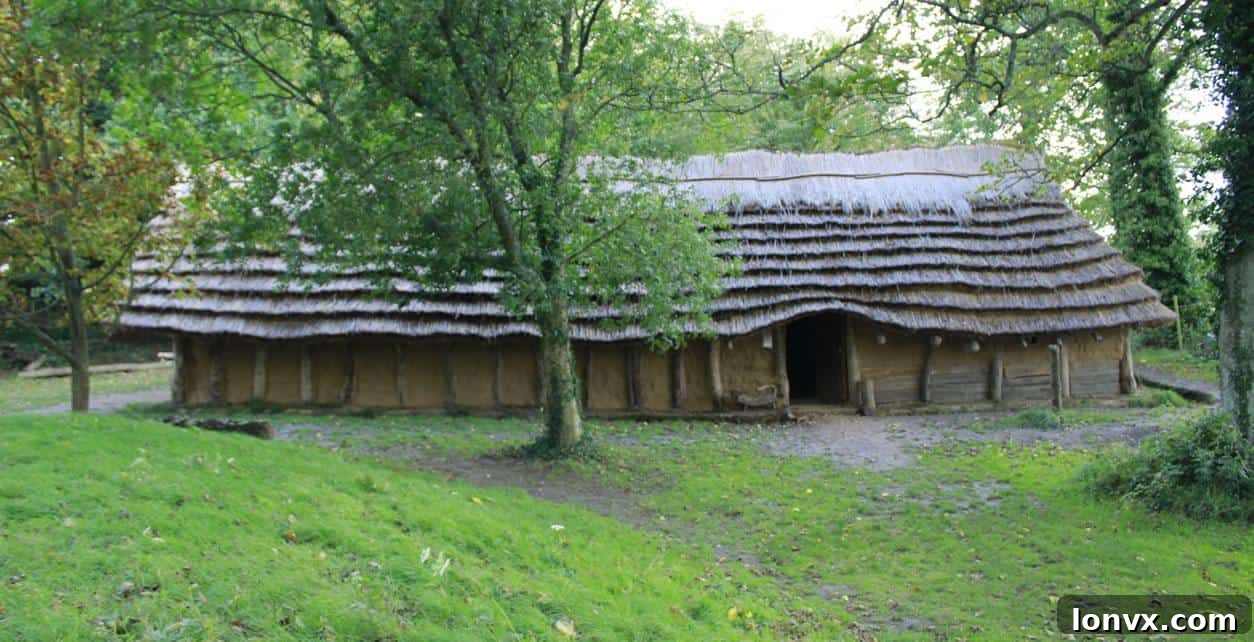
On the historically rich island of Jersey, tangible remnants of the Neolithic period abound, though direct evidence of Neolithic houses has long remained elusive. Despite this, it is widely believed that such dwellings were an integral part of life on the island during this transformative era. Now, thanks to an ambitious and highly successful partnership between Jersey Heritage and the Ancient Technology Centre, a full-scale replica of a typical Stone Age longhouse has been meticulously erected. This impressive structure stands proudly at La Hougue Bie, an important Neolithic passage grave site that itself bears witness to the significant farming populations that once thrived here.
The Dawn of Civilization: The Neolithic Revolution and Its Impact on Housing
A Transformative Era: From Nomadic Life to Settled Communities
The Neolithic period, often referred to as the “New Stone Age,” marked a profound turning point in human history – a true revolution that reshaped societies and altered our relationship with the environment forever. For hundreds of thousands of years prior, humanity had largely existed as nomadic hunter-gatherers, constantly moving in pursuit of food and resources. Their shelters were typically temporary, designed for mobility and easily abandoned. However, around 7,000 years ago in regions like Jersey, a radical shift began to occur: the domestication of plants and animals.
This agricultural revolution allowed communities to produce their own food, leading to a surplus and the ability to settle in one place. With the need for constant migration diminished, the concept of a permanent home became not just desirable but essential. This transition from a mobile existence to settled farming communities necessitated the development of more robust and enduring structures, providing long-term shelter, storage for crops, and a central hub for family and communal life. These early permanent homes were far more than simple shelters; they were symbols of a new way of life, fostering community cohesion, specialized labor, and ultimately, the foundations of complex societies.
Early European Settlements and Architectural Innovations
As settled communities emerged across Europe, so too did early forms of architecture. While materials like wood, mud, and thatch are perishable, archaeological excavations have revealed the “ghosts” of these ancient buildings. Post holes, foundation trenches, and scattered remnants of burnt materials provide invaluable clues to their size, shape, and construction methods. The discovery of these footprints allows archaeologists to reconstruct floor plans and infer the structure of the walls and roofs. It is through such meticulous detective work that we gain an understanding of the architectural innovations that characterized this era, reflecting a growing mastery over natural resources and an evolving understanding of engineering principles, however rudimentary they may seem by today’s standards.
Reconstructing the Past: Archaeological Evidence of Neolithic Architecture
Unearthing Clues: How We Know What Stone Age Homes Looked Like
The challenge of understanding Neolithic architecture lies in the materials themselves. Unlike stone monuments, typical Stone Age homes were constructed from organic matter – timber, mud, thatch, and woven branches – which decompose over centuries, leaving little direct trace. Yet, archaeologists are incredibly skilled at interpreting subtle cues left in the ground. Excavations often reveal distinct patterns of post holes, indicating where large timber uprights once stood, forming the skeletal framework of a building. Discolorations in the soil can mark the locations of former walls or internal partitions. Crucially, discoveries of burnt wattle and daub – clay mixed with straw and other binders, baked hard by ancient fires – provide direct evidence of wall composition, preserving the texture and even the imprints of the woven branches that formed the core of the walls.
These fragmented remains, combined with painstaking analysis and comparative studies across different sites, allow experts to create detailed hypotheses about the appearance and construction of Neolithic dwellings. It’s a process of piecing together an ancient jigsaw puzzle, where each piece of evidence, no matter how small, contributes to a clearer picture of life thousands of years ago.
The Danubian Longhouse: A Blueprint for Early European Dwellings
Among the most significant archaeological discoveries pertaining to early European housing are the remains of what are known as Danubian longhouses. Named for the Danube basin, where they were first extensively excavated, these structures represent some of the very first Neolithic houses built in Europe. Their distinctive style and layout provided a foundational architectural blueprint that influenced construction across vast swathes of the continent, including, it is believed, the dwellings built by the early farmers of Jersey. These longhouses were typically, as their name suggests, long and narrow in plan, often oriented along a northwest to southeast axis, with a doorway commonly found in the south wall.
Excavated remains consistently show rows of three robust wooden posts running down the interior, which were vital for supporting the heavy timber frame and thatched roof. Scorch marks within these archaeological footprints frequently indicate the presence of central hearths, which would have provided warmth and a cooking area. The burnt fragments of wattle and daub found at Danubian sites have been instrumental in confirming the materials and techniques used for constructing the walls. This invaluable evidence forms the primary basis for the design and construction of the Jersey longhouse replica, ensuring its historical accuracy and educational integrity.
Bringing History to Life: The La Hougue Bie Neolithic Longhouse Project
A Vision Realized: The Partnership Behind the Replica
The island of Jersey boasts a rich and captivating Neolithic heritage, evident in its numerous megalithic tombs and archaeological sites. La Hougue Bie, in particular, stands as a prime example of this ancient past – a massive passage grave that speaks volumes about the developed farming communities that once inhabited the island during the Stone Age. Recognizing the immense potential for education and historical interpretation, Jersey Heritage embarked on an ambitious project to bring the island’s Neolithic past to life. This vision was realized through a highly successful collaboration with the Ancient Technology Centre, a renowned UK-based organization specializing in historical reconstructions and traditional crafts.
The partnership aimed not only to construct a historically accurate replica but also to engage the community and provide an immersive, hands-on learning experience. The site of La Hougue Bie was chosen specifically for its deep historical roots and its existing connection to the Neolithic farming populations, providing an authentic context for the longhouse and allowing visitors to directly link the dwelling to the people who built the nearby passage grave.
The Monumental Undertaking: Building the 20-Meter Longhouse
The construction of the 20-meter (approximately 65-foot) long timber-frame longhouse was nothing short of a monumental undertaking, reflecting the scale of effort required by Neolithic builders themselves. This incredible feat was achieved through the tireless dedication of a vast team of 140 volunteers, including a core group of 18 individuals who committed significant time and energy to the project. Over two years, these passionate volunteers collectively poured an astonishing 8,500 hours into bringing the ancient structure to life. Their commitment underscores the power of community engagement in preserving and interpreting history, transforming a theoretical concept into a tangible, awe-inspiring reality.
The meticulously crafted longhouse replica at La Hougue Bie took 140 dedicated volunteers more than two years to construct, faithfully recreating Stone Age building techniques.
Mastering Ancient Crafts: Traditional Techniques in Action
Authenticity was paramount throughout the project, meaning that modern tools and methods were largely eschewed in favor of traditional Neolithic techniques. This commitment ensured that the building process itself became a living demonstration of ancient craftsmanship. Volunteers learned and applied methods such as mud daubing, where a sticky mixture of clay, earth, and organic fibers is plastered onto a woven framework. Thatching, a highly skilled craft, involved carefully layering plant materials like reeds or straw to create a waterproof and insulating roof. Bark-stripping, used for obtaining materials for various purposes, and the intricate process of making strong cordage from readily available natural resources like stinging nettles and brambles, were all integral parts of the construction. This remarkable adherence to historical accuracy was meticulously supervised by Luke Winter, a renowned UK ancient technology expert, ensuring that every detail reflected genuine Stone Age building practices.
Stepping Inside: The Interior of a Neolithic Home
The interior of the longhouse offers a compelling glimpse into the living spaces of our ancestors. Visitors stepping inside are greeted by several large, upright wooden posts, forming the backbone of the structure and supporting the impressive, water and weatherproof thatched roof. The walls are a prime example of wattle and daub construction: an intricate lattice of woven branches (the wattle) covered with a thick plaster-like mixture (the daub). The daub itself was a fascinating blend of local clay, straw for reinforcement, cow dung for binding properties, and even horsehair for added strength and durability – a testament to the resourcefulness of Neolithic builders. This wattle and daub technique, though incredibly effective, was a particularly labour-intensive process, highlighting the sheer effort involved in creating a comfortable and secure dwelling.
In a charming and historically resonant gesture, the official opening of the longhouse in March deviated from modern tradition. Instead of a ceremonial ribbon cutting with scissors, the event was marked by the symbolic cutting of a piece of hand-made cordage using a replica stone axe. This poignant act underscored the project’s dedication to historical authenticity and provided a memorable connection to the ancient tools and materials that shaped the lives of Neolithic people.
Life in Neolithic Jersey: Adapting to a New Island Home
The Genesis of an Island: Jersey’s Formation and Early Settlement
The history of Jersey as an island is intimately intertwined with the advent of the Neolithic period in the region. Roughly 7,000 years ago, as sea levels rose following the last ice age, the land bridge connecting Jersey to the European mainland submerged, transforming it into an island. This geographical transformation coincided with a pivotal shift in human societies. It was during this very period that people began to abandon their ancient hunter-gatherer existence, which had defined human life for millennia, in favour of a more settled, agricultural lifestyle. The isolation of island life would have presented unique challenges and opportunities for these early farmers, fostering a close-knit community and a deep connection to their immediate environment.
These early inhabitants of Jersey were pioneers, mastering new technologies and practices. They learned to make pottery for cooking and storage, crafted sophisticated stone tools for farming and daily tasks, and, for the very first time, constructed permanent homes. These dwellings, much like the one now proudly displayed at La Hougue Bie, represented a profound commitment to the land and a vision for a stable, enduring community on their newly formed island home. Their choice to settle and farm laid the groundwork for all subsequent human habitation on Jersey.
Daily Existence: What Life Was Like in a Longhouse
Living in a Neolithic longhouse would have been a communal experience. These large structures likely housed extended families or small community groups, fostering close social bonds and shared responsibilities. The interior, though basic by modern standards, would have been a hub of activity: food preparation around the central hearth, crafting tools and pottery, weaving textiles from plant fibers, and perhaps even sleeping areas delineated by simple partitions or animal hides. The thatched roof would have provided insulation against the elements, while the wattle and daub walls offered protection from wind and rain. Life was undoubtedly challenging, dictated by the seasons and the demands of farming. Yet, the longhouse represented security, a place of belonging, and a tangible symbol of human ingenuity in the face of a wild world. It was the heart of the community, where stories were shared, skills passed down, and the future of the farming settlement was forged.
Experience the Stone Age: A Unique Educational Opportunity at La Hougue Bie
The Neolithic Longhouse at La Hougue Bie is far more than just a static display; it is a dynamic, immersive educational experience. Visitors to the site are frequently treated to live demonstrations conducted by knowledgeable volunteers. These skilled individuals showcase some of the very ancient methods that were essential to Neolithic life, including intricate weaving techniques, the creation of functional and decorative pottery, and traditional woodworking. These interactive displays offer a captivating and tangible glimpse into daily life as it was lived more than 6,000 years ago, allowing visitors of all ages to connect with the past on a deeply personal level. It’s an opportunity to witness firsthand the skills, tools, and sheer perseverance that characterized this pivotal era in human development.
Beyond the demonstrations, exploring the longhouse itself offers a profound sense of connection to history. Walking through its timber frame and wattle and daub walls, one can almost hear the echoes of ancient conversations and imagine the warmth of the hearth. This unique attraction serves as an invaluable resource for understanding the roots of our settled societies, the evolution of human technology, and the enduring spirit of innovation that has defined our species.
Bridging Millennia: The Enduring Legacy of Neolithic Ingenuity
From the rudimentary shelters of hunter-gatherers to the sophisticated structures of settled farmers, the Neolithic longhouse represents a monumental achievement in human history. The replica at La Hougue Bie in Jersey stands as a powerful testament to this ingenuity, offering a tangible link to our ancient past. It reminds us that while our homes today are filled with countless modern conveniences, the fundamental human need for shelter, community, and security remains unchanged.
This remarkable project, built through collective effort and a deep respect for historical accuracy, not only enriches our understanding of the Stone Age but also highlights the enduring human capacity for adaptation, innovation, and cooperation. By preserving and interpreting these ancient structures, we gain invaluable insights into the journey of humanity and appreciate the long lineage of creativity that has shaped the world we inhabit today.