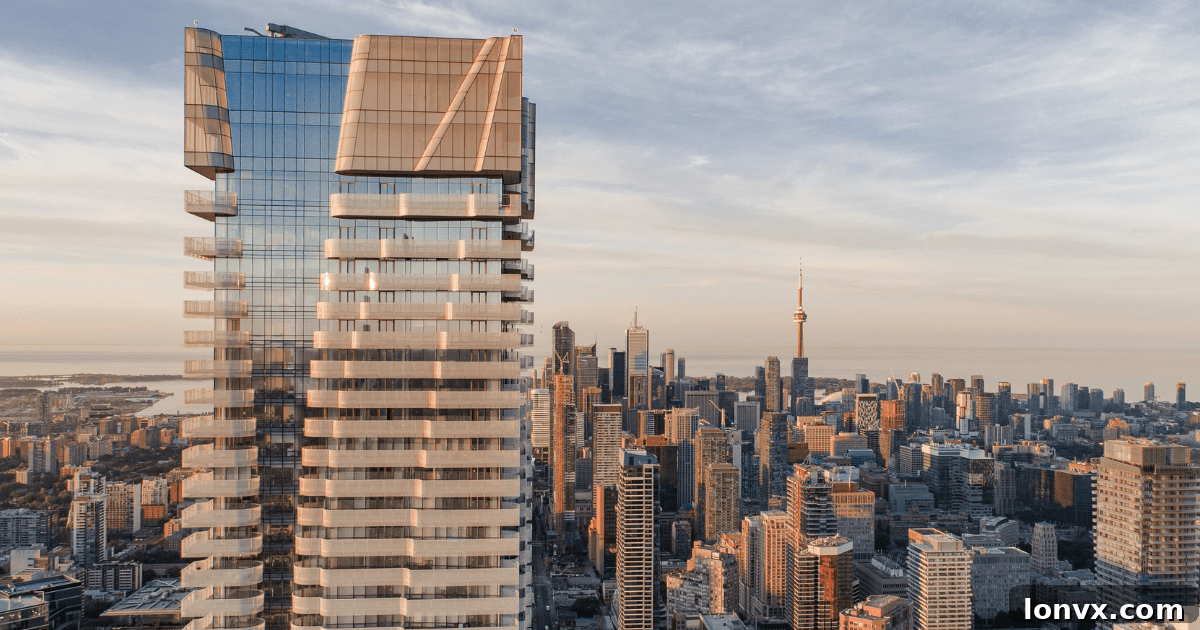
Image source: OneBloor.com
Toronto is rapidly emerging as a global leader in the ambitious realm of supertall tower development. Facing an escalating demand for housing and limited opportunities for outward expansion, the city has strategically embraced a ‘build up, not out’ philosophy. This vertical growth strategy is seen as a critical solution to increase housing supply, boost urban density, and accommodate a burgeoning population within its existing footprint. As a result, the city’s skyline is undergoing a transformative period, reflecting an urgent commitment to modern urbanism.
Supertall towers, officially defined as structures exceeding 300 meters in height, typically boast over 100 storeys and can house more than 1,000 residential units. These monumental projects represent the pinnacle of architectural ambition and engineering prowess. Currently, Toronto’s urban landscape is set to feature nine such supertowers actively under development, with an additional six impressive proposals on the drawing board, signaling a profound shift in how the city plans for its future. This surge in high-rise construction positions Toronto at the forefront of innovative urban development.
Highlighting Toronto’s pivotal role in this global trend, the Council on Vertical Urbanism chose the city to host its international conference in October. This prestigious event brought together experts and thought leaders from around the world, all keen to share their insights and perspectives on the burgeoning trend of supertall construction. Isaac Work, the associate director for the Canadian office of the Council on Vertical Urbanism, emphasized in an interview with Real Estate Magazine that Toronto was an ideal host city. Its dynamic real estate market and numerous groundbreaking developments provided a living laboratory for attendees to observe and discuss the challenges and opportunities presented by extreme vertical growth. The conference served as a testament to Toronto’s commitment to pushing the boundaries of urban design and planning.
The Driving Forces Behind Toronto’s Vertical Ambition
The global push towards supertall towers is fundamentally rooted in shifting market dynamics, primarily driven by the relentless escalation of urban land values. Isaac Work articulates a direct correlation: as land becomes more expensive, developers are compelled to maximize its utility by building higher. In densely populated urban centers like Toronto, where available land is scarce and prohibitively priced, vertical expansion becomes not just an option, but an economic imperative. This phenomenon is transforming skylines worldwide as cities grapple with the complexities of growth within finite boundaries.
Canada, and particularly Toronto, has experienced unprecedented immigration levels over recent years, placing immense pressure on existing housing infrastructure. Work points out that the traditional model of suburbanization is simply unsustainable in the face of this rapid population influx. The environmental impact, increased commute times, and strain on infrastructure associated with urban sprawl necessitate a more concentrated approach to development. There is a palpable and growing demand for greater densification within Canadian cities, making supertall developments an attractive and often necessary solution for accommodating new residents and fostering vibrant urban communities.
Despite its current development boom, Toronto still has ground to cover when compared to other global powerhouses in supertall construction. Work notes that iconic U.S. cities such as Chicago and New York City have long been pioneers in this architectural domain, establishing benchmarks years ago. Beyond North America, mega-cities in regions like Dubai and China boast towers that dwarf Toronto’s current projects, some reaching over 600 meters – effectively double the height of what is currently under construction or proposed in the Canadian metropolis. This comparison highlights both Toronto’s potential and the journey ahead in fully realizing its supertall aspirations, particularly as engineering and design continue to advance globally.
Evolving Investment Models and Housing Solutions
The landscape of supertall tower investment in Toronto has significantly evolved, particularly influenced by recent policy changes. Before Canada’s temporary ban on foreign ownership, the market for supertall condo units was heavily dominated by investors, many of whom were from outside the country. These buyers were often attracted by the promise of unobstructed, panoramic views that not only offered prestige but also served to retain and often increase the property’s value over time. The allure of a high-rise, luxurious lifestyle, coupled with investment potential, made these units highly desirable in a competitive global market.
However, since the implementation of the foreign ownership ban, a notable shift has occurred in the development strategies for supertall projects. According to Isaac Work, developers are now increasingly pivoting towards purpose-built rental units rather than exclusively focusing on ultra-luxury condominiums. This strategic change is aimed at broadening the appeal of these towering structures to a more diverse demographic, specifically average buyers and renters who are grappling with housing affordability challenges in Toronto. This move signifies a broader industry recognition of the need for accessible housing options, even within the context of monumental architectural projects, fostering long-term stability in the rental market.
This pivot towards purpose-built rentals addresses several critical urban challenges. It provides much-needed housing supply for a growing population, contributes to a more diversified housing stock, and can help mitigate some of the speculative elements previously seen in the luxury condo market. By focusing on rentals, developers can also create long-term income streams and contribute to a more stable and less volatile housing ecosystem. This strategic evolution not only adapts to policy changes but also aligns with the city’s broader goals of fostering inclusive growth and ensuring that vertical densification benefits a wider segment of the population, thereby reinforcing Toronto’s commitment to balanced urban development.
Pushing the Limits of Architectural Design and Technology
The development of supertall towers is fundamentally a testament to human ingenuity, constantly pushing the boundaries of architectural design and engineering technology. Mansoor Kazerouni, global director of architecture and urbanism at the renowned design firm Arcadis, was among the experts who attended the Council on Vertical Urbanism conference in Toronto. He shared his astonishment with Real Estate Magazine regarding the sheer scale of technological innovations showcased there. These advancements are not merely aesthetic but are critical for the safety, efficiency, and sustainability of buildings of such unprecedented height.
One particularly fascinating area of innovation lies in building aerodynamics and structural stability. For instance, developers are experimenting with novel building designs that incorporate large openings or “holes” in their middle sections. These strategic voids are not merely aesthetic features; they are engineered to allow high-speed winds to pass through the structure rather than exert immense pressure on its surfaces. This ingenious solution significantly reduces wind loads, thereby minimizing building sway – a crucial concern for occupant comfort and structural integrity in supertall structures. Such innovations highlight the marriage of form and function, where design directly addresses complex engineering challenges.
Beyond structural design, elevator technology is undergoing a revolution that profoundly impacts how supertowers function. Traditional elevator systems are being replaced by multi-car, vertically and horizontally traveling units. These cutting-edge systems, such as those pioneered by companies like ThyssenKrupp, can not only transport passengers at incredible speeds vertically but also move horizontally, allowing a single elevator shaft to service multiple levels across different sections of a building or even connect adjacent structures. Kazerouni encapsulated this spirit of innovation perfectly: “It’s kind of eye-opening. The technology is frankly limited by our imagination, but if we open ourselves up to it, we will discover whole other forms of development that will yet again redefine what living in a tall building means.” This vision anticipates a future where vertical cities are seamlessly integrated, offering unparalleled connectivity and efficiency.
Arcadis, the firm where Mansoor Kazerouni holds a leading role, stands as a prime example of this innovative spirit. The company has played a pivotal role in designing the proposed supertall tower at 19 Bloor West in Toronto. This ambitious project is envisioned to soar to an impressive 99 storeys and reach a height of 317 meters, marking it as a significant addition to Toronto’s evolving skyline. Such projects not only showcase architectural brilliance but also push the boundaries of what is technically feasible, setting new standards for urban living and design in one of the world’s most dynamic cities.
Building the Future: Engineering Marvels and Urban Vision
Constructing supertall towers presents a unique set of engineering challenges that far surpass those encountered in conventional high-rise developments. Mansoor Kazerouni underlines this complexity, using the example of installing a “tuned mass damper” in the M3 building in Mississauga. While technically just shy of the supertall threshold at 267 meters, the anecdote perfectly illustrates the immense logistical and technical hurdles. This critical piece of equipment, designed to counteract building sway caused by wind or seismic activity, weighed an astonishing 700 tonnes of steel. Transporting this massive component required approximately 60 trucks and a painstaking two months to hoist and install it at the top of the tower. This intricate process highlights the specialized equipment, precise planning, and extensive timelines required for such colossal projects.
Despite the arduous nature of these construction feats, Kazerouni remains adamant that the additional effort and investment in supertall towers are unequivocally worthwhile. He views these structures as vital components in preparing cities for the distant future, urging urban planners and developers to adopt a long-term perspective. “You can’t think of the city in its current context, you’ve got to think of it in 30 and 50 years,” he advises. This forward-looking approach demands anticipation of future population growth, evolving infrastructure needs, and the dynamic demands of urban living. Supertalls, in this vision, are not merely buildings but strategic investments in a city’s resilience and capacity to thrive decades from now.
The essence of this philosophy lies in maximizing the potential of urban sites. “What’s the city going to need? And where are you going to accommodate those needs? So you’ve got to make sure that we are developing these sites to their best potential,” Kazerouni explains. This means designing buildings that are adaptable, sustainable, and integrated into a broader urban fabric that can support future innovations. The discussion even extended to futuristic concepts, such as the possibility of flying cars akin to those in “The Jetsons,” zipping between supertalls. While speculative, Kazerouni’s reluctance to rule out anything underscores the open-mindedness and imaginative thinking required to plan for truly future-proof cities. Supertall towers are therefore not just about height, but about shaping a vision for an evolving urban existence.
The Human Element: Living at Lofty Heights
While supertall towers offer unparalleled views and architectural grandeur, the experience of living at such extreme heights is not universally appealing. Sean Miller, a real estate agent with Property.ca, shared his insights with Real Estate Magazine, reflecting on his agency’s experience representing One Bloor East. This impressive building, at 257 meters tall, stands just below the supertall threshold, yet Miller observed a distinct trend: a relative lack of overwhelming interest in its highest units. This suggests that for many prospective buyers, the allure of extreme height can be tempered by other considerations, challenging the notion that taller is always better.
Miller noted that a significant segment of buyers continues to gravitate towards smaller, more intimate boutique buildings rather than aspiring to live “high in the sky.” This preference often stems from a desire for a stronger sense of community, a more grounded connection to street-level amenities, or simply a comfort level that diminishes with extreme elevation. For some, a sense of vertigo can become a genuine concern when dwelling so far above the ground, transforming what might be considered a majestic view into an unsettling experience. The psychological impact of living at such immense heights is a factor that real estate professionals must increasingly address.
Recalling a particularly vivid experience, Miller described visiting a penthouse unit at One Bloor East on a cloudy winter day. As he gazed out the window, he realized he was literally above the clouds, a phenomenon that for many would evoke a sense of awe. However, for Miller and potentially many buyers, the experience was more disorienting than exhilarating. “A lot of people just don’t feel comfortable being up that high,” he commented, describing the sensation as “very eerie.” This personal account underscores the subjective nature of luxury living and highlights that while supertalls represent aspirational symbols of modernity, they must also contend with fundamental human comfort and psychological preferences. Finding the right balance between innovative design and human-centric living remains a key challenge in the ongoing evolution of Toronto’s impressive vertical landscape.