
As the vibrant hues of summer gently recede and the crisp air of autumn ushers in sweater weather, Canada’s housing market is unequivocally settling into a distinct cooling phase. This trend, mirroring the shifts observed throughout August, signals a notable departure from the vigorous activity witnessed earlier in the year. According to the insightful analysis of Robert Hogue, Assistant Chief Economist at RBC Economics, the pivotal factor behind this market recalibration has been the aggressive series of interest rate hikes implemented by the Bank of Canada over the summer months. These measures have effectively tempered what began as a robust and competitive spring market, ushering in an era of heightened buyer caution and a more balanced transactional landscape.
Canada’s Housing Market: Navigating a New Equilibrium
The latest August market reports, meticulously compiled by various local real estate boards across Canada, paint a clear picture of an ongoing rebalancing act between supply and demand. This shift is particularly pronounced in several of the nation’s most dynamic urban centres. Cities such as Vancouver, the Fraser Valley, Toronto, and Hamilton are at the forefront of this rebalancing trend, where market conditions are visibly easing from the tight seller’s markets experienced previously. In stark contrast, Calgary continues to defy national trends, maintaining an “exceptionally firm” market characterized by persistent high demand and constrained supply.
Robert Hogue elaborates on these unfolding dynamics, stating, “Consistent with rebalancing trends, there’s growing evidence this spring’s price rally is running out of steam in Ontario and B.C.” This observation is substantiated by reports from local real estate boards, which indicated modest month-to-month declines in the MLS Home Price Index (HPI) for key markets including Vancouver, the Fraser Valley, and Toronto. This deceleration in price growth marks a significant shift from the rapid appreciation seen earlier in the year. However, Calgary’s property values remain on a robust upward trajectory, buoyed by strong interprovincial migration and a vibrant provincial economy that continues to attract new residents and investment.
Despite a discernible uptick in housing inventory across many regions, the prevailing sentiment among prospective buyers is one of heightened caution this autumn. Several formidable headwinds are converging to impede any material recovery in market activity. Paramount among these are the elevated interest rates, which directly impact borrowing costs and mortgage affordability, making homeownership a more expensive proposition. Furthermore, persistent affordability concerns, particularly in high-cost urban centers, continue to challenge buyers. Adding to this complex mix is the looming threat of a potential economic recession, which fosters uncertainty and encourages a wait-and-see approach. Hogue suggests that any substantial acceleration in the housing market’s recovery is likely contingent upon a future scenario where interest rates begin to recede, a development he anticipates might materialize sometime in 2024.
The journey from a red-hot seller’s market to a more equitable playing field for both buyers and sellers is fraught with complexities. For sellers, this new phase necessitates a realistic assessment of market values and potentially more strategic pricing, while buyers gain a slight edge with more inventory and less intense bidding wars. This period of adjustment is crucial for the long-term health and stability of the Canadian real estate landscape, moving away from unsustainable growth rates towards a more measured and sustainable pace.
Greater Toronto Area: A Market in Transition
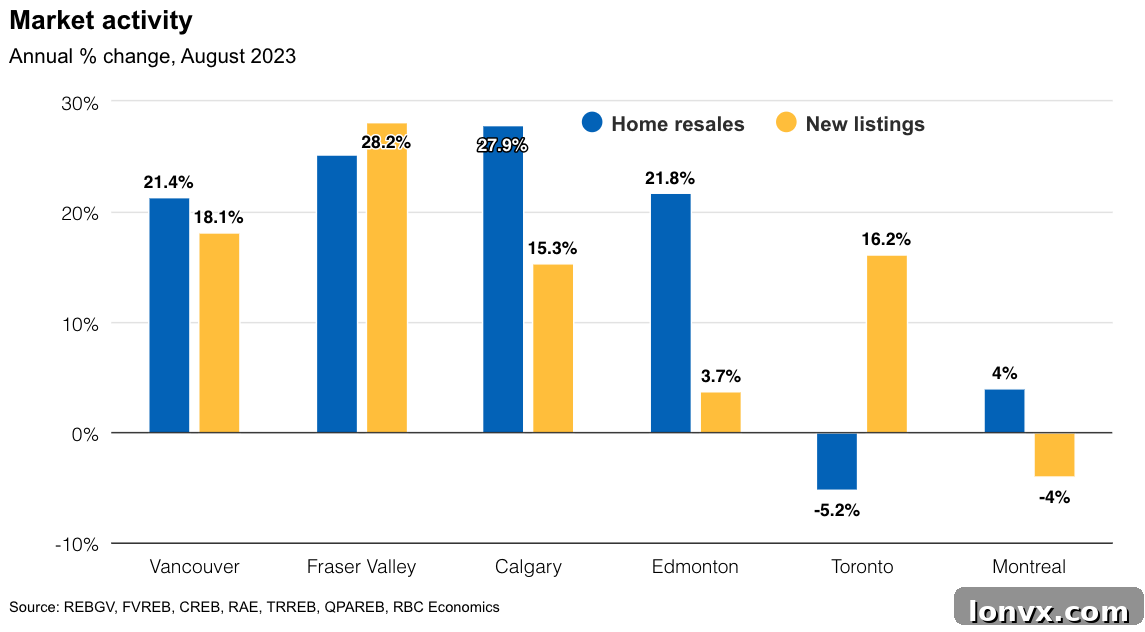
The Greater Toronto Area (GTA), historically one of Canada’s most dynamic and competitive real estate markets, experienced a noticeable slowdown in August. Home resales in the region slipped another 1.0 percent month-over-month on a seasonally-adjusted basis, signalling a continued deceleration from its earlier spring momentum. This trend indicates a market grappling with shifting forces, where buyer enthusiasm has been significantly curbed by external economic pressures.
Robert Hogue offers a granular explanation for this softening, noting, “What’s restraining the market has less and less to do with a lack of purchasing options. New listings and inventories have been rising noticeably fast over the past five months—including in August.” This crucial insight suggests that the primary bottleneck is no longer a scarcity of available properties, but rather a weakening of buyer confidence. He further clarifies, “Rather, it increasingly reflects sagging buyers’ sentiment in the face of high-interest rates, extremely poor affordability and a softening economy.” This confluence of factors—elevated borrowing costs, the persistent challenge of housing affordability in one of North America’s most expensive cities, and broader economic uncertainties—is collectively deterring potential purchasers, leading to reduced transaction volumes.
The demand-supply conditions in the GTA have undergone a significant rebalancing. The sales-to-new listings ratio, a key indicator of market tightness, is now approaching what is commonly defined as buyer’s market territory. This shift empowers buyers with more negotiation leverage and a wider selection of properties. Consequently, prices in the GTA edged lower for the first time since February, a clear signal of the market’s stagnant trajectory in the near term. This period of stagnation is allowing the market to digest the rapid price increases of previous years and adjust to the new economic realities, offering a breather for many aspiring homeowners who have been priced out of the market. For sellers, it means longer listing times and a need for realistic pricing strategies to attract cautious buyers.
Montreal Metropolitan Area: Sustained Activity Amidst Rising Supply
In the Montreal metropolitan area, the housing market presents a nuanced picture characterized by a growing supply of homes for sale, which has, counterintuitively, provided a boost to transaction flows. New listings have shown a consistent upward trend, increasing for the fourth time in five months. This influx of fresh inventory suggests that more sellers are choosing to enter the market, perhaps in response to previous price gains or changing personal circumstances. Despite this increased availability, demand-supply conditions in Montreal remain somewhat tight, preventing a drastic shift towards a buyer’s market. This delicate balance is providing modest, albeit uneven, support for property values across the region.
Hogue provides specific insights into Montreal’s varied performance across different property types and geographical segments. He notes, “In August, the median price for a single-detached home gained 1.1 percent from July, whereas it edged lower by 0.5 percent for a condo apartment.” This divergence highlights the varying demand dynamics within the market, with single-detached homes perhaps still benefiting from stronger demand or lower relative supply compared to condominiums. Furthermore, geographical disparities are evident: “Properties situated on the Island of Montreal generally recorded larger appreciation relative to Laval, and the North and South Shores.” This suggests that central, urban locations continue to command higher value growth. Looking ahead, Hogue anticipates “further measured appreciation in the near term” for the Montreal market, indicating a stable but not explosive growth trajectory, reflecting its resilience and underlying demand even amidst broader national cooling trends.
Vancouver Area: Momentum Lost, Balance Restored
Vancouver, a market notorious for its high prices and intense competition, has unequivocally seen its spring rally lose significant momentum. Buyers in this region have noticeably pulled back in August, signaling a retreat from the more fervent activity observed earlier in the year. The primary catalyst for this shift, according to analysis, has been the series of interest rate hikes by the Bank of Canada, which effectively unsettled prospective buyers. Even with an increase in the number of homes available for sale, the psychological and financial impact of higher borrowing costs has proven to be a powerful deterrent.
Hogue elaborates on this dynamic, stating, “Successive increases in the number of homes put up for sale since April—which reached a 15-month high in August—should have fired them up instead by offering opportunities to unlock pent-up demand that built during the year-long market correction.” This implies that while increased supply typically benefits buyers by offering more choice, the overwhelming concern over interest rates has overshadowed this advantage. He concludes, “The net result is a more balanced market. And with this spring’s tightness gone, prices are losing support.” This signifies a crucial transition: the seller’s market conditions that characterized the spring have largely dissipated, giving way to a more equitable environment. Consequently, the upward pressure on prices has diminished.
Evidence of this rebalancing is clear in the data: Vancouver’s aggregate MLS HPI experienced a slight dip between July and August, marking the first decline since March. This downward adjustment, though modest, is a significant indicator of the market’s changed direction. Hogue predicts that this “cautious tone” will persist, leading to prices maintaining a flat trajectory in the coming months. For buyers, this translates into more time to make decisions and potentially less competitive bidding, while sellers may need to adjust their expectations regarding sale timelines and final prices in this newly balanced landscape.
Calgary: An Unstoppable Market Force
Calgary continues to stand out as a remarkable outlier in the Canadian housing market, exhibiting a resilience and growth that defies the cooling trends observed elsewhere. August home resales in Calgary are estimated to have surged by an impressive 10 percent month-over-month on a seasonally adjusted basis, underscoring its exceptional performance. This robust activity persists despite a growing supply of homes, which, in other markets, would typically ease tightness. In Calgary, however, inventories remain exceptionally low, indicating that the influx of new listings is quickly absorbed by an insatiable demand. This imbalance keeps the market intensely competitive for buyers, forcing swift decisions and often multiple offers.
The sustained vigor of Calgary’s market is primarily fueled by two powerful drivers: strong demand and explosive population growth. Alberta, and Calgary in particular, has become a magnet for interprovincial migration, attracting residents from other parts of Canada seeking more affordable living and robust employment opportunities. This demographic boom directly translates into a significant need for housing. Furthermore, a thriving provincial economy, particularly within the energy sector and diversifying tech industries, underpins a strong job market, boosting consumer confidence and purchasing power. These fundamental factors ensure that Calgary’s market remains highly competitive, with property values continuing their upward climb.
Calgary’s aggregate MLS HPI is up a striking 7.9 percent from a year ago, an advance that is the most significant among all major Canadian markets. This impressive year-over-year growth further solidifies its position as the nation’s leading performer. Robert Hogue emphatically states that there are “no immediate signs of a cooling trend in the short term” for Calgary. This forecast suggests that the unique combination of migration, economic strength, and constrained supply will continue to fuel its exceptional market performance for the foreseeable future, making it a challenging but rewarding market for both buyers and sellers operating within its unique dynamics.
For a comprehensive understanding of these market shifts, delve deeper into Robert Hogue’s full report on the Canadian housing market. His expert analysis provides invaluable insights into the forces shaping real estate across the nation. Read the full report here.