
Canada’s Housing Crisis: Unveiling the Hidden Million Non-Permanent Residents
Canada is currently grappling with an unprecedented housing shortage, a crisis that has sent ripples through its economy and society. While myriad factors contribute to this predicament, a crucial underlying element has remained largely unnoticed, distorting the true scope of the challenge: the significant underestimation of non-permanent residents (NPRs) residing within the country’s borders. Official statistics, frequently cited and instrumental in policy formulation, fall short by nearly one million individuals, painting an incomplete and misleading picture of demographic realities and housing demand.
This startling revelation comes from Benjamin Tal, Managing Director and Deputy Chief Economist at CIBC Capital Markets. His comprehensive analysis peels back the layers of statistical oversight, revealing a profound discrepancy that has critical implications for Canada’s housing supply, affordability, and overall infrastructure planning. The true scale of this overlooked population not only deepens the perceived housing crisis but also necessitates a radical rethinking of current policy approaches.
The Far-Reaching Implications of Underestimation
Accurate population forecasting is an indispensable tool for any nation, serving as the bedrock for resource allocation, urban planning, and infrastructure development across all levels of government. Tal emphasizes the challenging yet essential nature of this endeavor, particularly its direct impact on housing strategies in provinces and municipalities nationwide.
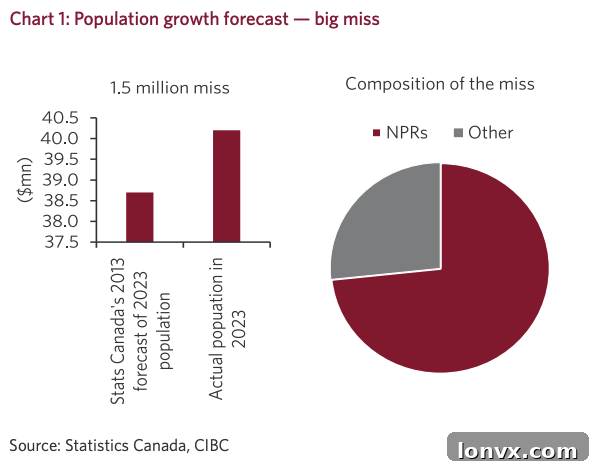
“Imagine if, a decade ago, we had possessed the foresight to know that Canada’s population would reach 40.2 million by 2023. Our preparedness would undoubtedly have been superior, and the magnitude of our current housing shortage would have been considerably smaller. Yet, that crucial knowledge eluded us,” Tal states, underscoring the severe consequences of inaccurate projections.
The discrepancy in Canada’s population projection for 2023 was a staggering 1.1 million, primarily attributed to an unanticipated surge in NPRs and robust immigration rates that surpassed expectations. From a housing perspective, this translates into a demand miscalculation equivalent to over two years of national building capacity—a monumental shortfall that speaks volumes about the planning deficit. However, Tal’s astute analysis suggests that the actual gap, when factoring in additional measurement issues, might be even more significant, nearing 2.5 million individuals. This means the housing demand miscalculation is a full million larger than initially reported, revealing a crisis far more severe than current official narratives suggest.
“While government policies and priorities inevitably evolve, two distinct measurement issues concerning the counting of NPRs imply that the true extent of the miss could be closer to 2.5 million—a full million more than the publicly reported discrepancy,” Tal elaborates, pointing to deep-seated methodological flaws.
Unpacking the Census Conundrum: Why Numbers Don’t Add Up
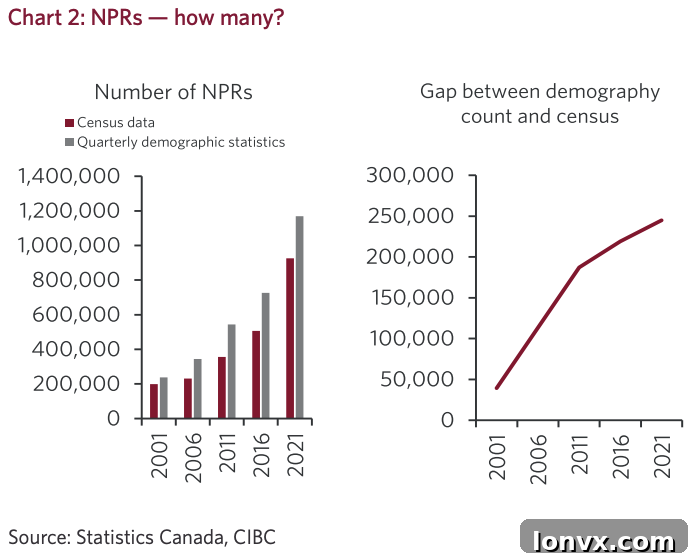
At the core of this statistical anomaly lies a significant gap in the NPR counts disseminated by Statistics Canada, the nation’s primary statistical agency. Tal’s investigation highlights a glaring inconsistency: the 2021 census recorded approximately 925,000 NPRs, while quarterly estimates for the same period indicated a figure closer to 1.17 million. This substantial difference represents a critical blind spot in national data collection.
Statistics Canada has, in the past, acknowledged such discrepancies. Tal recalls that the 2011 census undercounted NPRs by more than 40 percent. “Back then, the absolute number of NPRs was relatively modest, meaning the undercounting did not inflict profound implications on population growth forecasts or housing market demand planning. Today’s situation, however, is dramatically different,” he explains. With the exponential increase in NPRs in recent years, even a reduced percentage gap translates to a far greater absolute number of uncounted individuals, potentially reaching a shortfall of approximately 250,000 in 2021 alone.
Tal identifies two primary factors contributing to this persistent phenomenon. Firstly, a notable hesitancy among students from certain countries to engage with government authorities hinders accurate reporting. This reluctance can stem from cultural factors, privacy concerns, or a lack of understanding regarding the census’s purpose. Secondly, the census methodology itself inadvertently excludes specific segments of the NPR population, particularly temporary foreign workers and student visa holders who often struggle to comprehend and navigate complex census instructions. Language barriers, transient living situations, and unfamiliarity with Canadian bureaucratic processes can all lead to their omission from official counts.
These systemic issues mean that a significant portion of the non-permanent resident population remains statistically invisible, leading to an incomplete understanding of actual population dynamics and, consequently, an inadequate response to their housing and service needs.
The Unseen “Overstayers”: When Temporary Becomes Permanent
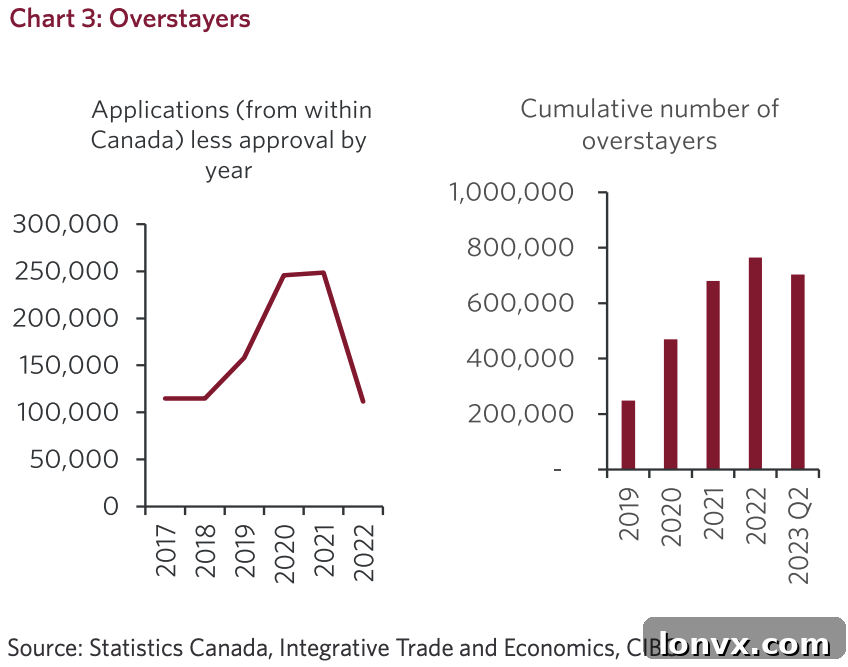
Another critical dimension emerges when examining the “temporary” status of NPRs, which frequently extends far beyond initial expectations. Statistics Canada’s long-held exit assumption—that temporary residents (TRs) would depart the country within 30 days of their visa expiry—has been demonstrably proven inaccurate. Research indicates a significant proportion, with a staggering 60 percent of international students, expressing a strong desire for permanent residency. This aspiration directly contributes to an increased number of “overstayers”—individuals who remain in Canada beyond their authorized period.
This trend is further exacerbated by evolving work visa policies and a growing array of employment opportunities, which motivate many NPRs to extend their stay while navigating the complex process of applying for permanent residency, often through programs like the Express Entry. The absence of clear administrative action by Immigration, Refugees and Citizenship Canada (IRCC) to track and address these expired visa holders further compounds the issue. Tal highlights a critical lack of mechanisms to remove these individuals from Canada’s administrative systems, including the continuation of their employment and the issuance of tax slips by the Canada Revenue Agency (CRA).
During the peak of the global pandemic in 2020 and much of 2021, travel restrictions inadvertently created a cohort of stranded TR visa holders, defying all anticipated exit timelines. Even in subsequent years, after international borders reopened, a substantial proportion of these individuals opted to remain in Canada. This phenomenon directly contradicts official assumptions and significantly inflates the actual population count without corresponding adjustments in planning for housing or public services.
The Hidden Million: A Crisis Deeper Than Imagined
When the undercounted NPRs and the growing population of overstayers are aggregated, the total discrepancy in Canada’s population statistics swells to nearly one million individuals. Tal notes the absence of official statistics specifically tallying this hidden population, making the true scale of their impact difficult to quantify precisely but impossible to ignore.
This revelation has profound implications for Canada’s already severe housing affordability crisis. It paints a far graver picture than what is currently perceived or accounted for in public discourse and policy frameworks. As policymakers, urban planners, and various levels of government rely heavily on official demographic numbers for critical decision-making—from zoning changes to infrastructure investments—the unacknowledged presence of almost a million additional residents means the existing shortage of available housing resources is even more acute and pressing. This invisible demand places immense strain on an already struggling market, driving up prices and reducing accessibility for all residents, permanent and non-permanent alike.
A Resounding Call to Action for Policy Makers
The economist’s findings serve as a powerful indictment of the status quo and a urgent plea for immediate and decisive action. “The practical implication of this systemic undercounting is that Canada’s housing affordability crisis is, in reality, far worse than currently understood. It demands even more urgent and aggressive policy intervention, particularly measures designed to better link the influx of non-permanent residents with the nation’s capacity to adequately house them,” Tal asserts.
Tal’s comprehensive findings unequivocally underscore the critical need to reevaluate existing policy responses to the housing crisis. The hidden demand, primarily driven by this uncounted NPR population, requires a strategic and integrated approach that goes beyond conventional planning. With the federal government’s impending fall fiscal update, Tal is emphatically calling upon bureaucrats and elected officials to confront this issue directly. He advocates for the swift unveiling of a comprehensive strategy that meticulously aligns housing supply targets with the actual, larger demographic realities, including the growing number of non-permanent residents.
Addressing this hidden demographic challenge is not merely about correcting statistics; it is about building a sustainable future for Canada. It requires robust data collection, transparent reporting, and a proactive policy framework that recognizes the full scope of population growth. Only then can Canada hope to tackle its housing crisis effectively, ensuring affordability and stability for all who call this country home.
Enjoying this article?
Get the latest articles in your inbox 3x week so you stay up to date on the latest in the Canadian real estate industry