
Canadian Housing Market: A Shift Towards Balance Amidst Evolving Trends
The Canadian housing market witnessed a notable cooling in sales activity during April, marking a slight dip compared to the previous month. This deceleration occurred despite a simultaneous increase in the number of properties available for sale, a phenomenon that traditionally signals the invigorated start of the spring real estate season. Nationally, home sales experienced a modest decline of 1.7% from March. However, this decrease was juxtaposed with a 2.8% rise in newly listed properties, culminating in a significant 6.5% surge in the overall inventory of homes available for sale. This expansion pushed the total number of properties on the market to its highest level since the initial onset of the COVID-19 pandemic, indicating a pivotal shift in market dynamics.
This evolving landscape suggests a move away from the intense seller-dominated conditions that characterized much of the post-pandemic era, ushering in an environment with more choices for prospective buyers. The interplay between receding demand and increasing supply is a key indicator that the frenetic pace of recent years is giving way to a more measured and potentially sustainable market. This article delves into the latest trends, regional variations, and what these changes mean for buyers and sellers navigating the complex Canadian real estate market.
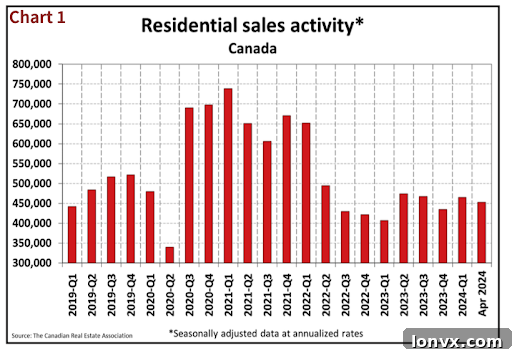
Historical Trends and Market Evolution
An examination of historical data reveals distinct patterns in the Canadian housing market over time. A prominent trend is the pronounced peak in sales activity observed roughly from Q3 2020 through Q3 2021. During this extraordinary period, national home sales consistently surpassed 600,000 units annually, even touching peaks close to 800,000 units in certain quarters. This unprecedented surge can be attributed to a confluence of powerful factors. Chief among these were historically low interest rates, which drastically reduced borrowing costs and made homeownership more accessible and attractive. The COVID-19 pandemic also played a significant role, as widespread lockdowns and remote work prompted many Canadians to reassess their living arrangements, leading to a scramble for larger homes, properties with outdoor space, or residences outside densely populated urban centers. Furthermore, a temporary rush to capitalize on these exceptionally favorable market conditions fueled speculative buying and accelerated purchasing decisions.
However, the narrative began to shift dramatically post-Q3 2021. Following this peak, there has been a clear and sustained downward trend in sales activity, with volumes gradually declining to below 400,000 units by April 2024. This reversal directly correlates with the Bank of Canada’s aggressive interest rate hikes, implemented to combat soaring inflation. Higher mortgage rates significantly eroded affordability, making it more challenging for first-time buyers to enter the market and for existing homeowners to upgrade. The initial pandemic-driven demand also began to wane, contributing to a more subdued purchasing environment.
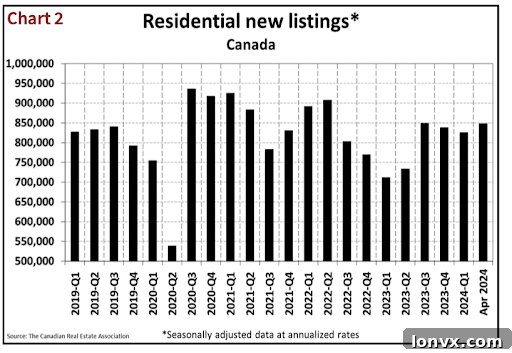
The Dynamics of Listings: Supply and Demand Interplay
Unlike the more volatile swings in sales volumes, new listings have exhibited a somewhat less erratic pattern. Intriguingly, the peak periods for new listings closely mirrored those for sales, indicating that the initial robust surge in demand was adequately supported by a substantial influx of new properties entering the market. This equilibrium in supply and demand during the peak allowed for high transaction volumes without immediately creating acute shortages, though competitive bidding was still rampant.
Post-2021, while sales experienced a sharp decline, new listings followed a more gradual downward trajectory but consistently remained above the 500,000-unit mark. This suggests that even as transaction volumes softened, the market maintained a relatively healthy, albeit less frenzied, supply of properties. The strong correlation between sales and listings, particularly during the boom years, highlights a period where market activity was both high and largely balanced in terms of properties available versus properties sold. As sales began their descent, listings also decreased but at a slower pace. This divergence is a critical indicator; it points towards a potential oversupply in certain segments or a reduced urgency among sellers, both of which contribute significantly to the overall cooling of the Canada real estate market and a shift in leverage towards buyers.
Current Market Conditions: A Balanced Outlook for Canadian Home Sales
The recent dip in actual transaction volumes for Canadian home sales in April can be partly attributed to the timing of the Easter long weekend, which often impacts monthly reporting cycles. More significantly, with sales easing and new listings on the rise in April, the national sales-to-new listings ratio moderated to 53.4%. This figure positions the market slightly below the long-term average of 55%, but comfortably within what is considered a balanced range. Experts generally agree that a sales-to-new listings ratio between 45% and 65% signifies a balanced market, where neither buyers nor sellers hold a distinct advantage. Readings above this range typically characterize a seller’s market, marked by intense competition and rapid price appreciation, while figures below indicate a buyer’s market, offering more choice and negotiation power.
Another crucial metric for assessing market balance is the “months of inventory.” This figure represents how long it would take to sell all currently listed properties at the current rate of sales. At the end of April, the national months of inventory stood at 4.2 months, an increase from 3.9 months in March and the highest level recorded since the onset of the pandemic. This increase in inventory, coupled with the balanced sales-to-new listings ratio, unequivocally signals a significant shift towards more balanced market conditions across Canada. After a prolonged period of tight supply and robust demand that drove prices upward, the market is now offering more breathing room for buyers, reducing the urgency and intensity that defined previous years.
This newfound equilibrium translates into several advantages for buyers. They now have more time to conduct due diligence, fewer multiple-offer situations, and greater opportunity to negotiate on price and conditions. For sellers, it means a need for realistic pricing and potentially longer listing periods. The market is maturing, moving past the speculative fever and settling into a phase where fundamental factors like interest rates, employment, and genuine housing needs will play a more dominant role in shaping demand and supply dynamics, influencing Canadian housing trends for the foreseeable future.
Navigating Regional Variations in Canada’s Housing Landscape
While the national outlook paints a picture of increasing market balance, it is imperative to acknowledge the significant regional housing trends that characterize Canada’s vast housing market. Real estate is inherently local, and conditions can differ dramatically from one city or province to another, influenced by unique economic drivers, population growth, and local supply-demand dynamics.
Western Canadian Resilience Amidst Shifting Housing Trends
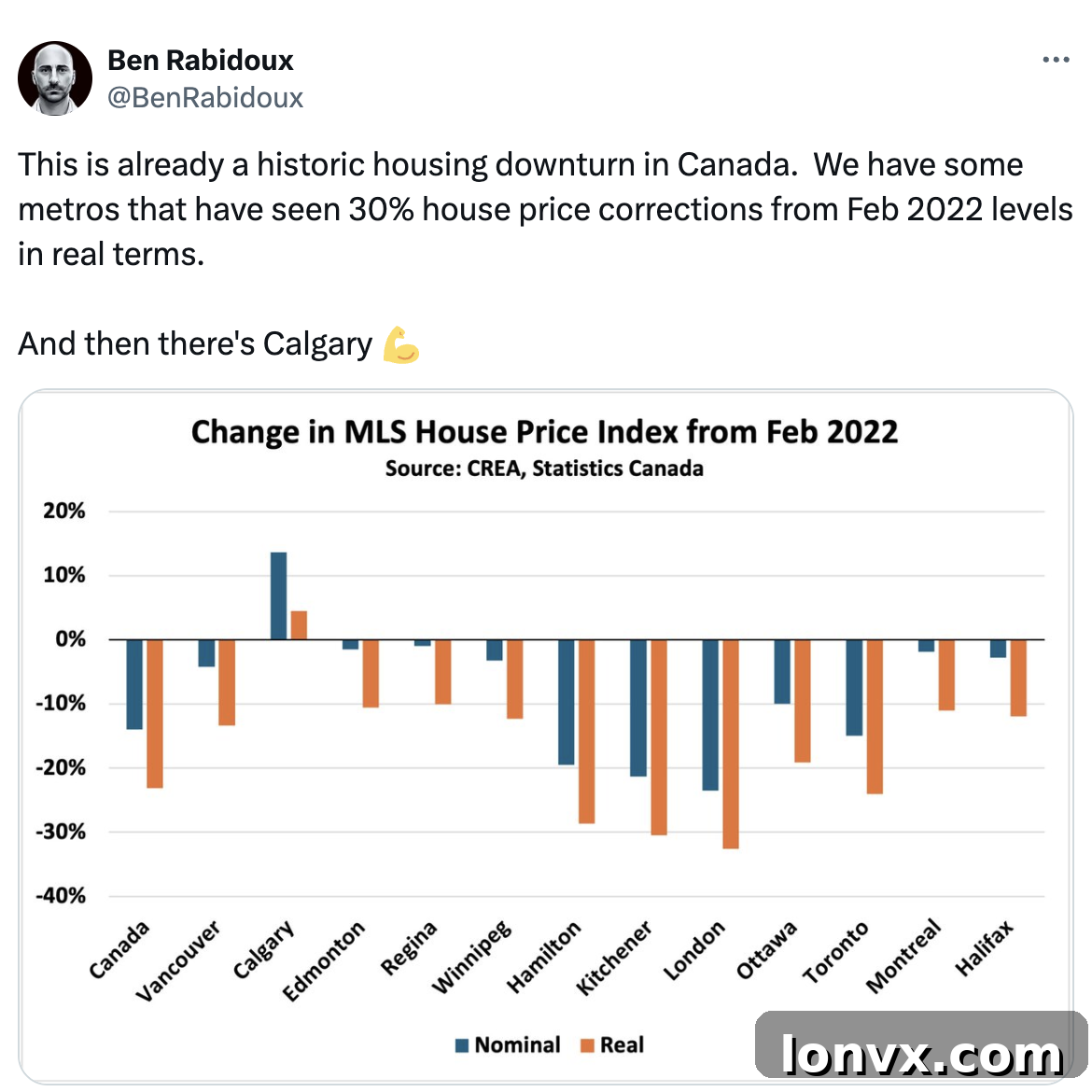
In stark contrast to some of the cooler national trends, cities like Calgary, Edmonton, and Saskatoon continue to exhibit steady and robust price growth. Prices in these Western Canadian hubs have been consistently ticking higher since the beginning of 2023. This resilience can be attributed to several factors: relatively stronger affordability compared to major coastal markets, sustained inter-provincial migration, and robust local economies driven by sectors like energy (in Alberta) and agriculture (in Saskatchewan). These factors contribute to healthy demand, often outpacing the growth in new listings, thus sustaining an upward pressure on prices and keeping these markets more competitive for buyers.
Mixed Signals in British Columbia and Ontario Real Estate
Conversely, home prices Canada are generally observed to be sliding sideways or experiencing slight corrections across most other regions of the country. The Lower Mainland of British Columbia, encompassing the highly desirable Greater Vancouver and Fraser Valley areas, saw modest month-over-month price declines in April, ranging from -0.2% to -0.5%. These subtle contractions suggest that even in historically hot markets, the impact of higher interest rates and increased inventory is starting to be felt. However, it is crucial to note that year-over-year price changes in these areas remain positive, with Greater Vancouver up 2.7% and the Fraser Valley up 1.9%. This indicates that while the pace of appreciation has slowed considerably, the overall value of homes in these regions has still increased over the past year.
Ontario’s diverse housing markets also exhibited a mixed performance, reflecting the provincial variations in affordability and economic activity. The Greater Toronto Area (GTA), Canada’s largest housing market, recorded a slight 0.4% month-over-month price increase. Other regions within Ontario, such as Kitchener-Waterloo (1.0% increase), Hamilton-Burlington (1.2% increase), and Ottawa (0.0% change), experienced modest gains or remained flat. This patchwork performance suggests a nuanced market where specific local factors are at play. Interestingly, some smaller markets showed more pronounced movements: Sudbury saw a significant 5.9% increase, potentially driven by local economic boosts or relatively lower price points attracting buyers, while Bancroft experienced a 3.4% decline, possibly due to unique local supply dynamics or reduced demand.
Eastern Canada’s Stability and Growth Pockets
In Quebec, the Montreal CMA (Census Metropolitan Area) experienced a modest 0.8% month-over-month price decline, while the Quebec CMA saw a 1.2% increase. This divergence within the same province underscores the localized nature of real estate trends. The Maritime provinces, including New Brunswick, Nova Scotia, and Prince Edward Island, generally saw modest price gains or remained stable in April. These regions have experienced significant population growth in recent years, fueled by inter-provincial migration seeking greater affordability and a different lifestyle, which has supported their housing values even amidst national cooling trends.
The actual (not seasonally adjusted) national average home price stood at $703,446 in April 2024, marking a 1.8% decrease from April 2023. This year-over-year decline in the national average price is a clear indicator of the broader cooling market conditions and the effect of increased inventory levels providing more options for buyers. However, it’s important to remember that averages can mask significant disparities, and individual market performance should always be assessed regionally.
An Oversupplied, Slower Spring Market: Empowering Buyers with Choice
According to Shaun Cathcart, Senior Economist at the Canadian Real Estate Association (CREA), the spring market of 2024 is distinctly different from previous years. It is characterized by a healthier and more robust number of properties available for buyers to choose from, yet paradoxically, it is met with less enthusiasm on the demand side compared to the preceding year. Most real estate professionals would readily concur with this assessment: the Canadian housing market finds itself in a state of relative oversupply when compared to the highly competitive spring markets of the immediate post-pandemic era. As a direct consequence, there is a noticeable absence of urgency among prospective buyers, who are now relishing the rare opportunity to browse, compare, and deliberate without the pressure of intense bidding wars or rapidly escalating prices. This shift transforms it into more of a buyer’s market Canada, offering opportunities for strategic purchasing.
James Mabey, Chair of CREA’s 2024-2025 Board of Directors, further articulated this sentiment, noting that the sustained increase in listings is contributing to the most balanced market conditions observed at the national level since before the pandemic. This equilibrium represents a significant departure from the frantic seller’s market Canada of 2020-2022, offering a more sustainable and less volatile environment for real estate transactions. While elevated mortgage rates Canada continue to pose affordability challenges for a segment of potential buyers, particularly first-timers, those who possess the financial capacity to purchase a home are now benefiting immensely from this market shift. They are enjoying unparalleled choice in available properties and, crucially, an increased bargaining power that was virtually nonexistent just a couple of years ago. Buyers can now make conditional offers, negotiate on price, and even request repairs or upgrades, a luxury that has been absent for a long time.
However, Mabey also astutely points out that this current balance in the market might be short-lived, given the persistent underlying demand for housing in Canada. Factors such as robust population growth driven by immigration, demographic shifts, and the long-standing issue of housing supply shortages in major urban centers continue to exert upward pressure on demand. Should interest rates eventually begin to decline, or if the pace of new construction fails to keep up with population expansion, this delicate balance could once again tip, potentially reverting to more competitive conditions. This highlights the importance of sustained policy efforts to address housing supply issues over the long term and influence the future real estate market forecast.
Looking Ahead: Navigating an Evolving Canadian Real Estate Market
From a personal perspective, the Canadian housing market is unequivocally transitioning towards a more balanced and mature state. This shift is clearly evidenced by the noticeable increase in housing inventory Canada and a welcome moderation in the pace of price growth. The frenetic energy of the past few years, fueled by low rates and pandemic-driven demand, has given way to a more rational and sustainable environment. However, it is crucial to reiterate that these broader national trends are not uniform; significant regional variations persist, indicating that while some areas are successfully stabilizing and offering more buyer opportunities, others may still experience fluctuations driven by local economic conditions, specific supply challenges, or continued migratory patterns.
As we advance further into the traditionally busy spring and summer buying seasons, it is abundantly clear that the market dynamics will continue to evolve. Prospective buyers are advised to leverage their increased choices and bargaining power by conducting thorough research, getting pre-approved for mortgages, and working closely with experienced real estate agents who can provide hyper-local insights. Sellers, on the other hand, should adopt a realistic pricing strategy, ensuring their properties are competitive within the current market context, and be prepared for potentially longer listing periods. Staying informed about the latest market trends, interest rate announcements from the Bank of Canada, and local economic indicators will be paramount for both parties to make informed decisions in this dynamically shifting Canadian real estate landscape. The era of easy gains may be over, but a healthier, more predictable market could be emerging, benefiting both long-term stability and sustainable growth in affordability Canada.
Enjoying this article?
Get the latest real estate market insights directly in your inbox 3x a week so you stay up to date on the latest in the Canadian real estate industry!