Navigating the Canadian real estate market can feel like a formidable challenge for many aspiring homeowners, especially with its recent volatility. The dream of homeownership, while deeply ingrained in Canadian culture, often confronts the stark realities of fluctuating property values, rising interest rates, and the continuous quest for affordability. However, a closer look at market data reveals a nuanced landscape, where opportunities for entry still exist for informed buyers.
Following a period of significant price declines starting early last year, many real estate professionals report a noticeable shift in buyer sentiment. Prospective homeowners who once observed from the sidelines, waiting for market stabilization or further price corrections, are now beginning to re-engage. This renewed interest coincides with recent upticks in average home prices, signaling a potential stabilization and even a modest recovery in certain key markets.
According to the Canadian Real Estate Association (CREA), the national average home price stood at $662,437 in February 2023. While this figure represented an 18.9 per cent decrease from the all-time peak recorded in February 2022, it also marked a significant month-over-month increase of over $50,000 from its January level. This rebound was largely driven by robust sales activity in Canada’s most dynamic and expensive housing markets: the Greater Toronto Area (GTA) and Greater Vancouver. These two urban centers, with their concentrated populations and strong economic fundamentals, exert a disproportionate influence on national housing statistics. Indeed, CREA regularly highlights that excluding these two markets from the national average calculation reveals a significantly different picture, reducing the average price by approximately $135,000 in February 2023 alone.
This illustrates a critical point for anyone looking to buy a home in Canada: the national average often masks significant regional variations. While headline figures might paint a picture of widespread unaffordability, a deeper dive into specific cities and provinces uncovers a more diverse range of possibilities for different income brackets.
Affordability in Focus: Dissecting Canadian Housing Markets
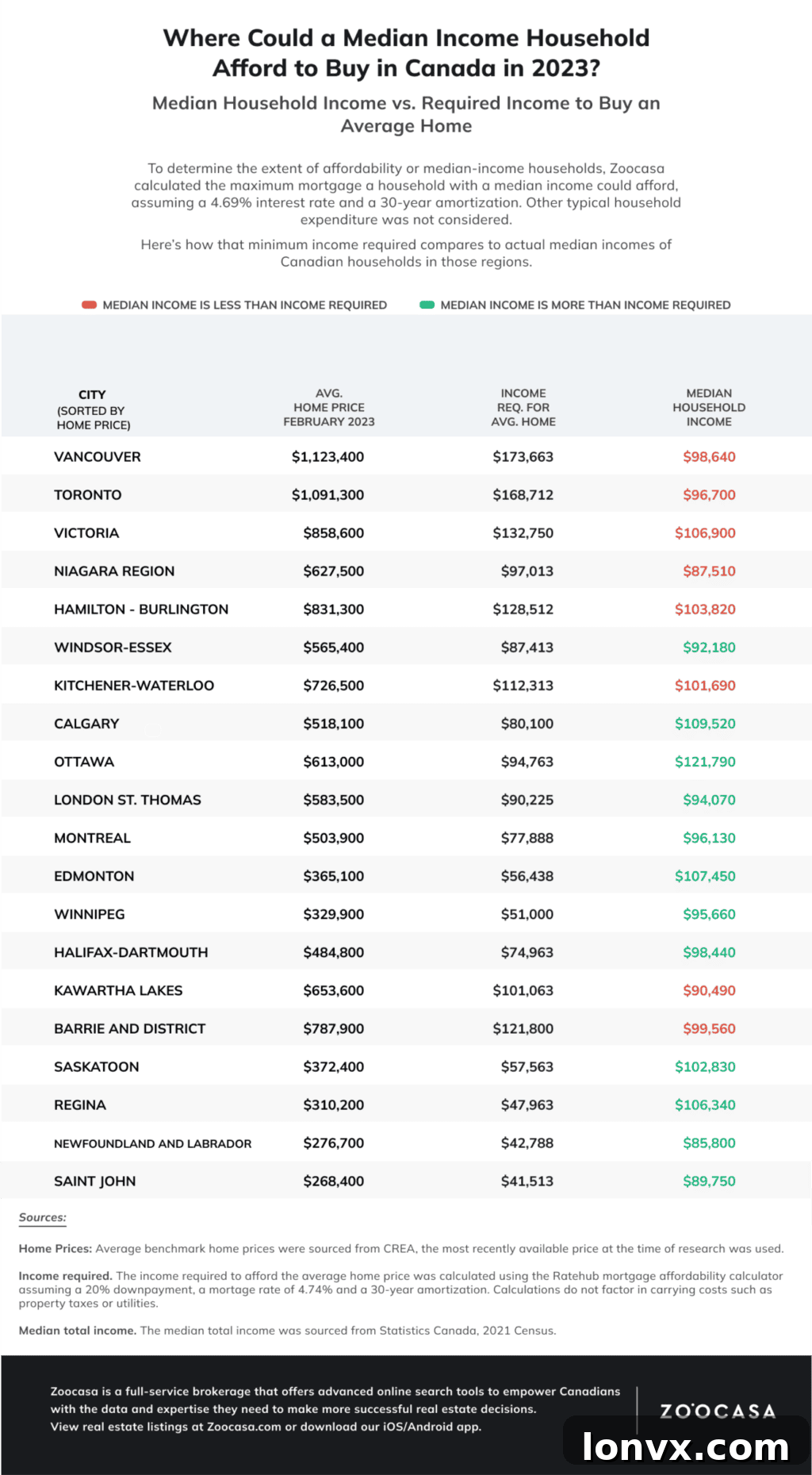
Understanding what constitutes “affordability” is paramount for prospective buyers. It’s not just about the sticker price of a home, but critically, how that price relates to local incomes. Zoocasa, a prominent real estate resource, undertook a comprehensive analysis of average home prices across 20 distinct Canadian cities. Their research meticulously compared the median household income in each city against the income required to comfortably afford the average home within that market. This methodology provides a pragmatic measure of real estate accessibility for the typical Canadian household.
The findings offer a glimmer of hope for many: of the 20 markets analyzed, buyers earning the median household income could realistically afford a home in just over half of them. This suggests that while Canada has its well-documented housing hotspots, there are numerous regions where the dream of homeownership remains tangible. The current market, with its blend of past corrections and recent growth, necessitates a strategic approach, focusing on specific locales rather than generalizing based on national headlines.
Ontario’s Diverse Housing Landscape: Beyond the Major Hubs
Ontario, as Canada’s most populous province and an economic powerhouse, often leads the discussion on housing affordability challenges. Its major urban centers, particularly Toronto, are synonymous with high property values and intense competition. However, the Zoocasa analysis reveals that even within Ontario, there are viable options for individuals and families earning around the median income, presenting a more optimistic outlook than often perceived.
Ottawa, the nation’s capital, stands out as a comparatively accessible major city. With an average home price of $613,000, purchasing a property here typically requires an annual household income of approximately $94,763. Fortunately, Ottawa boasts a robust economy, largely driven by government employment and a burgeoning tech sector, resulting in a median household income of $121,790. This comfortable margin ensures that a significant portion of the city’s residents can realistically aspire to homeownership, balancing urban amenities with achievable affordability.
Further west in Ontario, the London-St. Thomas area also presents a compelling case for affordability. Here, the average home price of $583,500 necessitates an income of around $90,225. This requirement is comfortably met by the local median income of $94,070. The region offers a more relaxed pace of life compared to Toronto, with a growing economy and a strong sense of community, making it an attractive destination for families and individuals seeking value without sacrificing access to urban conveniences.
However, the narrative shifts dramatically when examining Canada’s two most notorious real estate markets: Toronto and Vancouver. These global cities continue to set benchmarks for high property values, with average home prices of $1,091,300 and $1,123,400, respectively. The financial requirements for homeownership in these metros are staggering, demanding incomes of $168,712 for Toronto and $173,663 for Vancouver. These figures stand in stark contrast to their respective median household incomes of $96,700 and $98,640. The substantial gap between income and required affordability underscores the immense challenges faced by first-time buyers, young professionals, and even established families in these markets, often necessitating multi-generational wealth, exceptionally high-paying careers, or significant compromises in housing type and location.
Prairies and the East Coast: Discovering Relative Affordability
For those prioritizing affordability and a different lifestyle, Canada’s Prairies and East Coast regions emerge as undeniable havens. These areas consistently offer more accessible housing markets, where median incomes often significantly outpace the income required for homeownership. This makes them increasingly attractive destinations for those seeking to escape the intense competition and high costs of Canada’s major urban centers.
In the Prairies, Regina, Saskatchewan’s capital, exemplifies this affordability. With an average home price of $310,200, the income required to purchase a property is a modest $47,963. This is well within reach for the city’s median household income of $106,340, demonstrating a comfortable path to homeownership for many residents. Regina’s stable economy, driven by agriculture, resources, and government services, coupled with a lower cost of living, contributes to this favourable housing environment.
Similarly, Saskatoon, another major city in Saskatchewan, presents strong affordability metrics. An average home price of $372,400 requires an income of approximately $57,563, which is easily covered by the local median income of around $102,830. Saskatoon is known for its vibrant community, growing tech sector, and access to outdoor activities, making it an appealing choice for those seeking a balanced lifestyle without the financial strain of more expensive markets.
Moving to Canada’s scenic East Coast, Saint John, New Brunswick, stands out for its exceptional value. The average home price of $268,400 demands an income of just $41,513. This requirement is dwarfed by the city’s median household income, which is more than double that at $89,750. This significant disparity highlights the ease of homeownership in Saint John, a historic port city offering a charming lifestyle, rich culture, and proximity to natural beauty.
Further east, the entire province of Newfoundland and Labrador offers substantial affordability. While specific city data might vary, the provincial median household income of $85,800 can comfortably support the average home price of $276,700, where an income of only $42,788 is typically required. The capital city, St. John’s, mirrors this trend, providing a vibrant urban experience within a highly accessible market. This region’s unique culture, breathtaking landscapes, and welcoming communities make it an increasingly attractive option for those prioritizing quality of life and financial peace of mind over the high-pressure markets of Central and Western Canada.
Beyond the Averages: Key Considerations for Homebuyers
While average home prices and median incomes provide an invaluable starting point for understanding Canadian real estate affordability, it’s crucial for prospective buyers to recognize that these figures represent broad trends. Individual affordability is a complex equation influenced by a multitude of personal and market-specific factors that extend beyond these generalized statistics. A deeper dive into these variables can significantly alter one’s homeownership prospects.
Firstly, the type of home you’re looking to buy plays a pivotal role. A detached house will almost always command a higher price than a condominium or townhouse, even within the same neighbourhood. New constructions often come with a premium compared to resale properties. Understanding your priorities – whether it’s space, location, or budget – will help narrow down your options and refine your affordability assessment.
Secondly, your down payment is a critical determinant. A larger down payment reduces the amount you need to mortgage, thereby lowering your monthly payments and potentially the total interest paid over the life of the loan. Government programs and incentives for first-time homebuyers, such as the First-Time Home Buyer Incentive, can also help bridge the gap, but personal savings remain a cornerstone of entry into the market.
Thirdly, the prevailing interest rates at the time of purchase will profoundly impact your mortgage affordability. Even a slight fluctuation in rates can translate to hundreds of dollars difference in monthly payments over a 25-year amortization period. Keeping a close eye on the Bank of Canada’s monetary policy and seeking advice from mortgage professionals is essential for understanding your borrowing capacity.
Other vital factors include your overall debt-to-income ratio, which lenders meticulously assess to determine your borrowing eligibility, and the often-overlooked cost of living beyond just the mortgage. This encompasses property taxes, utility bills, home insurance, maintenance costs, and daily expenses like groceries, transportation, and childcare, all of which vary significantly from one city or province to another.
Ultimately, while analyses like Zoocasa’s offer a powerful lens through which to view the Canadian real estate market, personal financial planning, thorough research, and professional guidance are indispensable. For those looking to enter the market, understanding these nuances can transform what seems like an insurmountable challenge into a well-informed and achievable goal.
Source: Zoocasa