The Saltbox Passive House: A Beacon of Sustainable Living in Quebec’s Eastern Townships
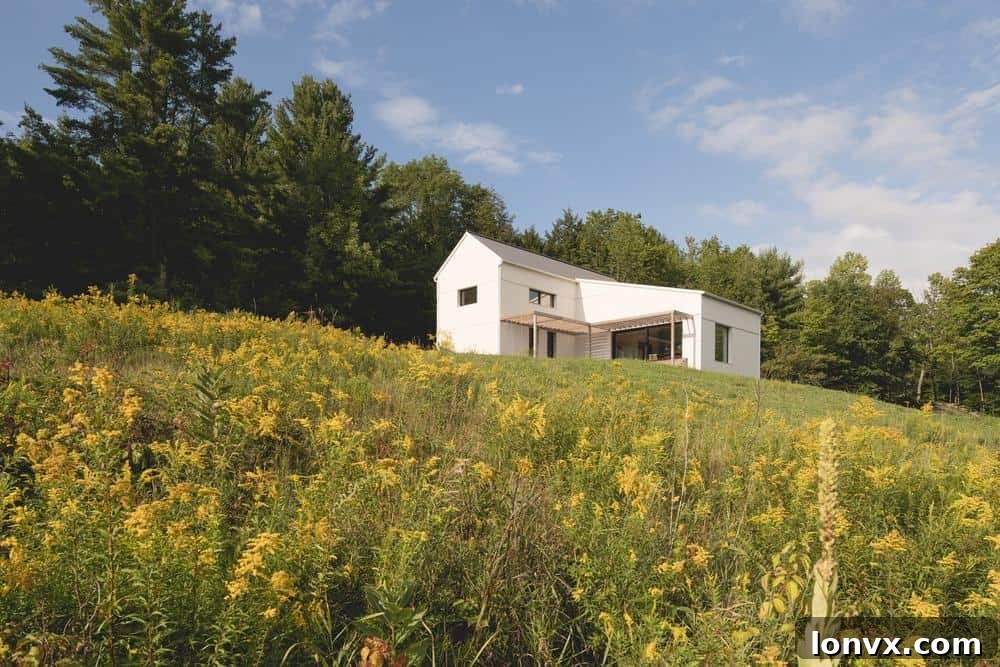
Nestled gracefully into the southern flank of Mont Gale in Bromont, a picturesque jewel within Quebec’s stunning Eastern Townships, stands the remarkable Saltbox Passive House. This primary residence, meticulously designed for a modern family of four, represents a harmonious blend of architectural heritage, cutting-edge sustainability, and unparalleled comfort. Spanning an expansive 3,100 square feet across three thoughtfully integrated levels, this single-family dwelling is more than just a house; it’s a testament to what is possible when design ambition meets ecological responsibility.
The home’s strategic placement on a sprawling 2.5-acre lot, set amidst a vibrant meadow and bordering a meticulously protected wooded area, speaks volumes about its commitment to nature. Far from being an imposing structure, the Saltbox Passive House emerges from its landscape, echoing the gentle contours of Mont Gale while offering panoramic, south-facing views across the verdant valley. Its design, deeply inspired by the region’s rich architectural traditions, has not only created a captivating aesthetic but has also earned it dual accolades: LEED Platinum and Passive House Institute U.S. (PHIUS) 2018+ certifications. This achievement is particularly noteworthy, marking it as only the third house in Quebec to attain the rigorous Passive House standard, setting a precedent for future sustainable developments in the province.
Architectural Roots: Embracing the Saltbox Legacy
The genesis of the Saltbox Passive House’s distinctive form lies in a profound appreciation for local vernacular architecture and the unique characteristics of its site. L’Abri, the acclaimed Montreal-based architecture and construction firm behind the project, along with a dedicated team of consultants, the builder, and a specialized PHIUS consultant, embarked on a journey to reinterpret a historical style for contemporary sustainable living.
As the architects eloquently describe, “The nature of the site and the local vernacular architecture prompted us to turn to a historical form.” The chosen silhouette, with its characteristic ‘L’ layout and the elegant combination of two distinct roof slopes, is a direct homage to the rural Saltbox-type buildings. These iconic structures first emerged in 17th-century New England and continue to dot the picturesque countryside of the Eastern Townships, forming an indelible part of the region’s visual identity. This colonial style, playfully named after the lidded containers where salt was once diligently kept above the hearth to remain dry, typically features a traditional gable roof on its main section paired with a single-pitch roof on the lower, often extended, section.
This architectural choice was not merely an aesthetic nod to the past; it was a foundational decision that inherently supported the home’s passive design principles. The Saltbox form, with its inherent simplicity and efficiency, provided an excellent canvas for integrating modern energy performance requirements. It allowed for optimal orientation, controlled massing, and a natural fit within the rugged yet beautiful Quebec landscape, demonstrating that historic forms can be incredibly relevant and powerful in addressing today’s environmental challenges.
Seamless Integration with Nature: A Site-Specific Design Philosophy
The integration of the Saltbox Passive House into its Mont Gale setting is a masterclass in site-specific design. Recognizing the prime opportunity for passive solar heating and breathtaking vistas, the house was meticulously oriented to face due south. This strategic positioning maximizes natural light penetration and solar gain during colder months, significantly reducing the need for artificial heating, while simultaneously framing uninterrupted, sweeping views of the valley below.
Further enhancing its connection to the land, the three-level construction is artfully “nestled into the mountain,” a design choice that serves multiple functions. By embracing the natural topography, the architects minimized the visual impact of necessary retaining walls, ensuring that the structure appears to emerge organically from the hillside rather than sitting heavily upon it. The rear portion of the ground floor is cleverly designed at garden level, blurring the lines between indoor living spaces and the surrounding natural environment. Moreover, the decision to opt for a roof slope that mirrors the land’s own contours imbues the house with a sense of belonging, making it an extension of the terrain itself. From the street, the Saltbox Passive House maintains a discreet profile, only fully revealing its architectural grandeur and welcoming presence as visitors proceed down the driveway. This thoughtful approach creates a journey of discovery, culminating in the lowest level which discretely houses a garage that also functions as a versatile workshop – an essential, yet hidden, amenity for the family.
The Heart of the Home: Interior Spaces Designed for Comfort and Connection
Stepping inside the Saltbox Passive House, one is immediately enveloped by an atmosphere of generosity and light. The interior layout is a testament to sophisticated spatial planning, prioritizing comfort, family interaction, and an inherent connection to the outdoors. The undisputed heart of the house is its central double-height room, a breathtaking volume illuminated by three expansive openings. These large windows are not just architectural features; they are crucial components of the building’s passive heating strategy, allowing ample sunlight to flood the space, warming it naturally and creating a vibrant, ever-changing play of light and shadow throughout the day.
This magnificent central volume serves as the anchor around which all other functions are organized. A pristine white central block, a focal point of minimalist design, efficiently houses essential utilities and services. Within its clean lines are thoughtfully integrated a practical mudroom, a state-of-the-art kitchen, a generous pantry, and a discreet powder room. This white volume extends upwards, seamlessly abutting the second-floor corridor, which acts as a graceful passageway providing access to the family’s private bedrooms and a cozy, functional mezzanine home office. This clever arrangement ensures that the upper level remains connected to the vibrant activity of the main living area while offering quiet retreats for work and rest.
On the north side of the house, the children’s bedrooms are designed with an intelligent balance of privacy, views, and energy efficiency. Rather than large, heat-losing windows, these rooms are illuminated by narrow, horizontal bands of glazing. These carefully proportioned openings frame captivating glimpses of the bordering forest, inviting nature indoors without compromising thermal performance. This strategy significantly limits heat loss, a crucial element in maintaining the Passive House standard. Completing the interior experience, and extending the living space outdoors, is a charming terrace nestled in the crook of the ‘L’ layout. Partially protected by stylish pergolas, this outdoor oasis serves a dual purpose: providing welcome sunscreens during warmer months and passively regulating the interior temperature of the house, ensuring year-round comfort and enjoyment.
Materials with Purpose: Sustainable Choices and Enduring Beauty
The material palette chosen for the Saltbox Passive House is a deliberate blend of durability, sustainability, and aesthetic harmony. Reflecting the natural ruggedness of Mont Gale, the substantial retaining walls are constructed from excavated stone, a choice that grounds the house firmly in its environment and minimizes the need for imported materials. This natural stone not only provides robust structural support but also adds a timeless, organic texture to the landscape integration.
For the main cladding of the house, wood was chosen – a renewable resource that inherently connects the structure to the surrounding forests. The entrance section features burnt cedar, a material prized for its exceptional durability, natural resistance to pests and rot, and its distinctive, rich charcoal finish. This Japanese technique, known as Shou Sugi Ban, not only enhances the aesthetic appeal with its unique texture and color variation but also significantly extends the lifespan of the wood, reducing maintenance needs over time. Capping off the entire structure is a robust grey steel roof. Known for its longevity, resistance to extreme weather, and minimal maintenance requirements, the steel roof also contributes to the home’s overall resilience and modern aesthetic, while potentially offering reflective properties that help manage solar heat gain.
The Passive House Standard: A Paradigm Shift in Building Performance
At the very core of the Saltbox Passive House’s exceptional performance lies its adherence to the Passive House standard – a high-performance building methodology that champions unparalleled energy efficiency, superior indoor comfort, and long-term sustainability. Developed over 30 years ago in Germany by the pioneering Passivhaus Institut, this rigorous standard has revolutionized how buildings are conceived and constructed globally. The architects affirm that buildings designed and built to this standard achieve staggering heating and cooling energy savings, often in the realm of 80 percent compared to conventional construction.
The basic principles underpinning the Passive House standard are deceptively simple yet profoundly effective. They include:
- **A Highly Insulated and Extremely Airtight Envelope:** This forms the protective shell of the building, minimizing heat transfer between the interior and exterior environments.
- **Superior Heat Recovery Mechanical Ventilation System:** Essential for continuous fresh air supply without significant energy loss, ensuring exceptional indoor air quality.
- **Thermal Bridge-Free Design:** Eliminating points where heat can easily escape or enter the building through structural elements.
- **High-Performance Windows and Doors:** Often triple-glazed, these components are strategically chosen and installed to prevent heat loss and optimize solar gain.
- **Optimized Orientation and Sizing of Openings:** Maximizing passive solar heating in winter and minimizing unwanted solar gain in summer.
Contrary to a common misconception, Passive House buildings are not “off-the-grid.” Instead, their primary goal is to drastically reduce energy consumption and, consequently, their dependence on conventional utilities. This approach significantly lowers utility bills, reduces carbon emissions, and fosters a more resilient, comfortable living environment. The PHIUS 2018+ certification, specifically, represents an adaptation of the original Passive House standard to better suit the diverse North American climate zones, ensuring optimal performance across a broader range of environmental conditions.
The Power of Collaboration: Building an Integrated Vision
The successful realization of a project as ambitious and technically demanding as the Saltbox Passive House is inextricably linked to the power of collaboration. The architects emphasize that “Achieving the performance criteria of a passive house is only possible with the close collaboration of the architect, the consultants, and the builder.” From the project’s inception, an integrated design approach was favored, bringing together all key stakeholders early in the process. This synergistic method allowed for continuous dialogue, problem-solving, and optimization across all disciplines, ensuring that every decision contributed to the overarching goals of sustainability and performance.
The dedicated team included Francis M. Labrecque, Jérôme Codère, Vincent Pasquier, and Antoine Mathys from the L’Abri architecture firm, who meticulously crafted the vision. Construction Rocket served as the skilled contractor, translating the complex designs into a tangible structure with precision and expertise. Guiding the project through the rigorous certification process was Sarah Cobb, the invaluable PHIUS consultant, whose specialized knowledge ensured adherence to the highest energy performance standards. This seamless collaboration proved instrumental, confirming that a building can indeed be both aesthetically captivating and deeply harmonious with its environment, while simultaneously achieving an extraordinary level of energy efficiency.
The Saltbox Passive House stands not just as a family home but as a shining example of what future building can and should be. It eloquently demonstrates that environmental responsibility, architectural beauty, and human comfort are not mutually exclusive but can be elegantly interwoven to create spaces that enrich lives and contribute positively to our planet. It is a true benchmark for sustainable architecture in Quebec and beyond, inspiring a new generation of eco-conscious design.