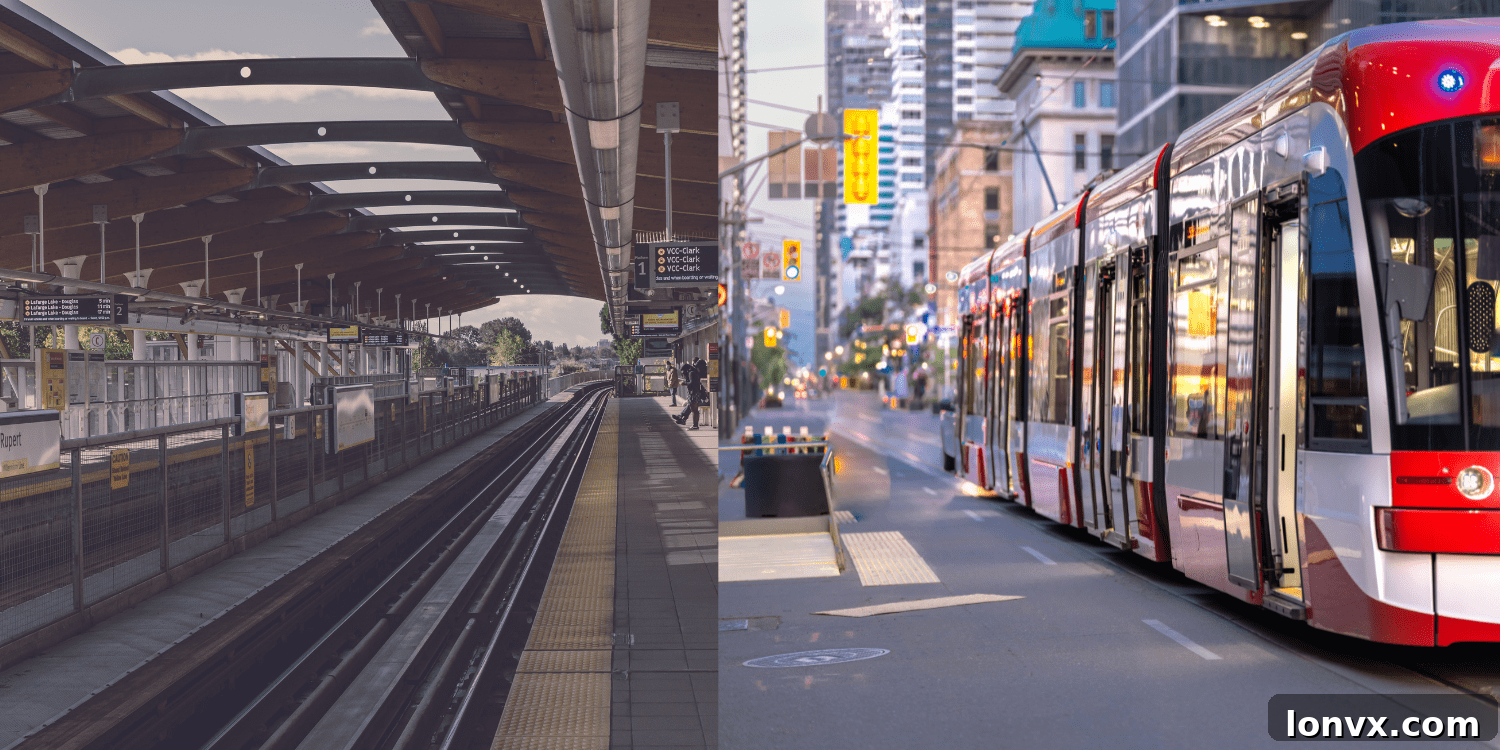
Close proximity to transportation has long been a foundational principle in real estate valuation, directly correlating with desirable housing. This classic equation, however, is being re-evaluated in today’s rapidly evolving landscape. With the widespread adoption of remote work, a renewed focus on energy sustainability, and unprecedented population growth, the intricate relationship between transit infrastructure and housing markets is more complex than ever. This article delves into how urban centers in Canada are grappling with these challenges, examining current realities, exploring innovative solutions, and highlighting the critical role of forward-thinking policy in shaping the future of our communities.
Navigating Urban Sprawl: The Interplay of Transportation and Housing Affordability in Canada
Toronto: A Metropolitan Region Outgrowing Its Transit Foundations
Peter Jordon, a seasoned real estate broker based in the Greater Toronto Area (GTA) with Century 21, offers a firsthand account of current market dynamics. “There’s an undeniable, enduring interest in properties located near reliable public transit options, such as GO stations,” Jordon observes. “Access to robust transit infrastructure will always be a top priority for homebuyers and investors alike. It’s a fundamental aspect of urban living that enhances convenience, reduces commuting stress, and often lowers household expenses.”
However, Jordon quickly points out that not all transportation networks are created equal, especially when measured against the demands of a burgeoning population. “Toronto, for its immense size and global standing, unfortunately possesses one of the most inadequate transit infrastructures I’ve encountered,” he states candidly. “The system, largely conceived and built for a population of merely 500,000, now struggles under the weight of over six million residents in the GTA. This stark mismatch has resulted in a chronically gridlocked system, rendering inter-quadrant travel across the city a time-consuming and often frustrating ordeal, potentially taking hours or even an entire day.” This inefficiency not only impacts daily commuters but also stifles economic productivity and diminishes the overall quality of urban life for millions.
The implications for housing are profound. While proximity to existing transit is still valued, the inadequacy of that transit can limit true accessibility. Buyers might pay a premium for a location near a subway stop, only to find the trains overcrowded and delays frequent, negating some of the perceived benefits. This highlights a critical challenge: investment in transit must keep pace with, or ideally precede, population growth and housing development to truly unlock its value.
The Roots of Unprecedented Unaffordability: A Lack of Foresight
Canada is bracing for significant demographic shifts, with its population projected to grow anywhere from 25 to 40 percent by 2046. This demographic boom necessitates a proportionate expansion of critical infrastructure, including diverse transportation options and, crucially, a dramatic increase in housing supply. The current housing crisis, marked by escalating prices and dwindling availability, is a direct consequence of historical policy shortcomings and a failure to anticipate this rapid growth.
Lee Haber, founder of Cambria Consulting and a respected expert in policy research focused on transportation and urban planning, articulates this challenge. “One of the primary drivers behind the unprecedented lack of housing affordability we’re witnessing today is a collective unpreparedness,” Haber explains. “We simply did not establish the necessary systems and regulatory frameworks to facilitate the rapid construction of housing and supporting infrastructure at the pace required to accommodate our growth. This oversight has created a significant supply-demand imbalance, pushing homeownership out of reach for many Canadians and exacerbating the affordability crisis.”
The problem isn’t just about building more homes; it’s about building them in the right places, supported by the right infrastructure. Urban planning decisions made decades ago, often favoring low-density development and car-centric designs, have proven unsustainable. Reversing this trend requires a coordinated effort across all levels of government, coupled with innovative financing and policy tools designed to accelerate sustainable urban development.
British Columbia’s Vision: A 350 km Rail Network to Catalyze Housing Growth
Lee Haber, through his involvement with Mountain Valley Express, a non-profit dedicated to establishing a regional rail network in southern British Columbia, offers a beacon of hope and a model for proactive planning. He believes that by learning from past mistakes, current generations can implement superior systems compared to those inherited from previous eras. “The adage holds true: the second-best time to plant a tree is today,” Haber reflects, emphasizing the urgency of action. “British Columbia is currently enacting policies designed to significantly increase housing supply. Critically, we can introduce mechanisms that accelerate transit expansion by strategically leveraging the value generated from development around new stations. This approach mirrors successful models observed in various Asian countries, where transit investments directly spur dense, mixed-use developments, capturing value to reinvest in further infrastructure.”
Haber’s team conducted a compelling analysis, revealing the transformative potential of such an approach. They determined that if British Columbia’s pioneering Transit Oriented Areas (TOA) policy were applied to their proposed 350 km regional rail system, an astonishing 440,000 people could be comfortably housed within close proximity to these new stations. This represents a substantial contribution, addressing at least 25 percent of the region’s anticipated population growth. “Regional rail presents an unparalleled opportunity to enable sustainable, compact development on a meaningful and impactful scale,” Haber asserts. Such development not only provides much-needed housing but also fosters vibrant, walkable communities, reduces reliance on private vehicles, and promotes environmental sustainability.
The TOA policy itself is a game-changer, mandating minimum densities and building heights near transit hubs, thereby streamlining the approval process and encouraging developers to build more housing where it’s most accessible. By combining this policy with strategic regional rail expansion, BC aims to create a virtuous cycle: transit investment increases land value, value capture mechanisms fund more transit, which in turn unlocks more housing potential. This integrated approach is vital for building resilient, future-ready cities.
The Sweet Spot: Balancing Affordable Housing with Quality Transit in Metro Vancouver
In Metro Vancouver, Denis Agar, the executive director of Movement—a non-profit advocating for enhanced transit—is actively addressing similar challenges, drawing on a decade of experience at TransLink. The correlation between public transit access and real estate values is undeniable, as highlighted by a 2022 University of British Columbia study. This research investigated the effects of rapid transit expansion on housing prices, concluding that while such expansions benefit households across all income brackets, high-income earners tend to reap the most significant financial advantages, often seeing the largest appreciation in property values.
Agar confirms this observation: “It’s common knowledge that housing tends to be more expensive in areas well-served by public transit. Homebuyers often face a critical decision: either invest more in a conveniently located home to save on transportation costs by driving less, or opt for a less expensive home further afield, necessitating higher vehicle expenses.” This decision is becoming increasingly pertinent, especially given the skyrocketing cost of vehicle ownership. “The average price of even a used car in British Columbia has now surpassed $40,000,” Agar points out, “compelling more individuals than ever to actively seek ways to reduce their reliance on private vehicles.”
Agar’s close monitoring of the Metro Vancouver market reveals a fascinating trend regarding ridership. “We are observing the fastest growth in public transit ridership in parts of the region that boast frequent bus connections to the SkyTrain network,” he notes. “These areas appear to strike a crucial balance between moderately affordable housing options and reasonably good transit service. However, the success of these frequent bus routes, such as the 49 and 323, is also their Achilles’ heel; they are frequently overcrowded, unreliable, and often forced to leave commuters behind, underscoring the urgent need for expanded capacity and improved service quality.” The existence of a sweet spot—where housing is not prohibitively expensive but transit is still functional—is key to maximizing transit adoption and achieving equitable access to opportunities across the region.
A Call to Action: Prioritizing Transit-First Urban Planning
The persistent challenge of balancing robust transportation with affordable housing demands a definitive solution, and Denis Agar firmly believes the onus rests with the government, particularly with the upcoming provincial election in October. “When governments commit to funding and implementing frequent, fast, and reliable transit extensions to more communities, they simultaneously expand the range of transit-friendly housing options available to prospective homebuyers,” Agar asserts. He paints a compelling vision for the future: “Imagine a scenario where our region is crisscrossed by an expansive network of bus-priority streets and high-capacity rail lines, directly connecting a majority of homes to key destinations. The only significant barrier preventing the realization of this vision is the prevailing assumption among governments that voters do not prioritize or desire such comprehensive transit investment. We must unequivocally communicate the opposite; voters are demanding better, more sustainable, and more equitable transportation solutions.”
The classic real estate axiom—”close proximity to transportation equals desirable housing”—unquestionably maintains its enduring validity, even amidst the multifaceted challenges confronting today’s dynamic markets. However, its full potential can only be realized through an unwavering commitment to innovation and an openness to embracing new opportunities, fostering the development of truly viable and sustainable long-term solutions. As Peter Jordon aptly summarizes, “When we strategically expand transportation networks to new areas, we inherently unlock those regions for significant population growth and crucial housing development.” Ultimately, regardless of the specific strategies employed to address this complex equation, the fundamental truth remains: a more accessible world is, by its very nature, a more connected, equitable, and prosperous one. Investing in integrated transit and housing is not just about moving people; it’s about building resilient communities and fostering economic vitality for generations to come.
Enjoying this article?
Get the latest REM articles in your inbox 3x week so you stay up to date on the latest in the Canadian real estate industry