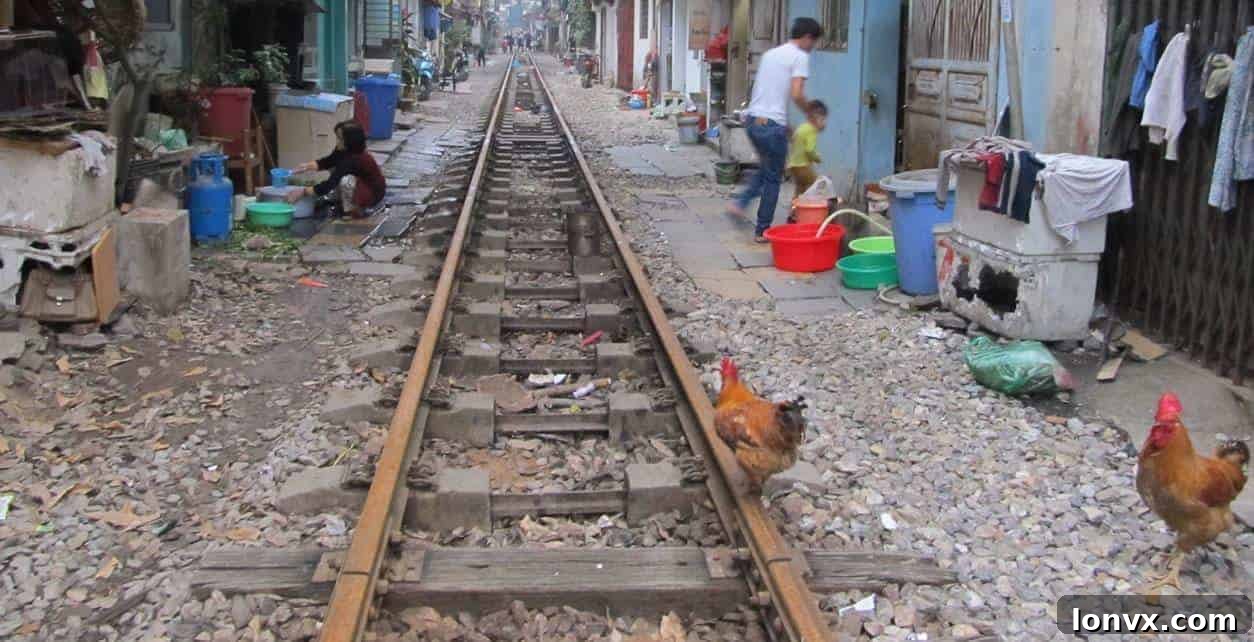
Hanoi Train Street: A Fascinating Glimpse into Vietnam’s Unique Urban Coexistence
In the vibrant heart of Hanoi, Vietnam, nestled within the ancient labyrinth of the Old Quarter, lies a sight so extraordinary it almost defies belief: a railway line that slices directly through a bustling residential street. This isn’t merely a track running parallel to homes; it’s a thoroughfare that passes within inches of front doors, shopfronts, and daily life. It’s a truly astonishing spectacle of urban adaptation, where the thundering rhythm of a train dictates the very pulse of a community.
For roughly half a mile, tall, narrow buildings, characteristic of Hanoi’s historic architecture, line either side of the railway. Twice daily, these seemingly fragile structures bear witness to a powerful locomotive barreling through this impossibly tight corridor, forcing an immediate and complete transformation of the streetscape. What might appear chaotic to an outsider is, in fact, a meticulously choreographed ballet of everyday life.
I recall encountering an elderly resident, his face etched with years of experience, who perfectly encapsulated the unique challenge of his home. When asked about living alongside the tracks, he simply shook his head, a wry smile playing on his lips, and emphasized one word: “Noisy. Very noisy.” His limited English prevented a deeper dive into the nuances of his daily existence, but his expression spoke volumes. One could easily imagine the entire house rattling with each passing train, the stories of near misses, or the quiet resilience required to thrive in such an unconventional setting.
The Unseen Rhythm of Life: Adaptation and Resilience
The lives of the residents here are inextricably linked to the train schedule. In the minutes leading up to the train’s anticipated arrival, a palpable shift occurs. The lively street, usually teeming with activity, transforms with remarkable speed and efficiency. It’s a community-wide drill, performed with practiced precision. Children and pets are gently ushered indoors, scooters and bicycles are moved to the closest possible proximity to the buildings, and plastic chairs, household items, and market stalls are swiftly cleared from the tracks. Every movable object finds its temporary safe haven, ensuring an unobstructed path for the colossal steel beast that is moments away.
You go first. Residents who live along a railway track in Hanoi learn to accommodate each other. (Photo by Diane Slawych)
History Etched in Iron: The Origins of a Unique Quarter
This remarkable integration of a railway line into a residential area is a fascinating byproduct of Hanoi’s long and rich history. The railway itself was constructed during Vietnam’s colonial era, a time when urban planning often prioritized functional infrastructure over existing communities. As Hanoi grew, the city’s unique “tube houses” – narrow, deep structures designed to maximize street frontage and minimize property taxes – sprung up around and along the tracks. Over generations, what might have been considered an anomaly became an integral, defining feature of this particular stretch of the Old Quarter, shaping not just the physical landscape but also the social fabric of its inhabitants.
Daily Rituals and the Fabric of Community
Beyond the dramatic spectacle of the train, life along the Hanoi Train Street is a testament to human ingenuity and the strength of community bonds. When the tracks are clear, they become an extension of people’s homes and businesses. With sidewalks often non-existent or too narrow for practical use, the railway ties serve as an impromptu walkway, a place for children to play, and a convenient shortcut for neighbors to meet. Small businesses spill out onto the tracks, offering street food, haircuts, or a leisurely cup of Vietnamese coffee. This shared space fosters a unique sense of camaraderie, where neighbors rely on and look out for each other, working together to maintain the delicate balance of their extraordinary environment.
The sounds of the street are a symphony of everyday life: the clatter of woks, the chatter of market vendors, the gentle whir of a fan battling the humid air, punctuated by the occasional distant rumble of an approaching train. The vibrant visuals are equally captivating: laundry strung from upper balconies, potted plants adding splashes of green against weathered walls, and the constant flow of people going about their day with an impressive sense of calm amidst the potential for chaos. It’s a living, breathing tableau that offers an unparalleled glimpse into the resilience and adaptability of Vietnamese urban life.
A Tourist’s Glimpse: Drawn to the Extraordinary
The Initial Encounter and an Unforgettable Promise
My first encounter with Hanoi Train Street was from the elevated perspective of a tour bus, an unexpected sight that instantly captivated my imagination. As our bus navigated the bustling streets of Hanoi, the final stop on a 15-day Mekong tour, the glimpse of homes so intimately intertwined with an active railway line left an indelible impression. I was immediately intrigued by the sheer audacity and everyday normalcy of it all. It was then that I made a silent vow: I would return to experience this phenomenon from the ground, to walk the tracks, and to witness this unique form of coexistence up close.
Immersive Exploration: Walking the Tracks, Witnessing Life
True to my word, I returned the following day, arriving around 5 pm, just as the street was awakening with its pre-dinner buzz. I quickly discovered I was far from the only curious soul drawn to this magnetic location. A film crew from Saudi Arabia meticulously documented the scene, capturing every nuance, while an Indian woman found her serene moment, striking a challenging yoga pose directly on the railway ties – a testament to the unexpected tranquility that could be found between train passages. The street was a magnet for those seeking authenticity, a slice of life unlike anywhere else.
Emboldened by the other visitors and the inviting atmosphere, I followed suit, venturing onto the tracks myself. It was an immersive journey through the heart of the community. I passed a small salon where a customer was having her hair luxuriously shampooed, the suds contrasting with the gritty reality of the tracks outside. Tall, verdant plants in colorful pots adorned the front of several homes, a splash of nature against the concrete and steel. Laundry fluttered gently on lines from upper balconies, a domestic scene played out against an industrial backdrop. A woman with curlers in her hair, clad in comfortable leopard-print slippers, sat on her haunches in a doorway, deftly chopping cabbage for a meal, while another resident carefully pushed her bicycle over the rough gravel alongside the tracks, a child comfortably seated on the back, observing the world with wide, innocent eyes.
The hot and humid temperatures typical of Hanoi meant many doors remained open, offering an unfiltered view into people’s living spaces. While this naturally allowed for little privacy, especially with inquisitive tourists passing by, the locals seemed remarkably accustomed to the attention. Some maintained a reserved demeanor, understandable given the constant stream of cameras and curious gazes. Others, however, engaged warmly with passersby. One man, in particular, stood out with his unusually pampered pet chicken. He cooed lovingly over the impeccably groomed bird, which he kept on a leash and proudly displayed on a small wooden perch, clearly showcasing his beloved companion. It was a beautiful specimen, though the sight of it tethered to a leash evoked a pang of sympathy.
Yet, the memory of other chickens I’d seen roaming freely earlier in the day, often darting across the very same railway tracks – for where else could they go? – offered a quiet explanation. In an environment where the line between public and private, and safe and dangerous, is so finely blurred, even a pet chicken requires a certain degree of precaution. It underscored the constant awareness and careful planning that defines daily life along Hanoi Train Street.
More Than Just a Railway: A Symbol of Resilience
Hanoi Train Street is more than just a quirky tourist attraction; it is a profound testament to human resilience, adaptability, and the enduring spirit of community. It embodies a unique form of urban harmony, where the relentless march of modern life, symbolized by the train, coexists with the deeply rooted traditions and daily rhythms of a historic neighborhood. This street offers a powerful narrative of how people not only survive but thrive in conditions that many would deem impossible, turning a potential hardship into a defining feature of their identity and a captivating draw for the world. It’s a place where history, culture, and the extraordinary everyday merge, leaving an unforgettable impression on all who witness its unique pulse.