
After a prolonged period of uncertainty and six consecutive months of declining sales, Canada’s dynamic housing market finally began to show tangible signs of resurgence in May. This month marked a crucial turning point, as national home sales witnessed a modest yet significant 3.6 per cent month-over-month increase, halting a downward trend that had persisted since last November. This uptick has sparked discussions across the industry: is this the long-awaited rebound, or merely a temporary reprieve?
While headlines might be quick to declare a full-fledged comeback, a closer and more honest examination of the underlying data reveals a nuanced picture. The market is indeed moving, but it’s doing so with a newfound sense of caution and deliberate pace, signaling a deeper rebalancing rather than an immediate return to past exuberance.
Industry observers had widely anticipated a surge in “pent-up demand” to unleash itself in May and June, particularly following the Canadian election that contributed to buyer hesitancy in the first quarter. While activity did pick up, the expected flood of buyers did not materialize with the overwhelming force many had predicted. This suggests that while the assumption of deferred activity was correct, its magnitude was perhaps overestimated. Buyers, rather than rushing back, are proceeding with a thoughtful approach, indicating a shift in market psychology.
The cautious re-entry of buyers has been met by a growing wave of sellers, who appear to be acting with increased speed and confidence. This dynamic is crucial, as it points to a market where new supply is outpacing new demand, a trend that seasoned analysts have been observing and highlighting for some time.
The latest report from the Canadian Real Estate Association (CREA) substantiates these observations. It confirms that the influx of new listings continues to expand more rapidly than buyer interest, painting a picture where the much-anticipated rebound feels more like a gentle echo than a resounding rally. This isn’t a market characterized by explosive growth, but rather by a subtle, yet profound, rebalancing act.
For those involved in Canadian real estate, understanding this quiet rebalancing is paramount. It represents the most significant market shift observed in over a year, and failing to read between the lines means missing out on crucial insights that will dictate success for buyers, sellers, and real estate professionals alike in the coming months. This article delves deeper into these shifts, offering a comprehensive analysis of Canada’s housing market trends and what they mean for you.
A Market on the Move, But Not in a Hurry: Analyzing Canadian Home Sales
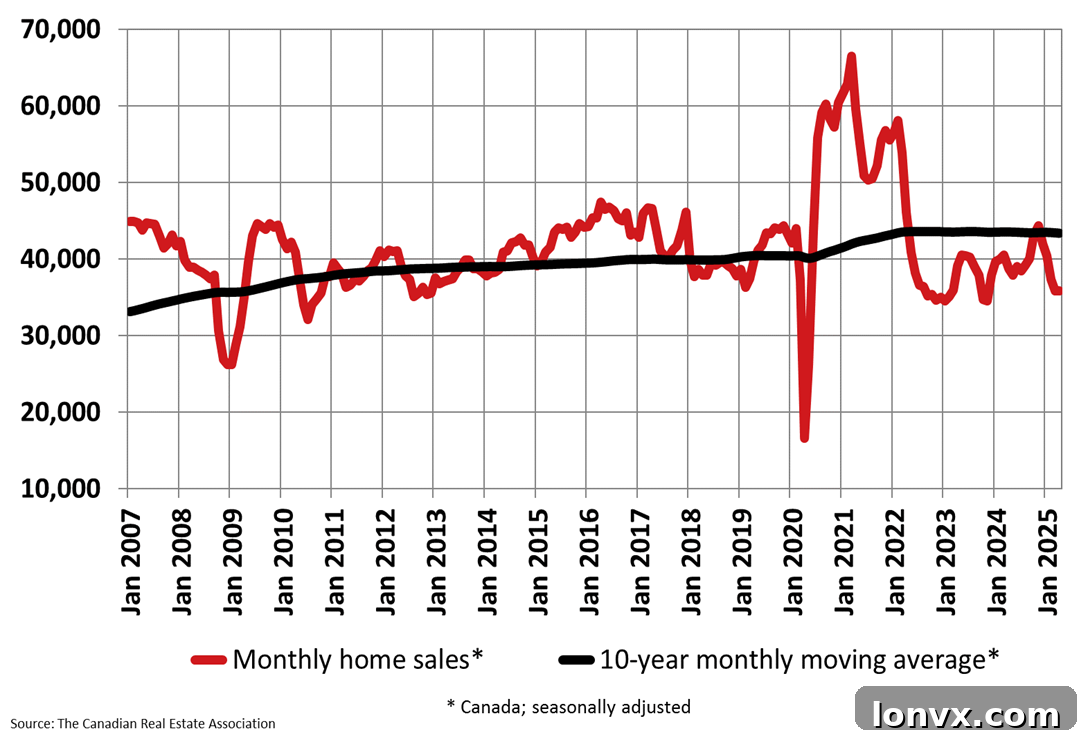
The 3.6 per cent increase in national home sales during May, while a positive indicator, warrants a closer look. This modest bump was largely propelled by robust activity in key urban centers such as Toronto, Calgary, and Ottawa—cities with substantial transaction volumes capable of influencing the national average. These regions, often bellwethers for the broader Canadian market, experienced renewed buyer interest, albeit not at the frenetic pace of previous boom cycles. Even with their significant contributions, the overall market activity across Canada remained 4.3 per cent below the figures recorded in the same month last year, underscoring the measured nature of the current recovery.
This data suggests movement, but critically, it lacks the velocity often associated with a scorching market. Buyers, influenced by sustained higher interest rates, economic uncertainties, and a more cautious outlook, are taking their time. They are not rushing into bidding wars or making snap decisions, a stark contrast to the urgency that characterized previous periods of intense demand. The chart below, illustrating sales trends from 2007 onwards, further contextualizes current activity, showing that while we’re off the bottom, we’re far from historical highs or even recent averages.
The absence of urgency among buyers is a telling sign of the market’s evolving psychology. Instead of fear of missing out (FOMO), there’s a growing sense of prudence and strategic decision-making. Buyers are exhibiting patience, conducting more thorough due diligence, and meticulously evaluating their options before committing. This shift empowers them with greater control in negotiations and signals a healthier, more balanced environment where informed choices prevail over impulsive actions. Understanding this change in buyer behavior is crucial for anyone navigating the Canadian real estate landscape today.
Inventory is Building: Slow, Steady, and Strategic Shifts in Supply
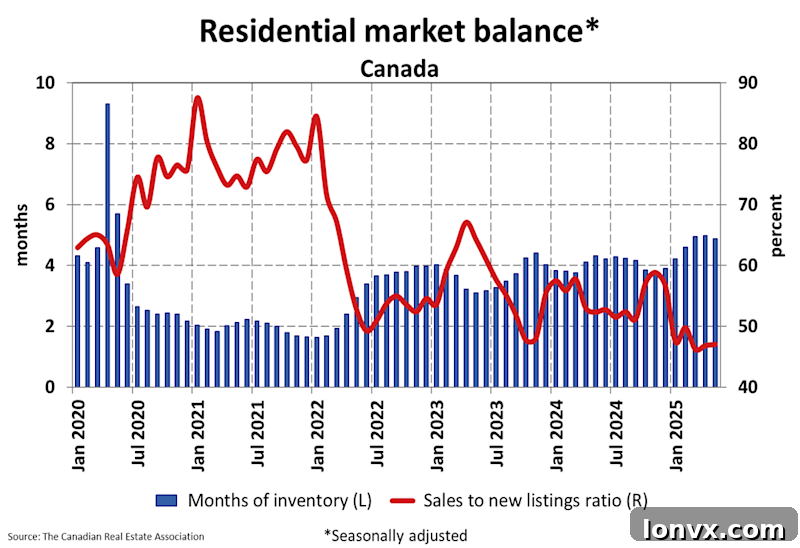
One of the most defining characteristics of the current Canadian housing market is the accelerating pace at which supply is changing relative to demand. May recorded another 3.1 per cent increase in new listings, marking the third consecutive month of gains. This consistent growth has pushed active listings across the nation to 201,880 units, representing a substantial 13.2 per cent rise year-over-year. This upward trajectory in available homes is bringing overall inventory closer to its long-term average, a development that carries significant implications for market dynamics.
This sustained increase in listings signifies a measured return of confidence among sellers. For much of 2024, many potential sellers seemed to be biding their time on the sidelines, perhaps waiting for clearer market signals or more favorable conditions. Their re-entry into the market, even if gradual, is sufficient to subtly but firmly shift the market’s equilibrium. This influx provides buyers with more choices and less pressure, fundamentally altering the competitive landscape that has long favored sellers in many Canadian regions.
The national sales-to-new listings ratio, a critical barometer of market balance, held steady at 47 per cent in May. This figure remains notably below the 10-year historical norm of 55 per cent. While a ratio between 40-60 per cent is generally considered indicative of a balanced market, the trend toward the lower end of this spectrum signals a crucial underlying shift. Technically balanced, the market is beginning to functionally lean in favor of buyers, providing them with more negotiating power than they’ve enjoyed in recent memory.
This underlying signal is profound: choice is expanding, and with it, buyer leverage is increasing. This pattern closely mirrors the developments seen in major markets like the Greater Toronto Area (GTA), where a significant increase in active listings combined with more subdued demand has granted buyers considerably more room to maneuver, negotiate, and take their time. The days of multiple offers and waived conditions are becoming less common, replaced by opportunities for buyers to include contingencies, conduct thorough inspections, and negotiate on price and terms. This strategic accumulation of inventory is a key factor in shaping the “negotiation market” that is now taking hold across Canada.
Prices Have Leveled, But Haven’t Rebounded: A Close Look at Value Stabilization
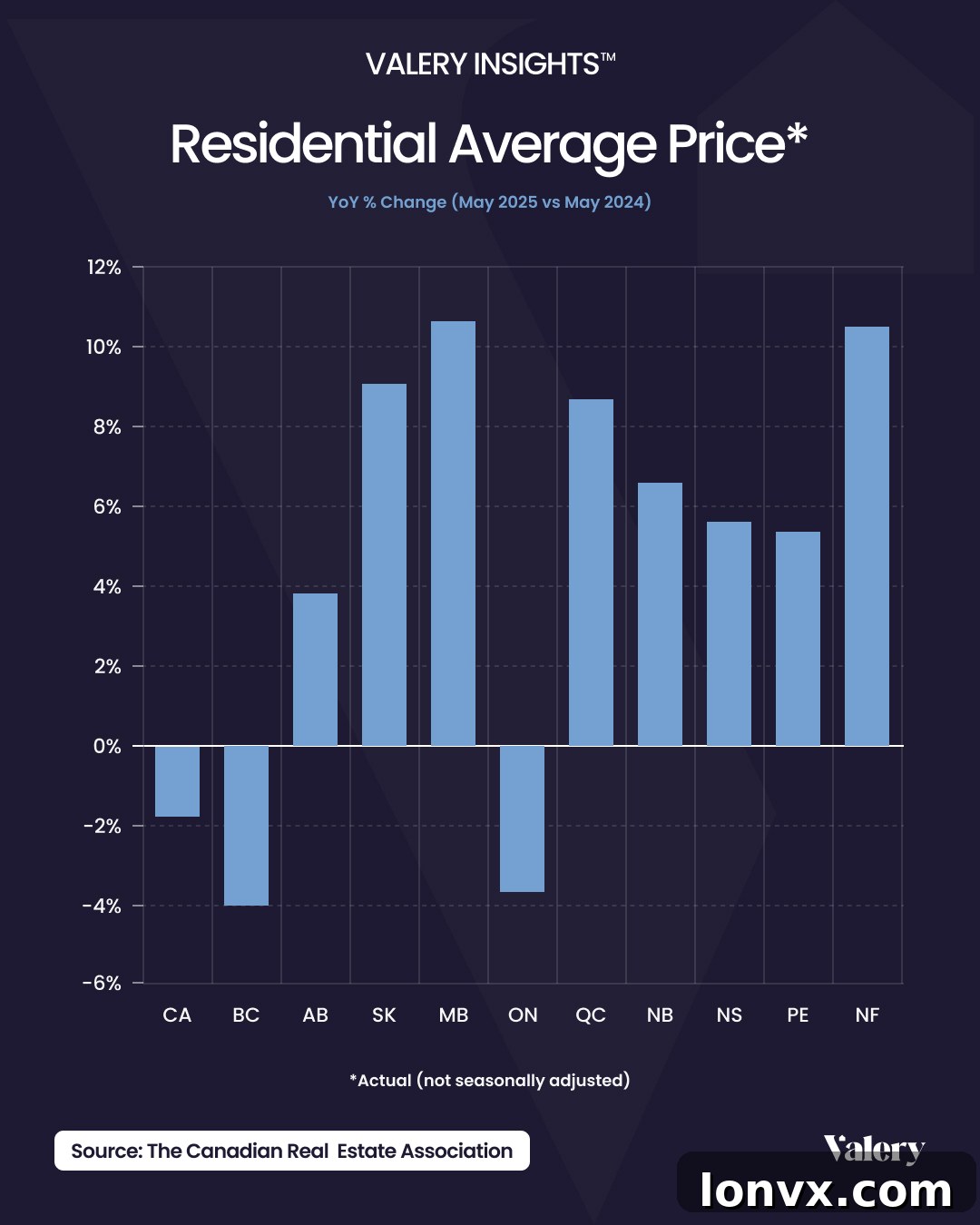
After enduring several months of national price declines, May brought a welcomed period of near-stabilization for Canadian home prices. The MLS Home Price Index (HPI), a more accurate measure of “typical” home price changes, recorded only a slight 0.2 per cent month-over-month slip. Concurrently, the actual national average sale price settled at $691,299, reflecting a 1.8 per cent decrease compared to May 2024. While still down year-over-year, the flattening trend month-over-month suggests a notable pause in the rapid depreciations seen earlier in the year. This stabilization indicates that the market is finding a new equilibrium, where significant price drops are becoming less common, yet a strong rebound is not yet in sight.
The return of sellers in greater numbers, as clearly evidenced by the rising inventory levels, has not translated into aggressive pricing strategies. Many sellers are listing their properties not with the intention of pushing market boundaries or initiating bidding wars, but rather to test current buyer interest and gauge realistic valuations. This cautious approach by sellers, coupled with buyers who are re-engaging without the previous sense of urgency, creates a delicate balance. The uptick in May sales indicates renewed interest, but it hasn’t generated sufficient upward pressure on prices to signal a robust rebound. While these early signs of value stabilization are encouraging, there’s a lack of convincing momentum to suggest that a sustained upward trend in prices is firmly underway. Buyers are discerning, and sellers are realistic, leading to a more rational pricing environment.
Regionally, the Canadian housing market presents a mixed and diverse picture, highlighting the importance of localized analysis. Ontario and British Columbia, traditionally high-value markets, continued to exert downward pressure on the national average, experiencing average price declines of roughly 3 per cent to 4 per cent. This reflects ongoing affordability challenges, tighter mortgage stress tests, and a greater supply of homes relative to demand in these provinces. In stark contrast, other parts of the country demonstrated considerable resilience, with average prices moving higher. Provinces like Manitoba, Quebec, Saskatchewan, and Newfoundland and Labrador posted impressive year-over-year gains ranging from 8 per cent to 10 per cent. These regions often benefit from relatively more affordable housing, stronger local economic conditions, and internal migration patterns, showcasing the fragmented nature of the Canadian real estate market.
In essence, the narrative is complex: the market is neither overheated nor frozen. Instead, it is highly regionalized, with local conditions now performing most of the heavy lifting in shaping price movements. Understanding these distinct regional dynamics is crucial for both buyers and sellers, as a national average can often mask significant variations and opportunities at the local level.
We’ve Entered a Negotiation Market: Strategy and Leverage in Canadian Real Estate
The current state of the Canadian housing market defies simple categorization. It is neither a sizzling hot market characterized by relentless price growth nor a full-blown correction marked by widespread depreciation. Instead, it represents an intricate middle ground, which can best be described as a “negotiation market.” In this environment, the traditional certainties of real estate are diminished; nothing is guaranteed, and virtually every aspect of a transaction is open for discussion and strategic maneuvering. This shift demands a sophisticated approach from all parties involved, emphasizing skill and insight over sheer speed.
In such a market, knowledge unequivocally translates into leverage. For buyers, understanding market comparables, seller motivations, and financing options becomes their most potent tool. For sellers, accurate pricing, compelling presentation, and a deep understanding of buyer psychology are paramount. The days of passively listing a property or making an unconditional offer are fading, replaced by a need for active, informed engagement.
Currently, buyers generally hold the upper hand, albeit temporarily. The sustained increase in inventory means options are widening significantly, allowing purchasers more time to evaluate properties, conduct thorough inspections, and consider various financing scenarios. The pervasive low urgency in the market means buyers are not pressured into hasty decisions, providing them with unprecedented space to think, compare, and, most importantly, negotiate terms that truly suit their needs. This buyer-friendly window, however, is not indefinite. Should interest rates decline later in the year, as some forecasts suggest, demand could re-ignite, potentially narrowing this opportune gap and shifting power dynamics once again.
Indeed, there are already early signs of some relief for buyers. According to the Q1 2025 Housing Affordability Monitorfrom the National Bank of Canada, mortgage rates have seen a slight downward adjustment. This subtle easing has translated into a marginal, but meaningful, reduction in the burden of homeownership. The national Mortgage Payments as a Percentage of Income (MPPI) dropped to 55.4 per cent, marking its lowest level in nearly three years. This improvement in affordability, while modest, could gradually re-energize a segment of the buyer pool and inject fresh demand into the market.
For sellers, this is not a market devoid of options, but one where strategy takes precedence over complacency. The “list-it-and-leave-it” approach is obsolete. Success in a negotiation market rewards precision: pricing a property accurately to align with current market values, staging that effectively showcases its best features and resonates with target buyers, and crafting a compelling narrative that clearly justifies its value. Sellers must be prepared to engage in discussions, potentially entertain offers with conditions, and demonstrate flexibility to secure a sale. Expert guidance in market analysis and negotiation tactics is more critical than ever to navigate these complexities successfully.
Still a Market for the Measured: The Path Forward in Canadian Real Estate
The performance of the Canadian housing market in May does not herald the beginning of a frantic boom. Instead, it signals something far more significant and sustainable: the return of discipline. After years of rapid growth and intense competition, the market is recalibrating, ushering in an era where thoughtful decision-making, meticulous research, and strategic positioning are paramount for success.
Buyers are re-entering the arena not in overwhelming droves, but with clear intention and a newfound sense of discernment. They are more cautious in their approach, more analytical in their evaluations, and crucially, more willing to walk away if a deal doesn’t align with their criteria or expectations. This isn’t about chasing ever-increasing prices; it’s about making informed, well-considered moves when the terms are unequivocally right. The market is currently offering ample room to negotiate, and savvy buyers are seizing this opportunity to secure more favorable outcomes, whether through price adjustments, inclusion of conditions, or extended closing periods.
Looking ahead, the landscape of Canadian real estate will not be defined by who moves first, but rather by who moves smartest. Impulsive decisions driven by fear or speculation are likely to yield suboptimal results. Instead, success will be reserved for those who prioritize thorough market analysis, understand the nuances of local conditions, and are prepared to adapt their strategies in response to evolving trends. This measured approach applies equally to sellers, who must be precise in their pricing and presentation, and to real estate professionals, who must offer unparalleled insights and negotiation expertise.
In this new and evolving phase of Canadian real estate, it won’t be the boldest or the most aggressive participants who ultimately achieve their goals. It will be the best-informed, those equipped with comprehensive data, clear understanding, and strategic foresight. As the market continues its subtle dance of rebalancing, staying ahead requires continuous learning and expert guidance. Don’t miss out—join industry experts for deep-dive analyses on market trends and what shifting sentiment means for Realtors, buyers, and sellers. For ongoing insights and expert market breakdowns, consider joining REM, where columnist Daniel Foch analyzes CREA’s latest stats, regional variations, and what shifting sentiment means for all market participants. Register for upcoming webinars here to stay informed and ahead of the curve.