Greenland’s Geopolitical Chess Match: Resources, Independence, and Real Estate in the Arctic
In an era of shifting global dynamics, the Arctic Circle, one of the planet’s most remote and resource-rich regions, finds itself at the epicenter of renewed geopolitical interest. Recent events, particularly the explicit U.S. interest in Greenland and even implicit threats concerning Canada, have ignited a fierce wave of patriotism and a renewed focus on national identity across the northern reaches. This diplomatic friction highlights the escalating strategic importance of the Arctic, not just for its vast untapped resources but also for emerging shipping lanes and military positioning.
The geopolitical temperature notably rose during a recent, controversial visit by a delegation of American representatives to Greenland. Among them was Vice President JD Vance, whose presence followed on the heels of previous assertions by Donald Trump regarding the potential “annexation” of the island. Greenland’s Prime Minister, Mute Egede, did not mince words, characterizing Trump’s decision to dispatch representatives as “highly aggressive.” This sentiment underscores a powerful, underlying desire among Greenlanders to assert their sovereignty and shape their own future, free from external pressures.
The American group’s initial itinerary in Greenland was ambitious, even including attendance at the culturally significant national dogsled race. However, amidst public outcry, diplomatic concerns, and logistical challenges, the visit was significantly curtailed. The delegation’s activities were ultimately scaled back to a visit to the U.S. military base, a stark reminder of the strategic military presence in the region. During this reduced visit, Vance reportedly criticized Greenland’s current governance, indicating a perceived vulnerability that the U.S. might exploit. His statement, “We think we’re going to be able to cut a deal, Donald Trump style, to ensure the security of this territory,” further fueled anxieties about Greenland’s autonomy and future.
Greenland’s Undeniable Strategic Value and Resource Wealth
It is an open secret that the U.S. interest in Greenland extends far beyond abstract national security concerns. Like other global superpowers such as China and Russia, Washington has long cast its gaze upon the island territory’s immense mineral resources. These resources, including rare earth elements, uranium, iron ore, zinc, and more, lie beneath Greenland’s vast, rapidly thawing ice sheet—an area three times the size of Alberta. The global demand for rare earths, essential components for modern technology from smartphones to electric vehicles and renewable energy systems, makes Greenland a critical, untapped treasure trove.
Beyond its mineral wealth, Greenland’s strategic location is becoming increasingly vital due to climate change. As the Arctic ice melts at an accelerating rate, prospective international shipping channels are emerging from their deep freeze. These new routes offer significantly shorter transit times between Europe, Asia, and North America compared to traditional routes through the Suez or Panama Canals. This development could reshape global trade and maritime power, making control or influence over these passages incredibly valuable. Consequently, climate change is inadvertently transforming Greenland—and indeed parts of Canada—into geopolitically hot commodities, drawing the attention of nations keen to secure economic advantages and strategic footholds in the new Arctic frontier.
The heightened global interest in Greenland is palpable, even at a local level. Miki Lynge, a real estate broker based in Nuuk, Greenland’s capital city where approximately one-third of the population resides, observes an unprecedented influx of foreign media. “There’s never been so many foreign media here,” Lynge notes, highlighting the world’s sudden focus on the island. This intense scrutiny, while raising Greenland’s profile, has also introduced a degree of uncertainty into the local real estate market, making some prospective buyers “a little hesitant.” Lynge points out that “the real estate market is relatively new here.” For generations, rental housing was predominantly provided by the public sector, meaning “it’s only about two or three generations that have had their own house or apartment,” underscoring the nascent nature of private property ownership.
Understanding Greenland’s Unique Property Market Dynamics
Greenland’s property market operates under a unique legal framework that often surprises foreigners. As explained by Anna Jensine Arntzen, a Scandinavian PhD student specializing in urban planning in Greenland, “You can’t own land there, but you can own the house sitting on it.” This distinction means that individuals acquire the rights to a property’s structure, but the underlying land remains under government ownership. To build or acquire a property, one “have to apply to the government for site allocation.” This system simplifies certain aspects of property ownership; for instance, “with no land rights, there’s no property tax,” which can be an attractive feature for residents and investors alike, albeit with specific considerations regarding long-term tenure and development rights.
While geographically positioned within North America, Greenland functions as a semi-autonomous territory of Denmark. Their relationship is often described as ‘complicated,’ a nuanced dance between historical ties, economic dependence, and a burgeoning desire for self-determination. Greenland’s economy is heavily reliant on its robust fisheries sector and substantial financial aid from Denmark, which funds crucial public services. However, Greenlanders, a vibrant blend of traditional Inuit culture and Danish influences, possess a powerful national identity. This identity fuels a persistent political movement towards gradual, full independence from Denmark. The political landscape is dynamic, as evidenced by the fact that a staunchly pro-independence political party, which also favored closer cooperation with the U.S., was notably excluded from a new government coalition agreement formed on the very day of the American delegation’s controversial arrival. This political maneuvering highlights the delicate balance Greenland seeks to strike between maintaining its autonomy, managing its relationship with Denmark, and navigating the increasing interest from global powers.
Fascinating Facts About Greenland: An Arctic Marvel
Greenland, an Arctic island often described as a land of extremes and breathtaking natural beauty, especially under the dazzling curtains of the Northern Lights, holds many fascinating distinctions:
- It is the largest island in the world. While Australia is four times larger, it is classified as a continent, making Greenland the undisputed king of islands by landmass.
- Only about 20% of Greenland’s vast expanse is inhabited. With a sparse population of approximately 57,000 people, scattered almost exclusively along its stunning, fjord-riddled southwest coast, the entire population could comfortably fit into a single large sports stadium. This demographic reality underscores the immense, untouched wilderness that defines much of the island.
- The preservation of the traditional sled dog population is considered paramount to Greenlandic culture and identity. Consequently, owning a pet dog purely for companionship is illegal in many parts of the country, emphasizing the working role of these animals.
- Due to the island’s rugged and challenging terrain, there is no extensive road network connecting different communities. This means that if you own a car, you are effectively limited to driving it within your own town, as “all roads stop on the outskirts.” Travel between settlements primarily relies on boats, planes, or, in winter, snowmobiles and dog sleds.
- Greenland is widely regarded as socially progressive, boasting free education and healthcare for its citizens. Its LGBTQ+ rights are among the most extensive and inclusive globally. However, beneath this progressive veneer, the nation grapples with significant social challenges, including the highest suicide rate in the world and a high prevalence of alcoholism. These issues are often linked to factors such as long, dark winters, cultural shifts, isolation, and socio-economic pressures.
Trump’s Previous Annexation Attempts and Market Implications
The recent U.S. interest in Greenland is not a new phenomenon; it represents a continuation of past overtures. Donald Trump first made a highly publicized play for Greenland in 2019 during his initial term in office. That attempt was met with similar disdain and outright rejection from the Greenlandic and Danish governments. Despite the clear rebuff, Trump publicly told journalists that acquiring Greenland would be “a great real estate deal” and one that would secure his “place in history.” His perspective, viewing the sovereign territory as a mere transaction, deeply offended the people of Greenland and Denmark.
Interestingly, the intense spotlight thrown on Greenland by Trump’s 2019 proposal did provide a temporary, albeit modest, boost to its nascent property market. The sudden global attention sparked curiosity and some speculative interest. However, this time around, despite renewed international focus, there hasn’t been a noticeable market uptick. This disparity can largely be attributed to new legislative measures. In February of the past year, Greenland implemented stricter laws restricting foreign ownership of property. These regulations were enacted specifically due to growing geopolitical concerns and the desire to protect national interests and resources from foreign acquisition, a direct response to the kind of interest expressed by the U.S.
Experts and observers note that Greenland is actively steering its course towards a future anchored in sustainability. The island is embracing green technologies and consciously positioning itself as a pioneer in eco-friendly real estate and responsible resource management. This strategic pivot reflects a broader commitment to environmental stewardship and a desire to leverage its unique Arctic environment responsibly, rather than succumbing to short-term extractive interests.
Real Estate Challenges and Opportunities in Nuuk
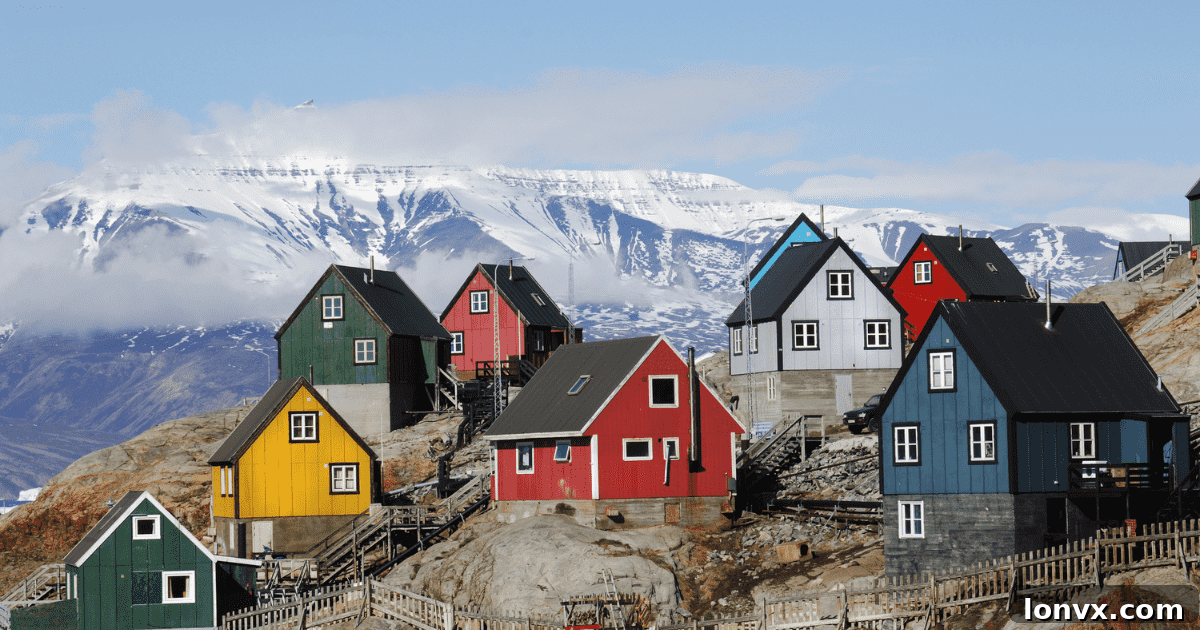
Even in Nuuk, Greenland’s largest urban center, which boasts a vibrant mix of street art, multi-storey housing blocks, and brightly painted wooden houses nestled into picturesque mountainsides, the real estate market remains remarkably small. Carina Serano, an agent with Netbolig Brokerage in Nuuk, observes that there are “less than a handful of real estate agencies (none of them North American brands).” Despite the small number of players, she notes, “We’re quite busy, and growing.” This indicates a market with significant potential but also one facing unique structural impediments.
Serano identifies the government’s recent restrictions on foreign purchases as “the biggest issue facing the market.” These laws, designed to safeguard national assets and maintain local control, inevitably limit the pool of potential buyers and investors. Furthermore, the transient nature of many Greenlanders means that “many Greenlanders tend to move every few years,” contributing to a dynamic but perhaps less stable property market. The cost of living in Greenland is notoriously high, primarily due to its remote location and heavy reliance on imports. Some would even describe it as “astronomical,” impacting affordability and long-term residency. While the standard of living is generally reasonable for residents, depopulation remains a persistent concern, with younger generations often seeking opportunities abroad. The U.S. has reportedly commented on the state of Greenland’s infrastructure, suggesting areas of disrepair, which could either be seen as a challenge or an opportunity for investment, depending on one’s perspective.
Housing prices across Greenland vary significantly by location. Homes and apartments in larger urban centers like Nuuk, Sisimiut, and Ilulissat can be comparable to, or even more expensive than, properties in Canada. This premium is driven by factors such as high import costs for construction materials, limited land availability in coastal areas, and the demand within these key economic hubs. Conversely, housing in smaller, more remote settlements can be substantially more affordable, reflecting the challenges of accessibility and limited amenities in those regions.
Navigating a Unique Real Estate Landscape
Working within Greenland’s real estate industry presents a distinctive set of circumstances. According to Carina Serano, “regulations are few.” In the absence of comprehensive local statutes, agencies like hers often look to established international practices, particularly those from Denmark. “So as much as we can, we like to follow Denmark,” she explains. Serano herself gained her education and license in Denmark, integrating Danish systems and standards into her transactions wherever possible and maintaining membership in pertinent Danish professional associations. Advertising for properties in Greenland is largely modernized, primarily conducted online through dedicated websites and various social media platforms, reaching a broader audience despite the physical remoteness.
However, the market still faces “some big holes,” as Serano candidly points out. A significant drawback is the absence of a Multiple Listing Service (MLS) database, which is standard in many developed real estate markets and facilitates efficient property searches and sales. Additionally, the lack of digitized documents often complicates transactions, leading to more manual processes and potential delays. Financing can also be a considerable hurdle, particularly for individuals residing outside the smattering of larger towns, where banking services and credit access may be limited. Furthermore, property registrations in far-flung settlements are occasionally not up to date, adding a layer of complexity and risk to transactions in these areas.
Despite these challenges, there are notable upsides to operating in the Greenlandic real estate sector. Serano highlights “minimal taxes and few competitors” as significant advantages. “It’s quite comfortable,” she asserts, indicating a less saturated market environment. She reports receiving a decent commission from sellers and also earns a salary, stating that her annual income places her in a top income bracket. This suggests that for those willing to navigate its unique complexities, Greenland’s real estate market offers lucrative opportunities.
As the world watches, it appears that Greenland, the world’s largest island, is poised to become a pivotal player in the escalating battle for control and influence in the Arctic. Its strategic location, vast resources, and the growing impetus for self-determination place it firmly on the global stage. One thing, however, remains abundantly clear amidst all the geopolitical maneuvering: neither Greenland nor its northern neighbor, Canada, has any desire to become the 51st state of the United States. Their respective national identities and aspirations for sovereignty are too strong to be subsumed by external ambitions.