
The Canadian rental market is currently experiencing a significant shift, with average asking rents declining for the fifth consecutive month. This downturn marks a notable departure from recent trends, bringing national average rents to their lowest point since July 2023. This change offers a glimmer of hope for renters who have faced soaring costs over the past several years, signaling a potential rebalancing in the country’s housing landscape.
According to the latest comprehensive report from Rentals.ca and Urbanation, February saw a 4.8 percent year-over-year decrease in average asking rents. This decline brought the national average to $2,088 per month, a figure that, while still substantial, reflects a tangible easing of pressure on prospective tenants. This sustained drop represents a critical moment for the Canadian housing sector, as both renters and investors closely monitor the evolving dynamics of supply, demand, and economic influences.
Shaun Hildebrand, president of Urbanation, provided crucial insight into these emerging trends, stating, “Rents in Canada are softening as supply is outweighing demand.” He elaborated on the contributing factors, highlighting that “apartment completions are currently running at record highs, while at the same time, population growth has slowed and the economy faces heightened risks due to a potential trade war with the U.S. Expect rents to continue decreasing in the near-term as these trends likely remain in place.” This expert analysis underscores a complex interplay of increased housing availability, moderating demographic shifts, and broader economic uncertainties that are collectively reshaping the rental environment.
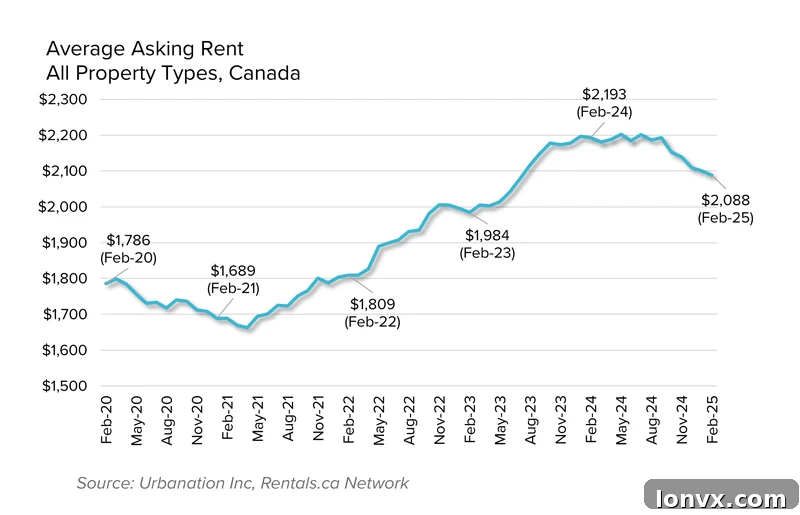
This downward trend is a stark reversal from just a year ago, when the Canadian rental market was characterized by relentless, double-digit annual rent increases. In February 2023, for instance, asking rents had surged by an astounding 10.5 percent year-over-year. The current situation, with average rents down $105 per month compared to a year ago, provides a much-needed reprieve for tenants. However, it’s important to frame this relief within a broader historical context: average rents remain 5.2 percent higher than they were two years ago, and a staggering $302 per month higher than five years ago. This indicates that while the market is softening, overall affordability challenges persist for many Canadians, particularly those in competitive urban centers. The recent decline, therefore, signals a potential stabilization rather than a complete return to pre-pandemic affordability levels.
Understanding the Forces Behind the Downturn
The current contraction in average asking rents is not a singular phenomenon but rather the result of several interconnected factors impacting both the supply and demand sides of the rental equation. The primary driver, as pointed out by industry experts, is a significant increase in the supply of available rental units, particularly new apartment completions. Developers across Canada, anticipating continued strong demand, have brought a substantial volume of new housing to market. This surge in inventory, particularly in major metropolitan areas, has begun to tip the scales, giving renters more options and thus tempering aggressive price increases.
Coupled with this heightened supply, Canada is also experiencing a slowdown in population growth. While immigration remains a key component of Canada’s demographic strategy, recent adjustments to immigration targets and changing economic conditions have led to a moderation in the pace of new arrivals. A slower influx of potential renters directly reduces competitive pressure in the market, allowing supply to catch up with, and in some areas, momentarily exceed demand. Furthermore, economic uncertainties play a critical role. The looming prospect of a trade war with the U.S., alongside persistent inflationary pressures and elevated interest rates, creates an environment of caution. Such economic risks can deter potential buyers, keeping some in the rental market longer, but also impact job stability and consumer confidence, indirectly affecting rental demand and the ability of households to afford higher rents.
Condo Rents See Steeper Declines
Among the most striking trends within the current market correction is the dramatic decline observed in the condominium rental sector. Average asking rents for condo apartments experienced a significant 7.6 percent fall year-over-year, plummeting to a 26-month low of $2,192. This segment-specific downturn is particularly pronounced because many condo units are investor-owned and rented out, making this part of the market highly sensitive to shifts in supply and investor sentiment.
The steepest declines within the condo market were recorded for smaller units, often favored by single individuals or couples. Studio apartments saw a remarkable 10 percent drop in average asking rents, while one-bedroom condos followed closely with an 8.8 percent decrease. Two-bedroom units also experienced substantial corrections, declining by 7.6 percent to an average of $2,323 per month. Even three-bedroom condos, which typically command higher prices and tend to be in consistent demand from families, were not immune, registering a 3.5 percent decrease to an average of $2,757. These figures highlight a widespread softening across all unit sizes within the condo rental market, suggesting an oversupply or reduced demand particularly affecting investor-owned properties.
In contrast, purpose-built rental apartments, which are typically professionally managed and constructed specifically for rental income, demonstrated more resilience. This segment experienced a more moderate 1.9 percent annual rent decline, averaging $2,070. The distinction between purpose-built and condo rentals is crucial; purpose-built buildings often have more stable ownership and management structures, potentially offering greater stability in rent pricing compared to the more volatile, investor-driven condo market.
Regional Variations: Where Rents Have Shifted Most
While the national average provides a broad overview, the Canadian rental market is highly localized, with significant variations across different cities and regions. This recent downturn has not impacted all areas equally, presenting a mixed bag of experiences for renters and landlords alike.
Some of Canada’s most expensive and competitive rental markets have witnessed the most substantial price adjustments. In Vancouver, a city consistently ranked among the priciest globally, one-bedroom rents saw a notable decrease of 5.1 percent year-over-year. Similarly, Toronto, another major urban center, experienced a comparable drop, with one-bedroom rents falling by 5.4 percent. These declines, while welcome, come after years of intense upward pressure, suggesting a market that is finally beginning to cool after reaching unsustainable heights. The influx of new construction in these dense urban areas, coupled with a slightly eased pace of internal migration, has likely contributed to this moderation.
Calgary, a traditionally more affordable major city, surprised many by experiencing one of the most significant declines, with one-bedroom rents plummeting by 7.5 percent year-over-year. This substantial correction could be attributed to a combination of increased housing supply and shifts in the provincial economy, which may have impacted job growth and demand for rental accommodation. Other prominent cities in Ontario, including Mississauga, Brampton, and North York, also saw dips in average asking rents ranging between 3 percent and 4 percent. These suburban centers, often serving as overflow markets for Toronto, are now reflecting the broader softening trend seen in the Greater Toronto Area.
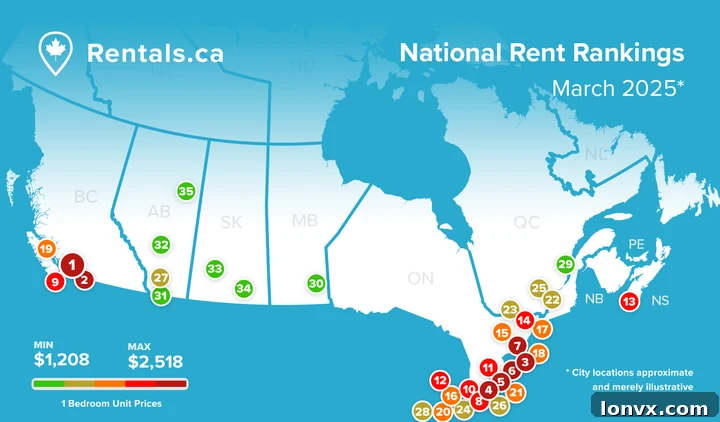
However, not all markets followed this downward trajectory. A few notable exceptions bucked the national trend, experiencing continued rent increases. Cities such as Guelph and Halifax saw average rents jump by approximately 5 percent. These markets often possess unique characteristics that insulate them from broader trends, such as strong local economies, robust student populations, or perhaps a slower pace of new housing development relative to demand. For instance, Halifax has seen significant growth and investment in recent years, maintaining strong demand despite national cooling. These regional disparities highlight the importance of understanding local market dynamics when assessing rental opportunities across Canada.
Implications for Renters and the Future Outlook
The sustained decline in average asking rents offers a tangible, albeit modest, reprieve for Canadian renters. For those struggling with affordability, particularly in high-cost urban centers, even a slight softening provides more breathing room and potentially greater choice. The increase in available inventory, especially in the condo market, means less intense competition for units, which could lead to fewer bidding wars and more stable negotiations between tenants and landlords. However, it is crucial to remember that despite these recent drops, rents remain significantly higher than they were just a few years ago, indicating that true affordability is still a distant goal for many.
For landlords and investors, this period of softening rents presents a new set of challenges and opportunities. While falling rents might squeeze rental yields in the short term, a more balanced market could lead to increased stability and potentially attract long-term tenants. The focus may shift from aggressive price increases to retaining good tenants and optimizing property management. Furthermore, developers might reassess their pipelines, potentially slowing down future projects if the market continues to soften significantly, which could, in turn, affect future supply levels.
Looking ahead, the outlook for the Canadian rental market suggests a continued period of adjustment. As Shaun Hildebrand noted, the combination of record-high apartment completions, moderated population growth, and ongoing economic uncertainties points towards further decreases in rent in the near term. However, the market is dynamic, and several factors could influence its trajectory. Government policies related to immigration and housing, interest rate decisions by the Bank of Canada, and the broader global economic climate will all play a crucial role in shaping the rental landscape over the coming months and years. While the recent trend is a welcome development for renters, a sustained path to long-term affordability will require continued attention to both supply-side solutions and demand-side management.
Conclusion: A Shifting Landscape
The Canadian rental market is at a pivotal juncture, marked by five consecutive months of declining average asking rents. This significant shift, bringing the national average down to its lowest point since July 2023, is primarily driven by a surge in housing supply, particularly new apartment completions, coupled with a slowdown in population growth and broader economic uncertainties. While this downward trend offers some relief to renters, especially in major cities like Vancouver, Toronto, and Calgary, it’s important to acknowledge that overall rents remain substantially higher than historical averages. The distinct movements in condo versus purpose-built rental markets, along with regional variations where some cities continue to see increases, underscore the complex and localized nature of Canada’s housing ecosystem. As the market continues to evolve, stakeholders will be closely watching these trends to navigate what promises to be a more balanced, albeit still challenging, rental environment.