
Understanding Canada’s Shifting Real Estate Landscape: A Deep Dive into Mortgage Rates and Economic Outlook
Canada’s real estate market is currently navigating turbulent waters, as the Bank of Canada’s aggressive monetary policy adjustments, driven by persistent inflation and a surprisingly resilient spring market, have propelled mortgage rates to a staggering 15-year high. This pivotal shift in the central bank’s strategy is sending significant ripple effects across the nation’s housing sector, impacting home sales, affordability, and the broader economic stability.
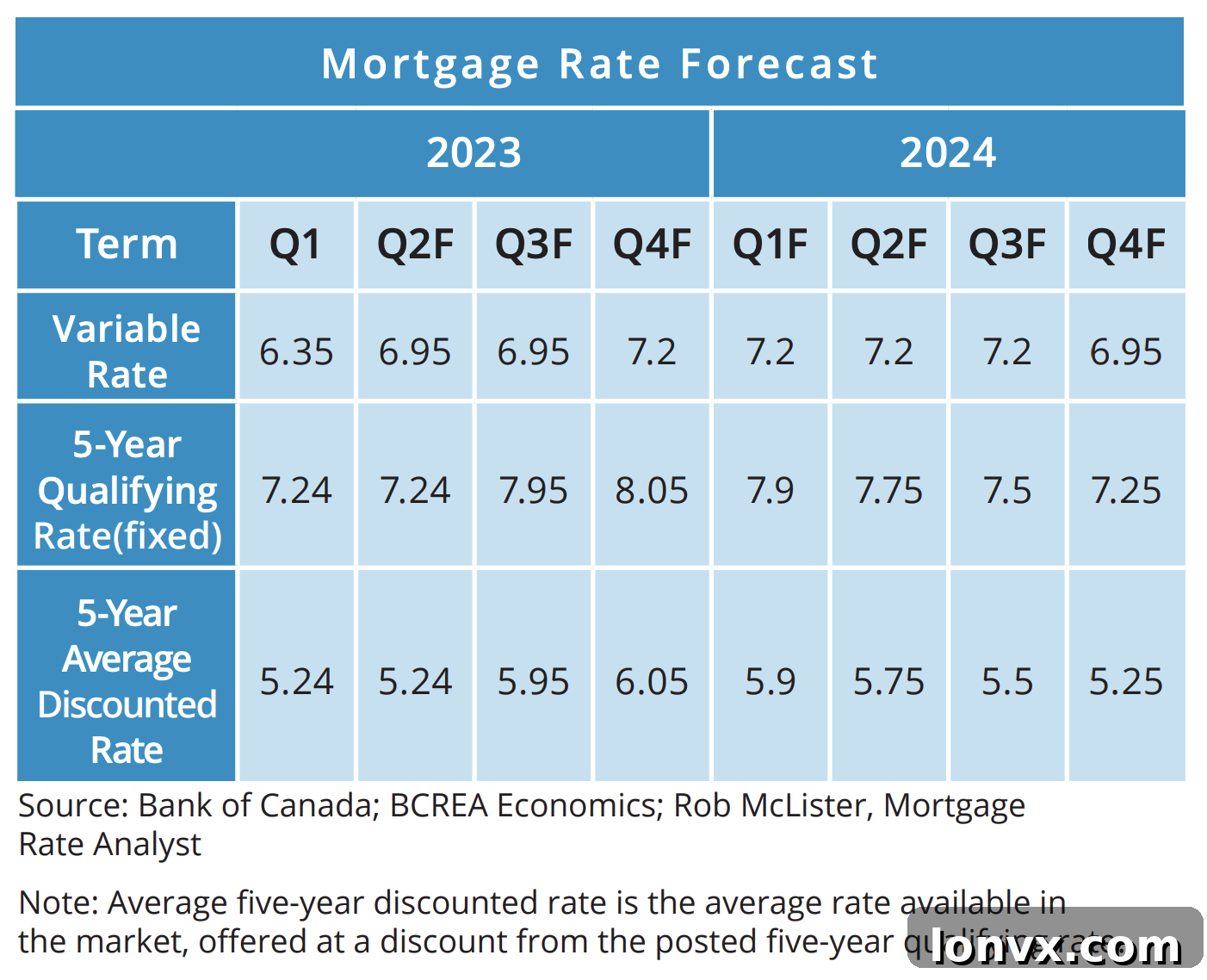
To provide a clearer picture of these unfolding dynamics, the British Columbia Real Estate Association’s (BCREA) Chief Economist, Brendon Ogmundson, alongside Economist Ryan McLaughlin, have meticulously analyzed the situation. Their latest September mortgage rate forecast offers invaluable insights into the potential trajectory of rates over the upcoming quarters, shedding light on what homeowners, prospective buyers, and investors can anticipate.
Navigating the Murky Economic Outlook and Soaring Mortgage Rates
The Bank of Canada’s response to prevailing economic conditions has been both swift and resolute. In quick succession, the central bank implemented policy rate hikes in June and July, culminating in an average variable mortgage rate reaching an imposing 6.95 percent. This upward trajectory has fundamentally recalibrated expectations regarding future rate adjustments.
Initially, there was a widespread anticipation of rate cuts commencing sooner, but these projections have now been pushed back significantly, extending to the end of 2024 or even as late as mid-2025. This recalibration has had a profound impact on long-term interest rates. Yields on five-year Government of Canada bonds, a key benchmark for fixed mortgage rates, have surpassed 4.0 percent for the first time in 15 years. Consequently, fixed mortgage rates are now inching perilously close to 6.0 percent. Adding another layer of complexity, increasingly stringent stress tests are further tightening lending conditions, making it more challenging for Canadians to qualify for mortgages and enter the housing market.
The confluence of an economy displaying nascent signs of decelerating growth—potentially even flirting with a brief contraction—and stubborn inflation rates hovering stubbornly between 3.0 and 4.0 percent, paints an undeniably uncertain picture for interest rates in the forthcoming year. This intricate economic balancing act poses significant challenges for policymakers and consumers alike.
The Inflationary Tug-of-War and Consumer Patience
BCREA economists caution that these elevated interest rates could briefly nudge the Canadian economy into negative territory. Furthermore, consumer spending, a vital engine of economic growth, is anticipated to decelerate once the cushion of excess household savings, accumulated during the pandemic, begins to deplete. This potential slowdown in consumer activity could have broader implications across various sectors.
However, the path back to the Bank of Canada’s target inflation rate of 2.0 percent is not expected to be swift, with projections indicating it may not be achieved until 2025. This extended timeline means that homeowners with variable-rate mortgages will likely need to exercise considerable patience in their wait for any significant relief. The dream of lower monthly payments might remain just that for some time.
Conversely, there might be a glimmer of hope for those holding fixed-rate mortgages. Five-year fixed rates could potentially experience a decline in early 2024. This adjustment would primarily be driven by bond markets reacting to evolving inflation expectations and the eventual anticipation of future rate cuts by the Bank of Canada. Such a development would offer a much-needed reprieve for a segment of the market, potentially spurring some renewed activity.
Unpacking the Impact on Canada’s Economic Growth and Labor Market Resilience
Despite the tightening financial conditions, Canada’s economic narrative remains complex. While the economy appears to be slowing, and possibly even entering a period of contraction, BCREA economists Ogmundson and McLaughlin emphasize a crucial distinction: “While the economy appears to be slowing, or perhaps even contracting, it is difficult to label it a recession without a weakening labour market.” This statement underscores the unusual resilience observed in Canada’s job market.
Indeed, Canada’s labor market continues to defy expectations, exhibiting remarkable robustness. Although recent months have presented a mixed picture of job growth, and the unemployment rate has seen a slight uptick from its historical lows, the overall labor market remains notably tight. Job vacancies, while showing a gradual decrease from their peak, still hover significantly above historical averages, signaling a persistent demand for workers across various sectors. Furthermore, wage growth continues at a brisk pace, ranging between 4.0 to 5.0 percent, a factor that, while beneficial for workers, also contributes to inflationary pressures.
Inflation, though it has receded from its alarming peak of over 8.0 percent in June 2022, persists stubbornly within the 3.0 to 4.0 percent range. This level remains notably above the Bank of Canada’s target of 2.0 percent. The BCREA economists stress that this sustained inflationary trend is a critical concern, indicating that additional monetary tightening measures may be necessary to steer the economy back towards the central bank’s inflation target. The delicate balance between curbing inflation and avoiding an economic downturn continues to be the primary challenge for monetary policymakers.
Anticipating the Bank of Canada’s Next Moves: A Tightrope Walk
Given the persistent nature of inflation, which has consistently stayed above 3.0 percent, the Bank of Canada’s recent decision to maintain its overnight rate at 5.0 percent is largely viewed as the “right one” by BCREA’s experts. This pause allows the central bank to assess the cumulative impact of its previous rate hikes on the economy.
However, the full effect of these past rate increases may take more time to materialize, especially in an economy still buoyed by substantial household savings. Despite this, a notable uptick in core inflation, observed in August, is “more than likely” to prompt an additional 25 basis point rate increase by the Bank of Canada. Core inflation, which excludes volatile items like food and energy, is a key indicator for the central bank, as it provides a clearer picture of underlying inflationary pressures.
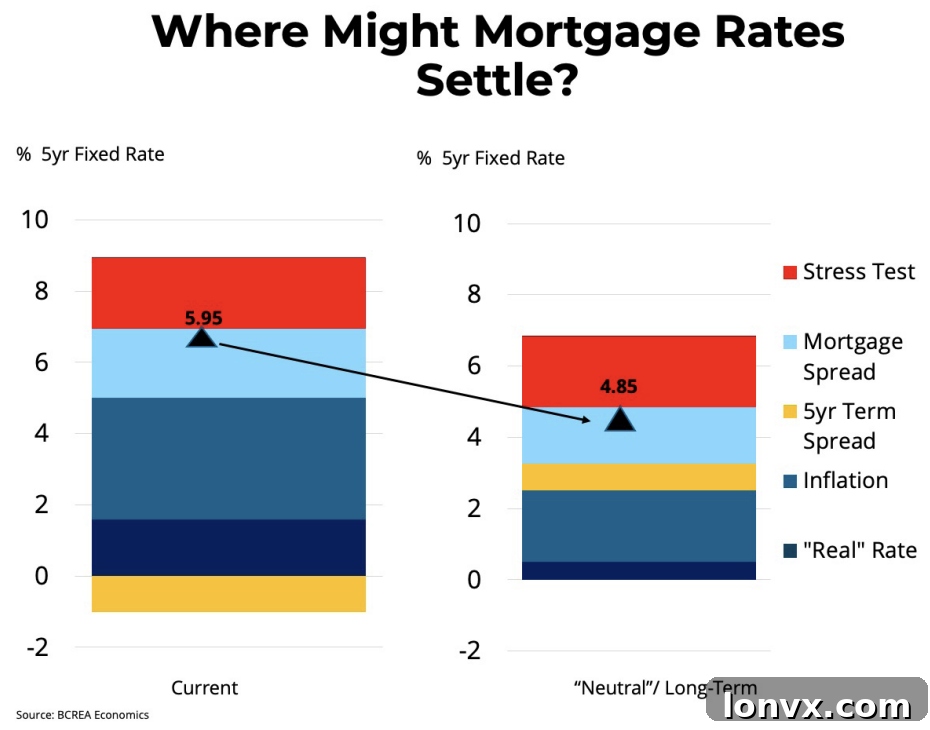
A significant challenge for the Bank of Canada lies in the fact that the current policy rate of 5.0 percent is considerably higher than what the central bank considers “neutral” for the economy. The neutral rate is the theoretical interest rate that neither stimulates nor slows down economic growth, typically estimated to be between 2.0 and 3.0 percent. Maintaining a policy rate significantly above this neutral level indicates an economy operating with excess demand, which fuels inflation.
As the BCREA economists eloquently put it, “At some point, inflation will return to its target, and the economy will no longer be experiencing excess demand, prompting the Bank to bring its policy rate back to its neutral rate of between 2.0 and 3.0 per cent.” This eventual return to a neutral rate would signal a more balanced economic environment.
However, even with future rate cuts, the impact on mortgage rates might be less dramatic than some homeowners hope. BCREA economists estimate that if the Bank of Canada’s overnight rate eventually settles around 2.5 percent—which aligns with a more neutral stance—it could lead to a five-year fixed mortgage rate of approximately 4.85 percent. This projection suggests that future rate cuts might only translate into a reduction of around 110 basis points in mortgage rates from their current highs. While certainly a relief, it implies that borrowing costs will likely remain elevated compared to the ultra-low rates seen in recent years.
What This Means for Canadian Homeowners and Buyers
The current economic climate demands careful consideration from all participants in the Canadian real estate market. For existing homeowners with variable-rate mortgages, the immediate future may involve sustained higher payments, necessitating prudent financial planning and potentially budgeting adjustments. Those approaching mortgage renewal face the reality of significantly higher rates than their previous terms, requiring strategic decisions on whether to lock into a fixed rate or opt for a variable product.
Prospective home buyers, particularly first-timers, face enhanced affordability challenges due to both elevated interest rates and stricter stress tests. This environment might encourage a more cautious approach, with some buyers choosing to delay purchases or reassess their budgets to align with current market realities. The dream of homeownership remains attainable, but the path is undoubtedly more challenging.
Understanding these forecasts and the Bank of Canada’s strategic maneuvers is crucial for making informed financial decisions in a rapidly evolving market. Staying updated with expert analyses, such as the BCREA’s reports, provides a valuable compass for navigating these uncertain economic waters.
For a detailed breakdown of these projections and further insights, you can read BCREA’s September 2023 mortgage rate forecast.