Canadian farmland has long been considered a stable and profitable investment, with its values consistently appreciating across the nation’s most agriculturally robust provinces. This upward trend has historically been closely tied to the income-generating potential of the land, reflecting the fundamental principle that productive assets command higher prices. However, recent global and economic shifts are severely testing this established relationship, introducing an unprecedented level of uncertainty into the market.
The agricultural landscape is currently navigating turbulent waters, primarily driven by the dramatic and often unpredictable fluctuations in commodity prices. Geopolitical tensions, such as the ongoing conflict in the Middle East, coupled with broader economic instability, are causing daily price swings that challenge farmers’ ability to plan and profit. Compounding this challenge, the cost of essential agricultural inputs—from fertilizers and fuel to machinery and labor—continues its relentless ascent, squeezing profit margins from both ends. This dual pressure of volatile revenues and rising costs is prompting crucial questions among farmers, investors, and real estate professionals alike: where do Canadian farmland values go from here, and can the market sustain its historical growth trajectory amidst these formidable headwinds?
Understanding Farmland Valuation in the Prairies: Insights from Saskatchewan
Tim Hammond, a seasoned agricultural real estate specialist and broker at Hammond Realty in Biggar, Saskatchewan, brings a deeply rooted perspective to the discussion. Having grown up on a third-generation grain farm just an hour outside of Saskatoon, Hammond intrinsically understands the intricate factors that dictate farmland values. He unequivocally states that the most significant determinant of a farm’s worth is the revenue it generates for its operators. This revenue, however, is far from static, fluctuating dramatically year to year based on a complex interplay of variables including unpredictable weather patterns, the escalating cost of essential inputs, and, most critically, the ever-changing prices of agricultural commodities in global markets.
The period between 2020 and 2023 serves as a prime example of how favorable conditions can fuel rapid appreciation. Strong commodity returns during these years ignited a sustained and robust run-up in Saskatchewan’s land values. This surge was further exacerbated by an exceptionally tight supply of available land, making the climb even steeper. Hammond recalls a time when approximately 800 farms might be listed on the MLS system in Saskatchewan. Yet, at the peak of this market frenzy, that number plummeted to a mere 200 listings. “People had money, and there was simply no inventory to buy,” Hammond explains, highlighting the classic supply-demand imbalance. This scarcity “just accelerated and perpetuated that increase,” creating a highly competitive seller’s market where prices seemed to know no ceiling.
Today, Hammond observes that the vast majority of his buyers, around 95 percent, are active working producers looking to expand their operations. The average sale he facilitates typically hovers around $1.5 million for approximately 2.5 quarters of land, which translates to about 400 acres. These transactions underscore the significant capital investment required to enter or grow in the Canadian agricultural sector, especially in a province as agriculturally rich as Saskatchewan.
Source: Farm Credit Canada
National Trends and the Looming Squeeze
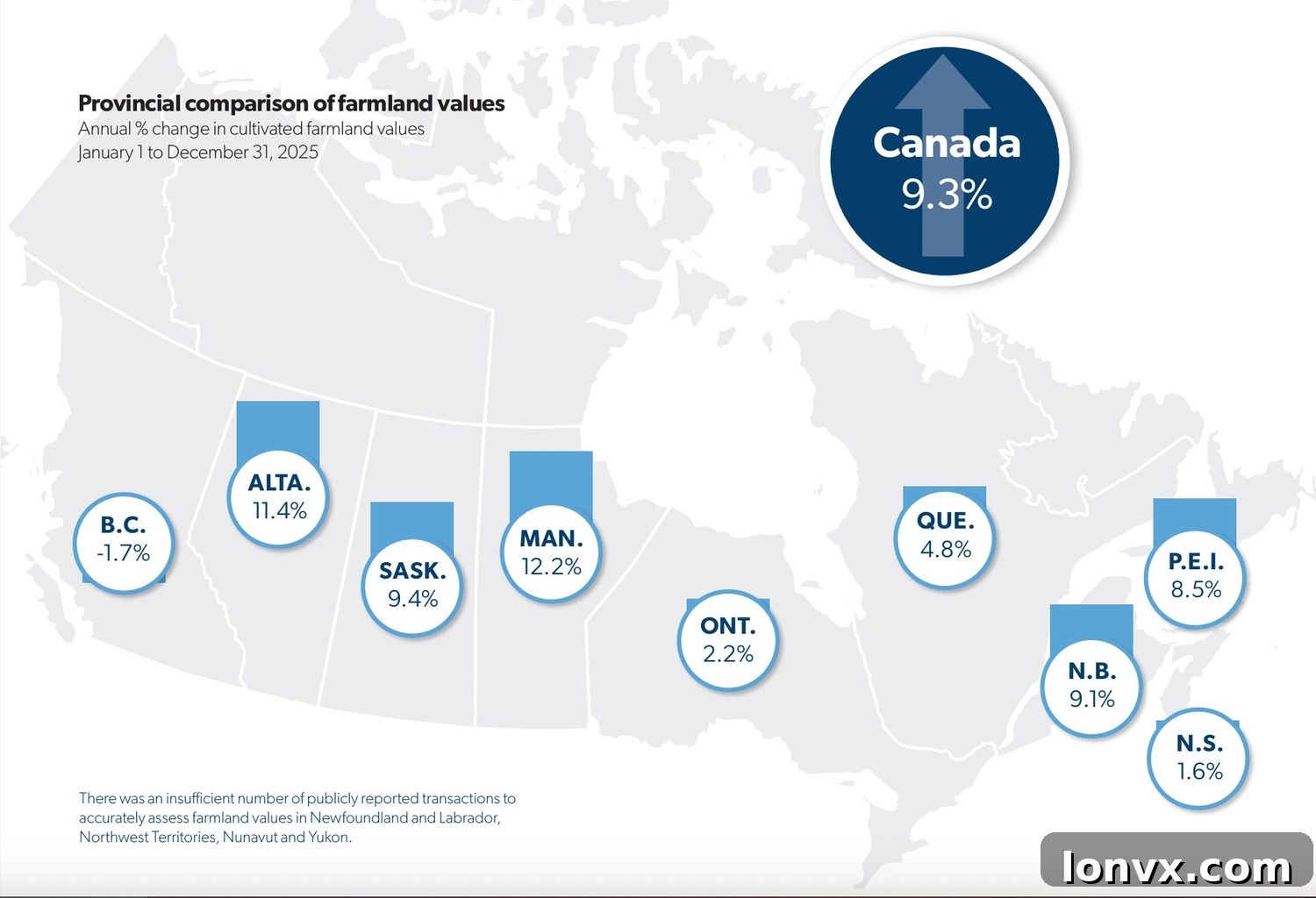
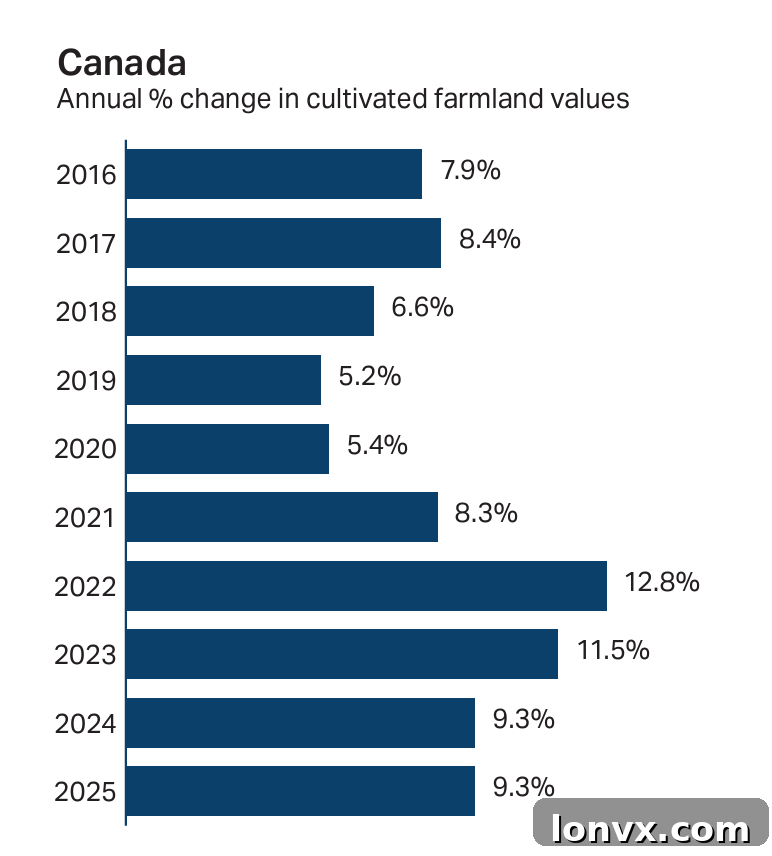
These provincial dynamics in Saskatchewan are mirrored in the broader national data, confirming a widespread pattern of rising values. A recent comprehensive report from Farm Credit Canada (FCC) revealed that farmland values across Canada soared by an average of 9.3 percent in 2025. This increase extends an impressive upward trend that has persisted for more than three decades, solidifying farmland’s reputation as a resilient asset class. The report highlighted the Prairie provinces as the primary engines behind much of this national growth, with Manitoba leading the country with a staggering 12.2 percent increase. Alberta followed closely at 11.4 percent, and Saskatchewan secured a robust 9.4 percent rise, underscoring the strong demand and perceived value of agricultural land in these fertile regions.
The Impact of Softening Commodity Prices
Despite these strong historical gains, there’s a palpable sense that the run-up is now tapering. Hammond points directly to the softening commodity prices as the critical factor. “We really don’t have control over that, and we don’t have control over our markets,” he states, encapsulating the farmer’s vulnerable position as a “price taker.” This means farmers must accept the prevailing market prices for their products, regardless of their production costs, making them highly susceptible to external market forces.
The financial strain on farmers is already evident in official statistics. According to data from Statistics Canada, cash receipts – representing the actual cash paid to farmers for their agricultural products – in Saskatchewan experienced a significant seven percent decline in the third quarter of 2025 compared to the same period a year earlier, dropping to $4.4 billion. This substantial reduction in income directly impacts a farmer’s ability to service debt, invest in new equipment, or expand their operations, casting a shadow over future land valuations.
Source: Farm Credit Canada
The stress is increasingly visible in Hammond’s office, where calls are now coming in from financially stretched producers. These farmers are exploring options to sell portions of their land to liquidate debt, often with the hope of leasing it back afterward to maintain their operational capacity. “They need to sell some land to liquidate some debt and reorganize,” Hammond explains. He characterizes these transactions not as massive, distressed sales, but rather as “micro adjustments” being strategically made in the marketplace by farmers trying to navigate challenging financial conditions.
Hammond anticipates that this trend will lead to a significant increase in available inventory. After years of historically tight supply where willing buyers struggled to find suitable parcels, he believes the market is on the cusp of a major shift. This impending increase in listings will undoubtedly empower buyers, providing them with more options and, crucially, more leverage in price negotiations. “We’ve been so short of land for the last six, seven years, but I think that is going to change,” he predicts. “Once the inventory starts to build, buyers can be more selective and they’ll have more negotiating ability.”
While this added supply will naturally exert downward pressure on prices, Hammond doesn’t foresee a dramatic correction in the immediate future. The market still retains considerable momentum from previous growth. Instead, he projects a period where values will “go sideways for a while, which is healthy.” He envisions a transition from an “extremely hot market” to one that is “more balanced,” offering a more sustainable environment for both buyers and sellers. This equilibrium could bring much-needed stability to a sector that has experienced rapid, sometimes dizzying, growth.
A Shifting Balance: Ownership, Rentals, and Market Dynamics
The structure of land ownership and tenancy significantly influences market dynamics, especially in regions like Saskatchewan. Hammond estimates that approximately two-thirds of farmland in the province is owned by the operator, while the remaining third is rented, predominantly from retired farm families. As a manager of roughly 80,000 acres of rented farmland himself, Hammond is intimately familiar with the nuances of these arrangements.
Many of these long-standing rental agreements often evolve into private real estate deals when the landlord decides it’s time to sell. In such scenarios, the land frequently changes hands discreetly, never even reaching the open market. “The tenant would not let the landlord put it on the open market,” Hammond recounts, illustrating the strong incentive for tenants to secure their operational base. The implicit understanding is often: “No, I will buy it.” This practice has historically contributed to the tight inventory on the public market.
However, Hammond believes this long-standing dynamic is also changing. Farmland prices have climbed to such unprecedented levels that even long-term tenants may begin to reconsider their purchasing decisions. “I think we’re getting to the point where the prices are so high that the tenant is gonna scratch his head and say, I don’t know if I wanna buy it at that price,” he muses. If tenants balk at current valuations, landlords seeking to sell may have no recourse but to list their properties on the open market, further contributing to the anticipated increase in inventory. This shift could fundamentally alter how agricultural land transactions occur in the Prairies.
Intense Local Competition on Prince Edward Island
The market dynamics on Prince Edward Island, while sharing some similarities with the Prairies, also present unique challenges, characterized by intensely local competition. Not long ago, prices of $3,000 or $4,000 an acre for farmland on P.E.I. seemed substantial. Tayler Weeks, a real estate professional on the island, vividly recalls the first time a sale crossed the $5,000 per acre threshold about a decade ago. “It seemed like a massive deal and people were quite upset that farmland in P.E.I. hit that,” he reminisces. At the time, someone presciently told him it was only a matter of time before the Island reached $10,000 an acre. “Sure enough, here we are already there,” Weeks confirms, highlighting the rapid escalation of values.
According to Farm Credit Canada, average cultivated farmland values on P.E.I. continued their upward trajectory, rising 8.5 percent in 2025. This followed gains of 1.4 percent in 2024 and 7.4 percent in 2023, demonstrating consistent appreciation. The demand for high-quality potato land, a cornerstone of P.E.I.’s agricultural economy, remained particularly strong, with desirable parcels rarely staying on the market for long.
Weeks, who works alongside his father and brother at Allan Weeks Real Estate Co. in Hunter River, P.E.I., notes that a main driver of these prices, much like in Saskatchewan, is extremely tight inventory. However, the competition on P.E.I. is intensely local and fierce. Dairy and potato farmers, eager to expand their operations, find themselves needing more acres. In many cases, established operators who have been patiently waiting for an opportunity to grow inevitably end up chasing the same limited parcels of land. “The main thing that we’re seeing is local farmers competing against each other because inventory is so tight,” Weeks explains. The unspoken rule is clear: “If they don’t buy it, someone else is going to come in and pick it up.” While most buyers are local, Weeks notes that recent dairy farm sales have attracted buyers from as far afield as Ontario and even Holland, indicating the broader appeal of P.E.I.’s productive land.
Similar to the Prairies, many agricultural land sales in Eastern Canada never publicly reach the open market, often handled privately between neighboring farmers or through existing tenant-landlord relationships. But when land *does* get listed publicly, Weeks and his colleagues have a well-established process. The farmer currently renting the land typically receives the first opportunity to purchase it, though their ability to act on it often depends on their financial performance from the previous year. From there, Weeks says they reach out to a select group of four or five local farmers to ensure everyone has a fair chance. “There’s normally a lineup of farmers that want a chance and the opportunity to have a fair shot at buying it,” he says, underscoring the high demand.
This small, close-knit market dynamic places agents like Weeks in a delicate position. “We like to get along with all of our local farmers and clients,” he explains. “If there’s a parcel of land and you have five farmers bidding against each other, one’s gonna be really happy with you,” implying that four others might be disappointed, a professional tightrope act that requires considerable tact.
The Agonizing Decisions of Farmland Investment
For potential buyers, the financial calculus involved in purchasing farmland can be agonizingly complex. Paying a few hundred dollars more per acre to secure a crucial parcel might not seem like a significant difference in the heat of the moment, especially when faced with fierce competition. However, when that additional cost is amortized over decades of a farm mortgage, it adds up substantially, impacting long-term profitability and financial leverage. Consequently, not every farmer is willing, or able, to stretch their budgets to meet escalating prices. Weeks has observed firsthand farmers who chose to pass on land opportunities, only to later regret their decisions as prices continued to climb.
“We’ve seen people miss out on some good opportunities over the value,” he states, acknowledging the inherent difficulty of these choices. He adds with a touch of professional detachment, “It’s not our money, so it’s easy for us to talk about it when they’re in those tough scenarios.” This highlights the immense pressure and the personal stakes involved for farmers making these generational investment decisions.
Despite these difficult choices and the occasional buyer hesitation, prices on Prince Edward Island have consistently marched upward. “It does seem like it just keeps growing and growing,” Weeks observes, indicating a persistent belief in the value of P.E.I. land. He anticipates this trend will continue into the current year, driven in part by the robust returns within P.E.I.’s thriving potato industry. Strong harvests and healthy profits encourage established growers to hold onto their land, reducing supply and sustaining high demand.
However, Weeks is quick to emphasize the inherent volatility of agriculture. He notes how rapidly circumstances can change; a poor harvest, an unexpected drought, or a significant shift in global commodity markets could be enough to prompt a “for sale” sign. Last summer’s dry season, for instance, significantly impacted some farmers’ profitability, serving as a stark reminder of these vulnerabilities.
Succession Planning: A Long-Term Driver of Market Supply
Beyond immediate market fluctuations, the longer-term picture for farmland supply is heavily influenced by succession planning within farming families. As farmers age, those with children willing and able to take over the family operation are in a vastly different position than those without a clear succession plan. The presence of a successor often means the land will remain within the family, not entering the open market.
Weeks observes that succession plays out differently across various agricultural sectors. Potato farming, for example, often brings younger generations into the business earlier and keeps them actively involved, fostering a natural continuity. Dairy farming, however, can be more complicated. A farm that comfortably supported one family in previous generations may struggle to support two families (the retiring generation and the incoming one) without substantial additional equity or expansion. This financial hurdle can make it exceedingly difficult for the next generation to step in, often requiring significant capital investment just to maintain the status quo.
When there is no one prepared or able to take over the farm, the land eventually must come to market. This demographic reality will inevitably release more inventory over time. “I could see, not this year, but soon, there’ll be some larger farmers just wanting to cash out,” Weeks predicts. These larger, often highly productive, farms coming onto the market could represent significant opportunities for expansion-minded operators, but also potentially shift the supply-demand balance even further in the coming years. Understanding these underlying generational shifts is crucial for anyone looking to forecast the future trajectory of Canadian farmland values.