
Canada’s Rental Market Undergoes Significant Shift: Average Rents Decline for the First Time Since 2021
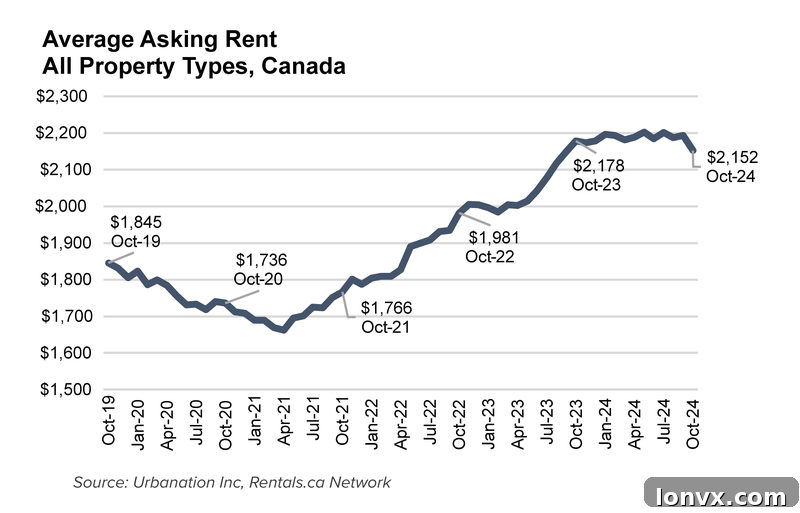
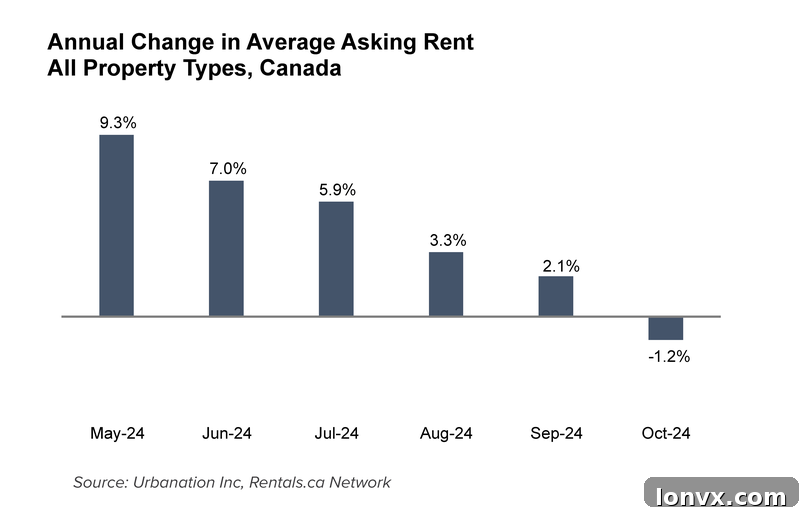
The Canadian residential rental market has reached a significant turning point, recording its first annual decline in average asking rents across all property types since July 2021. This notable shift, detailed in the latest comprehensive report from Rentals.ca and Urbanation, indicates a cooling trend that could offer much-needed relief to renters in specific regions.
According to the October 2023 report, the average monthly rent nationwide dropped by 1.2 percent compared to the previous year, settling at $2,152. This seemingly modest national figure masks a more complex story of divergent trends across Canada’s diverse urban and regional landscapes, with some areas experiencing significant price adjustments while others continue to see strong growth.
Major Urban Centers Lead the Rental Market Correction
The primary catalyst for this national decline is the substantial decrease in asking rents observed in several of Canada’s most populous and historically expensive cities. British Columbia and Ontario, provinces that have long been at the forefront of the country’s housing affordability crisis, are now seeing notable pullbacks in their rental markets.
Vancouver, often cited as one of the world’s least affordable cities, saw a significant year-over-year drop of 9.1 percent for one-bedroom units. Neighboring Burnaby, B.C., experienced an even steeper decrease, with a 9.4 percent decline in average asking rents. Toronto, Canada’s largest city and another hotspot for high rental costs, registered an 8.7 percent reduction. These declines in major metropolitan areas suggest a market adjustment, potentially influenced by increased supply, moderated demand, or a combination of factors.
The trend of decreasing rents is not confined to the West Coast and Ontario alone. Calgary, a bustling economic hub in Alberta, reported an annual decrease of 4.3 percent. Meanwhile, Montreal, Quebec’s largest city, also saw average asking rents fall by 4.6 percent year-over-year. These figures indicate a broader market recalibration extending across multiple key Canadian urban centers.
Expert Insights: Understanding the Market Reversal
Shaun Hildebrand, President of Urbanation, provided crucial context on this unprecedented development. “It is a rare occurrence for rents to decline at the national level. This is happening as the key drivers of rent growth in recent years—a strengthening economy, quickly rising population and worsening homeownership affordability—are beginning to reverse,” Hildebrand explained. His analysis points to a fundamental shift in the economic forces that have propelled rental costs skyward for an extended period.
The previously robust economy, while still resilient, has shown signs of cooling, which can impact employment and wage growth, thereby tempering rental demand. Furthermore, while Canada’s population continues to grow, the pace and composition of this growth, alongside evolving immigration policies, can influence specific segments of the rental market. Critically, the long-standing issue of worsening homeownership affordability, which pushed many into the rental market, might be easing slightly due to higher interest rates impacting mortgage qualification and property prices, or simply reaching a saturation point where rental price tolerance has been exceeded.
Hildebrand further emphasized the role of increasing housing supply, stating, “As a result, we can likely expect this trend for rents to continue in the near term, particularly as apartment completions remain at record highs.” A surge in new apartment completions, driven by aggressive construction in recent years, is finally adding significant inventory to the market, especially in larger cities. This increased supply, combined with a potential easing of demand, creates a more balanced market, putting downward pressure on prices.
Monthly Dynamics and Broader Market Volatility
Beyond the annual figures, the month-over-month trends also highlight the speed of this market adjustment. Average asking rents experienced a 1.9 percent decrease in October alone. This monthly decline further underscores the current market momentum. Looking at the bigger picture, current average rents are down 9.3 percent from the peak annual increase recorded in May, indicating a consistent downward trajectory over recent months. This volatility suggests a dynamic market that is quickly responding to changing economic conditions and housing supply levels.
Smaller Markets Experience Surges in Rental Costs
While the larger, more established urban centers are witnessing declines, a contrasting trend is unfolding in traditionally more affordable and smaller markets across Canada. These regions are experiencing significant annual increases in asking rents, suggesting a spillover effect or independent local demand drivers.
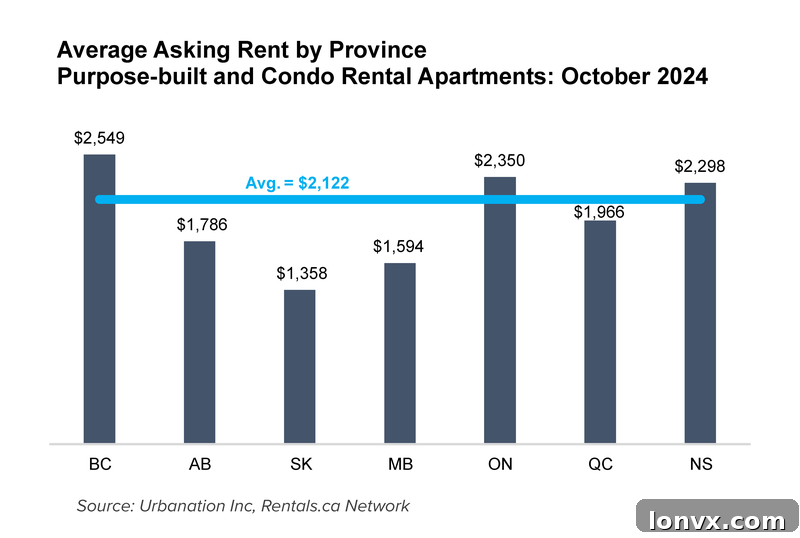
Saskatchewan, for instance, registered an impressive 17.1 percent year-over-year increase in apartment rents in October, pushing the average to $1,358. Despite this substantial jump, the average rent in Saskatchewan remains considerably below the national average, indicating its continued relative affordability compared to provinces like Ontario or British Columbia. This growth could be attributed to a strengthening local economy, internal migration from more expensive provinces, or a delayed reaction to national trends.
Similarly, Nova Scotia saw asking rents for apartments rise at the second-fastest pace provincially, with a 9.6 percent increase year-over-year, reaching an average of $2,298. This surge in Atlantic Canada reflects the ongoing popularity of the region, which has attracted new residents and investment, leading to increased demand for housing. The average rent in Nova Scotia is now even slightly above the national average, highlighting the rapid escalation of costs in certain smaller, desirable markets.
Rent Decreases Varied by Unit Type and Region
The rental market’s adjustments are also nuanced when broken down by unit type and provincial location, revealing that not all apartment configurations are affected equally.
- British Columbia: One-bedroom apartment units experienced the most significant decline, falling 4.9 percent annually to an average of $2,254. This suggests a potential saturation or reduced demand for smaller units in BC’s major urban centers.
- Ontario: In contrast, two-bedroom units saw the largest annual decrease in apartment rents, dropping by 6.9 percent to an average of $2,583. This could reflect a softening in the family or shared-living market segment, or a greater availability of new two-bedroom units.
- Quebec: Declines in apartment rents were primarily concentrated in one-bedroom units, which decreased by 3.2 percent year-over-year, settling at an average of $1,681. This mirrors the trend seen in British Columbia, indicating similar demand and supply dynamics for smaller units in Quebec’s major cities.
Interestingly, across most provinces, three-bedroom apartments demonstrated resilience, faring best in this downturn. These larger units either experienced the smallest rent declines or, in some cases, the largest increases. This could be attributed to their relative scarcity, strong demand from families, or their appeal for shared living arrangements that help mitigate high overall costs.
Implications for Renters, Landlords, and the Future Outlook
This national rent decline represents a critical development for Canada’s housing landscape. For renters in major cities, it offers a glimmer of hope and potentially more negotiating power, although prices remain high compared to historical averages. The market is slowly shifting from a landlord’s market to a more balanced one in these areas. Renters looking for better value might find it in larger cities, while those seeking affordability might still consider the growing smaller markets.
For landlords and property investors, these trends necessitate a re-evaluation of strategies. While the aggressive rent growth of previous years may be moderating, understanding regional and unit-specific demand will be key to optimizing rental income and occupancy rates. Investing in smaller markets with growing populations or focusing on resilient unit types like three-bedroom apartments might become more appealing.
Looking ahead, the rental market is expected to remain dynamic. Factors such as interest rate policies by the Bank of Canada, immigration levels, and the pipeline of new housing completions will continue to shape future rent trends. While the current decline offers a momentary respite, the long-term trajectory will depend on a complex interplay of economic, demographic, and policy-related forces. The October report from Rentals.ca and Urbanation clearly signals that the era of relentless rent increases across the board may be giving way to a more differentiated and, in some areas, more tenant-friendly market.
Enjoying this article?
Get the latest REM articles in your inbox 3x week so you stay up to date on the latest in the Canadian real estate industry