
Canadian Housing Market: Navigating the Turnaround and Future Outlook
The Canadian housing market is poised for a significant shift, with 2023 expected to mark the beginning of a turnaround following a period of correction. According to the latest insights from the Canadian Real Estate Association (CREA) and observations by RBC’s Assistant Chief Economist Robert Hogue, the landscape is evolving, driven by changing interest rate dynamics and persistent affordability challenges. While a full recovery may not be immediate, the market appears to be moving away from the intense uncertainty of the past year, offering a glimpse into a more stable, albeit complex, future for homeowners, buyers, and sellers across the nation.
CREA’s updated resale housing market forecast highlights a stabilization in national home sales since the summer, suggesting that the initial shock of rising interest rates and high economic uncertainty may have largely subsided. This emerging stability forms the cornerstone of the forecast, painting a picture of a market finding its footing after a turbulent period. However, this stability does not translate to uniform performance across the country, as regional variations in home prices continue to be a defining characteristic of the current market.
The Shifting Landscape: From Correction to Cautious Optimism
While the overall trend points towards stabilization, the performance of home prices across Canada remains distinctly mixed. More expensive markets, particularly within Ontario and British Columbia, have experienced a noticeable cooling in prices, reflecting the heightened sensitivity of these regions to interest rate hikes and affordability constraints. Conversely, provinces like Alberta, Saskatchewan, and Newfoundland and Labrador have demonstrated remarkable resilience, with home prices holding up well. Quebec and the Maritime provinces find themselves in a middle ground, experiencing more moderate adjustments. This divergence underscores the importance of a regional perspective when assessing the broader Canadian housing narrative.
Despite these recent adjustments, CREA emphasizes that current home prices, while down from their peak in February 2022, remain comfortably above the levels observed in the summer of 2020. This indicates that much of the pandemic-era gains, particularly the rapid appreciation seen in 2020 and 2021, have not been entirely erased. The market is not experiencing a return to pre-pandemic norms but rather a recalibration that maintains a higher baseline. The report articulates this nuanced outlook clearly: “With the shock from the Bank of Canada’s efforts to control inflation fading, and uncertainty about the path for housing markets and where borrowing costs will ultimately land also likely to wind down over the next few months, the theme of our 2023 forecast is not recovery, but the start of a turnaround.” This statement encapsulates the sentiment of cautious optimism, suggesting that while the worst of the market correction may be behind us, the path to sustained growth will be gradual and measured.
Interest Rates: The Unwavering Influence on Buyers and Market Dynamics
Interest rates continue to be a dominant factor shaping the accessibility and dynamics of the Canadian housing market. The national association anticipates that current mortgage rates will persist in posing significant challenges, particularly for many first-time buyers looking to enter the market. The elevated cost of borrowing directly impacts affordability, increasing monthly mortgage payments and often pushing homeownership out of reach for a substantial segment of the population, even for those with stable incomes.
However, CREA also forecasts a potential shift as buyers gain more certainty regarding the trajectory of interest rates. This certainty could stem from the Bank of Canada signaling a pause in rate hikes, or clearer indications about future monetary policy. Once prospective buyers have a more predictable outlook on borrowing costs, some pent-up demand is expected to be unleashed. This increased clarity would empower individuals to make more informed financial decisions, potentially leading to a gradual increase in market activity. The psychological barrier created by interest rate volatility is a powerful deterrent, and its reduction could play a crucial role in re-energizing buyer confidence. For first-time buyers, this period of stabilization might present an opportunity to plan more effectively, even if the absolute cost of borrowing remains higher than in recent years.
CREA’s 2023 Forecast: A Year of Stabilization and Price Adjustment
CREA’s specific predictions for 2023 underscore a year of stabilization rather than dramatic swings. The association anticipates that approximately 495,858 properties will change hands through the MLS system nationwide. This figure represents a modest 0.5 percent decline compared to 2022, indicating that the significant drop in sales volume experienced in the latter half of last year is largely over, and the market is settling into a new rhythm. While still a decline, the marginal percentage suggests a strong deceleration in the downward trend, reinforcing the idea of a market finding its floor.
Regarding pricing, the national average home price is projected to see a 5.9 percent decline in 2023, settling around $662,103. It’s crucial to understand the context of this forecast. CREA points out that a substantial portion of this predicted decline has already occurred throughout 2022. The record-setting start to that year, characterized by exceptionally high prices in early 2022, will statistically weigh down the annual average for 2023, even if prices stabilize or see modest gains later in the year. In essence, the year-over-year comparison reflects the sharp correction from peak levels rather than an ongoing freefall. The market is not expected to reach anywhere near those record 2022 levels in the current year, signifying a return to more sustainable pricing models that may alleviate some affordability pressures for certain buyer segments.
Addressing Affordability: RBC’s Perspective on Market Bottoming
Robert Hogue, Assistant Chief Economist at RBC, offers a complementary perspective, emphasizing the persistent challenge of affordability and its impact on the market’s recovery trajectory. In RBC’s monthly market update, Hogue notes that while sales are gradually stabilizing across most regions of the country, price stabilization may take a little longer to materialize. This suggests a lag effect, where transactional activity begins to find a base before prices fully adjust and firm up.
The MLS Home Price Index for Canada, a key measure of price trends, experienced its tenth consecutive monthly decline in December. Hogue anticipates that this downward slide will likely continue until at least the spring, primarily due to the ongoing issue of poor affordability. High interest rates coupled with still elevated home prices mean that the cost of homeownership remains a significant barrier for many potential buyers, thus exerting continued downward pressure on prices. However, Hogue also projects that the pace of price declines will gradually ease. This moderation is attributed to more stable demand-supply conditions, implying that the market is not being flooded with new listings, nor is demand completely collapsing. As indications of a market bottom become clearer, Hogue expects to see more sellers making their way to the market. This could be driven by reduced uncertainty, allowing those who have been holding off to proceed with their plans, knowing that the worst of the price adjustments might be over.
The Cyclical Low Point: A Gradual Path to Recovery
With the market’s cyclical low point now appearing to be within sight, Robert Hogue forecasts a recovery that will be gradual in its initial stages. The persistent challenges of high-interest rates and pervasive affordability concerns are expected to remain significant hurdles for prospective buyers throughout 2023 and potentially extending into the following year. These factors will likely temper market activity, preventing any rapid surge in demand or dramatic price increases immediately following the bottoming out. The recovery will not be a sharp rebound but rather a slow, steady climb.
Despite these short-term headwinds, a crucial long-term driver for the Canadian housing market remains population growth. Canada’s sustained immigration targets and increasing population are fundamental forces that will continue to fuel housing demand. As the population expands, the inherent need for housing will inevitably grow, acting as a natural stimulant for market activity over time. This demographic pressure is a powerful underlying factor that provides a degree of resilience to the market, even amidst current affordability stresses. While immediate growth may be constrained, the long-term outlook for increased market dynamism remains positive, supported by this demographic reality.
Glimpsing 2024: CREA’s Outlook for Renewed Growth
Looking further ahead, CREA’s projections for 2024 paint a more optimistic picture, signaling a clearer path towards recovery and renewed growth for the Canadian housing market. The association forecasts a substantial rise in sales activity, with a projected increase of 10.2 percent, reaching approximately 546,625 units. This significant rebound indicates a belief that markets will continue their return to more normalized conditions, driven by improved affordability, increased buyer confidence, and potentially more favorable interest rate environments.
In parallel with rising sales, the national average home price is also expected to embark on a moderate recovery. CREA anticipates a 3.5 percent increase from 2023 to 2024, pushing the average price to around $685,056. While this figure remains below the peak levels recorded in 2022, it is notably on par with prices observed in 2021. This moderate recovery suggests that while the market is strengthening, it is doing so in a sustainable manner, avoiding the kind of speculative surges seen in previous boom periods. The combination of increased sales volume and modest price appreciation points to a healthier, more balanced market entering 2024, offering more predictable conditions for all participants.
Conclusion: A Resilient Market Poised for Evolution
The Canadian housing market stands at a fascinating juncture, transitioning from a period of significant correction to the promising start of a turnaround. While 2023 is set to be a year of stabilization and adjustment, characterized by persistent affordability challenges and the ongoing influence of interest rates, the outlook for 2024 is decidedly more optimistic. The resilience of regional markets, coupled with Canada’s underlying demographic strengths, underscores a fundamental demand that will continue to shape the real estate landscape. As uncertainty gradually recedes and market conditions normalize, the Canadian housing market is poised for an evolutionary phase, balancing growth with the imperative of long-term sustainability.
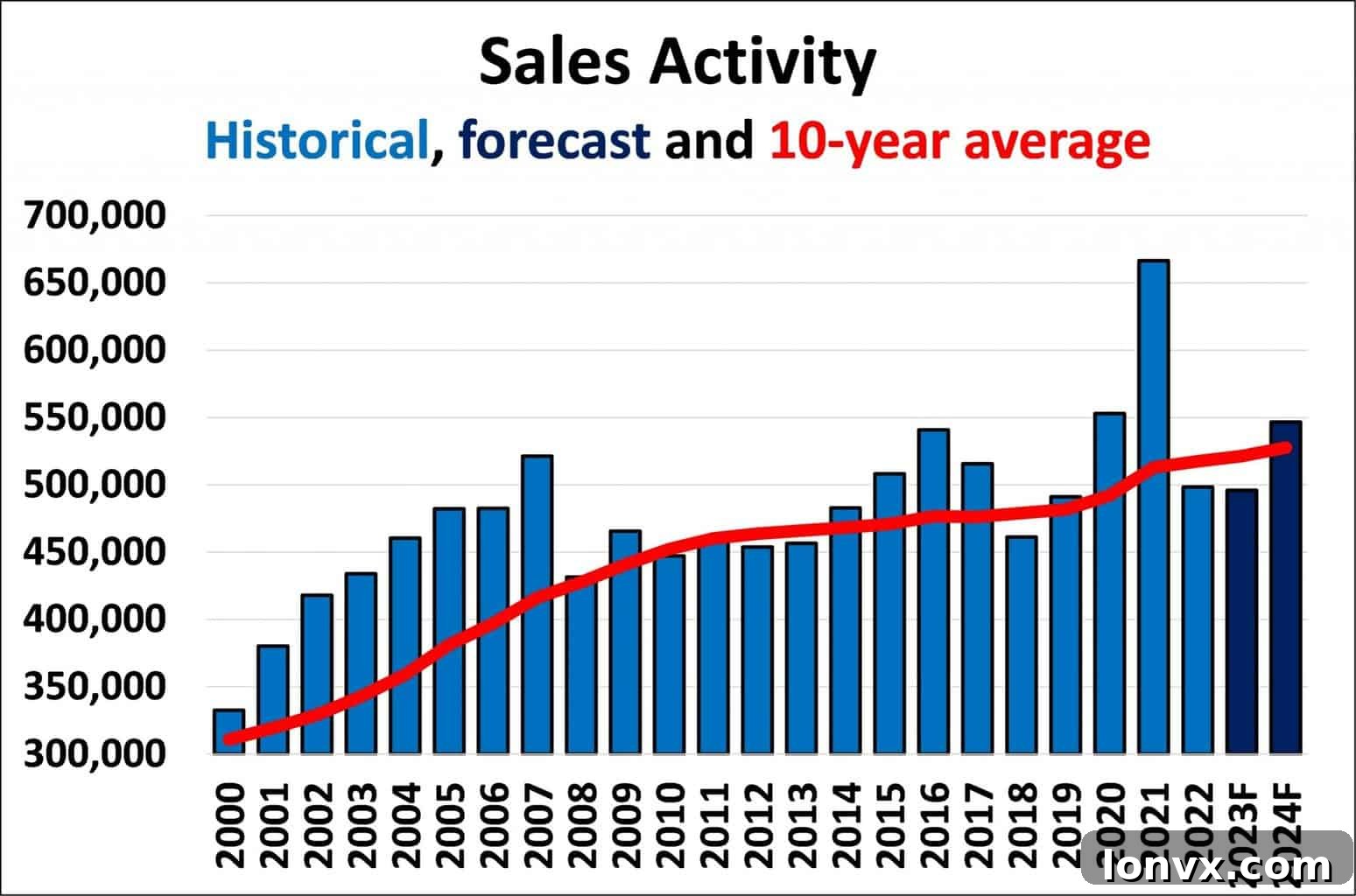
Source: Canadian Real Estate Association