
Navigating the Shifting Tides: A Deep Dive into Canada’s Housing Market Forecast
The Canadian housing market continues to be a central topic of discussion, with recent analyses from TD Economics indicating a more pronounced and extended downturn in home sales and average prices than initially projected. This revised outlook, stemming from a comprehensive report, paints a detailed picture of the challenges and opportunities ahead for prospective buyers, sellers, and policymakers across the nation.
The updated forecast suggests that the market will experience further adjustments, building on the significant shifts observed over the past year. Understanding the underlying drivers of these changes is crucial for anyone involved in the Canadian real estate landscape.
Canadian Home Prices and Sales Projected for Further Decline
According to TD Economics, Canadian home prices and sales are anticipated to recede further from their Q2 levels throughout the final quarter of this year (Q4) and into the early months of next year. Specifically, prices are expected to decline by 6 percent, while sales volumes are projected to fall by 8 percent. This represents a significant adjustment, reflecting a confluence of factors influencing market dynamics.
At the core of this anticipated decline are several key elements: evolving population changes and a much-needed increase in housing supply, following a prolonged period of historically low inventory levels. These structural changes are beginning to exert downward pressure on a market that has seen unprecedented growth in recent years, prompting a necessary rebalancing.
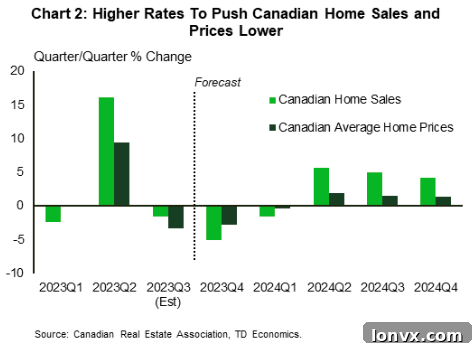
It is important to contextualize this expected downturn within the broader historical perspective. The current projections, while notable, do not mirror the dramatic drops experienced between Q1 2022 and Q1 2023, when prices plummeted by 20 percent and sales volumes by an astonishing 40 percent. That earlier, sharper correction was largely a direct consequence of the Bank of Canada’s aggressive interest rate hikes, implemented to combat soaring inflation. The current forecast suggests a more moderated, albeit extended, period of adjustment rather than a precipitous fall.
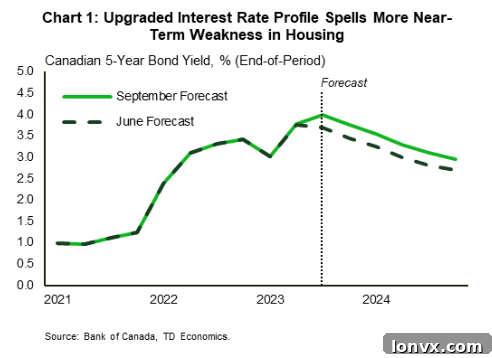
Looking ahead, there is a glimmer of hope on the horizon. TD Economics anticipates that the Bank of Canada will conclude its rate-hiking cycle and begin to lower its policy rate starting from Q2 of next year. This potential shift in monetary policy is expected to play a pivotal role in stabilizing and eventually revitalizing the housing market.
Key Drivers for a Potential Housing Market Rebound in Q2 2024
As the Canadian housing market navigates its current challenges, several powerful economic forces are expected to converge and potentially fuel a recovery beginning in the second quarter of 2024. Foremost among these is the anticipated decline in Canadian bond yields from their current multi-year peaks by the end of this year. Lower bond yields typically translate into more attractive mortgage rates, significantly improving affordability for prospective homebuyers.
Beyond interest rate adjustments, TD Economics highlights two other critical factors: robust population growth and a persistently tight job market. Canada’s sustained immigration levels continue to drive demand for housing across all segments, placing fundamental upward pressure on the market. Simultaneously, a strong employment landscape provides the financial stability necessary for individuals and families to enter or re-enter the housing market, underpinning consumer confidence and purchasing power.
The combined effect of easing interest rates, a growing population, and a resilient job market is expected to help elevate home prices and sales activity from Q2 next year onwards. However, it’s crucial to temper expectations regarding the pace of this recovery. The increase is likely to be slower-paced in most markets, primarily due to persistent affordability challenges that will continue to constrain buyers. We may not see national home sales consistently surpass pre-pandemic levels until at least 2025, indicating a gradual, rather than rapid, return to previous highs.
Regional Market Dynamics: A Mixed Outlook Across Canada
The Canadian housing market is not monolithic; regional variations are significant and are expected to become even more pronounced in the coming months. TD Economics offers specific speculations for different provinces, reflecting their unique economic conditions and market fundamentals.
Provinces Facing the Strongest Headwinds
The highest price drops and sales declines in the near term are anticipated in Ontario and British Columbia. This trend is a continuation of what has been observed since the Bank of Canada began its series of rate hikes in June. These provinces, characterized by some of Canada’s most expensive housing markets, are particularly sensitive to interest rate fluctuations and affordability constraints. Buyers in these regions face substantial hurdles, including elevated borrowing costs and high entry prices, leading to a more significant market correction.
Similarly, smaller but still noticeable decreases are likely to occur in Quebec, Nova Scotia, New Brunswick, and Prince Edward Island. While these markets may not experience the dramatic shifts seen in Ontario and BC, they are not immune to the broader national trends of rising interest rates and tightening credit conditions. TD Economics predicts that each of these provinces should see a limited bump in prices and sales by mid-2024, indicating a modest recovery rather than a robust rebound. A critical concern highlighted is that, throughout the next few quarters, affordability in every market except New Brunswick is projected to hover near record lows, harking back to levels not seen since 1988. This dire affordability situation will continue to be a significant barrier to widespread market recovery.
Provinces Showing Resilience and Growth
In stark contrast, Newfoundland and Labrador and the prairie provinces (Alberta, Saskatchewan, and Manitoba) are projected to experience a more positive trajectory, with prices and sales likely to rise during the same period. This divergence is primarily attributable to better relative affordability in these regions. Housing costs in the prairies and Atlantic Canada are generally lower compared to Ontario and British Columbia, making them more accessible for homebuyers even with higher interest rates.
Further bolstering the positive outlook for the prairies, sales-to-listings ratios have been climbing in favor of sellers since early 2023. This indicates a tightening market where demand is increasingly outpacing supply, leading to competitive conditions and upward pressure on prices. For instance, as of August, Newfoundland and Labrador’s sales-to-listings ratio was an impressive 30 percent higher than its long-term average, signifying a robust seller’s market. Alberta, in particular, has seen a substantial influx of migrants from other provinces, attracted by its economic opportunities and comparatively affordable housing, significantly contributing to its elevated market activity.
Broader Economic Influences and Future Outlook
Beyond regional specifics, the overall health of Canada’s economy will continue to cast a long shadow over the housing market. A weaker-than-expected national economy is likely to negatively affect demand, potentially leading to increased “forced selling” by homeowners facing financial difficulties. This scenario could further depress prices and create an overall negative housing outlook, despite some localized bright spots.
Furthermore, the future trajectory of interest rates remains a critical variable. Should inflation persist at higher-than-expected levels, the Bank of Canada might be compelled to maintain higher policy rates for a longer duration than currently forecasted. Such a scenario would undoubtedly prolong affordability challenges and dampen the pace of recovery in the housing market.
Conversely, the persistent issue of housing shortages continues to be a structural challenge. Even with potential market corrections, Canada’s population continues to grow at a healthy pace, driven by strong immigration targets. This sustained population growth, coupled with insufficient new housing construction in many urban centers, implies that housing shortages will likely persist. In the long run, this fundamental imbalance between supply and demand could exert upward pressure on prices, potentially raising them higher than anticipated once the current period of adjustment passes.
Conclusion: A Complex and Evolving Landscape
The Canadian housing market is currently navigating a complex and dynamic period. While the immediate forecast points towards a continued slowdown in sales and prices, particularly in high-cost provinces, the underlying economic currents suggest a potential stabilization and gradual recovery from Q2 2024. This recovery hinges on the Bank of Canada’s monetary policy, the continued strength of the labor market, and Canada’s robust population growth.
However, significant headwinds remain, primarily related to persistent affordability challenges and the overall health of the national economy. Regional disparities will be a defining feature of the market, with more affordable provinces like those in the prairies and Atlantic Canada potentially outperforming others. Stakeholders in the Canadian real estate sector must remain agile and well-informed, adapting to an evolving landscape shaped by both domestic economic policy and global financial trends.
For a more detailed analysis, readers are encouraged to consult the full outlook from Rishi Sondhi here.