
Canadian Housing Market Mid-Year Review: Stability Amidst Shifting Demographics and Regional Divergence
The first half of the year has painted a nuanced picture for Canadian housing prices, with the price per square foot generally holding steady across the nation. However, beneath this surface of stability, significant trends are emerging, most notably a pronounced shift by families seeking more affordable communities. This migration pattern extends both to nearby suburban areas and across provincial borders, as revealed by Century 21 Canada’s eighth annual Price per Square Foot survey. This comprehensive report, comparing prices in nearly 50 communities from January 1 to June 30, not only captures current market dynamics but also provides valuable insights into data trends dating back to 2018, encompassing both bustling urban centers and quieter, smaller communities. The consistent methodology of this survey makes it an indispensable tool for understanding the evolving landscape of Canadian real estate.
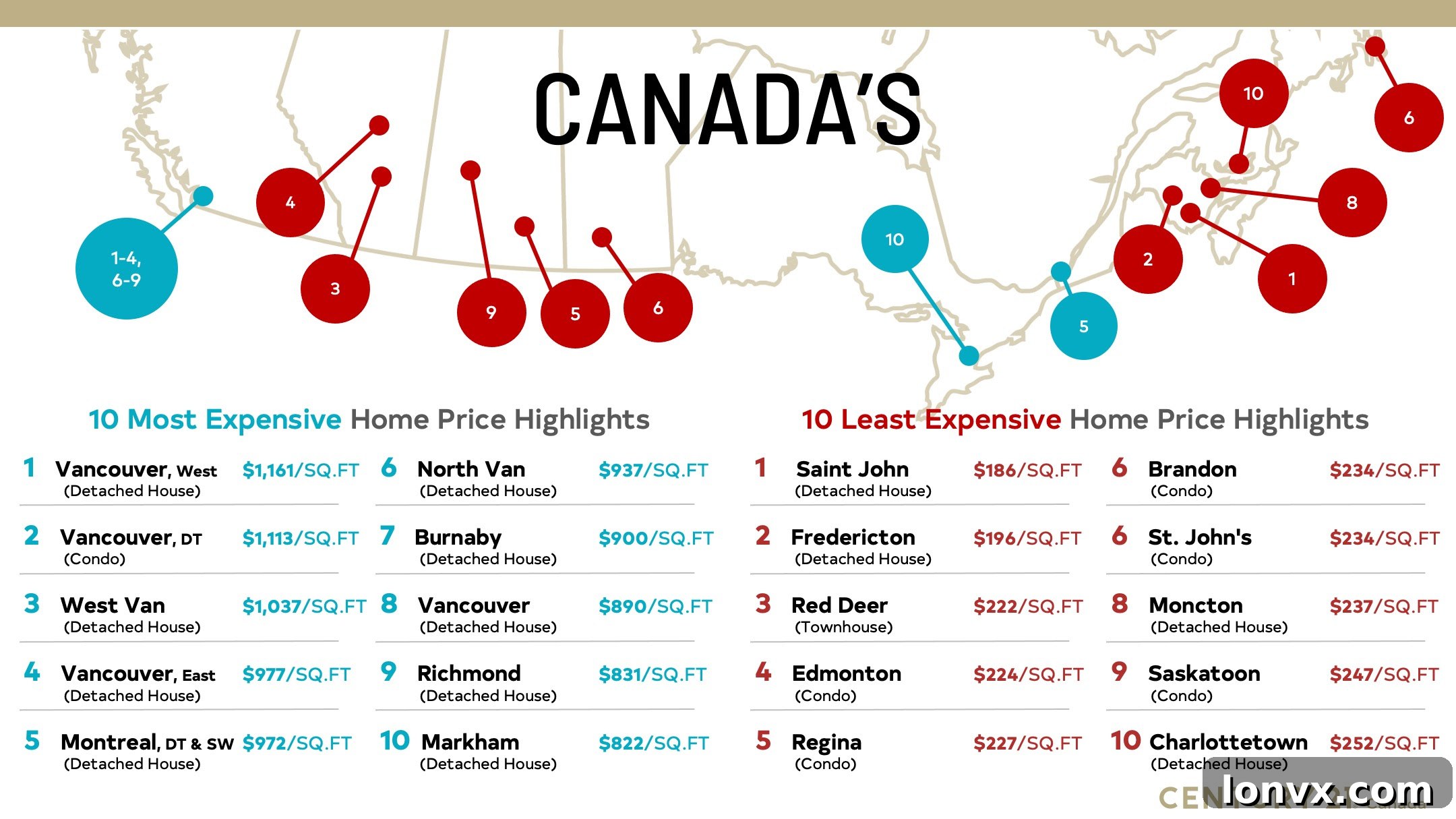
Understanding the Price Per Square Foot Metric
The “price per square foot” (PPSF) is a critical metric in real estate, offering a standardized way to compare property values regardless of size. It provides a more accurate representation of how much buyers are paying for space itself, rather than just the overall sticker price of a home. This is particularly useful when comparing different housing types (like condos versus detached homes) or properties in diverse locations. By focusing on PPSF, the Century 21 survey helps to cut through the noise of fluctuating list prices and reveals the true underlying value trends in various Canadian markets. A rising PPSF indicates increasing demand for available space, while a decline suggests either an increase in inventory, a decrease in demand, or a shift towards properties with lower square footage costs.
Regional Dynamics: Diverging Trends Across Provinces
Canada’s vast geography and diverse economies mean that housing market trends are rarely uniform. The latest survey highlights distinct regional narratives, shaped by local economic conditions, population movements, and varying affordability levels.
Stability and Suburban Growth in Ontario, British Columbia, and Atlantic Canada
In traditionally robust markets such as Ontario, British Columbia, and Atlantic Canada, the first half of 2024 largely saw a continuation of steady housing prices. However, a closer look reveals an important internal migration: significant gains were observed in smaller markets and suburban areas surrounding major metropolitan hubs. This trend underscores a broader movement away from the high costs and perceived congestion of urban cores. Families, often seeking more space for their money, better school districts, and a quieter lifestyle, are increasingly looking beyond city limits.
Conversely, downtown condominium prices in these regions experienced a decline. This dip signals a continued migration away from metropolitan cores, a trend that gained momentum during the pandemic but appears to be sustained by persistent affordability challenges and a growing preference for more spacious living environments. The demand for urban living, while still present, is being tempered by economic realities and lifestyle choices, pushing buyers towards areas where their housing dollar stretches further. This has created a bifurcated market where suburban and exurban areas are appreciating, while dense urban centers are experiencing some price adjustments.
Alberta’s Ascent: Significant Gains in Calgary and Edmonton
In stark contrast to the moderate movements in other parts of the country, Alberta’s major markets, particularly Calgary and Edmonton, witnessed significant price jumps. These robust increases reflect a growing confidence in Alberta’s economy, driven by strong energy prices and interprovincial migration. Many Canadians, facing prohibitive housing costs in Ontario and British Columbia, are finding Alberta’s comparatively lower prices highly attractive. This influx of new residents, coupled with a resilient job market, has fuelled demand and pushed up prices per square foot.
Despite these notable gains, it’s crucial to note that prices per square foot in Alberta still remain below those found in the more expensive markets of British Columbia, Quebec, and Ontario. This relative affordability continues to draw buyers, positioning Alberta as a key destination for those seeking value without compromising on economic opportunity. The province’s growing appeal as an affordable alternative is a major factor shaping its current housing trajectory.
Moderate Increases Across the Prairies
Beyond Alberta, the other Prairie provinces also experienced price increases, albeit at a more moderate pace. This steadier growth reflects a stable, albeit less frenetic, market driven by local demand and consistent economic activity. These regions typically offer greater affordability than the national average, making them attractive for those looking for sustainable homeownership opportunities without the intense competition seen in larger urban centers. The consistent, gradual appreciation indicates a healthy, balanced market without the speculative pressures observed elsewhere.
The Evolving Landscape of Major Condominium Markets
Condominiums, often seen as an entry point into homeownership or a choice for urban dwellers, have also shown varied performance across Canada’s key markets.
Alberta’s Condo Boom: Calgary, Edmonton, and High River Lead the Way
Alberta’s upward trend was particularly evident in its condominium sector. Calgary condominium prices surged by over 17 per cent, while Edmonton saw an increase of nearly 10 per cent. These figures underscore the robust demand for more affordable housing options within these growing cities. The town of High River, located south of Calgary, topped all increases with a remarkable jump of more than 22 per cent in condo prices. Despite this rapid appreciation, High River remains exceptionally affordable at $285 per square foot, making it an attractive option for commuters and those seeking a lower cost of living while still benefiting from proximity to a major urban centre. This dramatic rise in High River exemplifies the broader trend of buyers looking for value in secondary markets.
Modest Dips in Traditional Powerhouses: Vancouver, Toronto, and Montreal
In contrast, Canada’s most expensive condominium markets—Vancouver, Toronto, and Montreal—experienced modest dips in price per square foot. These minor corrections could be attributed to several factors, including heightened interest rates impacting buyer affordability, increased inventory levels, and a general cooling of the highly competitive conditions seen in recent years. While these declines are modest and prices remain elevated compared to historical averages, they suggest a recalibration of buyer expectations and potentially a brief respite from the relentless price escalation that has characterized these cities. Buyers in these markets are exercising more caution, creating a more balanced environment for transactions.
Historical Perspective: Resilience Amidst Shifting Tides
Despite some recent declines and market adjustments, the survey provides a reassuring historical context: pricing has not fallen below 2021 levels in any market. This demonstrates the underlying resilience of the Canadian housing market, which, even with fluctuations, has maintained significant value appreciation over the past few years. However, this stability in price does not tell the whole story. Sales volumes across Canada have notably declined from the exceptionally high levels seen in 2021 and 2022, a trend particularly pronounced in larger cities. This slowdown in transactional activity reflects a shift from a frenzied seller’s market to a more cautious environment.
“A number of our brokers are experiencing a slower market when compared to the conditions of just two years ago,” says Todd Shyiak, executive vice president of Century 21 Canada. This sentiment highlights the psychological shift among both buyers and sellers, who are now navigating a market that demands more patience and strategic thinking.
Navigating the Future: Inventory, Interest Rates, and Buyer Sentiment
The outlook for the latter half of the year remains subject to critical economic factors and evolving buyer behavior.
The “Wait and See” Approach: GTA and Lower Mainland
According to Shyiak, while markets across the Prairies and Atlantic provinces are currently quite active and balanced, the situation is different in the Greater Toronto Area (GTA) and the Lower Mainland (Vancouver and surrounding areas). Here, increasing inventory and hesitant buyers are fostering a “wait and see” market. Potential buyers, facing high interest rates and significant property values, are pausing their decisions, hoping for more favourable conditions or clearer market signals. This cautious approach is contributing to higher inventory levels, giving buyers more choice but also prolonging the sales process for sellers.
The Impact of Potential Rate Adjustments
A significant factor influencing this hesitation is the anticipation of future interest rate adjustments. With the next possible rate cut potentially coming on July 24, many buyers may be extending their “wait and see” approach until the fall. A reduction in interest rates could significantly improve affordability, making mortgages more accessible and potentially reigniting buyer demand. Conversely, if rates remain high or increase further, it could solidify the current cautious sentiment and further slow down market activity in these key regions.
Key Determinants: Inventory and Interest Rates
Shyiak explains that inventory levels and interest rates will likely be the major factors influencing future prices across the country. A healthy housing market requires a balance between supply and demand. If inventory continues to increase without a corresponding rise in buyer confidence (perhaps driven by lower rates), it could put downward pressure on prices. Conversely, a decrease in inventory combined with an interest rate cut could quickly reignite competition and lead to price appreciation. These two variables are in constant interplay, shaping the market’s direction.
Beyond the Numbers: Understanding the Big Picture
Understanding the Canadian housing market requires more than just looking at a single year’s data; it demands a broader, long-term perspective. While short-term fluctuations can cause anxiety, it’s essential to consider each data point within the larger context of Canada’s ever-evolving demographic and economic trends. Factors such as continued population growth, immigration levels, and the ongoing demand for housing contribute to the fundamental strength of the market over time. The persistent quest for affordability, combined with the desire for homeownership, continues to drive activity, albeit in cycles of varying intensity.
“Ultimately, we don’t know what the next six months holds for our housing prices, but it’s important not to get too focused on any single year and look at each data point within the larger context of ever-evolving trends. That’s why this survey becomes more valuable year-over-year, because it allows us to see the big picture of Canadian housing.”
This annual survey, therefore, serves as a crucial compass, helping stakeholders—from first-time homebuyers to seasoned investors and policymakers—to navigate the complex and dynamic landscape of Canadian real estate. It highlights that while regional differences and short-term challenges exist, the underlying drivers of demand remain robust, pointing to a resilient market capable of adapting to changing economic conditions.
Conclusion: A Dynamic and Adaptive Market
The first half of 2024 has shown that the Canadian housing market is both stable and dynamic. While national price per square foot figures indicate general resilience, the underlying movements reveal a market adapting to new economic realities and buyer preferences. The shift towards more affordable communities, the regional variations in price growth, and the cautious approach in major urban centers all point to an intricate market influenced by interest rates, inventory, and evolving lifestyle choices. As we move into the latter half of the year, these factors will continue to shape the trajectory of Canadian housing, demanding close attention to both micro and macro trends to understand where the market is truly headed.
For a detailed analysis and regional summaries, review the full report here.