Mastering Real Estate Marketing: The Essential Blend of Print, Digital, and Referrals
In today’s hyper-digital landscape, the conversation around real estate marketing often centers on the latest online trends, social media algorithms, and sophisticated analytics. Yet, a fascinating paradox persists: traditional print marketing tools like business cards, flyers, postcards, and lawn signs remain indispensable assets for real estate professionals. This raises a crucial question: why do these tangible elements continue to hold their ground, even when their direct return on investment (ROI) isn’t always as transparent as digital campaigns? A revealing survey by WebsiteBox, conducted in November 2014 among 369 real estate professionals across the United States and Canada, shed light on this intriguing dynamic, offering insights that remain highly relevant to modern real estate strategies.
The Enduring Power of Print in a Digital Age
The survey initially suggested that print marketing tools generated fewer direct sales leads compared to their online counterparts. This finding might lead some to conclude that print is an outdated relic. However, the story is far more nuanced. As Peyman Aleagha, CEO and founder of WebsiteBox, aptly highlighted, agents intuitively understand – and correctly so – that print marketing serves as a powerful catalyst, driving local traffic to their websites and delivering valuable sales leads directly into email inboxes. This underlying connection underscores print’s role not as a standalone marketing channel, but as a foundational element that enhances and supports digital efforts, particularly within a local context where a physical presence still carries significant weight.
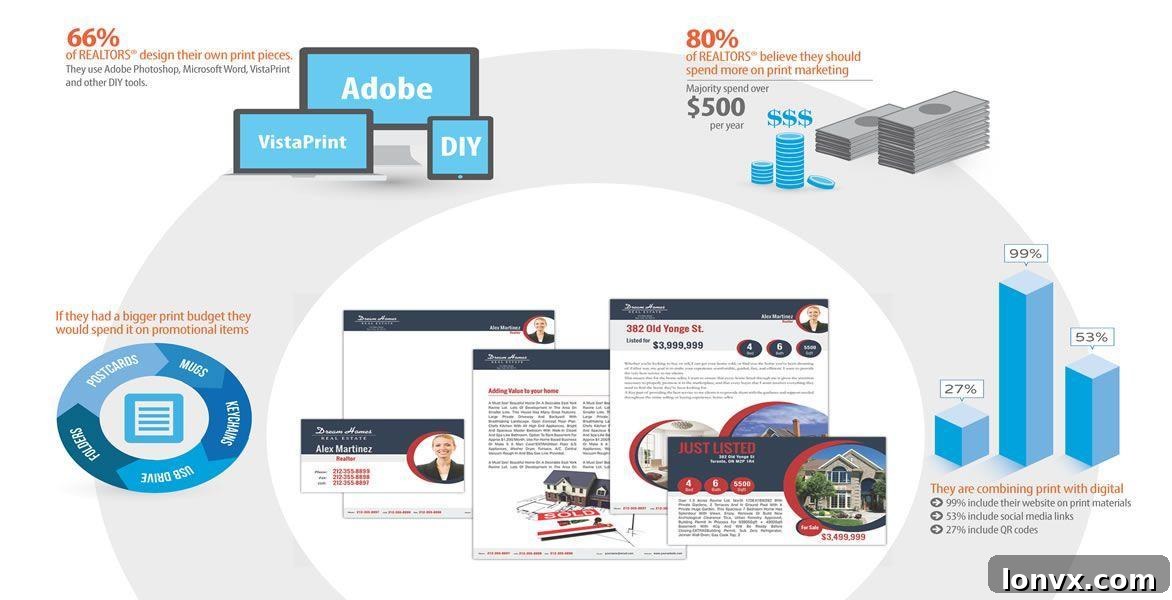
The strategic integration of print and digital is further evidenced by the survey’s findings: a staggering 99 percent of respondents consistently include their website addresses on all print marketing materials. Furthermore, over half (54 percent) leverage print to promote their social media presence, incorporating platforms like Facebook or Pinterest. This proactive approach demonstrates a clear understanding among agents that print acts as a bridge, guiding potential clients from a tangible interaction to their comprehensive online presence. It reinforces brand recognition and provides multiple pathways for engagement, ensuring that a potential client, having seen a lawn sign or received a flyer, knows exactly where to find more information digitally.
Unpacking the Survey Findings: Print vs. Digital Leads and the Reign of Referrals
The Lead Generation Landscape: A Closer Look
Despite the intuitive link between print and digital, the survey pointed to a disparity in direct lead attribution. Respondents reported that a mere 13 percent of their sales leads originated from traditional print promotions, significantly less than the 21 percent attributed to online marketing efforts. This apparent contradiction is often the source of debate and confusion for real estate professionals trying to optimize their marketing spend. Aleagha suggests this discrepancy might stem from a fundamental misunderstanding of how print works in concert with online marketing. Unlike a digital ad with trackable clicks and conversions, the journey from seeing a flyer to becoming a lead is often indirect and multi-faceted, making direct attribution challenging without robust tracking mechanisms.
Compounding this challenge is the fact that less than half (42 percent) of the survey respondents actively calculated the return on investment for their print marketing efforts. Without clear metrics, it becomes difficult to assess print’s true value, especially its role in brand building, local visibility, and driving traffic to digital platforms. This highlights a critical area for improvement: implementing better tracking and analytics, even for traditional channels, to gain a holistic view of marketing performance. Understanding the customer journey from first touchpoint, whether print or digital, to conversion is paramount for an optimized strategy.
The Undeniable Reign of Referrals: A Foundation for Success
Perhaps the most significant and often overlooked finding from the WebsiteBox survey was the enduring power of referrals. The survey revealed that an overwhelming 60 percent of real estate sales leads come from good old-fashioned referrals. This statistic serves as a powerful reminder that while marketing channels evolve, the human element of trust and personal recommendation remains the bedrock of the real estate industry. Effective marketing – both print and digital – doesn’t just generate direct leads; it also builds a strong brand, fosters positive relationships, and enhances an agent’s reputation, all of which contribute significantly to an increased flow of referrals.
Print materials, such as professionally designed business cards or branded stationery used in follow-up correspondence, play a crucial role in reinforcing professionalism and memorability, making an agent more referable. Similarly, a strong online presence cultivated through digital marketing can provide social proof and make it easier for satisfied clients to refer an agent. The synergy between a robust marketing strategy and a focus on client satisfaction is undeniable: successful marketing efforts create delighted clients who, in turn, become advocates, driving the most valuable leads of all.
Crafting Your Brand: Design, Spending, and Expanding Your Toolkit
DIY Design: Empowering Agents with Creative Control
The survey also delved into how agents produce their marketing materials. A significant majority – 66 percent – reported designing their own print pieces. This trend highlights the accessibility of modern graphics software packages, such as Adobe Photoshop, and user-friendly web-based tools like those offered by Vistaprint. Empowering agents to take control of their branding allows for quick adaptations, personalized touches, and cost savings on professional design services. The most frequently self-designed items included fundamental tools such as business cards, flyers, postcards, lawn signs, and letterhead – all essential for establishing a consistent and professional brand identity.
For information visit www.websitebox.com.
Investing in Visibility: Budgeting for Print Marketing
Despite the cost savings achieved through self-design, print marketing still represents a notable investment for many agents. The survey found that 60 percent of respondents typically spent more than $500 annually on print promotion. This figure underscores the perceived value of tangible marketing materials. Even more striking was the sentiment that agents felt they should be investing more: a sizable 80 percent expressed a desire to increase their print marketing budget. This indicates a strong belief in the effectiveness of print, suggesting that many agents recognize its potential but might be constrained by current budgetary allocations or uncertainty about optimal spending levels.
Smart budgeting for print involves not just allocating funds, but strategically deciding where those funds will yield the best results. This means considering the quality of materials, the target audience, and the specific goals of each print campaign. Investing in high-quality paper, professional printing, and impactful design can significantly enhance the perceived value of an agent’s brand. Rather than viewing print as a separate expense, it should be integrated into an overall marketing budget that supports both digital presence and tangible outreach, always with an eye on brand consistency and messaging.
Expanding Your Marketing Toolkit: Beyond the Essentials
When asked what they would prioritize if granted a larger print marketing budget, agents revealed a clear desire for expanded and more creative promotional items. Beyond increasing their order of staple items like postcards, they expressed interest in branded presentation folders – a sophisticated tool that enhances professionalism during client meetings and property showings. Furthermore, agents identified a wish to invest in promotional merchandise such as coffee mugs, key chains, and flash drives, all branded with their real estate information. These items serve a dual purpose: they are practical gifts that provide ongoing brand exposure and act as memorable tokens that keep an agent top-of-mind long after an initial interaction.
Branded promotional items contribute significantly to brand recall and positive association. Every time a client sips coffee from a branded mug or uses a branded key chain, the agent’s name and contact information are subtly reinforced. This continuous, low-pressure exposure can be invaluable in strengthening client relationships and encouraging future referrals. These items transform a transactional interaction into a relationship-building opportunity, extending the agent’s presence beyond the point of sale and into the daily lives of their clients and potential clients.
Integrating Strategies for Modern Real Estate Success
The WebsiteBox survey, though conducted a few years ago, offers timeless insights into the complex yet interconnected world of real estate marketing. It challenges the notion that digital marketing has rendered traditional print obsolete, instead advocating for an integrated approach. The most successful real estate professionals understand that print and digital are not competitors but complementary forces. Print excels at local visibility, tangibility, and directing initial interest, while digital offers broad reach, precise targeting, and measurable engagement. When strategically combined, they create a robust, multi-channel marketing ecosystem that reaches clients wherever they are, both online and offline.
Ultimately, the key to unlocking maximum marketing potential lies in developing a cohesive strategy that leverages the unique strengths of each channel. This means designing print materials that seamlessly guide prospects to online resources, using digital campaigns to reinforce messages seen in print, and always prioritizing exceptional client service that naturally generates invaluable referrals. By continuously analyzing performance, adapting to market trends, and embracing a holistic view of marketing, real estate agents can build powerful brands that resonate with clients and drive sustained growth.
Enhance Your Strategy with Expert Resources
To further assist real estate professionals in navigating this blended marketing landscape, WebsiteBox offers a valuable resource: a free ebook titled Real Estate Print Marketing for the Digital Age. This guide is specifically designed for salespeople eager to master the art of integrating traditional marketing and advertising with modern digital promotion. It provides practical insights and actionable strategies to ensure your marketing efforts are cohesive, impactful, and drive tangible results in today’s competitive real estate market.
For more detailed information on integrated marketing strategies and to access the free ebook, visit www.websitebox.com. Unlock the full potential of your real estate business by harmonizing your print and digital presence for unparalleled success.